


To improve your IBPS RRB Clerk Prelims mock scores in the last 30 days, focus on identifying weak areas, improving question selection and increasing accuracy under timed conditions. Taking more mock tests will not automatically improve your score. You need to analyse every test, understand why you lose marks and work on the mistakes that repeatedly affect your performance.
The IBPS RRB Clerk Prelims exam carries 80 questions for 80 marks, divided equally between Reasoning Ability and Numerical Ability. Candidates get 25 minutes for Reasoning and 20 minutes for Numerical Ability. Since both sections have separate time limits, you must improve your speed and accuracy in each section individually. This article explains how to analyse your current mock performance, improve both sections and follow a practical 30-day plan to make the most of your final preparation phase.

IBPS RRB Clerk Prelims Exam Pattern You Should Practise With
Before changing your mock test strategy, understand the actual exam structure. Your practice sessions should follow the same sectional time limits as the examination so that you become comfortable managing time in both sections.
- Reasoning Ability: 40 questions, 40 marks, 25 minutes.
- Numerical Ability: 40 questions, 40 marks, 20 minutes.
- Total: 80 questions, 80 marks, 45 minutes.
- Negative marking: One-fourth of the marks assigned to a question for every incorrect answer.
The sectional time limits mean you cannot transfer unused time from one section to another. For example, finishing Reasoning early does not give you additional time for Numerical Ability. Practise with separate timers and develop a realistic attempt strategy for each section.
Related PracticeMock article: Important IBPS RRB Clerk Topics to Revise before Exam
Analyse Your Current Mock Score Before Changing Your Strategy
Start by attempting two or three full-length mock tests under actual exam conditions. Do not immediately change your preparation strategy based on one unusually good or poor performance. Your average performance across multiple tests will give you a more reliable picture of your preparation level.
Record the following details after every mock test:
- Total score and section-wise scores.
- Number of questions attempted in each section.
- Correct and incorrect answers.
- Accuracy percentage.
- Questions left unattempted.
- Time spent on lengthy or difficult questions.
You can calculate your accuracy using this formula:
Accuracy = (Correct Answers ÷ Total Attempts) × 100
For example, suppose you attempt 50 questions in a mock test, out of which 44 are correct and 6 are incorrect. Your accuracy is 88%.
Your net score, assuming one mark for each correct answer and a penalty of 0.25 marks for each incorrect answer, will be:
44 − (6 × 0.25) = 42.5 marks.
This analysis helps you understand whether your score is low because of limited attempts, incorrect answers or poor time management. Work on the actual problem instead of simply trying to attempt more questions in your next mock.
Related PracticeMock article: How to Prepare for the IBPS RRB Clerk 2026 Exam at Home
Identify Why Your IBPS RRB Clerk Mock Scores Are Low
A low mock score can have several reasons. Identifying the exact cause is important because each problem requires a different solution. Review your last two or three mock tests and look for repeated mistakes.
Common reasons include:
- Conceptual gaps: You understand the question but cannot solve it because your basic concepts are unclear.
- Calculation errors: You know the method but make mistakes in multiplication, division, percentages or simplification.
- Poor question selection: You spend too much time on lengthy questions while leaving easier questions unanswered.
- Slow solving speed: You understand the concepts but take too long to reach the answer.
- Guesswork: You attempt questions without sufficient confidence, increasing negative marks.
- Exam pressure: You solve questions comfortably during practice but struggle to maintain speed in timed tests.
Maintain an error notebook to record these mistakes. Divide them into conceptual errors, calculation mistakes, time-consuming questions and incorrect question selection. Revise this notebook regularly so that you do not repeat the same errors in future mocks.
Section-Wise Strategy to Improve IBPS RRB Clerk Mock Scores
Your preparation should address Reasoning Ability and Numerical Ability separately. Both sections carry 40 marks, but they require different approaches to improve speed and accuracy.
How to Improve Your Numerical Ability Score
Numerical Ability has 40 questions to be solved in 20 minutes. You need strong calculation skills, familiarity with common question types and the ability to identify questions that can be solved quickly.
Prioritise these topics during the final month:
- Simplification and approximation
- Number series
- Data Interpretation
- Percentage
- Ratio and proportion
- Average
- Profit and loss
- Simple and compound interest
- Time and work
- Speed, time and distance
Follow these practical steps:
- Practise calculation daily: Spend 15–20 minutes revising tables, squares, cubes, fractions and percentage conversions.
- Solve timed question sets: Practise short sets of simplification, number series and arithmetic questions with a timer.
- Revise Data Interpretation: Practise different formats, including tabular, bar graph, line graph and caselet-based questions.
- Strengthen arithmetic basics: Revise formulas and practise commonly tested concepts instead of starting too many new topics.
- Avoid lengthy calculations: If a question requires too many steps, leave it temporarily and attempt easier questions first.
Do not aim to solve every question in the section. Focus on selecting questions that you can answer accurately within the available time.
How to Improve Your Reasoning Ability Score
Reasoning Ability carries 40 marks and has a 25-minute time limit. A good strategy is to secure marks from familiar standalone questions before spending time on lengthy puzzles and seating arrangements.
Focus on the following topics:
- Inequality
- Syllogism
- Coding-decoding
- Blood relations
- Direction and distance
- Order and ranking
- Alphanumeric series
- Linear seating arrangement
- Circular seating arrangement
- Floor-based and box-based puzzles
Use the following approach:
- Practise standalone questions: Improve your speed in inequality, syllogism, direction, blood relations and coding-decoding.
- Solve puzzles regularly: Practise different arrangements and scheduling-based puzzles to improve your ability to interpret conditions.
- Select manageable sets: Read the puzzle carefully and decide whether it is worth attempting before investing time.
- Avoid unnecessary cases: Do not create multiple possibilities unless the conditions require them.
- Review incorrect answers: Understand whether the mistake occurred while interpreting a condition, making a diagram or reaching the final arrangement.
Practise both easy and moderate-level questions. Your goal should be to improve your question selection rather than spend the entire section on one difficult puzzle.
Related PracticeMock article: IBPS RRB Clerk Mock Test Strategy for Beginners 2026
How to Analyse an IBPS RRB Clerk Mock Test Effectively
Mock analysis is as important as attempting the test. It helps you identify questions that you could have solved correctly with better time management or stronger concepts.
After completing each mock, review these four categories:
- Incorrect questions: Find out whether the mistake was caused by a conceptual gap, calculation error or misreading.
- Unattempted questions: Check whether you skipped an easy question or avoided it because you were unfamiliar with the topic.
- Time-consuming questions: Identify questions that took too long despite being solved correctly.
- Correct questions: Review whether you used an efficient method or spent more time than necessary.
Follow this simple mock analysis routine:
- Revisit every incorrect and unattempted question.
- Solve the question again without checking the solution immediately.
- Compare your method with the suggested solution.
- Record the mistake in your error notebook.
- Reattempt similar questions after two or three days.
Spend sufficient time analysing each mock instead of moving directly to the next test. A mock test is useful only when you learn something from your performance.
Related PracticeMock article: How to Improve Your Mock Score in the Last 15 Days for RRB PO Prelims
IBPS RRB Clerk Last 30 Days Mock Test Improvement Plan
A structured 30-day plan can help you balance mock tests, topic-wise practice and revision. The number of mocks you attempt should depend on your current preparation level and the time available for analysis.
Days 1–7: Identify Weak Areas
- Attempt two or three full-length mock tests.
- Calculate your average score and section-wise accuracy.
- Identify the topics where you lose the most marks.
- Start an error notebook and list repeated mistakes.
- Revise the basic concepts of your weakest topics.
Target: Understand your current performance and identify the areas that need immediate attention.
Days 8–14: Improve Concepts and Accuracy
- Revise weak topics in Numerical Ability and Reasoning.
- Practise sectional tests regularly.
- Attempt two or three full-length mocks during the week.
- Work on calculation speed and puzzle-solving techniques.
- Reattempt questions from your error notebook.
Target: Reduce repeated mistakes and improve accuracy in familiar question types.
Days 15–23: Focus on Speed and Question Selection
- Attempt three or four full-length mock tests, depending on your analysis time.
- Practise with the actual sectional time limits.
- Identify questions that consume too much time.
- Improve your approach to selecting easy and moderate questions.
- Revise important formulas, shortcuts and common puzzle patterns.
Target: Improve your net score through better time management and question selection.
Days 24–30: Revise and Maintain Consistency
- Attempt a few full-length mocks without exhausting yourself.
- Revise formulas, calculation techniques and important concepts.
- Review your error notebook and previously incorrect questions.
- Avoid starting multiple new topics at this stage.
- Maintain a consistent sleep schedule and take adequate rest before the examination.
Target: Maintain your performance, avoid unnecessary mistakes and build confidence for the actual examination.
Related PracticeMock article: How to Prepare for the IBPS RRB Clerk 2026 Exam at Home
Common Mistakes to Avoid While Improving Mock Scores
Some preparation habits can prevent you from making progress, even when you attempt several mock tests. Avoid these mistakes during the final month:
- Attempting too many mocks: Taking a test every day without proper analysis can leave repeated mistakes unresolved.
- Following a fixed attempt target: Do not force yourself to attempt a particular number of questions. Prioritise accuracy and question selection.
- Ignoring sectional performance: A good overall score can hide weak performance in one section. Track both sections separately.
- Changing study resources frequently: Use a consistent set of reliable practice materials instead of switching between multiple sources.
- Starting too many new topics: Focus on improving familiar and frequently tested topics before adding new ones.
- Ignoring revision and rest: Continuous practice without revision can reduce retention and affect exam-day performance.
A consistent routine with focused practice and proper analysis is more useful than attempting mock tests just to increase their count.
Related PracticeMock article: IBPS RRB Clerk Mock Test Strategy for Beginners 2026
Conclusion
Improving your IBPS RRB Clerk Prelims mock scores in the last 30 days requires a clear understanding of your mistakes, regular revision and better question selection. Analyse every mock, work on weak topics and practise Reasoning and Numerical Ability within their actual sectional time limits. Avoid chasing a fixed attempt target and focus on improving your net score consistently. Practise regularly with PracticeMock to assess your preparation and build confidence before the examination.
Related IBPS RRB Clerk Blogs
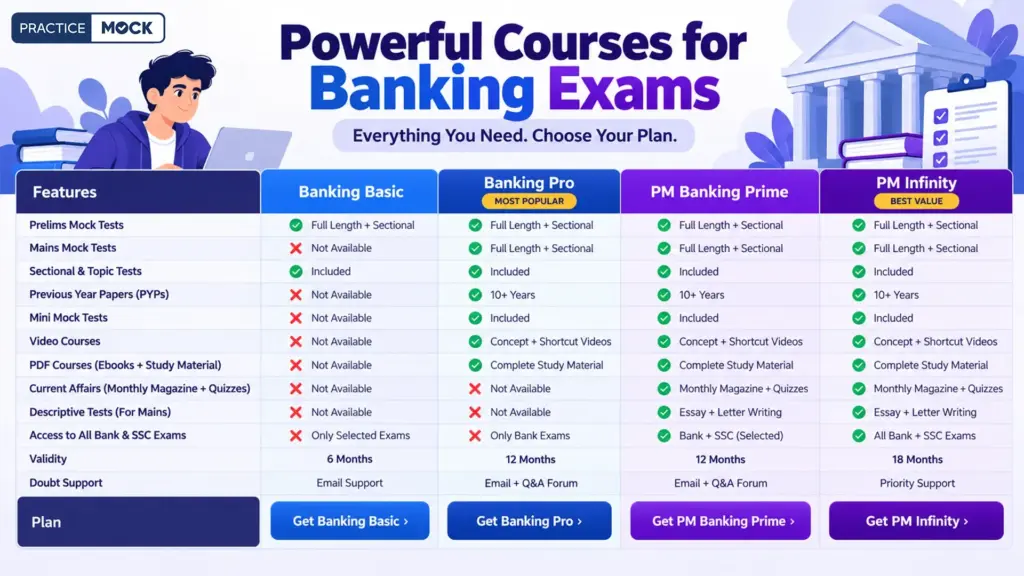
Powerful Courses for Banking Exams
FAQs on How to Improve IBPS RRB Clerk Prelims Mock Scores in the Last 30 Days
1. How many mock tests should I attempt in the last 30 days of IBPS RRB Clerk preparation?
The number depends on your preparation level. You can begin with two or three mocks per week, then adjust the frequency based on your analysis time. Always review incorrect and unattempted questions before attempting another full-length test.
2. Can I improve my IBPS RRB Clerk mock scores in 30 days?
Yes, you can improve your mock performance in 30 days by identifying weak topics, revising concepts and practising under timed conditions. However, the amount of improvement depends on your current preparation level, accuracy and consistency.
3. What is a good accuracy level for IBPS RRB Clerk Prelims mock tests?
Aim to maintain high accuracy while gradually improving your attempts. An accuracy level of around 90% can be a useful practice target, but it is not an official qualifying requirement. Your final score also depends on the difficulty of the paper and question selection.
4. Should I attempt a full-length mock test every day?
No, attempting a full-length mock every day is not necessary. You should leave enough time to analyse each test, revise weak topics and practise similar questions. Regular sectional tests can also help improve performance without taking another full-length mock.
5. Which section should I attempt first in IBPS RRB Clerk Prelims?
There is no compulsory order that works for every candidate. Practise both sections separately and identify where you can perform more accurately. Since the examination has sectional time limits, prepare a question-selection strategy for each section.
6. How much time should I spend analysing a mock test?
Spend enough time to review incorrect, unattempted and time-consuming questions. Depending on the length of the test and your mistakes, analysis may take as long as or longer than the test itself. Focus on understanding the reason behind each mistake.
7. Which Numerical Ability topics should I revise in the last 30 days?
Prioritise simplification, approximation, number series, Data Interpretation, percentage, ratio, average, profit and loss, simple and compound interest, time and work, and speed, time and distance. Give additional practice time to topics where you repeatedly make mistakes.
8. Which Reasoning topics are important for IBPS RRB Clerk Prelims?
Practise inequality, syllogism, coding-decoding, blood relations, direction, order and ranking, alphanumeric series, seating arrangements and puzzles. Improve your speed in standalone questions and learn to identify manageable puzzle sets.
9. How can I improve my speed in IBPS RRB Clerk mock tests?
Improve speed through daily calculation drills, timed sectional practice and regular revision of shortcuts. Avoid spending too long on a single question. Review your mock tests to identify where you lose time and practise those question types separately.
10. What should I do on the last day before IBPS RRB Clerk Prelims?
Revise important formulas, calculation techniques and your error notebook. Avoid attempting several difficult mock tests or starting unfamiliar topics. Check your examination documents, follow your usual routine and get sufficient sleep.
- Sign Up on Practicemock for Updated Current Affairs, Topic Tests and Mini Mocks
- Sign Up Here to Download Free Study Material
Free Mock Tests for the Upcoming Exams
- IBPS PO Free Mock Test
- RBI Grade B Free Mock Test
- IBPS SO Free Mock Test
- NABARD Grade A Free Mock Test
- SSC CGL Free Mock Test
- IBPS Clerk Free Mock Test
- IBPS RRB PO Free Mock Test
- IBPS RRB Clerk Free Mock Test
- RRB NTPC Free Mock Test
- SSC MTS Free Mock Test
- SSC Stenographer Free Mock Test
- GATE Mechanical Free Mock Test
- GATE Civil Free Mock Test
- RRB ALP Free Mock Test
- SSC CPO Free Mock Test
- AFCAT Free Mock Test
- SEBI Grade A Free Mock Test
- IFSCA Grade A Free Mock Test
- RRB JE Free Mock Test
- Free Banking Live Test
- Free SSC Live Test