


Starting your IBPS RRB PO Prelims 2026 preparation requires prioritizing speed-building basics in Quantitative Aptitude and easy scoring blocks in Reasoning Ability. Because the Preliminary exam evaluates only these two subjects across 80 questions in a tight 45-minute window, starting with high-weightage, low-complexity topics ensures quick marks and boosts early confidence.
This guide breaks down What to Study First for IBPS RRB PO Prelims, exact subject-wise preparation priorities, structural study phases, and execution strategies for an effective rrb po preparation strategy 2026 and rrb po study plan 2026.

What to Study First for IBPS RRB PO Prelims 2026
Start your IBPS RRB PO Prelims 2026 preparation with basic and scoring topics from Reasoning Ability and Quantitative Aptitude. Focus first on Inequality, Syllogism, Simplification, Approximation, and Number Series, then gradually move to Puzzles, Seating Arrangements, Arithmetic, and Data Interpretation.
IBPS RRB PO Prelims Topic-Wise Study Order
| Reasoning Ability | Quantitative Aptitude |
| Inequality and Syllogism | Simplification and Approximation |
| Alphanumeric Series and Coding-Decoding | Number Series and Quadratic Equations |
| Blood Relation and Direction Sense | Percentage and Ratio |
| Ranking and Order | Average and Profit & Loss |
| Linear Seating Arrangement | Simple and Compound Interest |
| Circular and Square Puzzles | Table DI and Bar Graph DI |
| Floor and Box-Based Puzzles | Caselet DI and Missing DI |
| Month and Scheduling Puzzles | Time and Work |
| Mixed Puzzle Practice | Time, Speed and Distance |
| Previous Year Questions | Mixed Arithmetic and Quant Practice |
| Sectional Tests | Full-Length Mock Tests |
| Revision of Weak Topics | Formula and Calculation Revision |
Suggested Study Approach:
- Start with basic, scoring topics to build accuracy.
- Move to puzzles and arithmetic after understanding the fundamentals.
- Practise both sections daily instead of completing one subject entirely before starting the other.
- Take sectional tests and full-length mocks to improve speed and time management.
Practice Questions for IBPS RRB PO Prelims
| Practice Set | Read & Practise |
|---|---|
| RRB PO Expected 40 Quant Questions | Practise Quant Questions with Answers |
| IBPS RRB PO Expected 40 Reasoning Questions with Solutions | Practise Reasoning Questions with Solutions |
1. Quantitative Aptitude Basic Topics to Start First
Quantitative Aptitude section contains 40 questions worth 40 marks to be attempted in 20 minutes. Building mental calculation speed and mastering formula-driven topics first forms the bedrock of an effective rrb po preparation strategy 2026.
Speed Math and Foundation Building Block
Before jumping into word problems or Data Interpretation (DI), candidates must achieve absolute mastery over mental math and fundamental calculation techniques.
- Simplification and Approximation (5–10 Marks): Practice BODMAS rules, square roots, cube roots, and fraction-to-percentage conversions.
- Quadratic Equations (5 Marks): Focus on the sign-comparison method to solve pair equations without step-by-step factorization.
- Number Series (5 Marks): Cover both Missing Number Series and Wrong Number Series patterns (addition, multiplication, square/cube differences, and double patterns).
Speed Math Focus Areas:
- Square Tables: 1 to 50
- Cube Tables: 1 to 30
- Multiplication Tables: 1 to 25
- Fraction-to-Percentage Equivalents: 1/1 to 1/20
Core Arithmetic to Support Data Interpretation
Once speed math yields quick marks, shift focus to core arithmetic concepts that directly drive Data Interpretation (DI) solving efficiency.
- Percentages and Ratio & Proportion: Form the direct base for bar graphs, line graphs, and pie charts.
- Averages, Profit & Loss, and Ages: High-frequency single-mark arithmetic questions.
- Data Interpretation (10–15 Marks): Practice basic Table DI, Bar Graphs, and Line Graphs after mastering percentage calculations.
| Topic Category | Expected Questions | Target Attempt Time | Priority Level |
| Simplification & Approximation | 5–10 Questions | 3–4 Minutes | High |
| Quadratic Equations | 5 Questions | 2–3 Minutes | High |
| Number Series | 5 Questions | 3 Minutes | High |
| Data Interpretation (DI) | 10–15 Questions | 6–7 Minutes | Medium |
| Miscellaneous Arithmetic | 10 Questions | 5–6 Minutes | Medium |
Practice speed math quizzes to sharpen calculation speed on the PracticeMock Quantitative Aptitude Sectional Tests & Quizzes.
2. Reasoning Ability Topics to Priority Study First
Reasoning Ability carries 40 questions worth 40 marks allocated across 25 minutes. Candidates should separate standalone non-puzzle topics from complex seating arrangements to lock in guaranteed marks early in the paper.
High-Yield Standalone Non-Puzzle Topics
Standalone topics are rule-based, require minimal writing, and offer high accuracy rates under strict time constraints.
- Inequalities (5 Marks): Direct and coded inequalities using statement-conclusion relationship rules.
- Syllogisms (3–5 Marks): Master Venn diagram methods alongside modern “Only a Few” and “Possibility” cases.
- Alphanumeric & Number Series (3–5 Marks): Fast scoring blocks evaluating position and pattern recognition.
- Direction Sense & Blood Relations (3–5 Marks): Short 2-to-3 question set problems.
- Coding-Decoding (3–5 Marks): Letter shifting and fictitious language (Chinese) coding patterns.
Seating Arrangements and Puzzles Sequence
Puzzles and Seating Arrangements account for 20–25 marks out of the total 40 marks. Do not start puzzle practice with complex multi-variable conditions. Instead, build systematic arrangement habits through a phased sequence:
- Linear Seating Arrangements: Single row (facing North/South) moving to parallel double rows.
- Circular & Square Arrangements: Inside/outside facing arrangements.
- Floor & Flat-Based Puzzles: 3 to 4 floors with 2 flats per floor.
- Day/Month/Year Scheduling Puzzles: Single-variable chronological grouping.
- Box-Based & Uncertain Linear Puzzles: Advanced grouping without fixed anchor positions.
Explore targeted logical reasoning practice modules through PracticeMock Reasoning Ability Quizzes.
3. IBPS RRB PO Prelims Exam Pattern and Subject Weightage 2026
The IBPS RRB Officer Scale 1 Preliminary Examination follows a objective computer-based test (CBT) structure. Knowing section-wise marks, question counts, and timing allocations helps structure daily study sessions.
| Subject | No. of Questions | Maximum Marks | Allocated Duration |
| Reasoning Ability | 40 Questions | 40 Marks | 25 Minutes |
| Quantitative Aptitude | 40 Questions | 40 Marks | 20 Minutes |
| Total | 80 Questions | 80 Marks | 45 Minutes |
Prelims Marking & Evaluation Rules:
- Correct Answer: +1.00 mark
- Incorrect Answer: -0.25 mark (1/4th penalty)
- Unattempted Question: 0.00 mark
- Merit Criteria: Prelims is a qualifying test for Mains. Its marks are not added to the final merit.
Check the updated IBPS RRB PO exam pattern and syllabus and sectional breakdowns on the official IBPS RRB PO Topic Wise Weightage 2026.
4. Structured IBPS RRB PO Study Plan 2026
Following a phased rrb po study plan 2026 ensures balanced topic coverage without burning out before test day.
| Phase | Phase Name | Core Focus Areas & Deliverables |
| Phase 1 | Foundational Skill Building | Foundation & Speed Math (Non-Puzzle + Basic Calculation) • Speed math basics (Simplification, Series, Quadratic Equations) • Standalone non-puzzle reasoning (Inequalities, Syllogisms, Direction Sense) • Daily topic-wise speed quizzes |
| Phase 2 | Core Topic Mastery & Practice | Core Arithmetic & Intermediate Puzzles + DI Graphs • Weightage-heavy arithmetic (Percentage, Ratio, Average, Profit & Loss) • Data Interpretation sets (Tables, Line, Bar, and Caselets) • Daily practice of Puzzles and Seating Arrangements across different formats |
| Phase 3 | Mock Test Execution & Speed Refinement | Full Mock Tests, Sectional Speed Drills & Weak Area Analysis • Full-length timed mock tests within the 45-minute environment • Sectional speed drills and question selection strategies • In-depth mock test analysis and error log tracking |
Phase 1: Foundational Skill Building
Focus on building calculation speed, learning shortcuts, and solving non-puzzle reasoning topics.
- Spend 2 hours daily on Quant speed math (Simplification, Series, Quadratic equations).
- Spend 2 hours daily on Reasoning basics (Inequalities, Syllogisms, Direction sense).
- Attempt 1 topic-wise speed quiz per subject daily.
Phase 2: Core Topic Mastery & Practice
Transition into weightage-heavy sections like Data Interpretation, Arithmetic, and standard Puzzles.
- Solve 5 to 7 Puzzles/Seating Arrangements daily across different formats.
- Practice 3 to 4 DI sets daily (Tables, Line, Bar, and Caselets).
- Cover core arithmetic chapters: Percentage, Ratio, Average, and Profit & Loss.
Phase 3: Mock Test Execution & Speed Refinement
Shift focus completely to timed mock test practice and sectional analysis.
- Take 1 full-length mock test daily within the 45-minute timed environment.
- Spend at least 1 hour analyzing unattempted and incorrect questions after every mock.
- Practice question selection strategies: skip lengthy or uncertain puzzles in the first pass.
5. Daily Execution Strategy for Beginners
Beginners should avoid completing one whole subject before starting the other. Divide daily hours between Quant and Reasoning to keep momentum balanced.
Recommended Daily Time Allocation
- Morning Session (2 Hours): Quantitative Aptitude concept learning, calculation practice, and arithmetic problem-solving.
- Afternoon Session (2 Hours): Reasoning Ability concept learning, non-puzzle drills, and puzzle sets.
- Evening Session (1.5 Hours): Mixed sectional speed tests and error notebook maintenance.
Effective Mock Test Analysis Method
- Identify Accuracy Gaps: Review every incorrect attempt to check whether errors were caused by calculation mistakes or conceptual confusion.
- Track Time Spent per Question: Ensure you spend no more than 40–45 seconds on standalone questions and 3–4 minutes on a 5-question puzzle set.
- Maintain an Error Log: Document hard number series patterns and tricky syllogism cases in a dedicated notebook for quick weekly revision.
Access free test series and daily subject quizzes for RRB PO Prelims at PracticeMock Sectional Mock Tests.
Final Thoughts
Choosing the right study order is essential to prepare effectively for the IBPS RRB PO Prelims 2026. Start Quantitative Aptitude with Speed Math topics such as Simplification, Number Series, and Quadratic Equations before moving to Arithmetic. In Reasoning Ability, cover Inequality, Syllogism, and Series first, then gradually take up Puzzles and Seating Arrangements.
Maintain a daily balance between both subjects and dedicate regular practice time to Data Interpretation and Puzzles. Once your basic concepts are clear, start attempting full-length timed mock tests to improve accuracy, speed, and time management within the 45-minute exam duration. Follow a consistent study routine, analyse your mistakes, and revise regularly to strengthen your preparation with PracticeMock.
Related RRB PO Articles
| IBPS RRB PO Salary | IBPS RRB PO Exam Pattern |
| IBPS RRB PO Cut Off | IBPS RRB PO Syllabus |
| IBPS RRB PO Previous Year Question Papers | |
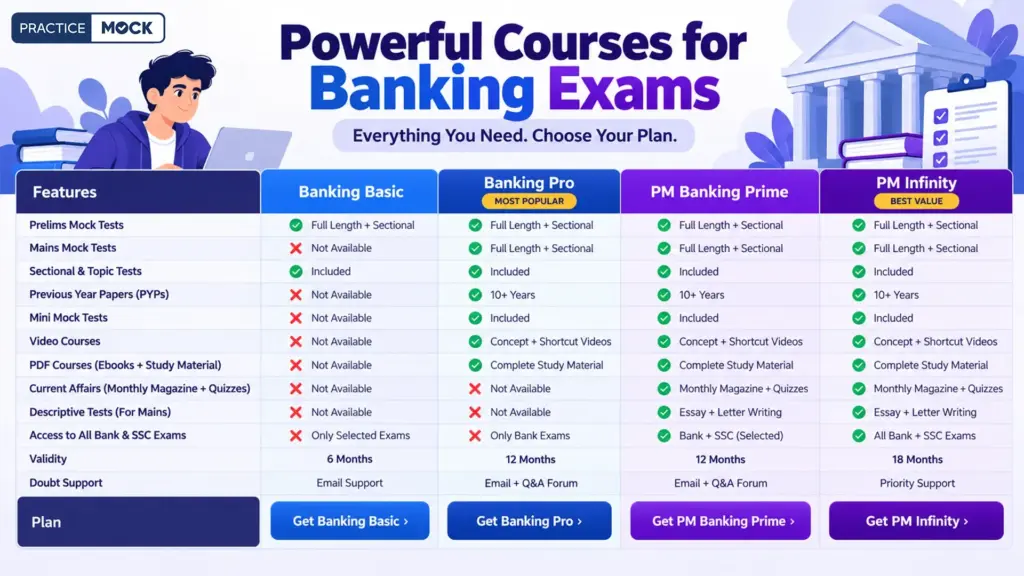
Powerful Courses for Banking Exams
What to Study First for IBPS RRB PO Prelims Frequently Asked Questions
What to study first for IBPS RRB PO Prelims 2026?
Begin with high-scoring foundation topics in both subjects. In Quantitative Aptitude, start with Simplification, Approximation, Quadratic Equations, and Number Series. In Reasoning Ability, begin with Inequalities, Syllogisms, Alphanumeric Series, and Direction Sense.
How many subjects are tested in IBPS RRB PO Prelims 2026?
The IBPS RRB PO Prelims paper assesses only two subjects: Quantitative Aptitude (40 questions) and Reasoning Ability (40 questions), totaling 80 questions for 80 marks.
What is the time duration for IBPS RRB PO Prelims 2026?
The total exam duration is 45 minutes. Under current patterns, candidates manage 25 minutes for Reasoning and 20 minutes for Quantitative Aptitude.
Is there negative marking in IBPS RRB PO Prelims 2026?
Yes, every incorrect answer attracts a penalty of 1/4th mark (0.25 marks). Unattempted questions incur no penalty.
Should beginners study Quantitative Aptitude or Reasoning Ability first?
Beginners should study both subjects side by side daily. Allocate equal daily hours to Quant speed math and Reasoning non-puzzle topics to build balanced conceptual clarity.
How much weightage do Puzzles carry in IBPS RRB PO Prelims?
Puzzles and Seating Arrangements carry 20 to 25 marks out of the total 40 marks in the Reasoning Ability section.
Which arithmetic topics are most important for IBPS RRB PO Quant?
Percentages, Ratio & Proportion, Averages, and Profit & Loss are critical because they form the base for Data Interpretation sets.
When should I start taking full-length mock tests for IBPS RRB PO Prelims?
Start full-length mock tests after finishing basic speed math, standalone reasoning topics, basic puzzles, and core DI graphs (typically within 2 to 3 weeks of starting preparation).
Are marks obtained in IBPS RRB PO Prelims counted for the final merit list?
No, the Preliminary exam is qualifying in nature. The final merit list for Officer Scale 1 relies on combined marks from the Mains Exam (80% weightage) and Interview (20% weightage).
Can an average student clear IBPS RRB PO Prelims 2026 on the first attempt?
Yes, by adhering to a structured rrb po study plan 2026, sharpening speed math techniques, practicing daily puzzles, and taking regular mock tests, candidates can clear the cut-off marks.
- Sign Up on Practicemock for Updated Current Affairs, Topic Tests and Mini Mocks
- Sign Up Here to Download Free Study Material
Free Mock Tests for the Upcoming Exams
- IBPS PO Free Mock Test
- RBI Grade B Free Mock Test
- IBPS SO Free Mock Test
- NABARD Grade A Free Mock Test
- SSC CGL Free Mock Test
- IBPS Clerk Free Mock Test
- IBPS RRB PO Free Mock Test
- IBPS RRB Clerk Free Mock Test
- RRB NTPC Free Mock Test
- SSC MTS Free Mock Test
- SSC Stenographer Free Mock Test
- GATE Mechanical Free Mock Test
- GATE Civil Free Mock Test
- RRB ALP Free Mock Test
- SSC CPO Free Mock Test
- AFCAT Free Mock Test
- SEBI Grade A Free Mock Test
- IFSCA Grade A Free Mock Test
- RRB JE Free Mock Test
- Free Banking Live Test
- Free SSC Live Test