


Download 200+ Most Important Reasoning Questions for IBPS PO 2026 PDF can make a significant difference to your exam preparation by helping you practise the topics that matter most in both the Prelims and Mains exams. Since the Reasoning section carries high weightage and often determines the overall cut-off, solving a carefully selected set of questions is far more effective than practising random problems.
This guide brings together 200+ topic-wise reasoning questions, covering Puzzles, Seating Arrangement, Syllogism, Inequality, Coding-Decoding, Blood Relations, Direction Sense, Input-Output, and other important topics. Along with solved examples, preparation strategies, and expert tips, you’ll learn how to improve your speed, accuracy, and confidence for the IBPS PO 2026 exam.

Key Highlights of Important Reasoning Questions for IBPS PO
- Practice 200+ Important Reasoning Questions for IBPS PO 2026 covering all major topics asked in Prelims and Mains.
- Build accuracy with topic-wise questions on Puzzles, Seating Arrangement, Syllogism, Inequality, Coding-Decoding, Blood Relations, and more.
- Understand the IBPS PO Reasoning exam pattern, including 35 questions, 40 marks, and a 20-minute sectional time limit in Prelims.
- Improve your preparation with solved examples, expert strategies, and time-saving techniques for high-level reasoning questions.
- Learn the best approach to solve Mains-level puzzles using case elimination, diagram-based solving, and regular mock test practice.
- Strengthen your exam readiness with a structured practice plan that combines topic-wise questions, sectional tests, and full-length mock tests.
200+ Important Reasoning Questions for IBPS PO 2026
What are the 200+ important reasoning questions for IBPS PO 2026? is simply a curated, exam-pattern-aligned question bank covering every Reasoning topic tested across Prelims and Mains. Instead of solving random questions, this set mirrors the actual difficulty and topic distribution IBPS uses.
The set is built around three practical goals:
- Strengthen concepts across every high-weightage topic, not just familiar ones
- Build speed on scoring topics that should take under a minute each
- Expose you to Mains-level difficulty before you see it in the real exam
How Many Reasoning Questions Are Asked in IBPS PO Prelims?
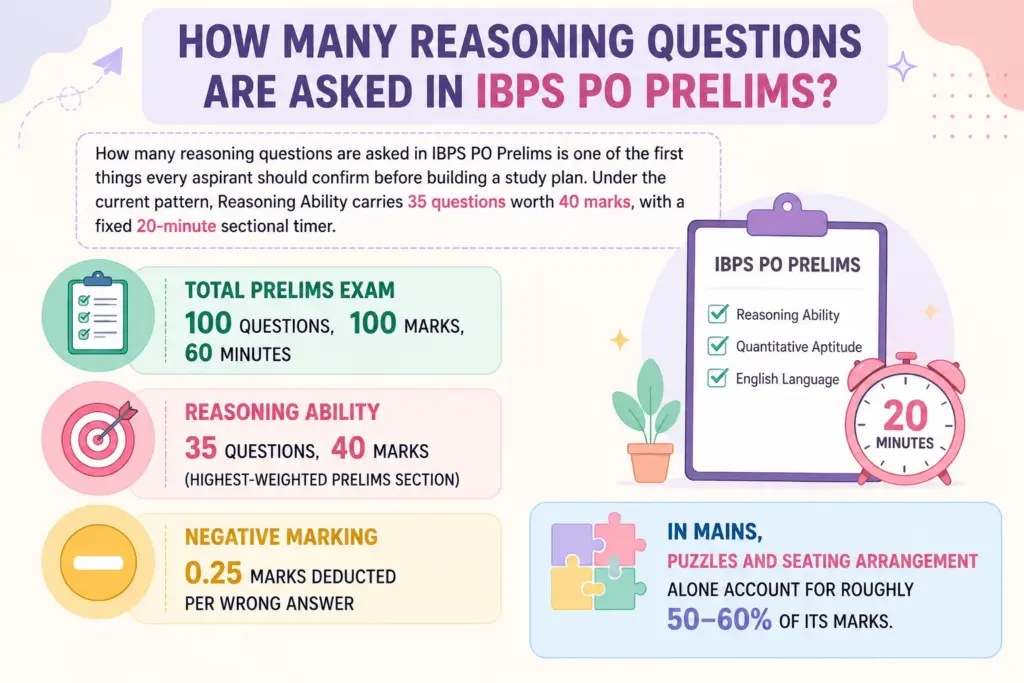
How many reasoning questions are asked in IBPS PO Prelims is one of the first things every aspirant should confirm before building a study plan. Under the current pattern, Reasoning Ability carries 35 questions worth 40 marks, with a fixed 20-minute sectional timer.
- Total Prelims exam: 100 questions, 100 marks, 60 minutes
- Reasoning Ability: 35 questions, 40 marks (highest-weighted Prelims section)
- Negative marking: 0.25 marks deducted per wrong answer
In Mains, puzzles and seating arrangement alone account for roughly 50–60% of its marks.
200+ Most Expected Reasoning Practice Questions with Solutions
Here are a few representative questions across difficulty levels to show the pattern you should expect in the full 200+ set.
Q1. Syllogism (Prelims-level) Statements: Some pens are books. No book is a table. Conclusion I: No pen is a table. Conclusion II: Some pens are not tables. Solution: Since some pens overlap with books, and no book is a table, that overlapping portion of pens cannot be a table, so Conclusion II follows. Conclusion I is too absolute to be guaranteed.
Q2. Coded Inequality (Prelims-level): If ‘A > B’ means A is coded as ‘@B’, and ‘A < B’ means A is coded as ‘#B’, decode: P@Q, Q#R. Does P > R hold? Solution: P@Q means P > Q. Q#R means Q < R. Since P > Q and Q < R, no direct relation between P and R can be concluded; the relationship is indeterminate.
Q3. Blood Relation (Moderate) Pointing to a photo, Rita said, “He is the son of my mother’s only daughter.” How is the boy related to Rita? Solution: Rita’s mother’s only daughter is Rita herself, so the boy is Rita’s son.
Download 200+ Important Reasoning Questions for IBPS PO 2026 PDF
Topic-Wise Breakdown of the 200+ Question Bank
A topic-wise breakdown of the 200+ question bank helps you see exactly where to invest your practice time instead of spreading effort evenly across low-yield areas.
| Topic Category | Approx. Questions | Priority Level |
| Puzzles & Seating Arrangement | 60–80 | Highest |
| Syllogism | 20–25 | High (scoring) |
| Blood Relations & Direction Sense | 15–20 | Moderate |
| Inequality (Direct & Coded) | 15–20 | High (scoring) |
| Coding-Decoding | 15–20 | High (scoring) |
| Alphanumeric Series & Order/Ranking | 15–20 | Moderate |
| Input-Output | 10–15 | Mains-focused |
| Critical/Logical Reasoning | 10–15 | Mains-exclusive |
Part A: Speed-Building and Scoring Topics for Prelims
Part A of your preparation should focus on speed-building and scoring topics that are designed for Prelims-level accuracy under a strict timer.
- Syllogism: Practise “Only,” “Only a few,” and possibility-based conclusions, not just the traditional All/Some/No format
- Inequality: Master both direct statements and coded inequality patterns for quick verification
- Coding-Decoding: Cover letter-shifting, Chinese coding, and conditional pattern shifts
- Blood Relations & Direction Sense: Practise 2–3 generation family trees alongside multi-turn direction problems
- Alphanumeric Series: Focus on missing-term and wrong-term identification patterns
These five topics combined should take no more than 12–15 minutes if practised regularly, leaving more time for puzzles.
Part B: High-Level Puzzles and Seating Arrangement for Mains
Part B shifts focus to high-level puzzles and seating arrangement, which is the single biggest scoring (and time-consuming) block in Mains Reasoning.
- Bi-directional arrangements: Linear, circular, or triangular setups with mixed inward/outward facing
- Concentric layouts: Inner-ring and outer-ring people interacting across borders
- Multi-variable grid puzzles: Mapping names with professions, ages, and dates simultaneously
- Vacant seat puzzles: More seats than people, adding an extra layer of deduction
- Uncertain number of persons: Total count itself must be deduced from clues
Two lines worth remembering before you attempt these: always draw before placing any name, and split into visible cases the moment a clue offers two possibilities.
Part C: Critical and Mains-Exclusive Reasoning Topics
Part C covers critical and Mains-exclusive reasoning topics that don’t appear in Prelims but carry real weight in the Mains objective paper.
- Input-Output: Composite rule-based shifting (digit sums, alphabetical reversals, word rearrangement)
- Data Sufficiency: Judging whether given statements are enough to answer a question
- Critical/Logical Reasoning: Statement-Assumption, Course of Action, Cause-and-Effect, and Strengthen/Weaken argument passages
These topics reward careful reading over speed, so practise them separately from timed puzzle drills.
How to Solve High-Level Puzzles for IBPS PO 2026
How to solve high-level puzzles for IBPS PO 2026 comes down to a consistent method rather than treating every puzzle as a fresh problem to guess your way through.
- Read the entire puzzle once before writing anything
- Batch direct clues separately from indirect (conditional) clues
- Anchor your diagram using the strongest, most definite clue first
- Split into Case 1 / Case 2 the moment a clue allows two possibilities
- Verify your final diagram against every single clue, not just most of them
As the examination approaches, candidates should also complete their exam-day preparation by downloading the IBPS PO Admit Card 2026 and checking the allotted exam date, reporting time, shift and examination centre.
Frequently Asked Questions
Q1. What are the most scoring topics in IBPS PO reasoning?
Syllogism, Inequality, and Coding-Decoding are the most scoring topics since they follow fixed rules and can be solved in under a minute each, unlike time-consuming puzzles that require multi-step case elimination.
Q2. How many reasoning questions are asked in IBPS PO prelims?
IBPS PO Prelims includes 35 Reasoning Ability questions worth 40 marks, to be completed within a 20-minute sectional timer, making it the highest-weighted section among the three Prelims subjects.
Q3. Where can I download important reasoning questions for IBPS PO?
Structured, topic-wise reasoning question banks are available through established banking exam preparation platforms offering PDFs with detailed, step-by-step solutions for both Prelims and Mains-level difficulty.
Q4. What are the most important reasoning topics for IBPS PO Mains?
Puzzles and seating arrangement dominate IBPS PO Mains reasoning, forming 50–60% of the section, followed by Input-Output, Data Sufficiency, and Critical Reasoning passages that test comprehension over speed.
Q5. How should I practise 200+ reasoning questions effectively?
Practise topic-wise first to fix weak areas, then attempt timed sectional mocks, and finally full-length mocks under exam conditions. Reviewing detailed solutions after each attempt improves accuracy faster than repeated blind practice.
See What a Successful Candidate has to Say
- Sign Up on Practicemock for Updated Current Affairs, Topic Tests and Mini Mocks
- Sign Up Here to Download Free Study Material
Free Mock Tests for the Upcoming Exams
- IBPS PO Free Mock Test
- RBI Grade B Free Mock Test
- IBPS SO Free Mock Test
- NABARD Grade A Free Mock Test
- SSC CGL Free Mock Test
- IBPS Clerk Free Mock Test
- IBPS RRB PO Free Mock Test
- IBPS RRB Clerk Free Mock Test
- RRB NTPC Free Mock Test
- SSC MTS Free Mock Test
- SSC Stenographer Free Mock Test
- GATE Mechanical Free Mock Test
- GATE Civil Free Mock Test
- RRB ALP Free Mock Test
- SSC CPO Free Mock Test
- AFCAT Free Mock Test
- SEBI Grade A Free Mock Test
- IFSCA Grade A Free Mock Test
- RRB JE Free Mock Test
- Free Banking Live Test
- Free SSC Live Test