


Practising Important Puzzle Questions for IBPS RRB PO 2026 can help you understand different puzzle formats, including floor-based, circular, linear, box-based, and month-based puzzles Puzzles and seating arrangements can account for around 20–25 marks, making them important for your Prelims preparation. Candidates should practise different formats, including floor-based, circular, linear, box-based, and scheduling puzzles. Understanding clues, making clear diagrams, and selecting easy questions first can help improve your speed and accuracy. In this blog, we have covered important puzzle types, practice questions, and simple solving strategies.
Most Important Types of Puzzles in IBPS RRB PO Prelims
Puzzles are an important part of the Reasoning Ability section. To prepare effectively, candidates should practise Important Puzzle Questions for IBPS RRB PO 2026 based on the following formats, identified through previous exam trends.

1. Floor and Flat-Based Puzzles
In floor-based puzzles, you have to arrange people on different floors of a building. Some questions also include two flats on each floor, such as Flat X and Flat Y.
Common clues include:
- A lives above B.
- C lives immediately below D.
- Two floors are between P and Q.
- R lives in Flat X, while S lives in Flat Y.
Preparation tip: Draw the floors from bottom to top. Place fixed positions first and then use the remaining clues.
2. Month and Date-Based Puzzles
In these puzzles, people attend meetings, events, or celebrate birthdays in different months and on different dates.
For example, eight people may attend meetings in January, February, March, and April on the 10th or 11th of each month.
Important points to remember:
- Check the number of days in each month.
- Identify odd and even dates.
- Understand immediate before and after clues.
- Avoid placing two people on the same date if the question does not allow it.
3. Linear and Parallel Row Seating Arrangements
In linear seating arrangement questions, people sit in a straight row and may face North or South. In parallel row puzzles, two rows of people sit opposite each other.
Common clues include:
- A sits third to the left of B.
- C sits immediately right of D.
- Two people sit between P and Q.
- R sits at one of the extreme ends.
Preparation tip: Always check the direction in which people are facing. Left and right change when a person faces South.
4. Circular and Square Seating Arrangements
In circular puzzles, people sit around a round table. In square arrangements, people sit at the corners and sides of a square.
Common clues include:
- A sits second to the right of B.
- C sits opposite D.
- P and Q are immediate neighbours.
- R faces outside while S faces inside.
Preparation tip: First identify whether everyone faces inside or outside. Fix one person as your starting point and arrange the others using the clues.
5. Box and Stack-Based Puzzles
In box-based puzzles, different boxes are arranged vertically or horizontally. You have to find their correct positions using the given information.
Common clues include:
- Box A is above Box B.
- Two boxes are between P and Q.
- Box C is immediately below Box D.
- Box E is not at the top or bottom.
Preparation tip: Draw all possible positions and eliminate those that do not follow the clues. If one clue creates two possibilities, make separate cases.
6. Designation and Year-Based Puzzles
These puzzles test your ability to arrange people according to their job positions, ages, or birth years.
For example:
- Seven employees hold different designations.
- One employee is senior to another.
- A person was born after 1995 but before 2005.
- One person is older than all others.
Preparation tip: Make a table and arrange the information from highest to lowest or oldest to youngest. Pay attention to the difference between age and birth year.
Important Puzzle Questions for IBPS RRB PO 2026
Practising Important Puzzle Questions for IBPS RRB PO 2026 helps you understand how different clues work together. Below is a month- and date-based puzzle for practice.
Directions (1–5):
Study the following information carefully and answer the questions given below:
Eight persons M, N, O, V, W, X, Y and Z attend Meetings on different months of the year viz. January, February, March and April, such that not more than two persons attend their Meetings in each of the months. Meetings can be held on either 10th or 11th day of the month. No two Meetings can be held on the same day.
- W attend meeting in a month which has less than 30 days.
- Only one person attend meeting between W and Z.
- O attends meeting in March.
- M attend meeting on even day of a month having 30 days.
- Equal Number of meetings are between Z and X as there between Z and V.
- Y attend meeting immediate before X.
Q1. M attends his Meeting on which of the following dates?
(a) 10th March
(b) 11th April
(c) 10th April
(d) 10th January
(e) None of these
Q2. Which of the following persons attends his Meeting on 11th January?
(a) W
(b) N
(c) M
(d) X
(e) None of these
Q3. How many persons attend the Meeting after W?
(a) 5
(b) 4
(c) 6
(d) 3
(e) None of these
Q4. Who among the following persons attends the Meeting on 10th March?
(a) W
(b) M
(c) V
(d) Z
(e) None of these
Q5. How many persons attended Meeting after V?
(a) 5
(b) 4
(c) 7
(d) No one
(e) None of these
Practice tip: Solve the arrangement on your own before checking any answer key. Pay special attention to the month conditions, the available dates, and the positions between Z, X, and V.
For more practice, attempt 10 Confusing Puzzle Questions for RRB PO Prelims and Mains.
Tips for Solving Puzzles Faster in IBPS RRB PO 2026
Puzzles become easier when you follow a fixed method. Regular IBPS RRB PO 2026 puzzle practice helps you understand how clues connect and improve your solving speed. Do not try to remember every clue in your head. Use diagrams and simple notes to arrange the information.
Follow these five tips:
1. Start with Definite Clues: Begin with direct information, such as a person sitting at an extreme end or living on a particular floor. These clues help you build the arrangement.
2. Draw Clear Diagrams: Use simple tables, boxes, or rows to arrange the information. A clear diagram reduces confusion and saves time.
3. Track Directions Carefully: In seating arrangement questions, check whether people face North, South, inside, or outside before placing them.
4. Make Two Possibilities When Required: If a clue creates two possible arrangements, draw both cases and check the remaining clues. Do not guess without testing them.
5. Skip and Return: If a puzzle takes too much time, move to another question. You can return to it after completing easier questions.
Exam-Day Strategy to Solve RRB PO Puzzles
Puzzles can help you score well, but spending too much time on one difficult set can affect your overall performance.
Keep these points in mind:
- Choose easy sets first: Quickly check the questions and identify manageable puzzles.
- Set a time limit: Aim to solve familiar puzzle sets in around 2–2.5 minutes, depending on their difficulty.
- Avoid getting stuck: If you cannot understand a set, move ahead and return later.
- Maintain accuracy: Check every clue before marking your answer.
- Practise other Reasoning topics: Do not ignore syllogism, inequality, coding-decoding, and blood relations.
Candidates should also practise the most scoring topics for IBPS RRB PO Reasoning to prepare for the complete section.
Final Thoughts
Important Puzzle Questions for IBPS RRB PO 2026 should be a priority in your Reasoning Ability preparation. Start with simple floor-based and linear arrangement questions, and gradually move towards circular, box-based, and scheduling puzzles. Understand the clues, draw clear diagrams, and practise different question formats regularly.
Remember, solving more questions is not the only way to improve. You must also analyse your mistakes and learn faster methods. Attempt regular sectional tests and full-length mock tests to check your progress. With consistent practice and the right strategy, you can improve your speed and accuracy for the IBPS RRB PO examination. Visit PracticeMock to practise free quizzes, mock tests, and Reasoning Ability questions for your banking exam preparation.
Related Blogs on IBPS RRB PO
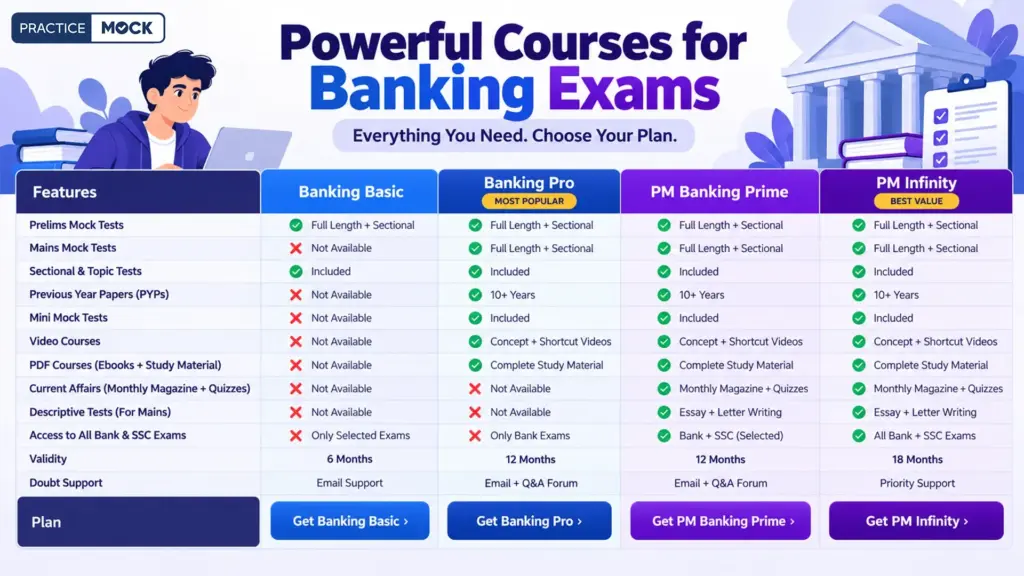
Powerful Courses for Banking Exams
FAQs on Important Puzzle Questions for IBPS RRB PO 2026
1. Which puzzles are most important for IBPS RRB PO 2026?
Floor-based, box-based, linear seating, circular seating, parallel-row, and month and date-based puzzles are important for IBPS RRB PO Prelims preparation.
2. How many puzzle questions are expected in IBPS RRB PO Prelims 2026?
Based on previous-year trends, puzzles and seating arrangements may account for around 20–25 marks. The actual number and distribution can vary across shifts.
3. How can I solve puzzle questions faster?
Start with definite clues, draw simple diagrams, make separate cases when required, and practise different puzzle formats regularly. Always check your final arrangement against all the clues.
4. Are floor-based puzzles important for RRB PO?
Yes. Floor-based puzzles are an important format to practise. Questions may involve multiple floors, two flats on each floor, and additional details such as professions or cities.
5. How many puzzles should I practise daily for IBPS RRB PO?
Start with 4–5 puzzle sets daily. Include different formats such as floor, box, circular, linear, and month-based puzzles. Focus on accuracy before increasing your speed.
6. Are seating arrangement questions and puzzles the same?
Seating arrangements are a type of puzzle. They involve placing people in a row, circle, square, or parallel rows according to given clues. Other puzzles may involve floors, boxes, dates, ages, or designations.
7. Are puzzles important for IBPS RRB PO Mains?
Yes. Puzzles are important for Mains as well. Candidates should practise more complex arrangements with additional variables and longer sets.
8. Where can I practise puzzle questions for IBPS RRB PO 2026?
You can practise puzzle questions through previous-year papers, sectional quizzes, and mock tests. PracticeMock also provides Reasoning Ability quizzes and puzzle practice resources.
- Sign Up on Practicemock for Updated Current Affairs, Topic Tests and Mini Mocks
- Sign Up Here to Download Free Study Material
Free Mock Tests for the Upcoming Exams
- IBPS PO Free Mock Test
- RBI Grade B Free Mock Test
- IBPS SO Free Mock Test
- NABARD Grade A Free Mock Test
- SSC CGL Free Mock Test
- IBPS Clerk Free Mock Test
- IBPS RRB PO Free Mock Test
- IBPS RRB Clerk Free Mock Test
- RRB NTPC Free Mock Test
- SSC MTS Free Mock Test
- SSC Stenographer Free Mock Test
- GATE Mechanical Free Mock Test
- GATE Civil Free Mock Test
- RRB ALP Free Mock Test
- SSC CPO Free Mock Test
- AFCAT Free Mock Test
- SEBI Grade A Free Mock Test
- IFSCA Grade A Free Mock Test
- RRB JE Free Mock Test
- Free Banking Live Test
- Free SSC Live Test