


The SBI PO Risk-Free Attempt Strategy helps candidates maximise their overall score by choosing the right questions instead of attempting every question. In SBI PO Prelims, every wrong answer attracts 0.25 negative marks, while unanswered questions carry no penalty. This means smart question selection is often more valuable than attempting the maximum number of questions.
Most successful candidates follow a balanced approach by targeting 72–80 attempts with 85% or higher accuracy. This strategy reduces unnecessary risks, improves time management, and increases the chances of clearing the expected SBI PO cut-off.

SBI PO Risk-Free Attempt Strategy: The 3-Round Attempt Method
One of the most effective ways to follow the SBI PO Risk-Free Attempt Strategy is by dividing every section into three simple rounds. Instead of solving questions in sequence, evaluate every question first and attempt them according to their difficulty level.

Round 1: The Quick Pass (First 5–7 Minutes)
The first round is all about securing quick and safe marks. If a question appears lengthy or confusing, skip it immediately and move ahead. Attempt only those questions that:
- Look familiar immediately.
- Can be solved within one minute.
- Belong to your strongest topics.
- Require minimum calculation.
For example:
- Simplification
- Approximation
- Number Series
- Syllogism
- Inequality
Round 2: Build Your Score (Next 10–12 Minutes)
After completing all easy questions, move to moderate-level questions that require slightly more time. Choose only those questions where you know the approach. Avoid spending several minutes on one problem. These may include:
- Arithmetic questions from familiar topics.
- Simple Data Interpretation sets.
- Coding-Decoding.
- Blood Relations.
- Vocabulary and grammar-based English questions.
Round 3: Attempt High-Risk Questions (Last Few Minutes)
The final round should begin only after you have secured your target score. If a question still looks difficult, leave it. Skipping one question is always better than losing marks due to guessing. Attempt difficult questions only if:
- Easy questions are already completed.
- Time is available.
- You clearly understand the solving method.
These questions may include:
- Complex Seating Arrangement puzzles.
- Lengthy Data Interpretation sets.
- Advanced Arithmetic questions.
- Reading Comprehension inference questions.
Sign Up To Download Free SBI PO PYQ PDF Now
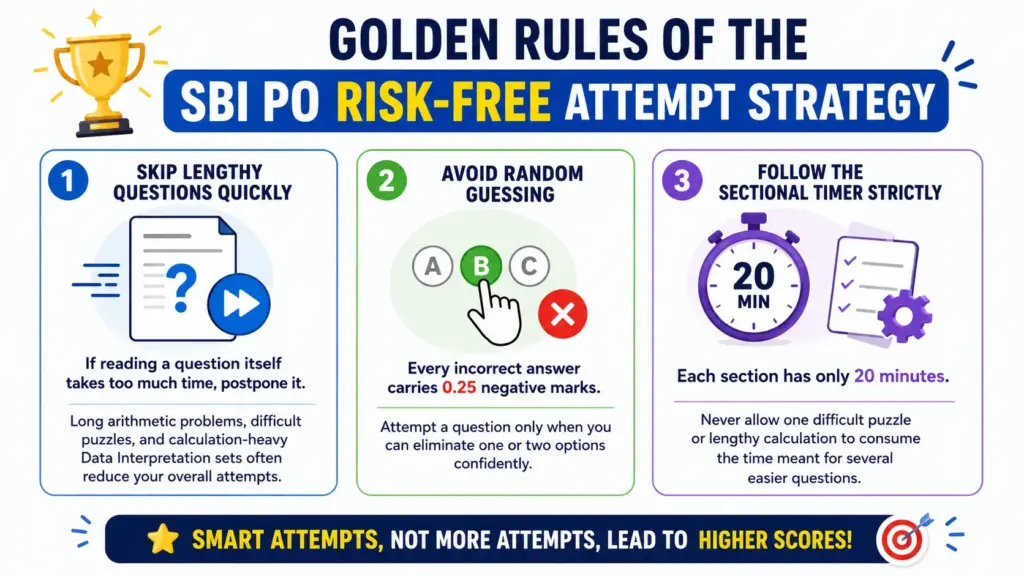
Golden Rules of the SBI PO Risk-Free Attempt Strategy
The SBI PO Risk-Free Attempt Strategy is based on simple yet effective principles that help candidates maximise accuracy while avoiding unnecessary mistakes during the exam.
SBI PO Risk-Free Attempt Strategy for English Language
English offers several quick-scoring opportunities when approached wisely. A smart SBI PO Risk-Free Attempt Strategy focuses on securing direct marks before moving to lengthy reading-based questions.
Attempt First: These questions generally require less time and help you build confidence early in the section.
- Vocabulary Questions
- Synonyms & Antonyms
- Error Detection
- Fillers
- Sentence Improvement
Attempt Later: As part of your Strategy, answer vocabulary and factual Reading Comprehension questions first. Return to inference-based questions only if time permits.
- Reading Comprehension
- Inference-based Questions
- Para Jumbles
SBI PO Risk-Free Attempt Strategy for Quantitative Aptitude
Quantitative Aptitude contains several questions that look easy but consume valuable time. A good Strategy helps candidates avoid these traps and secure quick marks first.
Attempt First: These topics usually provide fast and reliable scoring opportunities.
- Simplification
- Approximation
- Number Series
- Quadratic Equations
Attempt Later: Choose Data Interpretation sets with simple tables or bar graphs before attempting mixed or calculation-intensive sets. Spending four minutes on one difficult question can cost several easy marks.
- Arithmetic Word Problems
- One easy Data Interpretation set
- Lengthy Calculation-based Questions
SBI PO Risk-Free Attempt Strategy for Reasoning Ability
Reasoning Ability is highly scoring, but poor question selection can waste several minutes. A balanced Strategy begins with standalone questions before attempting puzzles.
Attempt First: These topics are generally quicker and easier to solve.
- Syllogism
- Inequality
- Coding-Decoding
- Blood Relations
- Direction Sense
Attempt Later: Complete all standalone questions first and then select the easiest puzzle. If a puzzle creates multiple cases or repeated dead ends, leave it and move to the next question.
- Seating Arrangement
- Floor-based Puzzles
- Multi-variable Puzzles
- Uncertain Linear Arrangements
How Many Questions Should You Attempt Using the SBI PO Risk-Free Attempt Strategy?
The SBI PO Risk-Free Attempt Strategy does not encourage candidates to attempt every question. Instead, it focuses on maintaining a balance between attempts and accuracy. The exact number of attempts depends on your preparation level, confidence, and mock test performance.
| Accuracy Level | Recommended Attempts | Expected Outcome |
| 95%+ | 82–90 | High score with minimal negative marking |
| 85–94% | 72–80 | Safe range for most candidates |
| 75–84% | 65–72 | Focus on improving accuracy first |
| Below 75% | 55–65 | Build concepts before increasing attempts |
Rather than chasing a fixed number, aim to maximise your net score through smart question selection.
How to Analyse Your SBI PO Risk-Free Attempt Strategy After Every Mock Test?
SBI PO Mock tests become valuable only when you analyse your decisions carefully. Reviewing every mock helps you identify whether your question selection strategy is improving. After every mock, evaluate the following:
| Analysis Area | Questions to Ask Yourself |
| Easy Questions Missed | Could I have attempted them? |
| Wrong Attempts | Should I have skipped them? |
| Time Wasted | Which questions consumed unnecessary time? |
| Skipped Questions | Were they actually difficult or did I panic? |
| Accuracy | Is my attempt range affecting my score? |
Common Mistakes Candidates Make in SBI PO Risk-Free Attempt Strategy
Even well-prepared candidates lose marks because they make poor decisions during the exam. Avoid these common mistakes to improve your overall performance.
Attempting Every Question
Many candidates believe higher attempts automatically lead to higher scores. In reality, unnecessary attempts often increase negative marking.
Spending Too Much Time on One Question
Trying to solve one difficult puzzle or lengthy Data Interpretation set can cost several easy marks from other questions.
Guessing Randomly
Blind guessing increases the chances of negative marking. If you cannot eliminate at least one or two options confidently, it is better to leave the question.
Ignoring Easy Questions
Some candidates become so focused on difficult questions that they miss quick-scoring opportunities from simpler topics.
Not Analysing Mock Tests
Attempting multiple SBI PO mock tests without reviewing mistakes leads to repeated errors. Improvement comes from analysing your decisions after every test.
Weekly Practice Plan to Improve Your SBI PO Risk-Free Attempt Strategy
Consistency is the key to improving question selection and accuracy. Regular practice helps you build confidence and reduces unnecessary risks on the actual exam day. Follow a structured weekly plan to develop better exam habits.
| Day | Activity |
| Monday | Full-Length Mock Test |
| Tuesday | Analyse Wrong Attempts and Time Usage |
| Wednesday | Sectional Tests with Fixed Timing |
| Thursday | Practice Weak Topics |
| Friday | Question Selection Practice |
| Saturday | Full-Length Mock Test |
| Sunday | Performance Review and Error Log Analysis |
SBI PO Risk-Free Attempt Strategy Tips
The Strategy becomes more effective when you follow disciplined exam habits given below. Small improvements in decision-making can create a significant difference in your final score.
- Target 72–80 attempts with high accuracy.
- Attempt easy questions before difficult ones.
- Use the three-round attempt method in every section.
- Avoid random guessing.
- Skip lengthy puzzles and calculation-heavy questions initially.
- Follow sectional timings strictly.
- Analyse every mock test carefully.
- Maintain an error notebook.
- Improve question selection through regular practice.
- Focus on increasing your net score rather than total attempts.
Final Thoughts on SBI PO Risk-Free Attempt Strategy
The SBI PO Risk-Free Attempt Strategy teaches candidates that success in the Prelims is not about attempting every question but about making smart choices. Selecting high-confidence questions, avoiding unnecessary risks, and maintaining strong accuracy can significantly improve your net score. By practising the three-round attempt method, analysing mock tests, and following a disciplined question-selection strategy, you can reduce negative marking and maximise your chances of clearing the SBI PO Prelims comfortably.
Related SBI PO 2026 Blogs
| Topic | Blog Link |
| SBI PO 21 Days Study Plan 2026 for Prelims | SBI PO 21 Days Study Plan 2026 for Prelims with Daily Targets |
| SBI PO Preparation Strategy Without Coaching for Prelims | SBI PO Preparation Strategy Without Coaching for Prelims |
| SBI PO Study Plan for Beginners | SBI PO Study Plan for Beginners: Start With a Free Diagnostic Test, Complete Analysis and Free PDF |
| SBI PO Syllabus 2026 | SBI PO Syllabus 2026: Complete Guide for Prelims & Mains |
| SBI PO Exam Pattern | SBI PO Exam Pattern 2026 |
| How to Crack Prelims in First Attempt | How to Crack SBI PO Prelims 2026 in First Attempt |
| How to Improve Speed in Prelims | How to Improve Speed in SBI PO Prelims 2026 |
| SBI PO Cut Off 2026 | SBI PO Cut Off 2026: Expected & Previous Year Trends |
| SBI PO Previous Year Question Papers | SBI PO Previous Year Question Paper PDF |
| SBI PO Exam Date 2026 | SBI PO Exam Date 2026: Expected Schedule |
| SBI PO Free Mock Test | SBI PO Mock Test 2026 — Attempt a Free Prelims Test |
FAQs on SBI PO Risk-Free Attempt Strategy
How many questions should I attempt in SBI PO Prelims?
Most candidates should aim for 72–80 attempts with 85% or higher accuracy, though the ideal number depends on individual preparation and mock test performance.
Should I guess answers in SBI PO Prelims?
No. Random guessing increases negative marking. Attempt a question only when you are reasonably confident or can eliminate incorrect options.
Why is question selection important in SBI PO Prelims?
Good question selection saves time, improves accuracy, and allows you to attempt more scoring questions while avoiding unnecessary risks.
How can mock tests improve my risk-free attempt strategy?
Mock tests help you identify time-consuming questions, analyse wrong attempts, improve question selection, and build confidence under real exam conditions.
What is the best way to reduce negative marking in SBI PO Prelims?
Attempt only questions you are confident about, avoid blind guessing, follow the three-round attempt method, and analyse every mock test to improve your decision-making.
- Sign Up on Practicemock for Updated Current Affairs, Topic Tests and Mini Mocks
- Sign Up Here to Download Free Study Material
Free Mock Tests for the Upcoming Exams
- IBPS PO Free Mock Test
- RBI Grade B Free Mock Test
- IBPS SO Free Mock Test
- NABARD Grade A Free Mock Test
- SSC CGL Free Mock Test
- IBPS Clerk Free Mock Test
- IBPS RRB PO Free Mock Test
- IBPS RRB Clerk Free Mock Test
- RRB NTPC Free Mock Test
- SSC MTS Free Mock Test
- SSC Stenographer Free Mock Test
- GATE Mechanical Free Mock Test
- GATE Civil Free Mock Test
- RRB ALP Free Mock Test
- SSC CPO Free Mock Test
- AFCAT Free Mock Test
- SEBI Grade A Free Mock Test
- IFSCA Grade A Free Mock Test
- RRB JE Free Mock Test
- Free Banking Live Test
- Free SSC Live Test