


Having a proper strategy for SBI PO in your first five minutes at exam hall can significantly improve your performance by helping you make the right decisions at the beginning of every section. The first five minutes of the SBI PO Prelims are crucial because they set your speed, confidence, and overall exam rhythm.
Many candidates waste time on lengthy puzzles, difficult calculations, or Reading Comprehension passages. The SBI PO first 5 minutes strategy helps you secure quick marks, build momentum, and stay in control throughout the exam. With the SBI PO Notification 2026 released for 1,500 vacancies and now is the right time to practise the strategy mentioned below.

SBI PO First 5 Minutes Strategy: Key Takeaways
- The SBI PO First 5 Minutes Strategy helps you build speed and confidence from the beginning of each section.
- Start with quick-scoring questions in every section.
- Avoid lengthy puzzles, Reading Comprehension, and Data Interpretation initially.
- Build momentum by collecting easy marks first.
- Follow the same question sequence in every mock test.
- Use the remaining 15 minutes for moderate and difficult questions.
- Skip time-consuming questions instead of getting stuck.
- Practise the SBI PO First 5 Minutes Strategy regularly to improve question selection and time management.
- Focus on accuracy before increasing attempts.
- A consistent start leads to a better overall score.
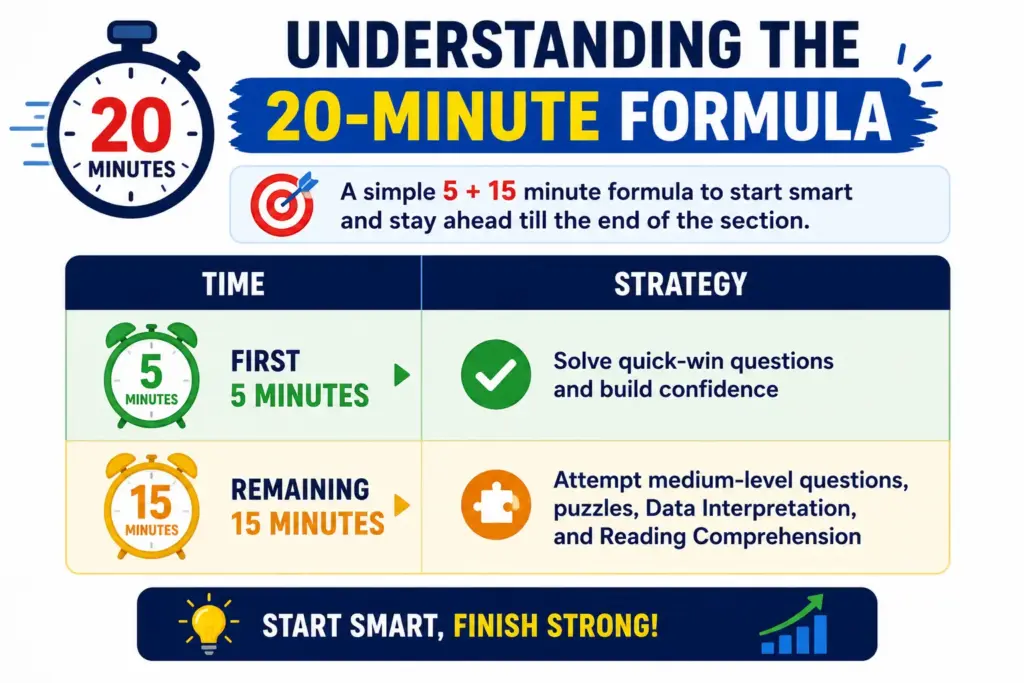
Understanding the 20-Minute Formula
A successful SBI PO First 5 Minutes Strategy follows a simple 5 + 15 minute formula. This simple approach prevents candidates from wasting valuable time at the beginning of a section and helps maintain a balanced pace till the end.

SBI PO First 5 Minutes Strategy for Prelims
A smart SBI PO first 5 minutes strategy for Prelims helps you collect easy marks first, stay calm under pressure, and improve both speed and accuracy throughout the exam.
SBI PO First 5 Minutes Strategy for Reasoning Ability
The SBI PO First 5 Minutes Strategy for Reasoning Ability should focus on collecting quick marks before attempting lengthy puzzles. Starting with standalone questions helps you gain confidence and keeps your speed high.
Quick-Win Topics: These questions are generally direct and can help you solve 10–15 questions within the first five minutes if you have practised them regularly.
- Syllogism
- Inequality
- Coding-Decoding
- Blood Relations
- Direction Sense
Time-Trap Questions: Avoid these questions during the first few minutes. Solve all standalone questions first and return to puzzles only after securing easy marks.
- Seating Arrangement
- Circular Arrangement
- Floor-based Puzzles
- Box-based Puzzles
- Multi-variable Puzzles
SBI PO First 5 Minutes Strategy for Quantitative Aptitude
The SBI PO First 5 Minutes Strategy for Quantitative Aptitude should focus on topics that require less calculation and provide quick scoring opportunities.
Quick-Win Topics: These topics are often called the scoring backbone of the Quant section as they can usually be solved within 20–30 seconds with regular practice. Completing them early helps you secure 10–12 questions before moving to lengthy calculations.
- Simplification
- Approximation
- Number Series
- Quadratic Equations
Time-Trap Questions: Do not begin the section with Data Interpretation or lengthy arithmetic questions. Following the strategy allows you to build momentum first and handle calculation-heavy questions with greater confidence later.
- Data Interpretation Sets
- Lengthy Arithmetic Word Problems
- Caselet DI
- Calculation-intensive Questions
SBI PO First 5 Minutes Strategy for English Language
The SBI PO First 5 Minutes Strategy for English Language should focus on direct grammar and vocabulary questions instead of lengthy reading passages. A quick start in English helps you build confidence for the remaining sections.
Quick-Win Topics: These questions generally take less time and allow you to secure 8–10 quick marks within the first few minutes.
- Error Detection
- Fillers
- Cloze Test
- Phrase Replacement
- Vocabulary Questions
Time-Trap Questions: Avoid jumping directly to Reading Comprehension. Solve grammar and vocabulary questions first, then return to reading-based questions after securing easy marks.
- Reading Comprehension
- Inference-based Questions
- Para Jumbles
- Author’s Tone Questions
SBI PO First 5 Minutes Strategy for Mains
The SBI PO First 5 Minutes Strategy is just as important in the Mains exam because the questions are more analytical and time-consuming. A smart start helps you identify scoring opportunities, avoid difficult question sets, and manage time more effectively.
SBI PO First 5 Minutes Strategy for General Awareness
The SBI PO First 5 Minutes Strategy for General Awareness focuses on answering direct and high-confidence questions first. Avoid spending time on doubtful questions or making random guesses, as negative marking can reduce your overall score.
Quick-Win Topics: These questions are direct and can help you secure 10–15 quick marks within the first few minutes if your preparation is strong.
- Current Affairs
- Banking Awareness
- Financial Awareness
- Static GK
- Government Schemes
Time-Trap Questions: Answer only the questions you are confident about. Avoid random guessing because negative marking can reduce your overall score.
- Doubtful Current Affairs Questions
- Confusing Statement-Based Questions
- Questions Requiring Excessive Guesswork
SBI PO First 5 Minutes Strategy for Data Analysis & Interpretation
The SBI PO First 5 Minutes Strategy for Data Analysis & Interpretation should be around focussing on selecting the right question set rather than solving the first one you see.
Quick-Win Topics: Choose the set that requires fewer calculations and has a clear data pattern. Scanning all the sets first can save valuable time.
- Simple Table DI
- Bar Graph DI
- Line Graph DI
- Ratio-Based Questions
- Direct Calculation Questions
Time-Trap Questions: Avoid starting with a lengthy DI set. Select the easiest set first and return to difficult ones only if time permits.
- Caselet DI
- Missing Data DI
- Mixed Graph DI
- Calculation-Heavy Sets
- Complex Data Sufficiency Questions
SBI PO First 5 Minutes Strategy for Reasoning & Computer Aptitude
The SBI PO First 5 Minutes Strategy for Reasoning & Computer Aptitude should help you secure marks easily before tackling high-level puzzles.
Quick-Win Topics: These questions are generally faster and help you build confidence early in the section.
- Syllogism
- Inequality
- Coding-Decoding
- Input-Output (Easy Pattern)
- Computer Awareness Questions
Time-Trap Questions: If a puzzle has multiple variables or no obvious starting point, move on instead of spending several minutes on it.
- High-Level Seating Arrangements
- Multi-Variable Puzzles
- Machine Input-Output (Complex Pattern)
- Logical Reasoning Sets
- Critical Reasoning Questions
SBI PO First 5 Minutes Strategy for English Language
The 5 Minutes Strategy for the Mains English section should focus on direct scoring opportunities before attempting lengthy passages.
Quick-Win Topics: These questions usually require less reading time and help you settle into the section quickly.
- Vocabulary Questions
- Error Detection
- Phrase Replacement
- Word Usage
- Grammar-Based Questions
Time-Trap Questions: Avoid starting with a lengthy Reading Comprehension passage. Complete grammar and vocabulary questions first, then move to reading-based questions after building momentum.
- Reading Comprehension
- Critical Reasoning
- Inference-Based Questions
- Paragraph Completion
- Long Editorial Passages
SBI PO First 5 Minutes Strategy for the Descriptive Test
The 5 Minutes Strategy is equally useful in the Descriptive Test. A planned start helps you organise your thoughts and write more effectively.
Quick-Win Activities: A structured plan improves clarity and saves editing time later.
- Read the topic carefully.
- Prepare a short outline.
- Decide the introduction and conclusion.
- List 3–4 key points before writing.
Time-Trap Activities: A clear outline during the first few minutes helps you complete the Descriptive Test within the allotted time while maintaining a logical flow.
- Writing immediately without planning.
- Spending too much time on the introduction.
- Frequently editing previous paragraphs.
- Changing ideas midway through the answer.
Why Is the First 5 Minutes Important in SBI PO Prelims?
The SBI PO First 5 Minutes Strategy is important as it sets the tone for the entire section. Candidates who begin with easy questions usually gain confidence quickly, maintain a steady pace, and make better decisions throughout the exam.
Since every section has only 20 minutes, spending the first five minutes wisely leaves enough time to solve moderate and difficult questions without panic. A smart beginning helps you:
- Build confidence quickly.
- Improve speed and accuracy.
- Reduce unnecessary pressure.
- Avoid difficult time-trap questions.
- Increase your overall score.
Common Mistakes Candidates Make During the First 5 Minutes
Even well-prepared candidates often lose marks because they make poor decisions at the beginning of each section. Following the SBI PO First 5 Minutes Strategy helps you avoid these common mistakes and use your time more effectively.
Starting with the Toughest Questions
Many candidates begin with a difficult puzzle, lengthy Data Interpretation set, or Reading Comprehension passage. This wastes valuable time and breaks their confidence early in the exam.
Spending Too Much Time on One Question
Trying to solve one difficult question during the first few minutes often leads to panic. If a question takes longer than expected, skip it and move to the next one.
Ignoring Easy Questions
Some aspirants overlook direct scoring questions while searching for difficult ones. Always collect quick marks before attempting lengthy problems.
Changing Your Attempt Order During the Exam
Switching your strategy midway creates confusion and affects your speed. Practise a fixed question sequence during mock tests and follow the same approach in the actual exam.
Panicking After Seeing a Difficult Paper
A difficult first question does not mean the entire section is difficult. Stay calm, skip the question, and continue with the next one.
How to Practise the SBI PO First 5 Minutes Strategy Through Mock Tests
The SBI PO First 5 Minutes Strategy becomes effective only when you practise it consistently during mock tests. Mock tests help you build speed, improve question selection, and develop confidence under real exam conditions.
While analysing every SBI PO mock, focus on the following:
| Analysis Area | Questions to Ask Yourself |
| First Five Minutes | Did I start with the right questions? |
| Easy Questions Missed | Could I have attempted them earlier? |
| Time Wasted | Which question consumed unnecessary time? |
| Question Selection | Did I avoid lengthy questions initially? |
| Accuracy | Was my quick attempt strategy effective? |
Weekly Practice Plan to Improve Your First 5 Minutes
A structured practice routine helps you make the SBI PO First 5 Minutes Strategy a habit before the actual exam. Following this plan consistently will help you start every section with greater confidence.
| Day | Activity |
| Monday | Full-Length SBI PO Mock Test |
| Tuesday | Analyse the First Five Minutes of Each Section |
| Wednesday | Sectional Tests with a Fixed Attempt Order |
| Thursday | Practice Quick-Scoring Topics |
| Friday | Improve Weak Areas and Speed |
| Saturday | Full-Length Mock Test |
| Sunday | Review Performance and Maintain an Error Log |
Final Thoughts
The SBI PO First 5 Minutes Strategy teaches candidates that a strong start can make the entire exam easier to manage. By following a fixed question sequence, avoiding time traps, and practising the same strategy through mock tests, you can improve both your speed and accuracy. A smart beginning not only reduces exam pressure but also increases your chances of scoring well in the SBI PO Prelims.
Also Read:
FAQs on SBI PO First 5 Minutes Strategy
Why are the first five minutes important in SBI PO Prelims?
The first five minutes set the pace for the rest of the section. A good start helps candidates manage time better, avoid panic, and secure quick marks early.
Which questions should I solve first in the Reasoning section?
Start with standalone topics like Syllogism, Inequality, Coding-Decoding, Blood Relations, and Direction Sense before attempting puzzles.
Should I start Quantitative Aptitude with Data Interpretation?
No. Begin with Simplification, Approximation, Number Series, and Quadratic Equations. Attempt Data Interpretation after securing quick marks.
Is it advisable to solve Reading Comprehension first in English?
No. Solve grammar and vocabulary-based questions first, such as Error Detection, Fillers, and Cloze Test. Attempt Reading Comprehension later if time permits.
How can mock tests improve my first five minutes strategy?
Mock tests help you practise a fixed question sequence, improve time management, identify quick-scoring topics, and analyse whether you are using the first five minutes effectively.
- Sign Up on Practicemock for Updated Current Affairs, Topic Tests and Mini Mocks
- Sign Up Here to Download Free Study Material
Free Mock Tests for the Upcoming Exams
- IBPS PO Free Mock Test
- RBI Grade B Free Mock Test
- IBPS SO Free Mock Test
- NABARD Grade A Free Mock Test
- SSC CGL Free Mock Test
- IBPS Clerk Free Mock Test
- IBPS RRB PO Free Mock Test
- IBPS RRB Clerk Free Mock Test
- RRB NTPC Free Mock Test
- SSC MTS Free Mock Test
- SSC Stenographer Free Mock Test
- GATE Mechanical Free Mock Test
- GATE Civil Free Mock Test
- RRB ALP Free Mock Test
- SSC CPO Free Mock Test
- AFCAT Free Mock Test
- SEBI Grade A Free Mock Test
- IFSCA Grade A Free Mock Test
- RRB JE Free Mock Test
- Free Banking Live Test
- Free SSC Live Test