


Reading Comprehension for IBPS PO 2026 can feel like the section that eats your time and gives back the least unless you know where to look and what to skip. Most aspirants lose 3–4 extra minutes per passage by reading every line instead of reading with purpose. This guide breaks the process into a repeatable, exam-tested system to help you solve RC passages accurately while leaving enough time for the rest of the English section.
Reading Comprehension, or RC, follows the bank exam’s standard format as per the latest IBPS PO Notification: long and short passages testing theme, inference, tone, and vocabulary. Solve faster by reading the questions first, skimming for the main idea, using keywords to locate answers, and attempting easy questions before inference-based ones.

IBPS PO 2026 Reading Comprehension Exam Pattern
Before building a strategy, it helps to know exactly how much of your exam time and score RC actually controls. Here is the verified section-wise breakdown from the official IBPS PO 2026 notification.
| Exam Stage | Section | Questions | Marks | Duration |
| Prelims | English Language | 30 | 30 | 20 minutes |
| Prelims | Quantitative Aptitude | 35 | 30 | 20 minutes |
| Prelims | Reasoning Ability | 35 | 40 | 20 minutes |
| Mains | Objective Test (all sections) | 170 | 200 | — |
| Mains | Descriptive Test (Essay + Comprehension) | 2 | 25 | 30 minutes |
Within the English section, RC generally makes up 7–10 questions in Prelims and 8–12 in Mains, based on recent exam trends, since IBPS does not publish a fixed sub-topic split.
Attempt Reading Comprehension for IBPS PO 2026 Free Quiz
The rapid proliferation of Central Bank Digital Currencies (CBDCs) marks a paradigm shift in the global financial architecture. Driven by the need to modernize payment infrastructures, counter the private encroachment of volatile cryptocurrencies, and enhance financial inclusion, central banks representing over 90% of global GDP are actively exploring or piloting digital versions of their sovereign currencies. Unlike decentralized cryptocurrencies, which function primarily as speculative assets due to their extreme volatility and lack of underlying intrinsic value, a CBDC is a digital token of sovereign currency issued directly by a nation’s monetary authority. It establishes a direct liability of the central bank, effectively mirroring the legal tender status of physical banknotes.
However, the transition from paper to pixels is not devoid of systemic risks. Economists argue that a poorly structured CBDC could inadvertently precipitate a process of bank disintermediation. In times of macroeconomic stress or systemic banking panics, commercial bank depositors might swiftly migrate their funds out of traditional checking accounts and into risk-free central bank wallets. Because central banks possess zero default risk, this digital “flight to safety” could happen at the click of a button, depriving commercial banks of their primary, low-cost funding source—retail deposits. Consequently, commercial banks would be forced to rely on more expensive wholesale funding markets, driving up their cost of capital. This upward pressure on costs would inevitably filter down to the broader economy, compressing credit availability and escalating borrowing costs for retail consumers and corporate enterprises alike.
To mitigate these vulnerabilities, central banks are experimenting with design guardrails. For instance, the Reserve Bank of India’s digital Rupee (e₹) and the European Central Bank’s digital Euro projects have contemplated imposing structural ceilings on individual digital wallet balances or implementing tiered, non-remunerative interest rate structures. By making large CBDC holdings financially unattractive or legally restricted, monetary authorities aim to preserve the traditional fractional reserve banking model while simultaneously reaping the transactional efficiencies of a programmatic, digital sovereign ecosystem.
Q1. Which of the following best describes the central theme of the passage?
Explanation: The passage first explains the purpose and benefits of CBDCs, then examines bank disintermediation risks and the guardrails proposed to reduce those risks. Option B captures this complete central idea.
Q2. According to the passage, why could a CBDC trigger a “flight to safety” during economic stress?
Explanation: The passage directly states that depositors may move money into central bank wallets because central banks possess zero default risk. Therefore, Option C is correct.
Q3. Which of the following can be inferred about the “design guardrails” being tested by central banks?
Explanation: Wallet ceilings and non-remunerative structures make large CBDC holdings unattractive or restricted. They are therefore designed to discourage excessive movement of deposits into central bank wallets.
Q4. Which word is most nearly the same in meaning as “precipitate” as used in the passage?
Explanation: In the phrase “precipitate a process of bank disintermediation,” precipitate means to cause or bring about something suddenly. “Trigger” is the closest synonym.
Q5. According to the passage, what is a direct consequence of commercial banks losing their low-cost retail deposits?
Explanation: The passage explains that banks would turn to more expensive wholesale funding, increasing their cost of capital and ultimately raising borrowing costs for consumers and businesses.
Quiz Summary
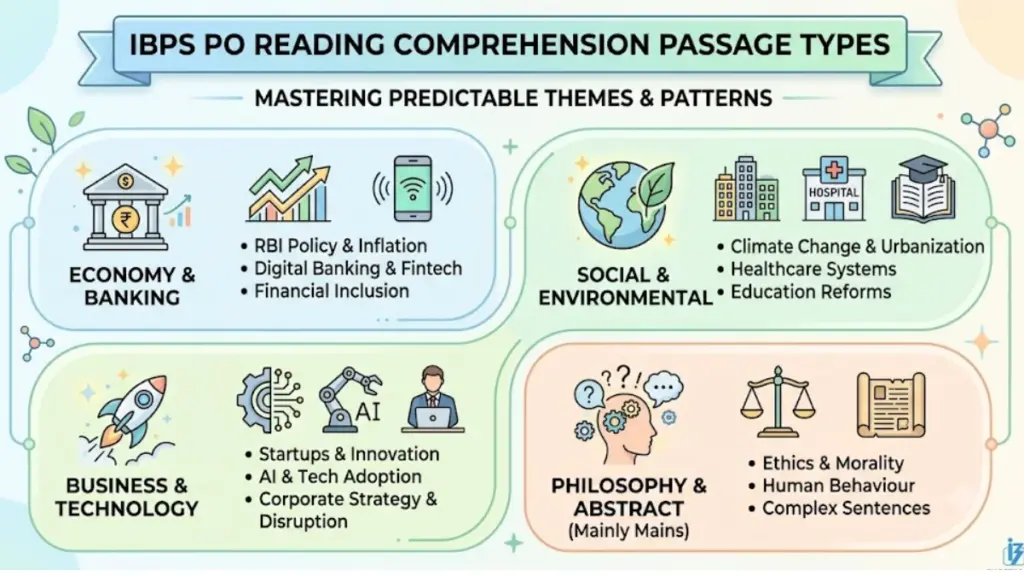
Types of Passages Asked in IBPS PO Reading Comprehension
IBPS PO passages are not random; they rotate through a predictable set of themes every cycle, so recognising the pattern early saves you real reading time.
- Economy and Banking: RBI policy, inflation, monetary tools, digital banking, financial inclusion.
- Social and Environmental Issues: climate change, urbanization, healthcare, education reforms.
- Business and Technology: startups, AI adoption, corporate strategy, industry disruption.
- Philosophy and Abstract Themes: ethics, human behaviour, and complex sentence structures, mainly in Mains.
Fast Reading Comprehension Solving Strategy for IBPS PO in 7 Steps
Reading Comprehension can be one of the most time-consuming sections in the IBPS PO English paper. A structured approach helps you answer questions faster without compromising accuracy. Follow these seven practical steps to improve your performance.
Step 1: Read the Questions Before the Passage
Before you start reading the passage, spend about 30 seconds scanning all the questions. Pay attention to keywords such as according to the passage, the author suggests, the central idea, or which of the following. Knowing what information is required helps you read with a clear purpose and reduces the time spent searching for answers later.
Step 2: Focus on the Main Ideas
Avoid trying to memorise every sentence. Instead, understand the overall flow of the passage by identifying the main idea, the author’s viewpoint, and the purpose of each paragraph. For example, one paragraph may introduce the topic, another may explain a problem, the next may discuss possible solutions, and the final paragraph may present a conclusion. This mental outline makes it much easier to locate answers.
Step 3: Skip Difficult Words and Keep Reading
Do not let unfamiliar vocabulary interrupt your reading. In most cases, the meaning of a difficult word can be understood from the surrounding context. Since IBPS PO Reading Comprehension primarily tests your understanding of the passage, focusing on the overall message is more beneficial than stopping to decode every unfamiliar word.
Step 4: Notice Transition and Connector Words
Pay close attention to transition words such as however, therefore, although, despite, consequently, and moreover. These words often indicate contrasts, conclusions, or changes in the author’s argument and frequently help answer inference, tone, and opinion-based questions.
Step 5: Attempt Questions in a Smart Order
Answer the easier questions first to build confidence and save time for more analytical ones. A recommended order is:
- Vocabulary and word meaning questions
- Phrase or expression-based questions
- Direct factual questions
- Main idea or title questions
- Author’s tone or attitude
- Inference and assumption-based questions
Inference questions generally require the most analysis, so solving them last helps improve overall time management.
Step 6: Eliminate Incorrect Options
If you are unsure of the correct answer, begin by removing options that are clearly incorrect. Many wrong choices contain extreme words such as always, never, or all, introduce information that is not mentioned in the passage, misrepresent the author’s opinion, or completely reverse the intended meaning. Eliminating such options significantly increases the chances of selecting the correct answer.
Step 7: Refer to the Relevant Paragraph Instead of Re-reading Everything
Avoid reading the entire passage again for every question. Use your understanding of the passage structure to return directly to the paragraph that discusses the relevant topic. For example, if a question is about government regulations, revisit only the paragraph that explains those regulations. This targeted approach saves valuable time during the examination.
Expected Reading Comprehension Pattern for IBPS PO 2026
Reading Comprehension remains one of the highest-scoring topics in the IBPS PO English Language section. Based on recent exam trends, candidates can expect a moderate number of RC questions in both the Preliminary and Main examinations. Managing time effectively while maintaining accuracy is crucial for maximizing your score.
| Exam Stage | Expected RC Questions | Expected Difficulty | Recommended Time |
| IBPS PO Prelims | 7–10 Questions | Easy to Moderate | 5–7 Minutes |
| IBPS PO Mains | 8–12 Questions | Moderate to Difficult | 7–10 Minutes |
Preparation Tip: In the Prelims, focus on solving direct and vocabulary-based questions quickly before attempting inference-based questions. In the Mains, expect longer passages with analytical and opinion-based questions, so practice reading editorials and solving timed Reading Comprehension sets regularly to improve both speed and comprehension.
| Also Read | |
| IBPS PO Exam Pattern | IBPS PO Salary |
| IBPS PO Previous Year Question Paper | IBPS PO Cut Off |
| IBPS PO Study Plan | IBPS PO Syllabus PDF |
Frequently Asked Questions
How many Reading Comprehension questions come in IBPS PO 2026 Prelims?
IBPS PO Prelims 2026 typically includes 7–10 RC questions within the 30-question, 30-mark English Language section, based on recent exam trends, though IBPS does not officially fix a sub-topic-wise split.
Is Reading Comprehension asked in IBPS PO Mains too?
Yes, Mains includes RC-based objective questions plus a Comprehension component in the Descriptive Test, which carries 25 marks alongside the essay under the revised 2026 pattern.
What is the best way to improve reading speed for IBPS PO RC?
Read daily editorials from The Hindu or Indian Express, practice timed passages, and focus on grasping paragraph-level ideas instead of memorizing every sentence word-for-word.
Should I read the questions or the passage first in IBPS PO RC?
Reading the questions first (30–45 seconds) helps you know exactly what information to look for, saving time compared to reading the entire passage before checking questions.
Which topics are most common in IBPS PO Reading Comprehension passages?
Economy, banking, digital finance, social issues, and technology dominate IBPS PO passages, so prioritize practice sets and editorials built around these themes for maximum exam relevance.
- Sign Up on Practicemock for Updated Current Affairs, Topic Tests and Mini Mocks
- Sign Up Here to Download Free Study Material
Free Mock Tests for the Upcoming Exams
- IBPS PO Free Mock Test
- RBI Grade B Free Mock Test
- IBPS SO Free Mock Test
- NABARD Grade A Free Mock Test
- SSC CGL Free Mock Test
- IBPS Clerk Free Mock Test
- IBPS RRB PO Free Mock Test
- IBPS RRB Clerk Free Mock Test
- RRB NTPC Free Mock Test
- SSC MTS Free Mock Test
- SSC Stenographer Free Mock Test
- GATE Mechanical Free Mock Test
- GATE Civil Free Mock Test
- RRB ALP Free Mock Test
- SSC CPO Free Mock Test
- AFCAT Free Mock Test
- SEBI Grade A Free Mock Test
- IFSCA Grade A Free Mock Test
- RRB JE Free Mock Test
- Free Banking Live Test
- Free SSC Live Test