


Preparing for the IBPS PO exam is about studying smart. Every year, a small percentage qualify for the final merit list. This often makes candidates wonder, “Why Most Candidates Fail To Clear IBPS PO Exam?” Most aspirants do not fail because the syllabus is too difficult. They fail due to avoidable preparation mistakes, poor exam strategy, weak analysis of mock tests, inconsistent revision, and ineffective time management.
This article explains the common reasons for failing bank exams multiple times, highlights the mistakes that prevent candidates from clearing the exam, and shares practical solutions to improve your preparation for IBPS PO 2026.

Why Most Candidates Fail To Clear IBPS PO Exam?
Most candidates fail to clear the IBPS PO exam because of poor preparation strategy, lack of concept clarity, ineffective time management, excessive guesswork, weak mock test analysis, and inconsistent revision. Many aspirants also ignore sectional cut-offs, rely only on shortcuts, or fail to practice under real exam conditions, reducing their chances of selection.
According to the latest IBPS PO 2026 notification, the selection process consists of Prelims, Mains, Personality Test (qualifying), and Interview, with the final merit prepared using Mains (80%) and Interview (20%). Since every stage is highly competitive, even a few incorrect answers or poor section management can affect your final selection.
Why IBPS PO Is Difficult to Crack
The IBPS PO exam is difficult to crack because of intense competition rather than an impossible syllabus. Every year, lakhs of aspirants compete for only a few thousand vacancies, making accuracy, speed, and consistency equally important.
Before understanding the common mistakes, it is important to know what makes this examination challenging.
| Factor | Why It Matters |
| High Competition | Lakhs of candidates compete for limited vacancies. |
| Sectional Timing | Every section has a fixed time limit. |
| Negative Marking | 0.25 marks are deducted for every incorrect answer. |
| Multiple Selection Stages | Candidates must perform consistently in every stage. |
| Increasing Difficulty | Mains questions continue to become more analytical each year. |
Success depends not only on completing the syllabus but also on developing the right exam strategy.
Understanding your mistakes is the first step toward improving your performance. Below are the most common bank exam failure reasons observed among aspirants who miss the final selection.
1. Lack of Concept Clarity Leads to Repeated Mistakes
Concept clarity is one of the biggest factors behind why most candidates fail to clear the IBPS PO Exam. Many aspirants begin solving mock tests before strengthening their basics in Quantitative Aptitude, Reasoning Ability, and English Language.
They often memorize formulas and shortcuts without understanding the underlying concepts. This works for straightforward questions but fails when IBPS introduces new question patterns.
Common conceptual mistakes include:
- Learning tricks without understanding the logic
- Weak arithmetic fundamentals
- Poor grammar basics
- Limited vocabulary and reading practice
- Difficulty solving new-pattern puzzles and Data Interpretation
How to improve
- Complete one topic before moving to the next.
- Solve basic-level questions first.
- Gradually increase the difficulty level.
- Revise concepts every week.
2. Poor Time Management During the Exam
Poor time management is another major reason why students fail in IBPS PO Prelims and Mains. Many candidates spend five to six minutes solving a single puzzle or Data Interpretation set, leaving little time for easier questions.
The IBPS PO exam rewards candidates who know when to skip difficult questions and maximize attempts with high accuracy.
Watch out for these mistakes:
- Attempting the toughest questions first
- Spending too much time on one puzzle
- Not following sectional time goals
- Rushing during the final minutes
Quick Time Management Tips
- Attempt easy questions first.
- Skip lengthy puzzles initially.
- Keep the last 2–3 minutes for review.
- Practice full-length mocks under actual exam timings.
3. Ignoring the Impact of Negative Marking
Negative marking impacts IBPS PO scores more than many candidates realize. Every incorrect answer attracts a penalty of 0.25 marks, meaning blind guessing can significantly reduce your final score.
Many aspirants focus only on increasing attempts instead of maintaining accuracy.
Avoid these mistakes:
- Random guessing
- Marking doubtful questions without elimination
- Chasing very high attempts
- Ignoring accuracy while practicing mocks
How Negative Marking Reduces Selection Chances
Before attempting doubtful questions, ask yourself:
✔ Can I eliminate two options?
✔ Am I at least reasonably confident?
✔ Will this guess improve or reduce my score?
Maintaining high accuracy often proves more beneficial than attempting every question.
4. Lack of Mock Test Analysis Slows Improvement
Bank PO mock test analysis pitfalls prevent many aspirants from improving despite taking dozens of tests. Simply attempting mock tests is not enough if you never analyze your mistakes afterward.
Many candidates immediately start another mock without reviewing:
- Wrong answers
- Time-consuming questions
- Weak topics
- Accuracy trends
A proper analysis helps identify recurring mistakes and ensures they are not repeated in the next exam.
Analyze Every Mock Using This Checklist
- Questions answered incorrectly
- Questions skipped despite being easy
- Time spent per section
- Accuracy percentage
- Topics requiring revision
One well-analyzed mock is often more valuable than several poorly reviewed ones.
5. Studying Without a Proper Preparation Strategy
IBPS PO preparation mistakes often begin with an unstructured study plan. Many aspirants study whatever topic they feel comfortable with instead of following a balanced schedule.
As a result, some subjects receive too much attention while others are completely ignored until the last few weeks.
Signs of poor preparation planning include:
- No weekly targets
- Irregular revision
- Ignoring Current Affairs
- Solving random questions without purpose
- No balance between Prelims and Mains preparation
Build a Smarter Study Routine
A balanced preparation plan should include:
- Concept learning
- Topic-wise practice
- Daily Current Affairs
- Weekly revision
- Mock tests with analysis
- Monthly performance review
Following a structured routine ensures steady progress and minimizes last-minute stress.
6. Weak English Preparation Affects Overall Score
Weak English preparation is a common reason why students fail in IBPS PO Prelims despite performing well in Quant and Reasoning. Many aspirants focus only on grammar rules and neglect Reading Comprehension, vocabulary, and daily reading practice.
Since the English section tests comprehension and application rather than rote learning, limited reading habits often result in low accuracy and slower attempts.
Common English Preparation Mistakes
- Reading only grammar notes
- Ignoring editorials and business news
- Memorizing vocabulary without revision
- Practicing fewer Reading Comprehension passages
- Not attempting sectional English mocks
How to Improve English for IBPS PO
- Read one editorial daily.
- Revise vocabulary using flashcards.
- Practice Reading Comprehension every day.
- Solve previous years’ English questions.
- Take one sectional English mock every week.
7. Ignoring Sectional Cut-Offs Can End Your Journey
Ignoring IBPS PO sectional cut-off issues is one of the biggest strategic mistakes candidates make. Even if your overall score is good, failing to achieve the qualifying marks in a single section can lead to disqualification whenever sectional qualifying criteria apply at different stages or participating banks.
Many aspirants spend excessive time strengthening their favorite subject while ignoring weaker sections.
Avoid these mistakes:
- Depending entirely on Quant or Reasoning
- Giving little attention to English
- Leaving sections incomplete
- Not monitoring sectional mock scores
Smart Strategy
Aim for balanced preparation across all sections instead of chasing exceptionally high marks in just one subject.
8. Relying Only on Shortcuts Without Understanding Concepts
Relying only on shortcuts is another major reason for bank exam failure. Tricks can save time, but they cannot replace conceptual understanding.
IBPS frequently introduces application-based and analytical questions where concepts matter more than memorized methods.
Problems with Shortcut-Based Preparation
- Difficulty solving unfamiliar questions
- Confusion in lengthy Data Interpretation sets
- Low confidence when shortcuts fail
- Higher error rate in Mains
Better Approach
Follow this sequence:
- Learn the concept.
- Solve basic questions.
- Practice moderate-level questions.
- Use shortcuts only after mastering the topic.
This approach improves both speed and accuracy.
9. Lack of Revision Reduces Retention
Lack of regular revision is one of the most overlooked IBPS PO preparation mistakes. Many candidates keep learning new topics but rarely revisit previously studied concepts.
Without revision, formulas, grammar rules, vocabulary, Current Affairs, and puzzle techniques are easily forgotten before the exam.
Effective Weekly Revision Plan
| Day | Revision Focus |
| Monday | Quant formulas & Arithmetic |
| Tuesday | Reasoning concepts & puzzles |
| Wednesday | English grammar & vocabulary |
| Thursday | Current Affairs revision |
| Friday | Banking Awareness |
| Saturday | Previous Year Questions |
| Sunday | Full-length Mock + Analysis |
A simple revision schedule helps improve long-term retention and reduces exam-day stress.
10. Exam Anxiety and Lack of Confidence
Exam anxiety explains why well-prepared students fail IBPS PO despite months of preparation. Many aspirants perform well during practice but struggle under actual exam pressure.
Common symptoms include rushing through questions, second-guessing correct answers, and panicking after encountering difficult puzzles.
Signs of Exam Anxiety
- Feeling nervous before starting the paper
- Constantly checking the timer
- Losing focus after one difficult question
- Changing correct answers unnecessarily
How to Stay Calm During the Exam
- Attempt familiar questions first.
- Follow the same strategy used in mock tests.
- Avoid comparing your progress with others.
- Practice deep breathing before the exam.
- Sleep well the night before the examination.
Confidence grows from preparation, consistency, and repeated exam-like practice.
IBPS PO Preparation Mistakes vs Smart Solutions
Knowing the mistakes is helpful, but knowing how to fix them is even more important. The table below summarizes the most common errors and their practical solutions.
| Common Mistake | Impact on Selection | Smart Solution |
| Weak concepts | Low accuracy | Build strong fundamentals first |
| Poor time management | Incomplete paper | Practice timed sectional tests |
| Blind guessing | Negative marking | Attempt only confident questions |
| No mock analysis | Repeated mistakes | Analyze every mock thoroughly |
| Irregular revision | Forgetting concepts | Maintain a weekly revision plan |
| Ignoring Current Affairs | Low Mains score | Study daily and revise monthly |
| Overusing shortcuts | Difficulty in new-pattern questions | Learn concepts before tricks |
| Weak English practice | Missing sectional targets | Read editorials and solve RCs daily |
| Exam anxiety | Poor performance under pressure | Simulate real exam conditions regularly |
How to Overcome Failure in IBPS PO Exam and Make a Comeback
How to overcome failure in the IBPS PO exam and make a comeback depends on identifying mistakes instead of simply increasing study hours. Every unsuccessful attempt provides valuable insights that can strengthen your preparation for the next exam.
If you have failed once or even multiple times, focus on improving your strategy rather than changing your goal.
Make Your Next Attempt Different
✔ Analyze previous scorecards.
✔ Identify your weakest section.
✔ Build concepts before attempting advanced questions.
✔ Attempt 2–3 full-length mocks every week.
✔ Maintain an error notebook to track recurring mistakes.
✔ Revise Current Affairs regularly.
✔ Improve typing and writing practice for the Mains descriptive paper.
✔ Prioritize accuracy over the number of attempts.
Consistency matters more than studying for extremely long hours.
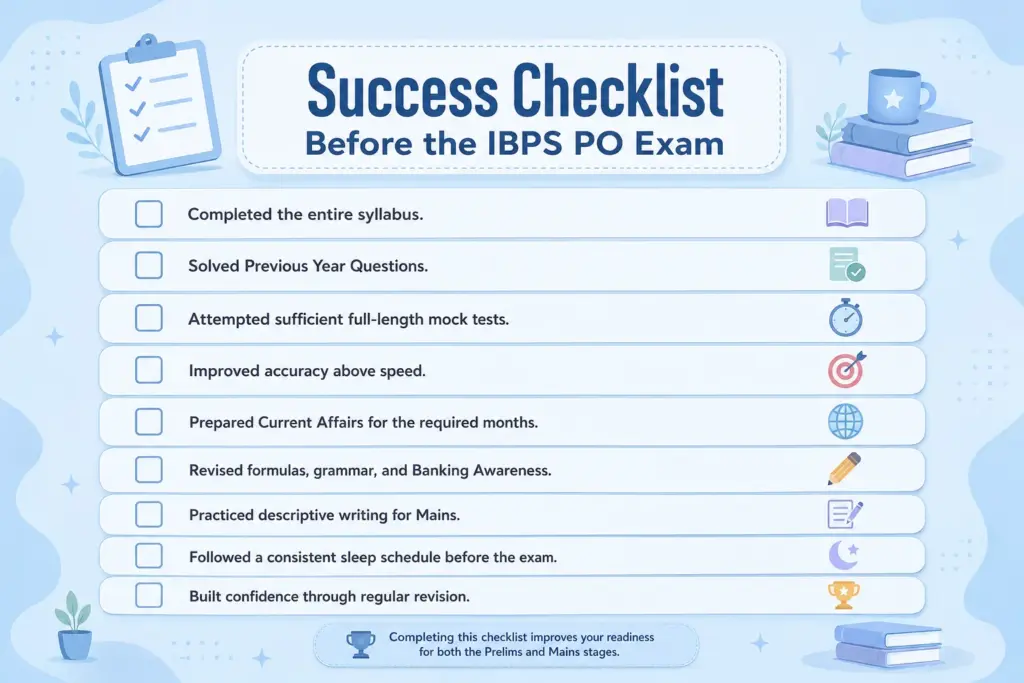
Success Checklist Before the IBPS PO Exam
A final checklist helps ensure that your preparation is aligned with the latest exam requirements.
Before your exam, confirm that you have completed the following:
- Completed the entire syllabus.
- Solved Previous Year Questions.
- Attempted sufficient full-length mock tests.
- Improved accuracy above speed.
- Prepared Current Affairs for the required months.
- Revised formulas, grammar, and Banking Awareness.
- Practiced descriptive writing for Mains.
- Followed a consistent sleep schedule before the exam.
- Built confidence through regular revision.
Completing this checklist improves your readiness for both the Prelims and Mains stages.
Expert Tips to Clear IBPS PO in the First Attempt
Preparing smart is more important than studying endlessly. Follow these practical tips to improve your chances of success.
- Build concepts before learning shortcuts.
- Practice topic-wise questions daily.
- Attempt 2–3 full-length mock tests every week.
- Spend at least as much time analyzing mocks as attempting them.
- Read an English editorial daily to improve comprehension and vocabulary.
- Revise Current Affairs regularly instead of leaving them for the last month.
- Prepare for Prelims and Mains simultaneously.
- Maintain an error notebook to avoid repeating mistakes.
- Focus on accuracy first, then increase speed.
- Stay consistent instead of studying irregularly for long hours.
Conclusion
Every unsuccessful attempt is an opportunity to identify weaknesses and improve your preparation. Most candidates who miss the IBPS PO cut-off are not lacking intelligence; they are often held back by avoidable mistakes such as inconsistent revision, poor mock analysis, weak time management, and over-reliance on shortcuts.
If you are preparing for IBPS PO 2026, start correcting these mistakes today. A disciplined approach, combined with regular practice and confidence, can help you clear the exam and secure your place in the final merit list.
Frequently Asked Questions (FAQs)
1. Is the IBPS PO exam tough to crack?
The IBPS PO exam is tough to crack because of intense competition, not because the syllabus is impossible. Every year, lakhs of candidates compete for a few thousand vacancies. Candidates with strong concepts, consistent mock practice, and effective time management have a much better chance of clearing the exam.
2. Why do students fail in IBPS PO Prelims?
Most students fail in IBPS PO Prelims due to poor time management, low accuracy, weak conceptual understanding, and inadequate mock test practice. Ignoring sectional preparation and attempting too many doubtful questions also increases negative marking, making it difficult to clear the cut-off.
3. How many candidates clear the IBPS PO interview?
Only candidates who qualify in the Mains examination and the qualifying Personality Test are called for the interview stage. The exact number varies every year depending on vacancies and IBPS recruitment requirements. The final merit list is prepared using 80% weightage for Mains marks and 20% for Interview marks, as specified in the latest recruitment process.
4. How many hours should I study to clear IBPS PO after failing once?
There is no fixed number of study hours. Most successful candidates focus on 5–7 hours of productive study, including concept building, revision, Current Affairs, and mock test analysis. After a failed attempt, improving weak areas is more important than simply increasing study time.
5. How does negative marking reduce selection chances in IBPS PO?
In the IBPS PO objective examination, 0.25 marks are deducted for every incorrect answer. Excessive guessing lowers your overall score and may push you below the qualifying cut-off. Maintaining high accuracy and attempting only reasonably confident questions usually results in better scores.
- Sign Up on Practicemock for Updated Current Affairs, Topic Tests and Mini Mocks
- Sign Up Here to Download Free Study Material
Free Mock Tests for the Upcoming Exams
- IBPS PO Free Mock Test
- RBI Grade B Free Mock Test
- IBPS SO Free Mock Test
- NABARD Grade A Free Mock Test
- SSC CGL Free Mock Test
- IBPS Clerk Free Mock Test
- IBPS RRB PO Free Mock Test
- IBPS RRB Clerk Free Mock Test
- RRB NTPC Free Mock Test
- SSC MTS Free Mock Test
- SSC Stenographer Free Mock Test
- GATE Mechanical Free Mock Test
- GATE Civil Free Mock Test
- RRB ALP Free Mock Test
- SSC CPO Free Mock Test
- AFCAT Free Mock Test
- SEBI Grade A Free Mock Test
- IFSCA Grade A Free Mock Test
- RRB JE Free Mock Test
- Free Banking Live Test
- Free SSC Live Test