



The RBI Assistant Prelims is a qualifying stage but highly competitive, with cut‑offs usually ranging between 90–95 marks. With only 60 minutes to solve 100 questions, aspirants must focus on topics that consistently carry higher weightage. This blog highlights the most important topics for each section — Quant, Reasoning, and English, along with preparation tips based on previous years’ exam analysis.
Subject-wise Important Topics
Success in RBI Assistant Prelims 2026 depends on mastering section‑wise high‑weightage topics. Each subject — Quantitative Aptitude, Reasoning Ability, and English Language — has recurring patterns from previous exams. By focusing on these, aspirants can maximize accuracy and speed in the actual test.

Quantitative Aptitude
Quant is all about speed and accuracy. Simplification, Arithmetic, and DI dominate this section, making them essential for scoring well. Regular practice of these topics ensures confidence and efficiency during the exam.
| Topic | Average Questions | Difficulty | Importance |
| Simplification/Approximation | 12–15 | Easy–Moderate | High scoring, speed‑based |
| Arithmetic (Profit & Loss, Ratio, Time & Work, Percentage) | 10–13 | Moderate | Core conceptual |
| Data Interpretation (DI) | 5–10 | Easy | Graphs, tables, caselets |
| Number Series (Missing/Wrong) | 5 | Easy | Quick scoring |
Reasoning Ability
Reasoning tests logical thinking and problem‑solving. Puzzles and Seating Arrangement form nearly half the section, while Syllogism and Inequality provide quick scoring opportunities. Prioritizing these ensures a strong attempt count.
| Topic | Average Questions | Difficulty | Importance |
| Puzzles & Seating Arrangement | 15–20 | Moderate | Highest weightage |
| Syllogism | 3–5 | Easy | Quick scoring |
| Inequality | 3–5 | Easy | Quick scoring |
| Coding–Decoding | 3–5 | Easy–Moderate | Commonly asked |
| Blood Relations | 3–5 | Easy–Moderate | Regular trend |
| Series/Direction Sense | 5/2–3 | Easy | Frequent |
English Language
English evaluates comprehension, grammar, and vocabulary. Reading Comprehension is the most consistent high‑weightage topic, while Error Detection and Fillers ensure quick scoring. Vocabulary‑based questions like Word Swap also appear regularly.
| Topic | Average Questions | Difficulty | Importance |
| Reading Comprehension (RC) | 7–10 | Easy–Moderate | Highest weightage |
| Error Detection | 5 | Easy | Grammar‑based |
| Fillers/Cloze Test | 5 | Easy | Vocabulary + grammar |
| Sentence Rearrangement/Para Jumbles | 2–5 | Moderate | Logical flow |
| Word Usage/Word Swap | 2–4 | Easy | Vocabulary |
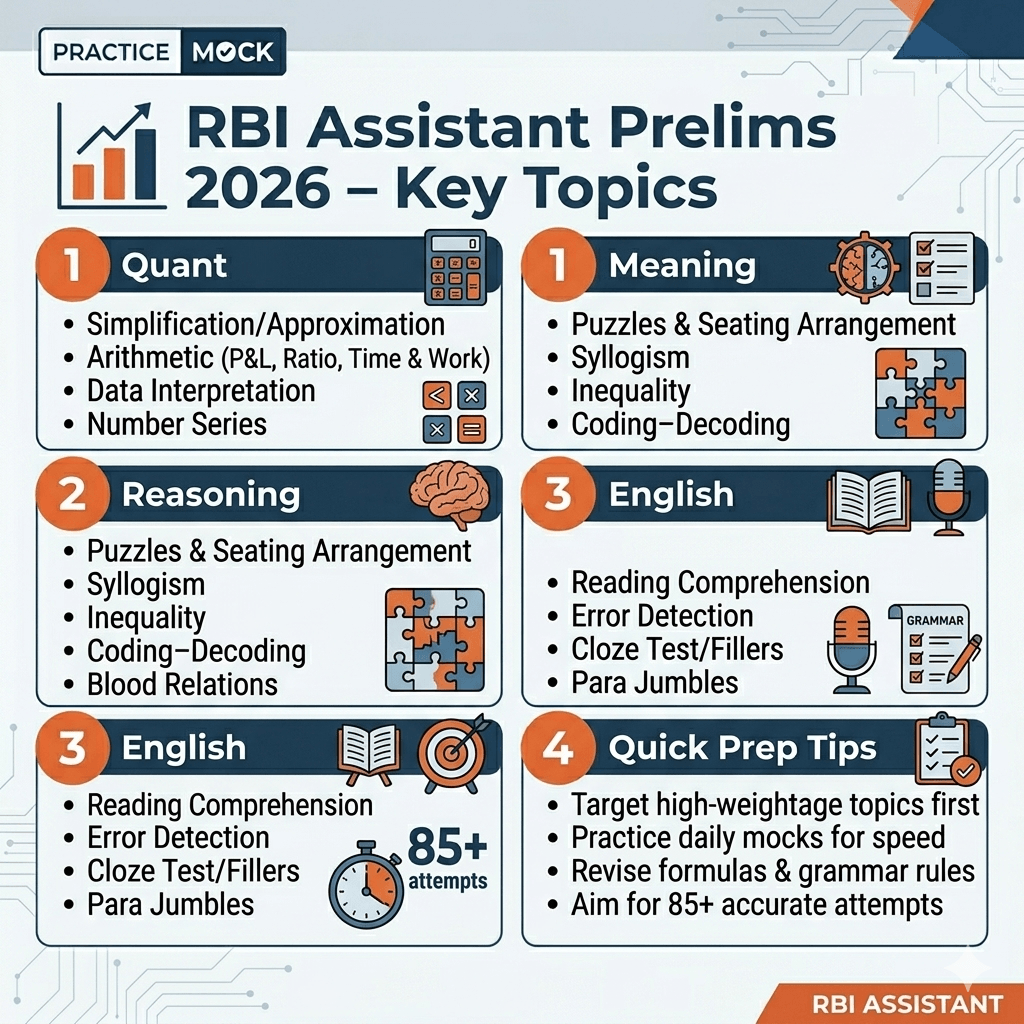
Previous Years’ Exam Analysis Insights
Understanding the exam trends from past years is crucial for aspirants preparing for RBI Assistant Prelims 2026. Previous papers reveal consistent patterns in topic distribution, difficulty levels, and cut‑off marks. By analyzing these insights, candidates can prioritize preparation and align their strategy with what the exam typically demands.
Quantitative Aptitude
In Quant, Simplification and Arithmetic have consistently dominated the section. Simplification questions, usually 12–15 in number, are designed to test calculation speed and accuracy. Arithmetic problems, covering topics like Profit & Loss, Time & Work, Ratio, and Percentage, form the backbone of conceptual testing. Additionally, Data Interpretation (DI) appears in almost every paper, often in the form of bar graphs, tables, or caselets. This makes DI a must‑practice area, as it combines arithmetic concepts with logical reasoning. Candidates who master these three areas can secure a majority of marks in Quant with efficiency.
Reasoning Ability
Reasoning is heavily tilted towards Puzzles and Seating Arrangement, which together account for nearly 50% of the section. These questions test logical sequencing and analytical skills, often requiring candidates to arrange people, objects, or conditions based on given clues. Alongside puzzles, topics like Syllogism, Inequality, Coding‑Decoding, and Blood Relations appear regularly, offering quick scoring opportunities. The consistent weightage of puzzles means aspirants must dedicate daily practice to different types — linear, circular, floor‑based, and box‑based — to ensure comfort with any variation presented in the exam.
English Language
In English, Reading Comprehension (RC) remains the most reliable scoring area. RC passages test comprehension, vocabulary, and inference skills, and typically carry 7–10 questions. Grammar‑based topics like Error Detection and Fillers/Cloze Tests provide quick attempts, while Sentence Rearrangement and Para Jumbles test logical flow and coherence. Vocabulary‑based questions such as Word Swap or Word Usage also appear consistently. The balance between comprehension and grammar ensures that candidates with strong reading habits and grammar basics can maximize their score in this section.
Cut‑off Trends
The Prelims cut‑offs have historically hovered around 90–95 marks, reflecting the competitive nature of the exam. Since the paper is speed‑based, aspirants must aim for high accuracy while attempting at least 85–90 questions. Cut‑off trends emphasize the importance of balancing speed with precision, as even a few incorrect attempts can significantly impact the final score.
Here’s the expanded Smart Last‑Minute Strategy section rewritten to about 450 words, with a 40‑word intro after the H2 and detailed explanations for each point:
Smart Last‑Minute Strategy
As the RBI Assistant Prelims 2026 exam approaches, aspirants must shift focus from learning new concepts to refining exam‑ready strategies. The final days are about consolidating strengths, practicing under timed conditions, and ensuring accuracy. Smart planning now can make the difference between clearing the cut‑off or falling short.
Focus on High‑Weightage Topics
In the last stretch, prioritize topics that consistently carry maximum weightage. For Quant, this means Simplification, Arithmetic, and Data Interpretation. In Reasoning, Puzzles and Seating Arrangement dominate, while in English, Reading Comprehension and Error Detection are crucial. Revising these ensures you maximize scoring opportunities in limited time.
Daily Mock Tests Practice
Mock tests simulate the actual exam environment and help aspirants manage stress. Attempt at least one full‑length mock daily, followed by thorough analysis. Identify weak areas, note recurring mistakes, and refine shortcuts. This practice builds confidence and ensures familiarity with exam pressure.
Improving Time Management
With only 60 minutes for 100 questions, time allocation is critical. A balanced approach is to spend 20 minutes each on Quant, Reasoning, and English. This prevents over‑spending time on one section and ensures all questions are attempted strategically. Stick to sectional time limits during mocks.
Accuracy Over Attempts
Speed is important, but accuracy decides the final score. Avoid the temptation to attempt every question. Skip doubtful ones to prevent negative marking. A safe strategy is to aim for 85–90 accurate attempts, which usually aligns with previous years’ cut‑off trends.
Revision
Revision is the backbone of last‑minute preparation. Go over formulas, arithmetic shortcuts, grammar rules, and puzzle approaches. Create quick notes or flashcards for percentage formulas, time‑work ratios, and common grammar errors. Revising these ensures you don’t waste time recalling basics during the exam.
Additional Tips
- Stay Calm: Anxiety can reduce efficiency. Practice breathing exercises before mocks.
- Sectional Practice: Attempt mini‑tests focusing on one subject daily.
- Error Log: Maintain a notebook of mistakes from mocks and revise them daily.
- Healthy Routine: Sleep well and avoid over‑studying the night before the exam.
Conclusion
The RBI Assistant Prelims 2026 demands smart preparation and focused revision. By prioritizing high‑weightage topics like Simplification, Arithmetic, Puzzles, Seating Arrangement, and Reading Comprehension, aspirants can maximize their score and clear the cut‑off comfortably. With the exam on April 11, 2026, the final days should be dedicated to mock practice, accuracy, and confidence building.
Join our exclusive Telegram group where our experts are ready to answer all your queries, guide you in banking exam preparation, and give personalised tips to boost your success. Get access to real-time solutions, expert advice, and valuable resources to improve your study journey. [Click here to join now
FAQs
The RBI Assistant Prelims 2026 exam will be conducted on April 11, 2026, as per the official notification.
Simplification/Approximation, Arithmetic word problems, and Data Interpretation are the most important topics, consistently appearing in previous years’ papers.
Puzzles and Seating Arrangement together account for 15–20 questions, making them nearly half of the Reasoning section.
Reading Comprehension (RC) remains the most reliable scoring area, followed by grammar‑based questions like Error Detection and Fillers.
Based on previous years’ trends, the cut‑off usually hovers around 90–95 marks, requiring both speed and accuracy.
- Sign Up on Practicemock for Updated Current Affairs, Topic Tests and Mini Mocks
- Sign Up Here to Download Free Study Material
Free Mock Tests for the Upcoming Exams
- IBPS PO Free Mock Test
- RBI Grade B Free Mock Test
- IBPS SO Free Mock Test
- NABARD Grade A Free Mock Test
- SSC CGL Free Mock Test
- IBPS Clerk Free Mock Test
- IBPS RRB PO Free Mock Test
- IBPS RRB Clerk Free Mock Test
- RRB NTPC Free Mock Test
- SSC MTS Free Mock Test
- SSC Stenographer Free Mock Test
- GATE Mechanical Free Mock Test
- GATE Civil Free Mock Test
- RRB ALP Free Mock Test
- SSC CPO Free Mock Test
- AFCAT Free Mock Test
- SEBI Grade A Free Mock Test
- IFSCA Grade A Free Mock Test
- RRB JE Free Mock Test
- Free Banking Live Test
- Free SSC Live Test