


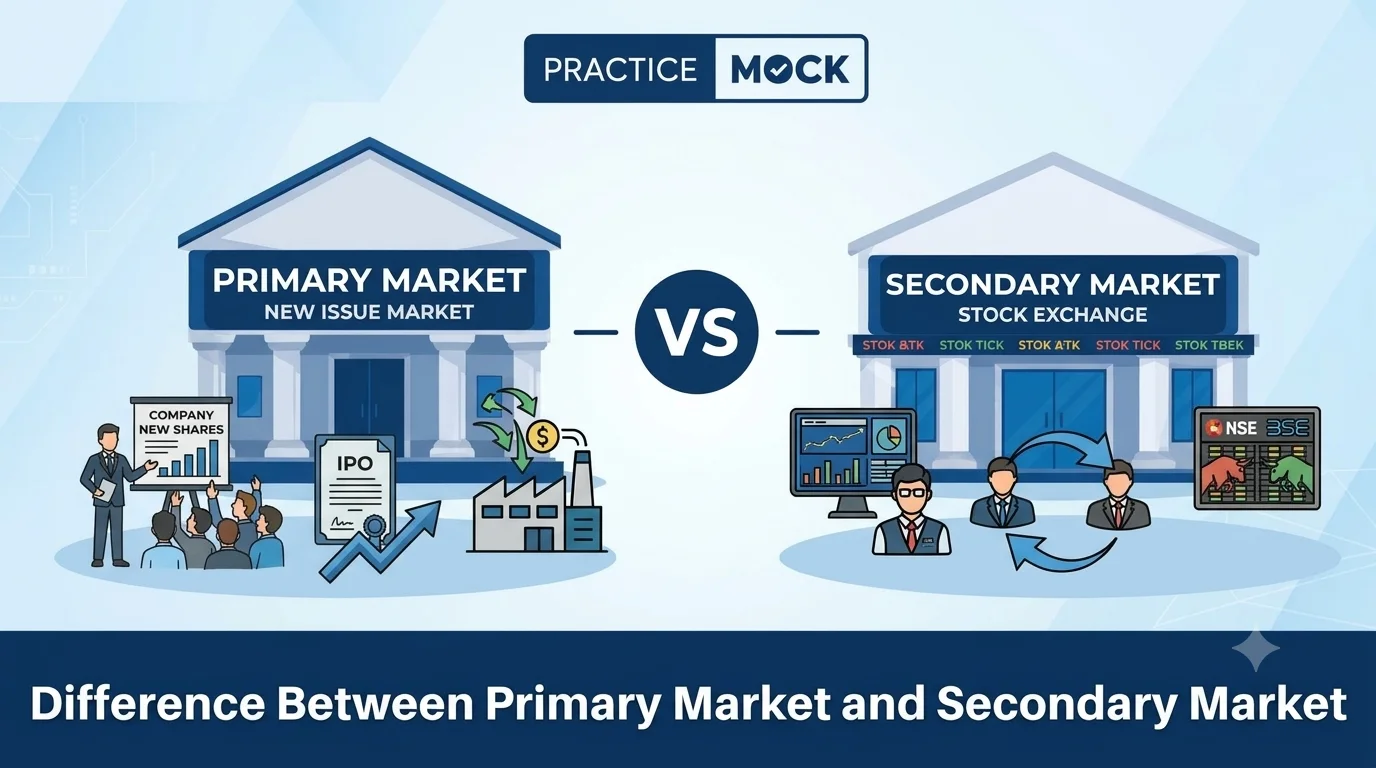
The primary market vs secondary market comparison forms a core topic in Banking Awareness and General Awareness sections of Indian competitive exams like IBPS PO, SBI PO, RBI Grade B, and SEBI Grade A. Simply put, the primary market is where companies and governments sell brand-new securities to investors for the first time to raise fresh capital, while the secondary market is where investors buy and sell those already-issued securities among themselves on stock exchanges like the NSE and BSE.
In India, the Securities and Exchange Board of India (SEBI) regulates both segments of the capital market to ensure transparency and investor protection. Understanding the difference between primary and secondary market structures, pricing mechanisms, and fund flows will help you solve both direct conceptual questions and application-based MCQs in your upcoming banking and insurance exams.

Key Takeaways on Capital Markets
- Primary Market Role: Facilitates direct capital formation by allowing companies and governments to issue new stocks and bonds directly to investors.
- Secondary Market Role: Provides liquidity and continuous price discovery by allowing investors to trade existing securities without involving the issuing company.
- Direction of Funds: In the primary market, money flows from the investor to the issuing company. In the secondary market, money moves strictly between buying and selling investors.
- Pricing Mechanism: Primary market prices are fixed by the issuer or discovered via book-building, whereas secondary market prices fluctuate dynamically based on supply and demand.
- Regulatory Oversight: SEBI oversees both markets in India under the SEBI Act, 1992, ensuring fair practices for retail and institutional participants.
Explore more foundational concepts in our Banking Awareness Study Notes on PracticeMock.
What is the Primary Market?
The primary market, also known as the New Issue Market (NIM), is the financial marketplace where companies, governments, and public sector institutions create and sell new financial securities for the very first time. Entities enter this market when they need long-term funds for business expansion, infrastructure projects, debt repayment, or working capital.
When you buy shares in a primary market offering, you purchase them directly from the issuing organization rather than from another trader. Because new securities are created during this process, the primary market directly increases the total capital stock available in the economy.
Types of Primary Market Offerings
Companies and institutions use specific methods to raise funds in the primary market depending on their regulatory status and funding goals:
- Initial Public Offering (IPO): An unlisted private company offers its shares to the general public for the first time and subsequently lists on a stock exchange.
- Follow-on Public Offering (FPO): An already listed company issues additional new shares to the public to raise extra capital or diversify its equity base.
- Rights Issue: A listed company invites its existing shareholders to purchase additional new shares in proportion to their current holdings, usually at a discounted price.
- Private Placement: A company sells new securities directly to a select group of institutional investors, such as mutual funds, banks, and insurance companies, rather than the general public.
- Preferential Allotment: A listed company issues shares or convertible securities to a specific group of individuals or entities at a predetermined price.
- Bonus Issue: A company distributes free additional shares to existing shareholders out of its accumulated financial reserves, without raising fresh cash.
Check out our detailed guide on Financial Markets in India on PracticeMock to strengthen your General Awareness preparation.
What is Secondary Market?
If you are wondering what is secondary market in simple words, think of it as a secondhand marketplace for financial securities. Once a company sells its shares in the primary market and gets listed, investors use the secondary market to buy and sell those existing shares among themselves whenever they want to enter or exit an investment.
In the secondary market, the issuing company does not participate in daily trades and receives zero money from the transactions. If you buy 50 shares of a company on the National Stock Exchange (NSE) or Bombay Stock Exchange (BSE), you are buying them from another investor who decided to sell, and your money goes to that seller.
Major Segments of the Secondary Market
The secondary market operates through distinct trading structures to accommodate different types of securities and participants:
- Auction Markets (Stock Exchanges): Centralized platforms like the NSE and BSE where buyers and sellers submit competitive bids and offers simultaneously. The exchange matches orders transparently based on the highest bid and lowest ask price.
- Dealer Markets (Over-the-Counter / OTC): Decentralized networks where specialized dealers hold inventories of securities and stand ready to buy or sell at quoted prices. Corporate bonds, government securities (G-Secs), and foreign exchange frequently trade in dealer and OTC environments.
- Third and Fourth Markets: Institutional trading segments where large financial institutions trade exchange-listed securities directly through OTC dealers (Third Market) or via electronic communication networks without brokers (Fourth Market) to minimize transaction costs.
Read our latest Banking Awareness Blog on PracticeMock for clear explanations of stock exchanges and money market instruments.
Difference Between Primary and Secondary Market
Understanding the difference between primary and secondary market operations is essential for tackling comparative questions in banking and insurance examinations. The table below highlights how both markets contrast across core financial parameters:
| Basis of Comparison | Primary Market | Secondary Market |
| Core Meaning | Marketplace where new securities are created and sold for the first time. | Marketplace where existing, previously issued securities are traded among investors. |
| Alternative Name | New Issue Market (NIM). | Aftermarket or Stock Market. |
| Primary Purpose | Raising fresh long-term capital for companies and governments. | Providing liquidity, marketability, and continuous price discovery to investors. |
| Key Participants | Issuing companies, merchant bankers, underwriters, and initial investors. | Buying investors, selling investors, stockbrokers, and market makers. |
| Flow of Funds | Money flows directly from investors to the issuing company or government. | Money flows between the buying investor and the selling investor. |
| Company Involvement | The issuing company is directly involved in selling the securities. | The issuing company has no direct role in daily buy-and-sell transactions. |
| Frequency of Sale | A specific security can be sold in the primary market only once. | A security can be bought and sold an unlimited number of times. |
| Price Determination | Fixed by the issuer or discovered via a book-building price band. | Determined dynamically by real-time market demand and supply forces. |
| Physical / Digital Location | No fixed physical location, operated via merchant banks and subscription platforms. | Operates on organized exchanges (NSE, BSE) and regulated OTC networks. |
| Common Examples | IPO, FPO, Rights Issue, Sovereign Gold Bond tranches, and Private Placement. | Daily equity trading on NSE/BSE and secondary bond trading platforms. |
Practice exam-level MCQs on capital markets with our General Awareness Quizzes on PracticeMock.
How Primary and Secondary Markets Work Together
The primary and secondary markets function as two interdependent halves of the broader capital market ecosystem. Neither segment can operate effectively without the support of the other.
- Capital Creation Leads to Trading: Companies raise funds in the primary market to build factories, launch products, and expand operations. Once those shares are allotted, they list on secondary exchanges so investors can trade them.
- Liquidity Encourages Initial Investment: Investors willingly subscribe to IPOs and new bond issues in the primary market only because they know the secondary market offers an easy exit route to convert their holdings back into cash.
- Price Discovery Guides New Issues: Valuation trends and investor sentiment in the secondary market help merchant bankers determine realistic price bands for upcoming IPOs and FPOs in the primary market.
- Economic Growth Cycle: By channeling household savings into productive corporate investments while keeping assets liquid, both markets accelerate national capital formation and GDP growth.
Revise complete financial terms using our Banking and Insurance Awareness PDFs on PracticeMock.
Real-Life Example of Primary vs Secondary Market
A practical example makes the transition from primary to secondary market trading straightforward for exam aspirants:
- Step 1 (Primary Market Transaction): Suppose ABC Infrastructure Ltd. needs Rs. 500 crore to build a new solar power plant. The company launches an IPO at a price band of Rs. 200 to Rs. 210 per share. You apply for 100 shares at Rs. 210 each and receive allotment. Your Rs. 21,000 goes directly into ABC Infrastructure Ltd.’s bank account to fund the project.
- Step 2 (Secondary Market Transaction): One week later, ABC Infrastructure Ltd. lists on the NSE. Strong demand pushes the share price up to Rs. 260. You decide to book profits and sell all 100 shares on the NSE to another trader named Rahul for Rs. 26,000. Here, you earn a Rs. 5,000 profit, Rahul receives the shares, and ABC Infrastructure Ltd. receives nothing from this trade.
Attempt topic-wise Banking Awareness Mock Tests on PracticeMock to test your conceptual clarity.
Role of SEBI and Key Market Intermediaries
To protect retail investors from fraud and price manipulation, SEBI enforces strict compliance rules across both primary and secondary market activities. Key intermediaries ensure smooth settlement and execution:
- Merchant Bankers (Book Running Lead Managers): Manage IPO due diligence, draft the Red Herring Prospectus (RHP), and determine issue pricing in the primary market.
- Underwriters: Guarantee the subscription of primary market issues by agreeing to buy unsubscribed shares if public demand falls short.
- Registrars to an Issue: Process IPO applications, verify investor bids, and handle share allotment and refunds.
- Stockbrokers and Sub-Brokers: Registered members of exchanges like NSE and BSE who execute secondary market buy and sell orders on behalf of clients.
- Depositories (NSDL and CDSL): Hold securities in electronic (dematerialized) form and facilitate instant ownership transfer after secondary market trades.
Stay updated with regulatory news through our RBI and SEBI Current Affairs Capsules on PracticeMock.
Conclusion
Mastering the primary market vs secondary market distinction gives you a strong edge in the Banking and Financial Awareness sections of major competitive exams. Remember that the primary market builds new capital by connecting issuers directly with investors through IPOs and FPOs, while the secondary market sustains investor confidence by providing liquidity and fair price discovery on stock exchanges. Focus on understanding fund flows, pricing rules, and key intermediaries rather than memorizing definitions in isolation. To strengthen your preparation further, take regular Banking Awareness sectional tests and full-length mock exams on PracticeMock.
Related Blogs on Banking, Finance & Current Affairs
Primary Market vs Secondary Market FAQs
1. What is the main difference between primary market and secondary market?
The main difference lies in the issuance of securities and flow of funds. The primary market sells newly created securities directly from the issuer to investors to raise fresh capital, while the secondary market allows investors to trade existing securities among themselves.
2. What is secondary market in simple words?
In simple words, the secondary market is a marketplace where investors buy and sell shares or bonds that have already been issued earlier. Stock exchanges like the NSE and BSE act as secondary markets where daily trading happens between investors.
3. Does a company make money when its shares are traded in the secondary market?
No, the issuing company receives zero money when its shares are bought or sold in the secondary market. The transaction money moves strictly between the buying investor and the selling investor, while the company only benefits indirectly from market valuation.
4. Is an IPO part of the primary market or secondary market?
An Initial Public Offering (IPO) is a primary market activity. During an IPO, a private company issues fresh shares to the public for the first time to raise capital before its shares begin trading on a secondary stock exchange.
5. Who regulates the primary and secondary markets in India?
The Securities and Exchange Board of India (SEBI) regulates both the primary and secondary markets in India. SEBI frames rules for IPO disclosures, stock exchange operations, broker conduct, and investor protection under the SEBI Act, 1992.
6. Can an investor sell shares directly in the primary market?
No, investors can only buy or subscribe to newly issued securities in the primary market. To sell those allotted shares later and convert them into cash, the investor must use the secondary market through a stockbroker.
7. How are prices decided in the primary market vs secondary market?
In the primary market, prices are fixed by the issuing company or determined within a price band through the book-building process. In the secondary market, prices change every second based on real-time supply and demand among traders.
8. What is an Over-the-Counter (OTC) market in the secondary market?
An Over-the-Counter (OTC) market is a decentralized secondary market where two parties trade financial instruments like bonds, derivatives, or currencies directly through a dealer network rather than on a centralized stock exchange floor.
9. Why is the secondary market important for the primary market?
The secondary market provides liquidity, assuring investors that they can easily sell their shares whenever needed. Without a strong secondary market, fewer investors would risk locking their money into primary market IPOs and bond offerings.
10. What are the common instruments traded in primary and secondary markets?
Common instruments include equity shares, preference shares, corporate debentures, government securities (G-Secs), treasury bills, and exchange-traded funds (ETFs). Newly issued units start in the primary market and subsequently trade in the secondary market.
- Sign Up on Practicemock for Updated Current Affairs, Topic Tests and Mini Mocks
- Sign Up Here to Download Free Study Material
Free Mock Tests for the Upcoming Exams
- IBPS PO Free Mock Test
- RBI Grade B Free Mock Test
- IBPS SO Free Mock Test
- NABARD Grade A Free Mock Test
- SSC CGL Free Mock Test
- IBPS Clerk Free Mock Test
- IBPS RRB PO Free Mock Test
- IBPS RRB Clerk Free Mock Test
- RRB NTPC Free Mock Test
- SSC MTS Free Mock Test
- SSC Stenographer Free Mock Test
- GATE Mechanical Free Mock Test
- GATE Civil Free Mock Test
- RRB ALP Free Mock Test
- SSC CPO Free Mock Test
- AFCAT Free Mock Test
- SEBI Grade A Free Mock Test
- IFSCA Grade A Free Mock Test
- RRB JE Free Mock Test
- Free Banking Live Test
- Free SSC Live Test