


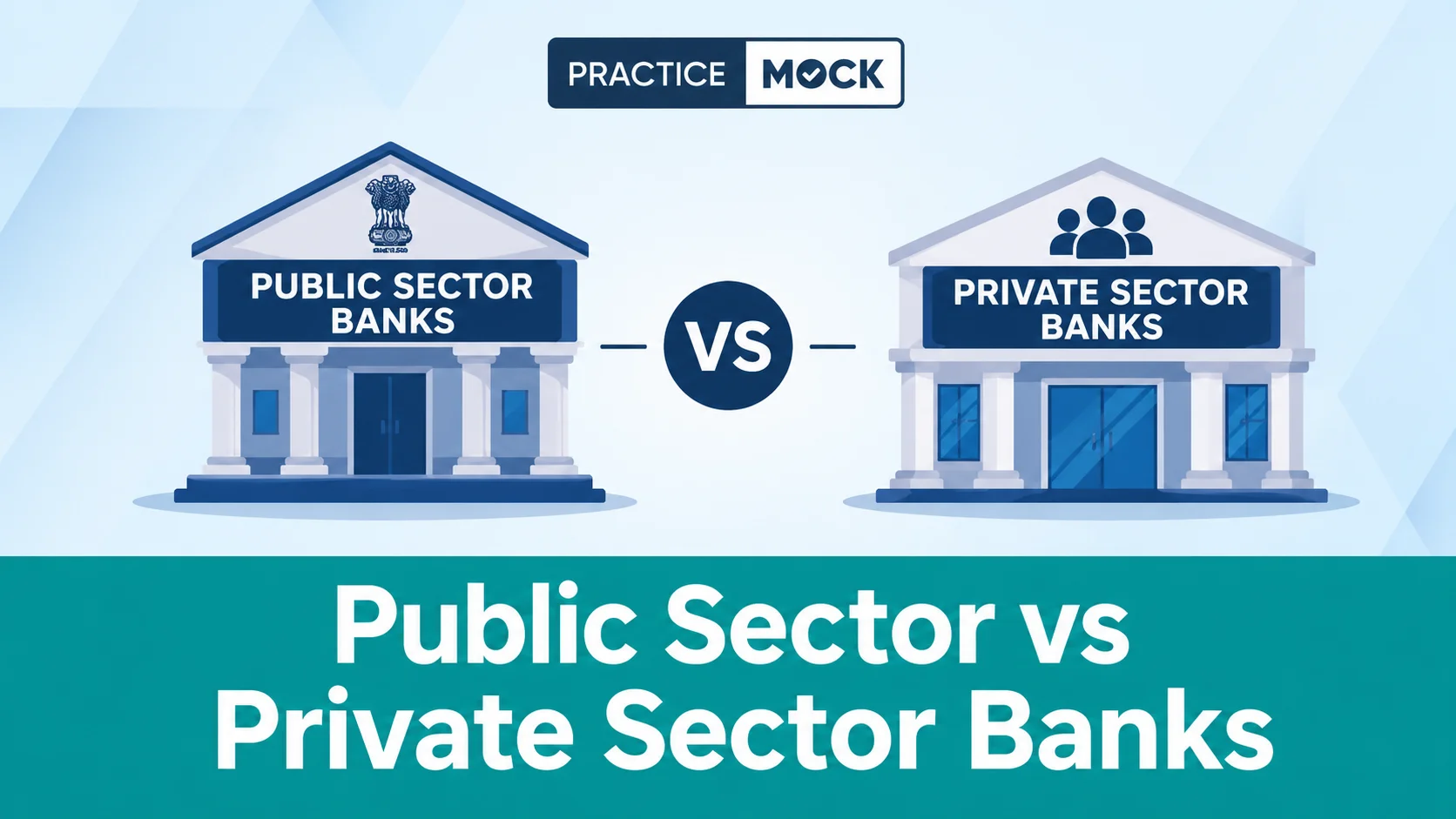
Public sector vs private sector banks differ mainly in ownership, management, objectives and working structure. Public sector banks are majority-owned by the government, while private sector banks are primarily owned by private shareholders and institutions. However, both operate under the regulation and supervision of the Reserve Bank of India (RBI).
The main difference between public and private sector banks lies in their approach to banking services, financial inclusion, business growth and customer experience. Understanding these differences is important for Banking Awareness, General Awareness and other competitive examinations. This article explains their meaning, features, examples, advantages and key differences in a simple comparison.

What Are Public Sector Banks?
Public sector banks (PSBs) are banks in which the government holds more than 50% ownership. The Central Government or State Government exercises majority control through its shareholding.
These banks play an important role in India’s financial system by providing banking services to different sections of society. They also support financial inclusion, rural banking, government welfare schemes and economic development.
Key Features of Public Sector Banks
- Government Ownership: The government holds the majority shareholding and exercises control over the bank.
- Financial Inclusion: These banks provide banking services to rural, semi-urban and urban customers.
- Government Schemes: They help implement schemes such as Pradhan Mantri Jan Dhan Yojana (PMJDY) and other financial inclusion initiatives.
- Wide Branch Network: Public sector banks maintain an extensive branch network across India.
- Public Accountability: Their operations involve accountability to shareholders, regulators and government authorities.
- Competitive Banking Services: They provide savings accounts, current accounts, loans, deposits and digital banking facilities.
Examples of Public Sector Banks in India
According to the Department of Financial Services, India has 12 public sector banks.
| Public Sector Bank | Headquarters |
| State Bank of India | Mumbai |
| Punjab National Bank | New Delhi |
| Bank of Baroda | Vadodara |
| Canara Bank | Bengaluru |
| Union Bank of India | Mumbai |
| Indian Bank | Chennai |
| Bank of India | Mumbai |
| Bank of Maharashtra | Pune |
| Central Bank of India | Mumbai |
| Indian Overseas Bank | Chennai |
| UCO Bank | Kolkata |
| Punjab & Sind Bank | New Delhi |
For a better understanding of bank classification, functions and ownership structures, candidates can also read our detailed guide on Types of Banks in India.
What Are Private Sector Banks?
Private sector banks are banks in which private individuals, companies and institutional investors hold the majority ownership. These banks operate as commercial financial institutions and focus on business growth, profitability, customer service and operational efficiency.
Private sector banks offer banking services to individuals, businesses and corporate customers. They also invest in digital banking, technology and customised financial products to improve customer experience.
Key Features of Private Sector Banks
- Private Ownership: Private shareholders and institutions hold the majority ownership.
- Professional Management: These banks operate through professional management teams and boards.
- Technology-Driven Services: They invest in mobile banking, internet banking, digital payments and other technology-based services.
- Customer Experience: They often focus on faster service delivery and customised banking solutions.
- Business Growth: Profitability, operational efficiency and market expansion are important business objectives.
- Performance-Based Work Culture: Employee performance and business targets can influence incentives and career progression.
Examples of Private Sector Banks in India
Some prominent private sector banks in India include:
| Private Sector Bank | Headquarters |
| HDFC Bank | Mumbai |
| ICICI Bank | Mumbai |
| Axis Bank | Mumbai |
| Kotak Mahindra Bank | Mumbai |
| IndusInd Bank | Mumbai |
| Federal Bank | Aluva |
| IDFC FIRST Bank | Mumbai |
| Bandhan Bank | Kolkata |
| Yes Bank | Mumbai |
| RBL Bank | Mumbai |
Candidates preparing for banking interviews can also strengthen their conceptual understanding by practising these IBPS PO Interview Banking Awareness Questions.
Difference Between Public Sector and Private Sector Banks
The difference between public sector and private sector banks becomes clearer when we compare their ownership, objectives, management, customer services, technology and employee work culture.
Both types of banks provide essential financial services, but their business models and operational priorities differ.
Public Sector vs Private Sector Banks – Key Differences
| Basis of Comparison | Public Sector Banks | Private Sector Banks |
| Ownership | Majority ownership rests with the government | Majority ownership rests with private shareholders |
| Main Objective | Financial inclusion and commercial growth | Profitability and business growth |
| Management | Professional management under government majority ownership | Professional management under private ownership |
| Decision-Making | May involve additional administrative and policy processes | Generally follows more flexible internal processes |
| Customer Base | Serves customers across income groups and locations | Serves individuals, businesses and corporate customers |
| Branch Network | Extensive presence in rural, semi-urban and urban areas | Strong presence in urban and semi-urban markets, with growing rural reach |
| Technology | Increasing investment in digital banking and automation | Strong focus on digital innovation and technology |
| Customer Service | Service experience varies across branches and channels | Often focuses on quick service and customised solutions |
| Lending | Supports priority sector lending and government-backed schemes | Focuses on retail, corporate and other commercial lending |
| Employee Recruitment | Mainly through structured recruitment processes, including IBPS and SBI examinations | Generally through individual bank recruitment processes |
| Work Culture | Structured hierarchy and established service rules | Often performance-oriented and target-driven |
| Career Growth | Structured promotion policies and internal examinations | Career progression may depend on performance and available opportunities |
| Examples | SBI, PNB, Bank of Baroda | HDFC Bank, ICICI Bank, Axis Bank |
1. Ownership and Management
The most important difference between public sector and private sector banks is ownership. Public sector banks have majority government shareholding, whereas private sector banks have majority private shareholding.
Both types have professional management and operate under RBI regulations. However, their ownership structures influence their governance, business priorities and management decisions.
2. Objectives and Functions
Public sector banks focus on financial inclusion, economic development and commercial banking. They support government initiatives and provide banking facilities to underserved communities.
Private sector banks focus on profitability, operational efficiency, customer retention and business expansion. However, they also participate in financial inclusion and priority sector lending as required by RBI regulations.
3. Customer Service and Technology
Private sector banks often invest heavily in digital platforms, mobile applications, automated services and personalised banking facilities. These investments help them improve service delivery and customer convenience.
Public sector banks have also expanded digital banking facilities through mobile banking, internet banking, UPI and other technology-based services. Therefore, it is incorrect to assume that all private banks offer better technology or that public banks lack digital services.
4. Branch Network and Market Reach
Public sector banks have an extensive presence across rural, semi-urban and urban areas. Their branch networks support government banking services, agricultural credit and financial inclusion.
Private sector banks have a strong presence in cities and business centres. However, they also operate in rural and semi-urban locations and contribute to priority sector lending.
5. Employee Recruitment and Work Culture
Public and private sector banks follow different recruitment and employment structures. Public sector banks offer structured recruitment, service rules and promotion frameworks, while private banks generally recruit directly according to their organisational requirements.
For banking aspirants, this distinction is particularly important when choosing a career path.
- Public sector banks: Candidates can apply through IBPS PO, IBPS Clerk and SBI recruitment examinations, depending on the vacancy.
- Private sector banks: Candidates generally apply through individual bank career portals, recruitment drives and campus hiring programmes.
- Work pressure: Private banking roles may involve sales targets and performance-based evaluations. Public sector roles also have business targets and customer-service responsibilities.
- Job security: Public sector employment generally offers greater service stability, subject to applicable rules and performance requirements.
To revise other important banking concepts and comparison-based questions, check our 50 Most Expected Banking Awareness Questions.
Similarities Between Public Sector and Private Sector Banks
Although their ownership and business objectives differ, public and private sector banks perform several similar functions. Both are essential to India’s banking and financial system.
The major similarities include:
- RBI Regulation: Both operate under the regulatory supervision of the Reserve Bank of India.
- Banking Services: Both offer savings accounts, current accounts, fixed deposits, recurring deposits and loans.
- Digital Transactions: Both support digital banking facilities, including UPI, NEFT, RTGS and IMPS, subject to applicable services.
- Financial Inclusion: Both contribute to expanding access to banking facilities.
- Deposit Insurance: Eligible deposits in both categories are covered by DICGC, subject to the applicable insurance rules.
- Economic Development: Both provide credit to individuals, businesses and different economic sectors.
One important point for banking examinations is that eligible deposits in public and private sector banks receive the same DICGC insurance coverage. The current limit is Rs. 5 lakh per depositor per bank, including principal and interest, subject to the same-right and same-capacity conditions.
To understand how banking institutions work and prepare for related examination questions, practise the IBPS PO Most Probable General Awareness Questions.
Advantages of Public Sector and Private Sector Banks
Both banking categories offer different advantages to customers and employees. Understanding these benefits helps aspirants answer comparison-based Banking Awareness questions.
Advantages of Public Sector Banks
- Wider Reach: Their extensive branch networks provide banking facilities in different parts of India.
- Government Initiatives: They play a major role in implementing financial inclusion and welfare schemes.
- Structured Employment: They offer established recruitment, promotion and service frameworks.
- Diverse Banking Services: They provide retail, agricultural, corporate and government-related banking services.
- Public Accountability: Their majority government ownership brings additional public accountability.
Advantages of Private Sector Banks
- Digital Banking: They invest in technology-driven banking solutions and digital platforms.
- Customer Convenience: Many offer customised services and dedicated customer support.
- Product Innovation: They introduce different financial products to meet customer requirements.
- Operational Flexibility: Their management can respond to business and market requirements through internal decision-making.
- Performance-Based Opportunities: Certain roles offer incentives and faster career progression based on performance and organisational requirements.
Candidates planning a career in public sector banking can also explore our IBPS PO Preparation Guide for practical guidance on exam preparation and banking career goals.
Which Is Better, Public Sector or Private Sector Banks?
The choice between public and private sector banks depends on the customer’s banking requirements and an employee’s career expectations. Neither category is universally better because both offer different advantages.
The following points can help understand their suitability.
| Requirement | Suitable Option to Consider |
| Extensive rural banking access | Public sector banks |
| Digital banking convenience | Both, depending on the bank |
| Government banking schemes | Public sector banks have a major implementation role |
| Personalised banking services | Private sector banks often offer more customised options |
| Structured government bank recruitment | Public sector banks |
| Performance-linked incentives | Available in certain private sector roles |
| Agricultural and priority sector lending | Both categories |
For customers: Compare account charges, interest rates, loan terms, branch access, digital facilities and customer support before selecting a bank.
For job aspirants: Compare recruitment methods, salary structure, service conditions, work responsibilities, transfers and career growth opportunities before choosing a banking career.
Public Sector vs Private Sector Banks for Banking Exams
Public sector vs private sector banks is an important topic for Banking Awareness and General Awareness sections of competitive examinations. Questions may test bank ownership, examples, functions, regulatory authorities and differences between the two categories.
Candidates preparing for SBI PO, SBI Clerk, IBPS PO, IBPS Clerk and IBPS RRB examinations should remember the following facts:
| Important Question | Answer |
| Who regulates banks in India? | Reserve Bank of India |
| How many public sector banks are there in India? | 12 |
| Which is the largest public sector bank in India? | State Bank of India |
| What is the main difference between public and private banks? | Ownership |
| Who owns public sector banks? | Government holds majority ownership |
| Who owns private sector banks? | Private shareholders and institutions |
| Is HDFC Bank a private sector bank? | Yes |
| Is Punjab National Bank a public sector bank? | Yes |
| Are public and private banks regulated by RBI? | Yes |
| What is the DICGC deposit insurance limit? | Rs. 5 lakh per depositor per bank |
Preparation tip: Do not just memorise bank names. Understand ownership, functions, RBI regulations and important banking concepts to answer application-based questions.
To strengthen your preparation, practise the 50 Most Expected Banking Awareness Questions 2026 and revise the explanations after attempting them.
Conclusion
The difference between public sector and private sector banks mainly depends on ownership, management, business objectives and operational structure. Public sector banks have majority government ownership and play an important role in financial inclusion, while private sector banks focus on business growth, technology and customer experience.
For banking aspirants, understanding these differences is useful for improving Banking Awareness and General Awareness preparation. Revise the examples, ownership structure, functions and important facts regularly. You can also visit PracticeMock to access banking exam preparation resources, practice questions and mock tests.
Related IBPS PO Articles
Related RRB PO Articles
| IBPS RRB PO Salary | IBPS RRB PO Exam Pattern |
| IBPS RRB PO Cut Off | IBPS RRB PO Syllabus |
| IBPS RRB PO Previous Year Question Papers | |
Related Articles on RBI Grade B
| RBI Grade B 2026 Without Coaching | RBI Grade B Study Plan 2026 For 60 Days |
| RBI Grade B Syllabus | RBI Grade B Previous Year Question Papers |
| RBI Grade B Important MCQs | |
Powerful Courses for Banking Exams
FAQs on Public Sector vs Private Sector Banks
1. What is the main difference between public sector and private sector banks?
The main difference is ownership. Public sector banks have majority government ownership, whereas private sector banks have majority ownership by private shareholders and institutions. Both provide banking services and operate under RBI regulation.
2. How many public sector banks are there in India in 2026?
There are 12 public sector banks in India as of November 2026. These include State Bank of India, Punjab National Bank, Bank of Baroda, Canara Bank, Union Bank of India and seven other banks.
3. Which is the largest public sector bank in India?
State Bank of India (SBI) is the largest public sector bank in India. It provides banking and financial services through an extensive domestic and international network.
4. Is SBI a public sector bank or a private sector bank?
State Bank of India is a public sector bank because the Government of India holds the majority shareholding. SBI provides retail banking, corporate banking, loans, deposits and digital banking services.
5. Is HDFC Bank a public sector bank or a private sector bank?
HDFC Bank is a private sector bank in India. Its majority ownership rests with private shareholders and institutional investors. It offers retail banking, corporate banking, loans, deposits and digital financial services.
6. Are public sector banks safer than private sector banks?
Both public and private sector banks operate under RBI regulation. Eligible deposits in both categories receive DICGC insurance coverage of up to Rs. 5 lakh per depositor per bank, subject to applicable conditions. Government ownership alone does not mean every deposit is fully guaranteed.
7. Which banks are better for government job aspirants?
Public sector banks are relevant for candidates seeking government-owned banking employment through examinations such as IBPS PO, IBPS Clerk and SBI recruitment. Private sector banks generally recruit through their own selection processes.
8. Do private sector banks offer higher salaries than public sector banks?
Salary depends on the position, experience, bank and employment structure. Private sector banks may offer performance-linked incentives, while public sector banks generally follow established pay structures and service benefits.
9. Are public sector banks controlled by RBI?
Public sector banks are regulated and supervised by the Reserve Bank of India. However, their majority ownership rests with the government. RBI performs regulatory and supervisory functions for both public and private sector banks.
10. What are the examples of public sector and private sector banks?
Examples of public sector banks include SBI, PNB, Bank of Baroda, Canara Bank and Union Bank of India. Examples of private sector banks include HDFC Bank, ICICI Bank, Axis Bank, Kotak Mahindra Bank and Federal Bank.
- Sign Up on Practicemock for Updated Current Affairs, Topic Tests and Mini Mocks
- Sign Up Here to Download Free Study Material
Free Mock Tests for the Upcoming Exams
- IBPS PO Free Mock Test
- RBI Grade B Free Mock Test
- IBPS SO Free Mock Test
- NABARD Grade A Free Mock Test
- SSC CGL Free Mock Test
- IBPS Clerk Free Mock Test
- IBPS RRB PO Free Mock Test
- IBPS RRB Clerk Free Mock Test
- RRB NTPC Free Mock Test
- SSC MTS Free Mock Test
- SSC Stenographer Free Mock Test
- GATE Mechanical Free Mock Test
- GATE Civil Free Mock Test
- RRB ALP Free Mock Test
- SSC CPO Free Mock Test
- AFCAT Free Mock Test
- SEBI Grade A Free Mock Test
- IFSCA Grade A Free Mock Test
- RRB JE Free Mock Test
- Free Banking Live Test
- Free SSC Live Test