


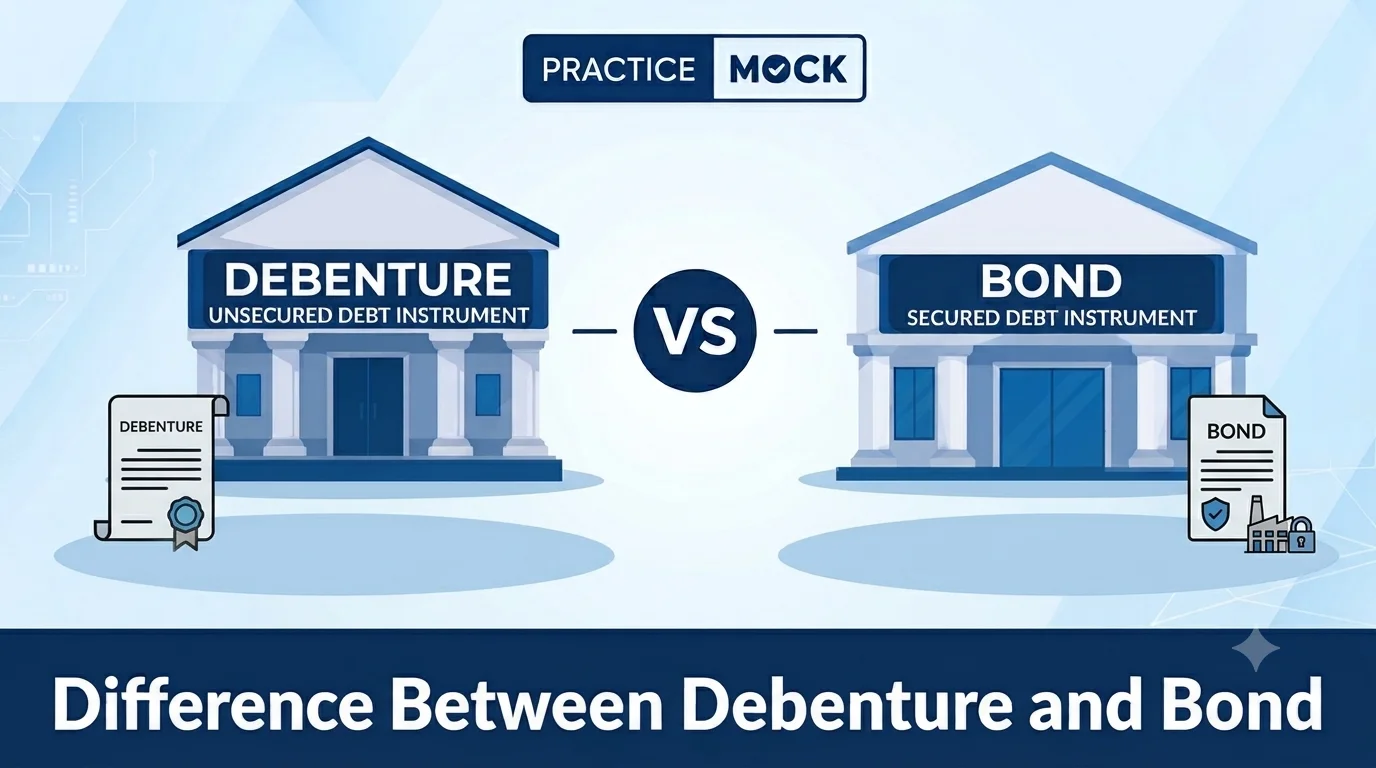
Debenture vs Bond is an important topic in finance, banking awareness, and competitive examinations. Both are debt instruments used by companies, governments, and other organisations to raise funds from investors. However, they differ in their issuers, security, risk, and purpose of borrowing.
A debenture is generally associated with corporate borrowing, while bonds are issued by governments, financial institutions, and companies. However, the distinction is not always strict, particularly in India, where the terms may overlap. Understanding their features, types, examples, and differences helps students prepare for banking, regulatory, and other competitive exams.

What is a Bond?
A bond is a debt instrument issued by governments, public sector undertakings (PSUs), corporations, or other organisations to borrow money from investors. Investors who purchase bonds lend money to the issuer and receive interest according to the agreed terms.
The issuer repays the principal amount on the maturity date. Bonds are commonly used to finance infrastructure projects, business expansion, public expenditure, and other long-term requirements.
Key Features of Bonds
- Issuer: Governments, PSUs, corporations, and financial institutions.
- Interest: Bonds may offer fixed or floating interest rates.
- Maturity: They generally have a defined maturity period.
- Security: They may be secured or unsecured, depending on their terms.
- Repayment: The issuer repays the principal according to the bond’s terms.
Types of Bonds
| Type of Bond | Meaning |
| Government Bonds | Issued by the Central or State Government to raise funds. |
| Corporate Bonds | Issued by companies to finance business activities and expansion. |
| PSU Bonds | Issued by public sector undertakings to fund projects and operations. |
| Zero-Coupon Bonds | Do not pay periodic interest and are generally issued at a discount to face value. |
| Convertible Bonds | Allow investors to convert the bond into equity shares under specified conditions. |
| Floating-Rate Bonds | Carry interest rates that change according to a benchmark or specified formula. |
Bonds are popular among investors seeking regular income, but their risk depends on the issuer, credit rating, interest rate, and repayment terms.
Read our detailed guide on the Difference Between FPI and FDI to understand their meaning, features, and key differences.
What is a Debenture?
A debenture is a debt instrument through which a company raises money from investors. It represents the company’s obligation to repay the borrowed amount along with interest according to the agreed terms.
In India, Section 2(30) of the Companies Act, 2013, defines debentures broadly to include debenture stock, bonds, and other instruments evidencing debt, whether they create a charge on the company’s assets or not, subject to the exclusions specified in the law.
Key Features of Debentures
- Issuer: Primarily companies that need funds for business operations or expansion.
- Interest: May carry fixed or floating interest rates.
- Security: May be secured against company assets or unsecured.
- Repayment: Usually repayable after a specified period.
- Convertibility: May be convertible into equity shares or remain debt instruments.
Types of Debentures
| Type | Meaning |
| Secured Debentures | Backed by a charge on specified assets of the company. |
| Unsecured Debentures | Not backed by a specific charge on assets. |
| Convertible Debentures | Can be converted into equity shares according to the issue terms. |
| Non-Convertible Debentures (NCDs) | Cannot be converted into equity shares. |
| Redeemable Debentures | Repaid after a specified period or on a specified date. |
| Irredeemable or Perpetual Debentures | Have no fixed maturity date, subject to applicable law and issue conditions. |
Debentures allow companies to raise funds without immediately diluting ownership. Investors receive interest, but the repayment risk depends on the company’s financial position and the terms of the issue.
To understand related foreign investment concepts, read Foreign Trade in India, FDI, FII and FPI.
Key Differences Between Bonds and Debentures
The difference between bonds and debentures is generally explained through their issuer, security, risk, interest rate, and purpose. However, these differences are not absolute because both instruments can have similar features.
| Basis | Bond | Debenture |
| Meaning | Debt instrument used to raise funds | Debt instrument acknowledging money borrowed |
| Issuer | Governments, PSUs, corporations, and institutions | Primarily companies and corporate entities |
| Security | May be secured or unsecured | May be secured or unsecured |
| Risk | Depends on issuer and credit rating | Depends on issuer, security, and credit rating |
| Interest Rate | Fixed or floating | Fixed or floating |
| Purpose | Government expenditure, infrastructure, and corporate financing | Corporate financing, expansion, and business operations |
| Convertibility | May be convertible or non-convertible | May be convertible or non-convertible |
| Repayment | As specified in the issue terms | As specified in the issue terms |
| Investor | Retail investors, institutions, and other investors | Retail investors, institutions, and other investors |
Important: It is incorrect to assume that all bonds are secured and all debentures are unsecured. Both can have secured or unsecured structures. Their risk depends on the issuer’s creditworthiness and the instrument’s terms.
Read RBI Grade B 2026, FDI, FPI and Disinvestment for more economy-related concepts relevant to regulatory examinations.
Bond vs Debenture Example
A simple example can help explain the difference between a bond and a debenture.
Suppose the Government of India issues a bond worth ₹10,000 with an annual interest rate of 7% and a maturity of 10 years.
An investor purchasing this bond would receive ₹700 in annual interest, assuming the coupon is paid annually, and the principal amount of ₹10,000 would be repaid at maturity, subject to the bond’s terms.
Now suppose ABC Ltd. issues a debenture worth ₹10,000 with an annual interest rate of 9% and a maturity of 5 years.
The investor would receive ₹900 in annual interest and the principal amount would be repaid at maturity, subject to the issue terms.
| Particulars | Government Bond | ABC Ltd. Debenture |
| Investment | ₹10,000 | ₹10,000 |
| Interest Rate | 7% | 9% |
| Annual Interest | ₹700 | ₹900 |
| Issuer | Government | Company |
| Maturity | 10 years | 5 years |
| Risk | Depends on bond type, sovereign bonds have low default risk | Depends on company’s creditworthiness and security |
The debenture offers a higher interest rate in this example. However, a higher return does not automatically mean a better investment, as the investor must also consider the possibility of default and other risks.
For the latest foreign investment-related developments, candidates can refer to PracticeMock’s Banking and Financial Current Affairs.
Which is Better, Bond or Debenture?
The choice between bonds and debentures depends on the investor’s financial goals, risk tolerance, investment period, and the issuer’s creditworthiness. Neither instrument is universally better than the other.
When are Bonds Better?
Bonds may be suitable for investors who:
- Prefer relatively stable returns.
- Want to invest in government or highly rated debt securities.
- Prioritise capital preservation and predictable income.
- Have a long-term investment horizon.
When are Debentures Better?
Debentures may suit investors who:
- Want to explore corporate debt investments.
- Are willing to evaluate credit risk.
- Seek potentially higher interest income.
- Understand the issuer’s financial position and repayment terms.
Investors should check the credit rating, interest rate, maturity, security, liquidity, and repayment conditions before investing in either instrument. A higher interest rate may indicate higher credit risk.
Debenture vs Bond vs Share
Bonds and debentures are debt instruments, whereas shares represent ownership in a company. This is an important distinction for banking, finance, and commerce examinations.
| Basis | Bond | Debenture | Share |
| Nature | Debt | Debt | Equity |
| Holder | Creditor | Creditor | Owner |
| Return | Interest | Interest | Dividend |
| Payment | As per terms | As per terms | Depends on company profits and declaration |
| Voting Rights | Generally no | Generally no | Generally available to equity shareholders |
| Risk | Depends on issuer | Depends on issuer | Higher market risk |
| Repayment | As per maturity terms | As per redemption terms | Generally not repaid during the company’s lifetime |
| Ownership | No ownership | No ownership | Represents ownership in the company |
A debenture holder or bondholder is a creditor of the issuing entity, whereas a shareholder owns a part of the company. Debt holders generally have a contractual claim for interest and repayment, while shareholders receive dividends when declared.
Conclusion
Bonds and debentures are both debt instruments that help organisations raise funds from investors. Their differences mainly depend on the issuer, security, risk, and purpose of borrowing. Bonds are commonly issued by governments and corporations, while debentures are primarily associated with corporate borrowing. For competitive examinations, remember that debentures can be secured or unsecured, and bonds can also be secured or unsecured. The distinction between the two is not always absolute, particularly under Indian company law.
Candidates preparing for banking and regulatory examinations can strengthen their financial awareness concepts and practice related questions with PracticeMock.
Related Blogs on Banking, Finance & Current Affairs
Frequently Asked Questions on Debenture vs Bond
1. What is the difference between a debenture and a bond?
A bond is a debt instrument issued by governments, corporations, or institutions to raise funds. A debenture is generally associated with corporate borrowing. Both may be secured or unsecured and offer interest according to their terms.
2. Are debentures riskier than bonds?
Not necessarily. Risk depends on the issuer’s creditworthiness, security, credit rating, maturity, and repayment terms. An unsecured debenture from a financially strong company may have lower risk than a poorly rated corporate bond.
3. Are all bonds known as debentures?
In India, Section 2(30) of the Companies Act, 2013, includes bonds within the broad definition of debentures issued by companies. However, the terms may have different meanings depending on the instrument, issuer, and legal or market context.
4. Are bonds secured or unsecured?
Bonds can be secured or unsecured. Government bonds are backed by the government’s repayment capacity, while corporate bonds may be secured by assets or issued without collateral.
5. Are debentures secured or unsecured?
Debentures may be secured or unsecured. Secured debentures have a charge on specified assets, while unsecured debentures rely on the issuer’s creditworthiness and repayment ability.
6. What is the difference between a bond and a debenture with an example?
A government may issue a bond to finance public expenditure, while a company may issue debentures to fund business expansion. Both instruments provide interest income and repayment of principal under their respective terms.
7. Which offers higher interest, bonds or debentures?
Debentures may offer higher interest rates when they carry greater credit risk. However, interest rates depend on the issuer, market conditions, maturity, credit rating, and instrument structure.
8. What is the difference between debentures and shares?
Debentures represent borrowed funds and make the holder a creditor of the company. Shares represent ownership in the company. Debenture holders receive interest, while shareholders may receive dividends.
9. What are Non-Convertible Debentures (NCDs)?
Non-Convertible Debentures are debt instruments that cannot be converted into equity shares. They generally provide interest income and repay the principal according to the issue’s terms.
10. Can debentures be converted into shares?
Yes. Convertible debentures can be converted into equity shares under specified conditions. Non-convertible debentures cannot be converted into shares.
- Sign Up on Practicemock for Updated Current Affairs, Topic Tests and Mini Mocks
- Sign Up Here to Download Free Study Material
Free Mock Tests for the Upcoming Exams
- IBPS PO Free Mock Test
- RBI Grade B Free Mock Test
- IBPS SO Free Mock Test
- NABARD Grade A Free Mock Test
- SSC CGL Free Mock Test
- IBPS Clerk Free Mock Test
- IBPS RRB PO Free Mock Test
- IBPS RRB Clerk Free Mock Test
- RRB NTPC Free Mock Test
- SSC MTS Free Mock Test
- SSC Stenographer Free Mock Test
- GATE Mechanical Free Mock Test
- GATE Civil Free Mock Test
- RRB ALP Free Mock Test
- SSC CPO Free Mock Test
- AFCAT Free Mock Test
- SEBI Grade A Free Mock Test
- IFSCA Grade A Free Mock Test
- RRB JE Free Mock Test
- Free Banking Live Test
- Free SSC Live Test