


As you all know, the SEBI Grade A 2025 Exam is scheduled to be conducted on 10th January 2025, which means the countdown has officially begun! There’s very little time left, so if you’re truly serious about becoming a SEBI Grade A Officer, the best time to start your preparation is right now, not tomorrow, not next week, but today! Here’s the best part: Paper 2 of Phase 1 and Phase 2 is the same; the only difference is that the difficulty level increases in Phase 2. So, if you build a strong foundation for Paper 2 during your Phase 1 preparation, you’ll already have an edge when you move to Phase 2.
Your main focus should be on concept clarity, regular mock tests, and improving weak areas. The earlier you start, the better grip you’ll have on the subjects and by the time the exam arrives, you’ll be fully exam-ready and confident.

Let’s begin your SEBI Grade A 2025 journey with a smart, well-structured, and effective preparation strategy that helps you master both Phase 1 and Phase 2 for General Steam Candidates.
SEBI Grade A Phase 1 Master Strategy
In SEBI Grade A Phase 1, you will face two papers — Paper 1 and Paper 2.
- Paper 1 includes four sections: Reasoning, Quantitative Aptitude, English Language, and General Awareness (GA).
- Paper 2 covers six subjects: Commerce, Management, Finance, Economics, Costing, and Companies Act.
If you’re appearing for the exam for the first time, the best way to begin your preparation is by starting with Phase 1. Begin by focusing on Paper 1, where your goal should be to clear the sectional cut-offs. You don’t need to master every topic at once – instead, start with the basic concepts and scoring topics in each section. A good grasp of the fundamentals will help you secure approximately 30% of the marks, which is more than enough to comfortably clear the sectional cut-offs. Once you gain confidence in Paper 1, shift your main focus to Paper 2, as it plays a crucial role in your final selection. Start your Phase 2 preparation early, beginning with theory-based subjects like Management, Economics, and Companies Act, as these topics require conceptual understanding and consistent revision. Subsequently, move on to numerical and practical subjects like Commerce, Finance, and Costing. This step-by-step approach is suitable for all candidates, whether you are from a commerce or non-commerce background. It helps you maintain balance, build conceptual clarity, and gradually master both phases without feeling overwhelmed. In the next section, we will discuss subject-wise strategies and detailed tips on how to effectively prepare for each paper.
Practice like a topper, crack the exam like a pro – Access tests now!
| SEBI Revision Notes | Mock Test 1 |
| SEBI Study Notes | Mock Test 2 |
| Sampoorna – Paper 2 Current Affairs | Mock Test 3 |
| SEBI Notes – Chapterwise Tests | Mock Test 4 |
| SEBI Paper 2 – CA Tests | Mock Test 5 |
SEBI Grade A Paper 1 Preparation Strategy
After Quant, let’s now look at how to prepare for Reasoning, English, and General Awareness (GA) in SEBI Grade A Phase 1 Paper 1. Each section requires a different approach, while Reasoning and English focus more on logic and language skills, GA is a theory-based section that needs regular updates and revision.
SEBI Grade A Paper 1 Preparation Strategy – Quantitative Aptitude
To prepare well for Paper 1 Quantitative Aptitude, your first step should be to analyse previous year papers or exam analysis reports. This helps you identify the most frequently asked and scoring topics. Once you know what’s important, you can focus your preparation smartly instead of studying everything randomly.
Let’s look at the most scoring and expected topics for the SEBI Grade A Quant section:
| Topic Name | Expected No. of Questions |
| Data Interpretation (DI) | 5 |
| Missing Number Series | 2 |
| Quadratic Equation | 3 |
| Arithmetic-related topics such as Profit and Loss, Interest, Time & Work, Speed, Time & Distance, Permutations, Combinations, Proportions, etc. | 10 |
Now, let’s discuss how you should prepare step by step
Step 1: Start with Arithmetic Basics
Begin your preparation with arithmetic topics like Profit and Loss, Simple & Compound Interest, Time and Work, Speed–Time–Distance, and Ratio–Proportion.
Understand the concepts and formulas properly. Don’t rush — build your foundation first. Once your basics are clear, solving questions will become much easier.
Step 2: Practice Topic-wise Tests
After learning each topic, take topic-wise quizzes or tests to check how well you’ve understood it.
Then, move on to sectional mock tests that include mixed questions from all topics. This will help you manage time and improve accuracy.
Step 3: Make Personal Quant Notes
While preparing, maintain a Quant notebook for yourself. Note down:
- Important formulas
- Shortcuts or tricks you discover during practice
- Common mistakes to avoid next time
These notes will become your quick revision guide before the exam. When only a few days are left, you won’t need to study everything again — just revise your notes and take mock tests regularly.
Step 4: Practice and Revise Regularly
The key to scoring well in Quant is practice + revision. Set a daily target, for example, 2 topics per day with short quizzes. Keep increasing your speed while maintaining accuracy.
If you follow this plan consistently, by the time the exam arrives, you’ll be confident enough to handle any Quant question, no matter how tricky it looks.
Reasoning Ability Preparation Strategy
Just like Quant, start by checking previous year papers or mock test analysis to understand which topics are most frequently asked. Focus on topics that carry higher weightage and can be mastered with regular practice.
| Topic Name | Expected No. of Questions |
| Seating Arrangement & Puzzles | 10–12 |
| Syllogism | 3–4 |
| Inequality | 3–4 |
| Blood Relation | 2–3 |
| Direction Sense | 2–3 |
| Coding-Decoding | 2–3 |
| Miscellaneous (Order & Ranking, Alphanumeric Series, etc.) | 3–4 |
Step-by-Step Preparation Plan
Step 1: Start with Easy Topics
Begin with simpler chapters like Inequality, Syllogism, Blood Relation, and Direction Sense. These are quick to learn and boost your confidence early on.
Step 2: Practice Puzzles & Seating Arrangements Daily
These topics carry the most marks but require strong logical skills. Start with linear and circular arrangements, then move to floor-based and box puzzles. Practice at least one puzzle daily to build speed and accuracy.
Step 3: Attempt Topic-wise Tests
After completing each topic, solve topic-wise quizzes followed by sectional tests to analyze your weak areas.
Step 4: Revise Concepts & Mistakes
Make short notes of logic types, trick patterns, and your common mistakes. Regular revision helps avoid confusion during the exam.
English Language Preparation Strategy
The English section checks your grammar, comprehension, and vocabulary. Focus on understanding concepts rather than memorising rules.
| Topic Name | Expected No. of Questions |
| Reading Comprehension | 7–8 |
| Cloze Test | 5 |
| Error Detection | 4–5 |
| Para Jumbles | 4–5 |
| Fill in the Blanks | 3–4 |
| Vocabulary (Synonyms/Antonyms) | 2–3 |
Step-by-Step Preparation Plan
Step 1: Strengthen Grammar Basics
Start with basic grammar topics — tenses, prepositions, subject-verb agreement, and articles. These form the foundation for all other questions.
Step 2: Improve Reading Speed & Comprehension
Read one editorial or article daily from a reputable newspaper. It will help improve reading comprehension, vocabulary, and understanding tone of passages.
Step 3: Practice Daily Quizzes
Attempt error detection, para jumble, and cloze test quizzes regularly to develop accuracy.
Step 4: Maintain an English Notes Journal
Keep a small notebook of new words, idioms, and grammar rules. Revise them weekly to strengthen your vocabulary and usage.
General Awareness (GA) Preparation Strategy
GA is a theory-based and high-scoring section. It doesn’t need calculation — just consistency and smart revision.
| Topic Name | Focus Area |
| Current Affairs (Last 6 months) | National & International Events, Awards, Appointments |
| Banking & Financial Awareness | RBI Updates, Banking Terms, Reports |
| Static GK | Capitals, Currencies, Important Days, National Parks |
| Economic & Government Schemes | Budget, Economic Survey, New Policies |
Step-by-Step Preparation Plan
Step 1: Study GA Daily (At least 1 Hour)
Dedicate 1 hour daily to reading current affairs from reliable sources. Focus on the last 6 months before the exam.
Step 2: Make Short Notes
Prepare concise notes for revision — include important dates, schemes, and financial terms. These notes will be your lifesaver before the exam.
Step 3: Revise Weekly & Attempt GA Quizzes
Weekly revision helps retain information. Take daily or weekly GA quizzes to test memory and identify areas you forget easily.
Step 4: Focus on Accuracy, Not Guesswork
GA can boost your overall score if you focus on accuracy. Avoid wild guesses — answer only those questions you are confident about.
SEBI Grade A Paper 2 Preparation Strategy
Paper 2 of SEBI Grade A Phase 1 is one of the most important and scoring parts of the exam. It covers six subjects — Commerce, Management, Finance, Economics, Costing, and Companies Act. With the right study plan and reliable resources, you can easily clear this paper even in your first attempt.
Start your preparation with the theory section of each subject. Go through the concepts slowly and focus on building a strong foundation. Once you complete a chapter, attempt chapter-wise quizzes to test your understanding. This helps reinforce what you’ve studied and makes revision easier.
If you are preparing through online resources, make sure you stick to one trusted platform or educator to maintain conceptual clarity. Avoid switching between multiple sources, as it may create confusion.
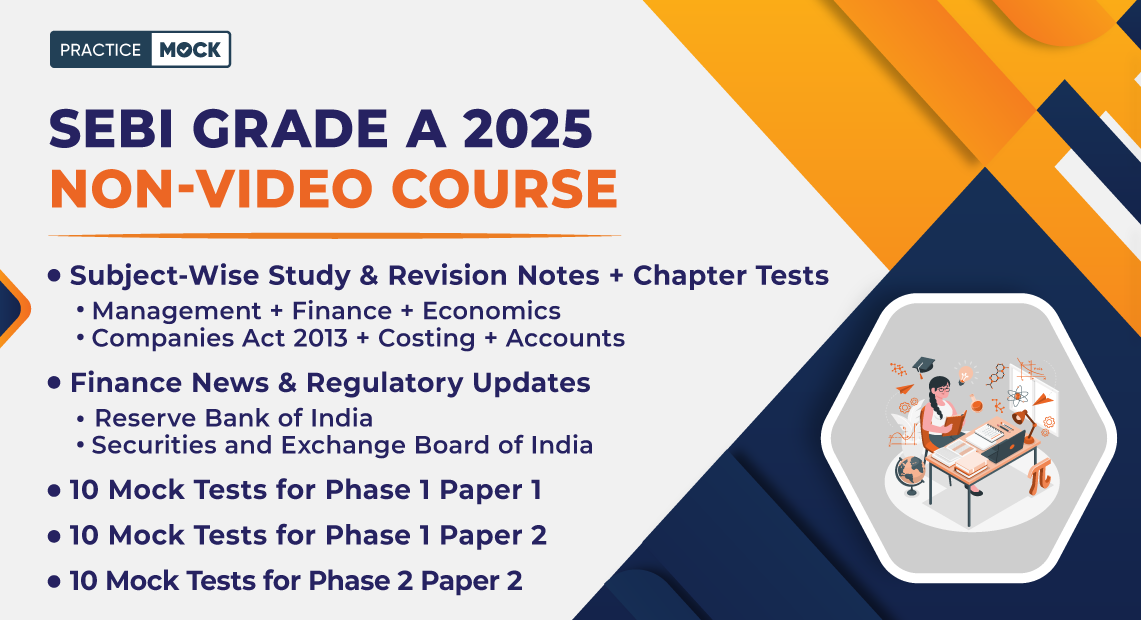
To make your Paper 2 preparation more effective, we are also providing dedicated resources designed specifically for SEBI Grade A aspirants:
- Subject-Wise Study & Revision Notes + Chapter Tests
Covers Management, Finance, Economics, Companies Act 2013, Costing, and Accounts. These structured notes help you revise quickly and understand key concepts in a simple way. - Finance News & Regulatory Updates
Stay updated with the latest developments from the Reserve Bank of India and the Securities and Exchange Board of India. These updates are extremely useful for both conceptual clarity and current-affairs-based questions. - 10 Mock Tests for Phase 1 Paper 2
Full-length mock tests to help you get real exam experience. Practice them regularly to improve accuracy, speed, and confidence.
Even if you find numerical questions tough, focus on strengthening your theory part — because a solid conceptual understanding can easily help you achieve the 40% sectional cut-off.
Lastly, revise regularly, practice mock tests, and analyse your performance after every attempt. With consistent study and the right resources, clearing Phase 1 Paper 2 will become much easier and stress-free.
SEBI Grade A Phase 2 Master Strategy
The SEBI Grade A Phase 2 exam is crucial, as your final selection depends largely on your performance in this phase. It consists of two papers – Paper 1 (Descriptive English) and Paper 2 (Subject-Based Multiple Choice Questions).
- In Paper 1, you are required to write an essay, summary, and comprehension, which tests your writing and communication skills. To prepare well, practice writing essays daily on finance, economics, and current affairs. Focus on writing in simple and clear language and maintaining correct grammar. Reading editorials and reports from financial newspapers can also help you improve your content and vocabulary.
- Paper 2 includes questions from subjects such as commerce, accountancy, management, finance, costing, the Companies Act, and economics. Start your preparation with theoretical topics such as management and the Companies Act. Once your concepts are clear, move on to the numerical sections of finance and costing. Practice topic-wise questions, take mock tests, and analyze your mistakes.
Since Step 2 carries a higher weightage (2/3 of the total marks), allocate more time to it in your daily study plan. Revise regularly, stay updated with financial news, and practice descriptive writing every week. With regular study and proper planning, you can easily perform well in Step 2 and move closer to your final selection.
SEBI Grade A Paper 1 Preparation Strategy (Stage 2)
In SEBI Grade A Stage 2, Paper 1 is an English descriptive test that tests your writing and communication skills. This paper is the same for all streams and is designed to test how clearly and effectively you can express your ideas. It carries 100 marks and you have 60 minutes to complete it. This test typically consists of three types of questions: essay writing, precis writing, and comprehension.
To prepare for essay writing, read editorials and articles from newspapers like The Hindu or The Economic Times daily. Focus on topics related to finance, economics, business, governance, and current affairs, as these are frequently asked in the exam. Practice writing an essay every week and aim to structure it properly – start with an introduction, then write the main body with relevant points or statistics, and end with a balanced conclusion.
- For precis writing, practice summarising long paragraphs in a concise form while retaining the original meaning. Focus on using simple, clear language and avoiding repetition.
- For comprehension, improve your reading speed and comprehension. Practice reading passages and answering questions to improve accuracy and time management.
Good grammar, vocabulary, and sentence structure are crucial for scoring well. You can improve these by regularly reading and revising common grammar rules. Since the exam is conducted online, take mock descriptive tests to get used to typing on the computer within the time limit.
Remember, this paper carries 30% weightage in the second stage, so don’t take it lightly. Consistent writing practice, good reading habits, and time management will help you score well in Paper 1 and improve your overall performance in the second stage.
SEBI Grade A Phase 2 Paper 2 Preparation Strategy
In the second stage of SEBI Grade A, Paper 2 plays the most crucial role in your final selection as it carries a higher weightage (2/3 of the total marks). The subjects in Paper 2 of the second stage are similar to those in Paper 2 of the first stage – Commerce, Accounting, Management, Finance, Costing, Companies Act, and Economics. The difference is that in the second stage, the questions are slightly more in-depth and concept-based.
Since you have already studied these subjects in the first stage, your concepts should be largely clear by now. Therefore, instead of starting everything from scratch, focus on revision, application, and practice. Dedicate at least 2 hours daily to preparing for Paper 2 – divide your time by topic and solve chapter-wise quizzes to strengthen your conceptual understanding.
Now, your main goal should be to practice and analyse more. Solve topic-wise mock tests regularly and focus on accuracy and time management. Review each test carefully to understand where you’re losing points – this step will help you avoid repeating mistakes in the actual exam.
Also, read up on important updates and changes in financial operations or policies, as SEBI sometimes includes practical or real-life questions. Make short notes of key terms, definitions, and formulas for quick revision before the exam.
With consistent daily practice, concept clarity, and smart revision, you can easily score good marks in Paper 2 of Phase 2 and achieve a strong overall rank in SEBI Grade A.
Join our unique Telegram group immediately to skyrocket your preparation for Regulatory exams via expert guidance, top tips, perfect feedback, and much more!
[ Click Here to join the PracticeMock Telegram Group! ]
[ Click Here to join the PracticeMock Telegram Discussion Group Link! ]
- Sign Up on Practicemock for Updated Current Affairs, Topic Tests and Mini Mocks
- Sign Up Here to Download Free Study Material
Free Mock Tests for the Upcoming Exams
- IBPS PO Free Mock Test
- RBI Grade B Free Mock Test
- IBPS SO Free Mock Test
- NABARD Grade A Free Mock Test
- SSC CGL Free Mock Test
- IBPS Clerk Free Mock Test
- IBPS RRB PO Free Mock Test
- IBPS RRB Clerk Free Mock Test
- RRB NTPC Free Mock Test
- SSC MTS Free Mock Test
- SSC Stenographer Free Mock Test
- GATE Mechanical Free Mock Test
- GATE Civil Free Mock Test
- RRB ALP Free Mock Test
- SSC CPO Free Mock Test
- AFCAT Free Mock Test
- SEBI Grade A Free Mock Test
- IFSCA Grade A Free Mock Test
- RRB JE Free Mock Test
- Free Banking Live Test
- Free SSC Live Test