


SBI PO Sectional Mock Test Strategy is one of the most effective ways to improve your score before the exam. While full-length mock tests help you understand your overall performance, sectional mock tests allow you to identify weak areas, improve speed, and increase accuracy in individual sections. The best strategy is to combine sectional practice with regular full mocks and detailed analysis. In this guide, you’ll learn when to attempt sectional mocks, how often to practise them, and how to use them effectively for both SBI PO Prelims and Mains.
SBI PO Prelims vs Mains: Why Your Sectional Strategy Should Change?
Your SBI PO sectional mock test strategy should be different for Prelims and Mains because the SBI PO exam pattern is different. During Prelims, sectional mock tests mainly help improve speed within the fixed 20-minute limit for each section. During Mains, they prepare you for longer, more analytical questions that require stronger concepts and better decision-making.

| Stage | Sectional Strategy |
| SBI PO Prelims | Focus on improving your overall score while maintaining good accuracy in all three sections. |
| SBI PO Mains | Give equal attention to every section because sectional cut-offs and higher difficulty make balanced preparation essential. |
What Changed in the SBI PO 2026 Pattern
Before building any sectional strategy, get the current numbers right. A few things shifted this year.

| Stage | What’s True for 2026 |
| Prelims | 100 marks, 3 sections, 20 minutes each, no sectional cut-off |
| Mains Objective | 200 marks, 4 sections, separate timing per section, sectional cut-off applies |
| Mains Descriptive | Cut from 50 to 30 marks |
| Mains Total | Reduced from 250 to 230 marks |
| Negative Marking | 0.25 marks deducted per wrong answer, unchanged, applies to both stages |
- In Prelims, there’s no sectional cut-off, so a weak section can still be “covered” by a strong one — but only up to a point.
- In Mains, sectional cut-offs are very much in play, so you cannot afford to ignore a weak section here the way you might in Prelims.
- The descriptive cut means objective marks now carry more weight in your final Mains score than before.
How to Identify Your Weak and Strong Sections in SBI PO?
Before creating a SBI PO sectional mock test strategy, you need to know which subjects require more attention. Many students assume a section is weak simply because of one poor mock test. Instead, analyse your performance across the last 4–5 full-length mock tests.
Signs That a Section Needs More Practice
| Performance Indicator | What It Means |
| Accuracy below 75% | Concepts need improvement |
| Good accuracy but low attempts | Speed needs improvement |
| Many unanswered questions | Poor time management |
| Same low score across several mocks | Requires regular sectional practice |
The 60–40 Rule for SBI PO Sectional Mock Test Strategy
One of the simplest ways to improve your score is to divide your SBI PO sectional mock test strategy wisely. Many aspirants make the mistake of practising only their weak section. This often causes their strongest section to lose speed and accuracy over time. The goal is not to make every section perfect. Instead, bring your weakest section to a safe score while keeping your strongest section reliable.
A practical rule is the 60–40 approach.
- Spend 60% of your sectional mock practice on your weakest subject.
- Spend the remaining 40% on your strongest subject to maintain consistency.
How to Attempt a Sectional Mock Test Effectively?
Simply taking more sectional tests is not enough. The way you analyse them determines how much you improve. Follow this process every time you attempt a sectional mock.
Step 1 – Set the Actual Exam Timer: Attempt the mock using the same time limit as the real SBI PO exam. Avoid pausing the timer or checking solutions during the test.
- Prelims: 20 minutes per section
- Mains: Follow the official sectional timing
Step 2 – Attempt Like the Real Exam: Treat every sectional mock as an actual examination.
- Skip lengthy questions.
- Don’t get stuck on difficult puzzles.
- Maintain proper speed.
- Avoid random guessing.
Step 3 – Analyse Every Question: Spend at least 10–15 minutes reviewing the mock. Check:
- Why was the answer wrong?
- Was it a concept mistake?
- Was it a calculation error?
- Did time pressure affect accuracy?
Step 4 – Reattempt the Same Mock: After 3–4 days, solve the same sectional test again without looking at the solutions. If you still make the same mistakes, revise the concepts before attempting another mock.
How to Use Sectional Mock Tests for SBI PO Prelims?
One of the biggest advantages of following an effective SBI PO Sectional Mock Test Strategy is that it helps you improve one section at a time. For the Preliminary Examination, each section has a fixed time limit of 20 minutes. Since you cannot transfer unused time from one section to another, learning how to perform well within these 20 minutes is essential.
English Language (40 Questions | 40 Marks)
The English section rewards accuracy more than speed. Focus on grammar, vocabulary, and reading comprehension while practising under timed conditions.
Preparation Strategy
- Attempt one English sectional mock every 2–3 days.
- Read the Reading Comprehension passage carefully before answering.
- Revise grammar rules after every mock.
- Maintain an accuracy of at least 85%.
Quantitative Aptitude (30 Questions | 30 Marks)
Quant is often the most time-consuming section. Instead of solving every question, learn to identify easy questions first.
Preparation Strategy
- Practise Simplification, Approximation, and Number Series daily.
- Solve 2–3 Data Interpretation sets every day.
- Memorise squares, cubes, tables, and fraction-to-percentage conversions.
- Analyse calculation mistakes after every sectional mock.
Reasoning Ability (30 Questions | 30 Marks)
Reasoning usually determines your overall Prelims score because puzzles carry significant weight.
Preparation Strategy
- Practise different types of Seating Arrangement and Puzzle questions daily.
- Solve Syllogisms, Inequalities, Blood Relations, and Coding-Decoding regularly.
- Learn to skip lengthy puzzles and return later if time permits.
- Review every incorrect answer to understand where your logic broke down.
SBI PO Sectional Mock Test Strategy for Mains
The SBI PO Sectional Mock Test Strategy becomes even more important in the Main examination as the questions are more analytical and each section has separate timing. You need strong concepts, smart question selection, and effective time management. Instead of attempting every question, focus on solving the most scoring ones first.
Reasoning & Computer Aptitude (40 Questions | 60 Marks)
This is usually the toughest section of the Mains examination.
Focus Areas
- High-level Seating Arrangements
- Floor-based and Box Puzzles
- Input-Output
- Logical Reasoning
- Computer Awareness
Mock Strategy
- Practise two high-level reasoning sectional mocks every week.
- Learn to identify easy puzzles within the first minute.
- Skip puzzles with too many variables.
Data Analysis & Interpretation (30 Questions | 60 Marks)
This section combines arithmetic with complex Data Interpretation.
Focus Areas
- Caselet DI
- Missing DI
- Arithmetic DI
- Probability
- Data Sufficiency
Mock Strategy
- Solve one DI sectional test every alternate day.
- Improve calculation speed before attempting advanced DI.
- Revise formulas after every mock.
English Language (40 Questions | 20 Marks)
The Mains English section tests comprehension and analytical ability.
Focus Areas
- Reading Comprehension
- Para Jumbles
- Cloze Test
- Error Detection
- Vocabulary
Mock Strategy
- Attempt one English sectional mock every week.
- Improve reading speed by reading editorials daily.
- Analyse why incorrect options looked attractive.
General, Economy & Banking Awareness (60 Questions | 60 Marks)
This section is highly scoring if prepared consistently.
Focus Areas
- Cover the last 4–6 months of Current Affairs.
- Revise Banking Awareness every week.
- Prepare RBI updates, Government Schemes, and important financial terms.
- Attempt weekly GA sectional quizzes.
Descriptive Test
Many aspirants ignore this section until the last moment.
Focus Areas
- Write one essay every week.
- Practise one formal letter every week.
- Focus on structure, grammar, and typing speed.
- Review your writing before moving to the next topic.
Weekly SBI PO Sectional Mock Test Study Plan
Following a fixed weekly routine helps you stay consistent and track your progress. A good SBI PO Sectional Mock Test Strategy should include sectional mocks, topic-wise revision, full-length mock tests, and detailed analysis. This balance helps you improve both speed and accuracy without feeling overwhelmed.
Weekly Sectional Mock Test Schedule
| Day | Focus Area |
| Monday | Quantitative Aptitude Sectional Mock + Analysis |
| Tuesday | Reasoning Ability Sectional Mock + Topic Revision |
| Wednesday | English Language Sectional Mock + Grammar Practice |
| Thursday | Weak Section Sectional Mock + Error Analysis |
| Friday | Strong Section Sectional Mock + Speed Practice |
| Saturday | Full-Length SBI PO Mock Test |
| Sunday | Mock Analysis, Revision & Previous Year Questions |
When Should You Start Taking SBI PO Sectional Mock Tests?
The right time to start sectional SBI PO mock tests depends on your preparation level. If you are still learning basic concepts, spend most of your time understanding topics and solving questions. Once you complete the major chapters, begin taking sectional mock tests. A well-planned SBI PO sectional mock strategy helps you improve one section at a time while gradually building overall exam readiness.
| Preparation Stage | Recommended Strategy |
| Beginning | Learn concepts and solve topic-wise questions. |
| After completing basic syllabus | Start sectional mock tests. |
| After completing most topics | Combine sectional mocks with full-length mocks. |
| Final 3–4 weeks | Increase sectional practice and analyse every mock carefully. |
How Many SBI PO Sectional Mock Tests Should You Attempt Every Week?
There is no fixed number that works for every candidate. Your sectional mock frequency should depend on how well you know the SBI PO syllabus and how much time you have for revision. One well-analysed mock test is far more valuable than several tests taken without review. A practical SBI PO study plan looks like this:
| Preparation Level | Sectional Mocks Per Week |
| Beginner | 2–3 |
| Intermediate | 4–5 |
| Advanced | 5–7 |
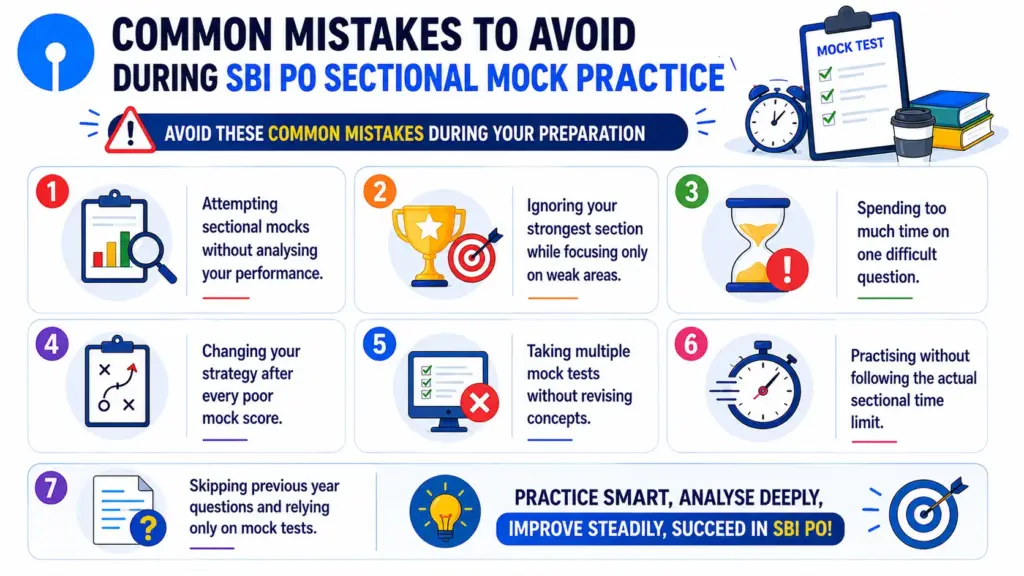
Common Mistakes to Avoid During SBI PO Sectional Mock Practice
Many aspirants take several sectional mock tests but see very little improvement because they repeat the same mistakes. A smart SBI PO Sectional Mock Test Strategy is not about attempting the maximum number of mocks—it is about learning from each one.
Why Are Sectional Mock Tests Important for SBI PO?
Many aspirants focus only on full-length mock tests. However, full mocks do not always show which section needs improvement. The SBI PO sectional mock test strategy helps you practise one subject at a time, improve speed and accuracy, and manage time better. Using both sectional and full-length mocks gives better results than relying on full mocks alone.
Benefits of SBI PO Sectional Mock Tests
- Identify weak and strong sections quickly.
- Improve speed in one subject at a time.
- Build confidence before attempting full mocks.
- Reduce repeated mistakes through regular practice.
- Improve accuracy with proper time management.
- Strengthen difficult topics without studying the entire syllabus again.
Final Thoughts
Following the right SBI PO Sectional Mock Test Strategy can significantly improve your chances of clearing both the Preliminary and Main examinations. Instead of relying only on full-length mock tests, use sectional mocks to strengthen individual subjects, improve speed, and eliminate recurring mistakes. A balanced preparation plan that combines sectional practice, full-length mocks, and regular revision will help you perform consistently across every section. With disciplined practice and continuous learning, you can maximise your score and move one step closer to becoming an SBI Probationary Officer.
Related Blogs
FAQs
1. What is the best SBI PO Sectional Mock Test Strategy?
The best SBI PO Sectional Mock Test Strategy is to identify your weak and strong sections, practise sectional mocks regularly, analyse every test thoroughly, and gradually improve your speed and accuracy before moving to full-length mock tests.
2. How many sectional mock tests should I attempt every week?
Most aspirants should attempt 3–5 sectional mock tests every week along with 1–2 full-length mock tests. The exact number depends on your preparation stage and performance.
3. Are sectional mock tests better than full-length mock tests?
Both are important. Sectional mocks help improve individual subjects, while full-length mocks prepare you for the actual exam environment. A balanced preparation plan should include both.
4. When should I start attempting sectional mock tests?
You can start sectional mock tests after completing the basic concepts of each subject. Once you understand the syllabus, regular sectional practice helps improve speed, confidence, and question selection.
5. How should I analyse a sectional mock test?
Review every incorrect, skipped, and guessed question after the test. Identify whether the mistake was due to weak concepts, calculation errors, poor time management, or careless mistakes, and revise those topics before your next mock.
6. Can sectional mock tests improve my SBI PO score?
Yes. Regular sectional practice improves subject-wise accuracy, strengthens weak areas, and helps you manage time more effectively during the actual examination.
7. Which section requires the maximum sectional practice?
Reasoning Ability and Quantitative Aptitude usually require more sectional practice because they contain lengthy puzzles, Data Interpretation, and calculation-intensive questions. However, every candidate should allocate practice based on their individual strengths and weaknesses.
8. Should beginners attempt sectional mock tests?
Yes. Beginners should first complete the basics of each topic and then start taking sectional mocks. This approach builds confidence gradually and makes learning more structured.
- Sign Up on Practicemock for Updated Current Affairs, Topic Tests and Mini Mocks
- Sign Up Here to Download Free Study Material
Free Mock Tests for the Upcoming Exams
- IBPS PO Free Mock Test
- RBI Grade B Free Mock Test
- IBPS SO Free Mock Test
- NABARD Grade A Free Mock Test
- SSC CGL Free Mock Test
- IBPS Clerk Free Mock Test
- IBPS RRB PO Free Mock Test
- IBPS RRB Clerk Free Mock Test
- RRB NTPC Free Mock Test
- SSC MTS Free Mock Test
- SSC Stenographer Free Mock Test
- GATE Mechanical Free Mock Test
- GATE Civil Free Mock Test
- RRB ALP Free Mock Test
- SSC CPO Free Mock Test
- AFCAT Free Mock Test
- SEBI Grade A Free Mock Test
- IFSCA Grade A Free Mock Test
- RRB JE Free Mock Test
- Free Banking Live Test
- Free SSC Live Test