


SBI PO Reasoning Section Analysis helps candidates understand how toppers approach the Reasoning section to maximise their score in the SBI PO Prelims exam. Instead of attempting questions randomly, toppers focus on quick-scoring topics first, build confidence with accurate answers, and leave lengthy puzzles for later. This smart approach improves speed, reduces negative marking, and increases overall attempts. With the SBI PO 2026 exam expected soon, understanding the right question sequence can make a significant difference in your final score.
SBI PO Reasoning Section Analysis: Key Highlights
- SBI PO Reasoning Section Analysis shows that toppers prioritise easy questions before lengthy puzzles.
- Start with rule-based topics like Syllogism and Inequalities.
- Build confidence by securing quick marks in the first few minutes.
- Attempt Blood Relations and Direction Sense after standalone topics.
- Scan all puzzle sets before selecting one.
- Skip difficult puzzles instead of wasting time.
- Focus on accuracy rather than maximum attempts.
- Analyse mock tests regularly to improve question selection.
- Follow the same attempt order in every mock test.
- Smart planning helps improve both speed and accuracy.
SBI PO Reasoning Section Analysis: How Toppers Approach the Paper
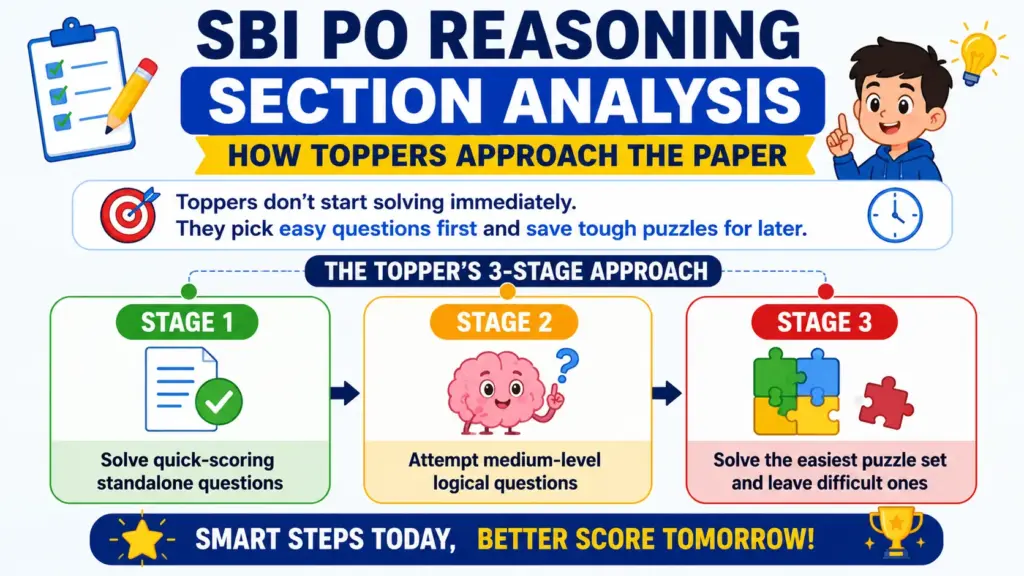
One common habit among toppers is that they never start solving the SBI PO paper immediately. They first identify easy questions and leave time-consuming puzzles for later. This simple strategy helps them score safe marks before attempting moderate and difficult questions.

Before planning your preparation, toppers also recommend to review the exam pattern and SBI PO Syllabus 2026 to understand the Reasoning section in detail.

SBI PO Reasoning Strategy for Prelims
The SBI PO Prelims Reasoning section consists of 30 questions to be solved in 20 minutes. Since every minute is valuable, toppers follow a fixed attempt order instead of solving questions randomly.
A smart SBI PO Reasoning Attempt Strategy divides the section into three phases. This sequence helps maximise accuracy without increasing pressure.
- Quick-scoring topics
- Medium-level reasoning
- Puzzle-based questions
SBI PO Phase 1: Quick-Scoring Topics (First 5–7 Minutes)
The first few minutes are the most important in the SBI PO exam. Toppers solve questions that require direct concepts and simple rules. These questions usually take less time and carry a lower risk of negative marking.
Syllogism
Syllogism is one of the easiest scoring topics in SBI PO Reasoning. Most questions can be solved quickly using Venn diagrams.
Topper’s Strategy
- Draw simple Venn diagrams.
- Check every conclusion separately.
- Avoid making assumptions.
- Solve possibility questions carefully.
Inequalities
Inequality questions are completely rule-based and require very little calculation.
Topper’s Strategy
- Compare symbols carefully.
- Solve statements from left to right.
- Verify every conclusion independently.
- Avoid combining unrelated statements.
Coding-Decoding & Alphanumeric Series
These questions mainly test observation skills and pattern recognition.
Topper’s Strategy
- Identify alphabet positions quickly.
- Look for repeating patterns.
- Solve easy coding questions first.
- Skip lengthy new-pattern questions if they appear confusing.
SBI PO Phase 2: Moderate-Level Reasoning Questions (Next 5 Minutes)
After completing standalone topics, toppers move to questions that require short diagrams and logical thinking in the SBI PO prelims exam. These questions are slightly more time-consuming but still offer good scoring opportunities.
Direction Sense
Direction Sense questions become much easier when solved using diagrams instead of mental calculations.
Topper’s Strategy
- Draw a simple North-South-East-West diagram.
- Mark every turn immediately.
- Solve shortest-distance questions using simple calculations.
- Avoid solving long movements mentally.
Blood Relations
Blood Relation questions become easy once candidates create a simple family tree.
Topper’s Strategy
- Draw the family tree while reading.
- Connect every new member immediately.
- Read the final question carefully.
- Ignore unnecessary family information.
Order & Ranking
Order and Ranking questions usually involve position-based reasoning.
Topper’s Strategy
- Write positions clearly.
- Read both ends of the arrangement.
- Verify rankings before marking the answer.
- Avoid mental calculations.
SBI PO Phase 3: Puzzle-Based Questions (Final 8–10 Minutes)
Puzzles carry the highest weightage in SBI PO Prelims, but they also consume the most time. Instead of attempting the first puzzle they see, toppers quickly scan all available puzzle sets and choose the easiest one.
According to recent SBI PO reasoning section analysis, Puzzles and Seating Arrangements contribute the largest share of questions in the Reasoning section, making smart puzzle selection essential.
Linear & Circular Seating Arrangement
As per the SBI PO topic wise weightage, the Linear and Circular Seating Arrangement questions carry high weightage in the exam. However, toppers never attempt these questions without first checking the complexity of the puzzle. They always look for fixed clues and avoid puzzles that involve multiple possibilities.
Topper’s Strategy
- Read all clues once before drawing.
- Identify fixed positions first.
- Draw a clean diagram.
- Fill direct clues before indirect ones.
- Leave multiple-case puzzles for later if they seem lengthy.
Floor & Box Puzzles
Floor and Box Puzzles often appear in SBI PO Prelims and can be highly scoring if solved systematically. Instead of reading the paragraph repeatedly, toppers convert clues into short symbols and solve them step by step. To attempt puzzle-solving questions, candidates can take the SBI PO Puzzle Strategy Quiz to analyse their performance.
Topper’s Strategy
- Draw a vertical grid.
- Place the lowest floor at the bottom.
- Fill fixed clues first.
- Add variable information gradually.
- Eliminate incorrect possibilities immediately.
SBI PO Reasoning Analysis: Recommended Time Distribution
One major difference between average candidates and toppers is time allocation. SBI PO toppers divide the 20-minute Reasoning section into small phases instead of spending excessive time on one question.
| Phase | Topics | Recommended Time |
| Phase 1 | Inequalities, Syllogism, Coding-Decoding | 5–7 minutes |
| Phase 2 | Blood Relations, Direction Sense, Ranking | 4–5 minutes |
| Phase 3 | Puzzles & Seating Arrangement | 8–10 minutes |
Following this SBI PO Mock Time Management Strategy 2026 helps candidates maximise attempts without rushing.
Top 3 Rules Every SBI PO Exam Topper Follows
The SBI PO Reasoning Section Analysis of successful candidates shows that they follow a few simple rules in every mock test and in the actual exam.
Rule 1: Never Guess Randomly
Guessing without understanding the question increases negative marking. Attempt questions only when you are confident or can eliminate incorrect options.
Rule 2: Set a Time Limit for Every Question
Avoid spending more than 1–2 minutes on a difficult question. If no progress is made, move to the next question.
Rule 3: Practice Sectional Mock Tests
Regular sectional mocks improve speed, accuracy, and question selection. They also help candidates build a consistent SBI PO Reasoning Preparation Strategy.
For regular practice, candidates should attempt the SBI PO Mock Test and analyse every attempt carefully.
Why is SBI PO Reasoning Section Analysis Important?
Understanding the SBI PO Reasoning Section Analysis helps candidates learn how successful aspirants solve the paper within the 20-minute sectional time. The Reasoning section includes both easy standalone questions and lengthy puzzle-based questions. Attempting them in the wrong order often leads to poor time management.
A proper SBI PO Reasoning Preparation Strategy helps candidates:
- Improve question selection.
- Increase the number of accurate attempts.
- Reduce negative marking.
- Build confidence early in the section.
- Manage time more effectively.
Common Mistakes Candidates Make in the Reasoning Section
Many aspirants lose marks not because they lack preparation but because they follow the wrong approach during the exam.
| Common Mistakes | Better Approach |
| Starting with Puzzles | Complete standalone topics first and return to puzzles later. |
| Spending Too Much Time on One Question | Skip the question and revisit it if time remains. |
| Ignoring Easy Questions | Collect quick marks before attempting lengthy reasoning sets. |
| Changing Correct Answers | Modify an answer only if you find a genuine error. |
How to Analyse Your SBI PO Prelims Reasoning Mock Tests?
SBI PO Mock analysis is one of the biggest reasons toppers improve consistently. Attempting mocks alone is not enough. Candidates should identify mistakes after every test. Spend enough time reviewing your mock as you spend attempting it.
For detailed improvement methods, refer to the SBI PO Mock Analysis Strategy.
| Metric | What to Analyse |
| Total Attempts | Overall performance |
| Correct Answers | Accuracy percentage |
| Wrong Answers | Negative marking pattern |
| Skipped Questions | Missed scoring opportunities |
| Time per Topic | Time management |
| Weak Topics | Areas requiring revision |
Weekly Improvement Plan for SBI PO Prelims Reasoning Section
Improvement becomes easier when preparation is divided into weekly goals. The SBI PO Prelims Reasoning Preparation Plan helps candidates improve gradually without feeling overwhelmed.
| Week | Focus Area |
| Week 1 | Strengthen standalone topics |
| Week 2 | Improve puzzle selection |
| Week 3 | Increase solving speed |
| Week 4 | Analyse mock tests and reduce mistakes |
| Week 5 | Build consistency under exam conditions |
SBI PO Prelims vs Mains Reasoning Section Analysis
Although the basic concepts remain the same, the approach required in SBI PO Prelims and Mains is different. Candidates preparing for Mains should continue following the same question selection strategy while improving analytical reasoning skills.
| Feature | Prelims | Mains |
| Difficulty Level | Moderate | High |
| Focus | Speed & Accuracy | Analytical Thinking |
| Puzzles | Moderate | High-Level |
| Computer Aptitude | No | Yes |
| Best Strategy | Quick standalone topics first | Smart question selection |
Final Thoughts
The SBI PO Reasoning Section Analysis clearly shows that toppers do not attempt questions randomly. They build confidence by solving easy standalone topics first, move to medium-level reasoning questions, and attempt puzzles only after securing quick marks. With regular mock practice, proper time management, and consistent revision, you can develop the same exam strategy and perform confidently in the SBI PO Prelims.
Related SBI PO Blogs
FAQs on SBI PO Reasoning Section Analysis
What is SBI PO Reasoning Section Analysis?
SBI PO Reasoning Section Analysis explains how successful candidates attempt the Reasoning section, select questions, manage time, and maximise their score in the exam.
Which Reasoning topics should I attempt first in SBI PO Prelims?
Start with Syllogism, Inequalities, Coding-Decoding, and Alphanumeric Series before moving to Blood Relations, Direction Sense, and Puzzles.
Why do toppers solve puzzles last?
Puzzles consume more time and can reduce overall attempts. Toppers first secure quick marks through standalone questions before attempting lengthy puzzles.
How much time should I spend on puzzles?
Avoid spending more than 8–10 minutes on puzzle-based questions during the 20-minute Reasoning section. If one puzzle becomes confusing, move to another set.
How can mock tests improve my Reasoning score?
Mock tests improve speed, accuracy, time management, and question selection. Analysing each mock helps identify weak areas and avoid repeated mistakes.
Is the Reasoning strategy different for SBI PO Mains?
Yes. Prelims focus on speed and quick question selection, while Mains require stronger analytical skills and smarter selection of high-level reasoning questions.
- Sign Up on Practicemock for Updated Current Affairs, Topic Tests and Mini Mocks
- Sign Up Here to Download Free Study Material
Free Mock Tests for the Upcoming Exams
- IBPS PO Free Mock Test
- RBI Grade B Free Mock Test
- IBPS SO Free Mock Test
- NABARD Grade A Free Mock Test
- SSC CGL Free Mock Test
- IBPS Clerk Free Mock Test
- IBPS RRB PO Free Mock Test
- IBPS RRB Clerk Free Mock Test
- RRB NTPC Free Mock Test
- SSC MTS Free Mock Test
- SSC Stenographer Free Mock Test
- GATE Mechanical Free Mock Test
- GATE Civil Free Mock Test
- RRB ALP Free Mock Test
- SSC CPO Free Mock Test
- AFCAT Free Mock Test
- SEBI Grade A Free Mock Test
- IFSCA Grade A Free Mock Test
- RRB JE Free Mock Test
- Free Banking Live Test
- Free SSC Live Test