


SBI PO Reasoning Do’s and Don’ts can significantly improve your score by helping you avoid unnecessary negative marking in the SBI PO exam. Every incorrect answer carries a penalty of 0.25 marks. Making smart question selection just as important as conceptual knowledge. Instead of attempting every question, focus on solving easy, high-scoring topics first, skip lengthy puzzles initially, and prioritise accuracy over speed. This approach helps you maximize your net score while staying calm throughout the Reasoning section.
SBI PO Reasoning Do’s and Don’ts: Key Takeaways
The SBI PO Reasoning Do’s and Don’ts help candidates improve both speed and accuracy during the exam.

- Every incorrect answer attracts a penalty of 0.25 marks.
- Prioritise accuracy over attempting more questions.
- Solve standalone Reasoning topics before puzzles.
- Avoid blind guessing in the Reasoning section.
- Skip lengthy puzzles that consume excessive time.
- Attempt questions only when reasonably confident.
- Analyse every mock test to identify recurring mistakes.
- Follow a fixed question sequence in every mock.
- Stay calm if the paper feels difficult.
- Consistent practice improves both speed and question selection.
SBI PO Reasoning Do’s and Don’ts: Understanding Negative Marking
One of the biggest mistakes candidates make is ignoring the impact of negative marking. Instead of attempting every question, the SBI PO Reasoning Do’s and Don’ts recommend focusing on questions you can solve confidently. Leaving a doubtful question is often a better decision than making a random guess.

| Particulars | Marking Scheme |
| Correct Answer | +1 Mark |
| Wrong Answer | –0.25 Mark |
| Unattempted Question | No penalty |
This means four wrong answers cancel out the marks earned from one correct answer.
SBI PO Reasoning Do’s and Don’ts for Prelims
The Prelims Reasoning section contains 30 questions to be solved within 20 minutes. Since time is limited, candidates should prioritise standalone questions before moving to lengthy puzzles.
Do’s and Don’ts for Easy Topics in SBI PO Prelims Reasoning
Standalone topics are usually less time-consuming and provide quick scoring opportunities. These topics improve confidence and help candidates secure easy marks within the first few minutes.
Do’s
- Start with Coding-Decoding.
- Solve Inequality questions early.
- Attempt Syllogism using Venn diagrams.
- Complete Blood Relations by drawing family trees.
- Solve Direction Sense using simple diagrams.
- Follow the same attempt order during every mock test.
Don’ts
- Don’t solve questions mentally if a diagram makes them easier.
- Don’t assume relationships without verifying the statements.
- Don’t ignore basic inequality rules.
- Don’t spend unnecessary time verifying obvious conclusions repeatedly.
For better speed in these topics, candidates can also refer to the SBI PO Reasoning Cheat Sheet 2026.
SBI PO Prelims Reasoning Do’s and Don’ts for Puzzles & Seating Arrangement
Puzzles contribute the highest weightage but are also the biggest time traps. For advanced puzzle-solving questions, take the SBI PO Puzzle Strategy quiz. Following these SBI PO Reasoning Do’s and Don’ts helps candidates protect valuable time for easier questions.
Do’s
- Scan every puzzle before choosing one.
- Start with puzzles having fixed positions.
- Draw neat diagrams.
- Convert lengthy clues into symbols.
- Leave multiple-case puzzles for later if they appear confusing.
Don’ts
- Don’t begin the section with a difficult puzzle.
- Don’t redraw the same puzzle repeatedly.
- Don’t continue solving a puzzle after reaching repeated dead ends.
- Don’t spend more than 2–3 minutes initially on one puzzle.
SBI PO Reasoning Do’s and Don’ts for Mains
The Mains Reasoning section is significantly more difficult than Prelims and includes Computer Aptitude questions. Success depends on maintaining high accuracy while handling lengthy analytical questions. Candidates should focus on selecting the right questions rather than attempting every question.
Do’s and Don’ts for SBI PO Mains Reasoning
The Mains Reasoning section tests analytical thinking, logical accuracy, and smart decision-making. Unlike Prelims, Mains rewards smart selection more than aggressive attempting. Following these tips helps you choose high-scoring questions, manage time effectively, and minimise negative marking in lengthy reasoning sets.
Do’s
- Scan all questions before starting lengthy sets.
- Attempt familiar question types first.
- Solve high-confidence questions before analytical puzzles.
- Keep rough work neat and organised.
- Maintain a steady pace throughout the section.
Don’ts
- Don’t panic if the first puzzle appears difficult.
- Don’t attempt unfamiliar logical patterns without understanding them.
- Don’t rush through Computer Aptitude questions.
- Don’t sacrifice accuracy to increase attempts.
SBI PO Reasoning Do’s and Don’ts: Follow the Elimination Rule
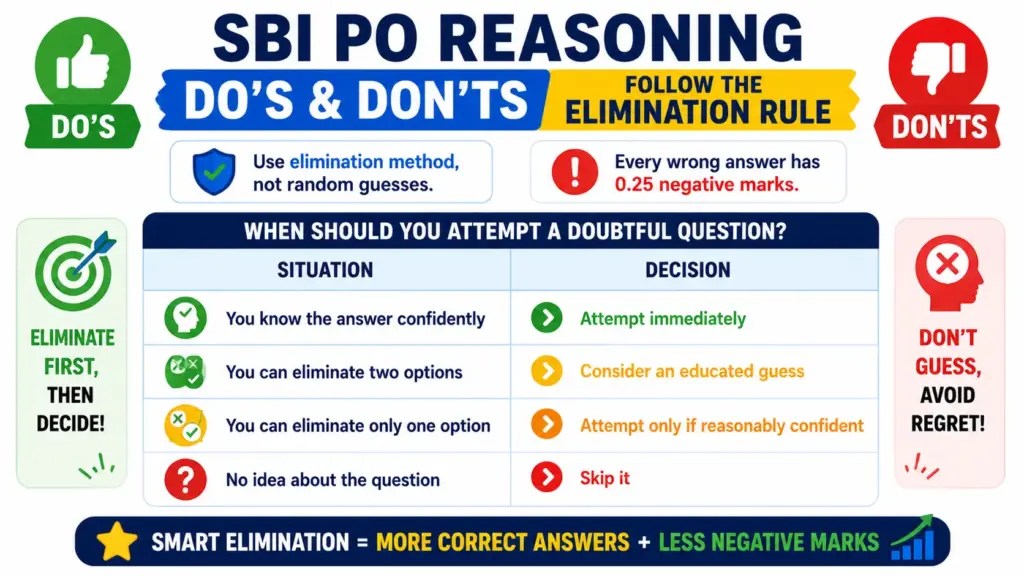
One of the most effective ways to use the elimination method instead of making random guesses. Since every incorrect answer attracts 0.25 negative marks, candidates should attempt doubtful questions only when they can confidently eliminate incorrect options.
SBI PO Reasoning Do’s and Don’ts: Accuracy vs Attempt Strategy
Many candidates believe attempting more questions automatically leads to a higher score. In reality, accuracy matters much more because of negative marking. The SBI PO Reasoning Do’s and Don’ts recommend maintaining 70–75 quality attempts with 85% or higher accuracy rather than chasing maximum attempts.
For better question selection, candidates can also follow the SBI PO Risk-Free Attempt Strategy.
| Attempts | Accuracy | Expected Outcome |
| 90 | 75% | High negative marking lowers the score |
| 80 | 85% | Safe score with controlled risk |
| 70–75 | 90% | Excellent net score with fewer mistakes |
Why Follow SBI PO Reasoning Best Practices?
Following the SBI PO Reasoning Do’s and Don’ts helps candidates avoid common mistakes that reduce their overall score. Since the Reasoning section contains both quick-scoring questions and lengthy puzzles, choosing the right questions becomes essential.
Before starting your preparation, review the SBI PO Exam Pattern and Syllabus 2026 to understand the weightage of different Reasoning topics.
A smart approach helps candidates:
- Reduce negative marking.
- Improve question selection.
- Complete more accurate attempts.
- Save time for scoring questions.
- Maintain confidence throughout the exam.
Common Mistakes Candidates Make in the SBI PO Reasoning Section
Even well-prepared candidates lose marks because of poor decision-making during the exam. Identifying these errors early helps improve accuracy, save time, and reduce negative marking.
| Common Mistakes | Better Approach |
| Random guessing increases negative marking and reduces your overall score. | Attempt only when you understand the concept or can eliminate incorrect options. |
| Spending Too Much Time on One Puzzle | Leave the puzzle after 2–3 minutes if no clear progress is made and return later if time permits. |
| Ignoring Standalone Questions | Complete quick-scoring topics first to build confidence and secure safe marks. |
| Over-Attempting Questions | Focus on maintaining a high accuracy percentage instead of attempting everything. |
| Not Reviewing Mock Tests | Review every incorrect answer to identify conceptual mistakes, poor question selection, or unnecessary guesses. |
How to Analyse Your Reasoning Performance After Every SBI PO Mock Test?
Regular SBI PO mock analysis helps candidates identify the mistakes responsible for negative marking. Candidates should spend almost the same amount of time analysing a mock as they spend attempting it. For detailed improvement techniques, refer to the SBI PO Mock Analysis Strategy.
Review the following details after every mock:
| Metric | What to Analyse |
| Total Attempts | Overall performance |
| Correct Answers | Accuracy level |
| Wrong Answers | Negative marking pattern |
| Questions Skipped | Missed scoring opportunities |
| Time per Puzzle | Time management |
| Repeated Errors | Topics requiring revision |
Weekly Improvement Plan to Reduce Negative Marking
The SBI PO Reasoning Do’s and Don’ts become more effective when followed consistently. Small improvements every week lead to noticeable improvements during the exam time.
| Week | Focus Area |
| Week 1 | Strengthen standalone topics |
| Week 2 | Improve puzzle selection |
| Week 3 | Increase solving speed without reducing accuracy |
| Week 4 | Analyse mock mistakes and eliminate guessing |
| Week 5 | Build consistency under exam conditions |
Related SBI PO Blogs
FAQs on SBI PO Reasoning Do’s and Don’ts
What are the SBI PO Reasoning Do’s and Don’ts?
The SBI PO Reasoning Do’s and Don’ts are practical strategies that help candidates improve accuracy, avoid negative marking, and manage time effectively during the Prelims and Mains exams.
How can I avoid negative marking in SBI PO Reasoning?
Avoid blind guessing, attempt high-confidence questions first, skip lengthy puzzles initially, and use the elimination method whenever possible.
Should I attempt every Reasoning question?
No. It is better to skip doubtful questions than lose marks through random guesses. Prioritise accuracy over the number of attempts.
Which Reasoning topics should I attempt first?
Begin with quick-scoring standalone topics such as Coding-Decoding, Syllogism, Inequality, Blood Relations, and Direction Sense before attempting puzzles.
How much time should I spend on one puzzle?
Avoid spending more than 2–3 minutes on a difficult puzzle during the first attempt. If you cannot make progress, move on and return later if time allows.
How can mock tests improve my Reasoning score?
Mock tests help improve speed, question selection, and accuracy. Analysing every mock also helps identify common mistakes and reduces negative marking in future exams.
- Sign Up on Practicemock for Updated Current Affairs, Topic Tests and Mini Mocks
- Sign Up Here to Download Free Study Material
Free Mock Tests for the Upcoming Exams
- IBPS PO Free Mock Test
- RBI Grade B Free Mock Test
- IBPS SO Free Mock Test
- NABARD Grade A Free Mock Test
- SSC CGL Free Mock Test
- IBPS Clerk Free Mock Test
- IBPS RRB PO Free Mock Test
- IBPS RRB Clerk Free Mock Test
- RRB NTPC Free Mock Test
- SSC MTS Free Mock Test
- SSC Stenographer Free Mock Test
- GATE Mechanical Free Mock Test
- GATE Civil Free Mock Test
- RRB ALP Free Mock Test
- SSC CPO Free Mock Test
- AFCAT Free Mock Test
- SEBI Grade A Free Mock Test
- IFSCA Grade A Free Mock Test
- RRB JE Free Mock Test
- Free Banking Live Test
- Free SSC Live Test