


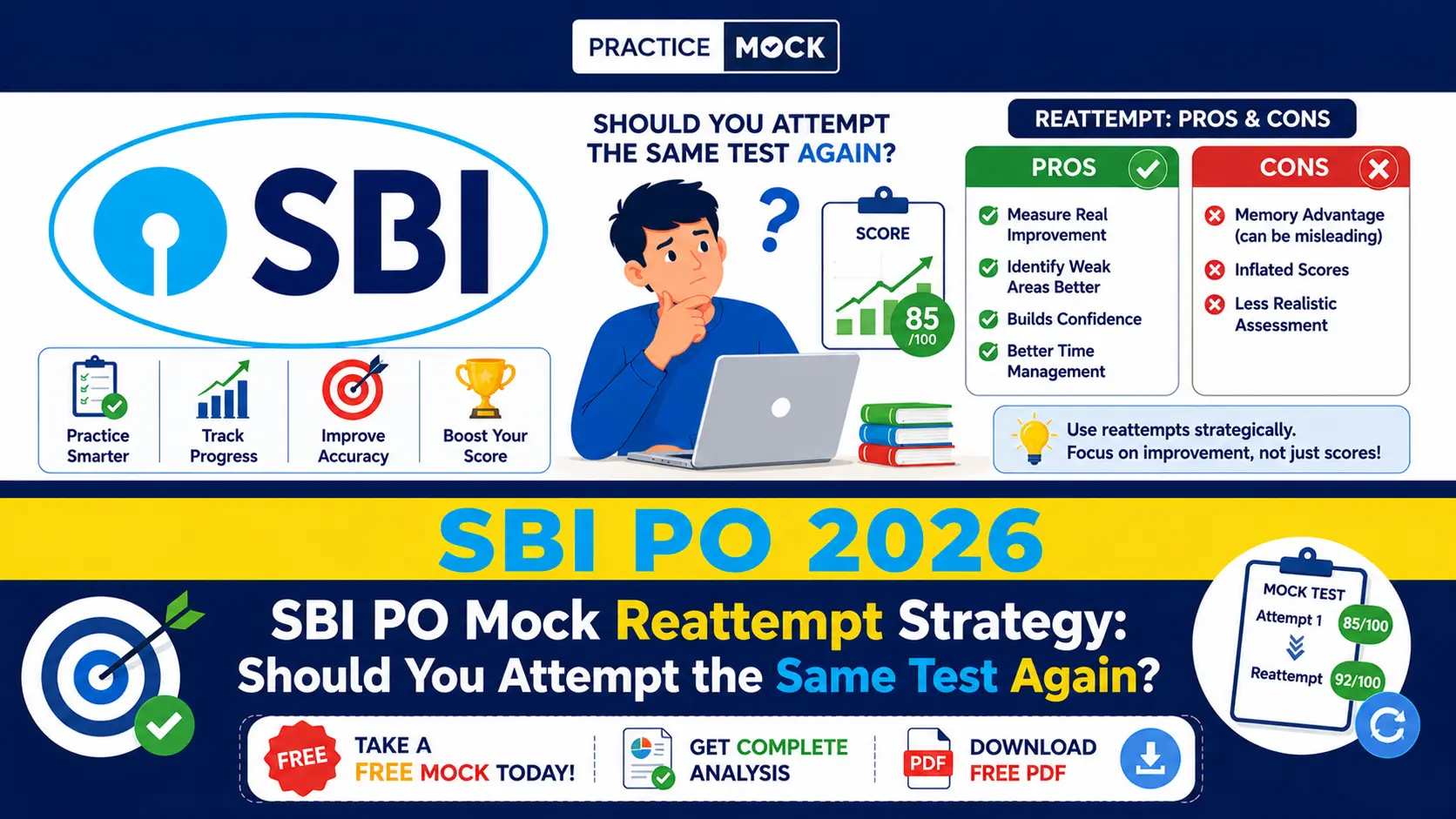
A strong SBI PO mock reattempt strategy involves taking the same test again only after analysing mistakes, revising weak concepts, and allowing enough time between attempts. Reattempting a mock can help you check whether you have corrected previous errors, improved your speed, and learned better question-selection methods. However, repeating the test immediately may produce an inflated score because you remember the answers.
Most candidates should reattempt selected SBI PO mocks after approximately seven to fourteen days. The purpose should not be to achieve a higher score through memory. Instead, the second attempt should verify whether you can independently solve previously incorrect, skipped, or time-consuming questions.

SBI PO Mock Reattempt Strategy: Key Takeaways
- Do not reattempt a mock immediately after checking its solutions.
- Analyse and revise before taking the same test again.
- Maintain a gap of approximately seven to fourteen days.
- Reattempt mocks that reveal major weaknesses or repeated errors.
- Compare accuracy, speed, attempts, and selection—not just scores.
- Exclude remembered answers when evaluating the second attempt.
- Reattempt incorrect and skipped questions before retaking the full test.
- Avoid repeatedly taking the same easy mock to increase confidence.
- Use fresh mocks as the main readiness benchmark.
- Treat reattempts as correction tests, not performance rankings.
- Record whether each previous mistake was genuinely resolved.
- Stop reattempting when memory begins to dominate performance.
Reattempting a test is valuable only when the second attempt measures learning. A higher score caused mainly by answer familiarity does not represent improved SBI PO readiness.

Should You Attempt the Same SBI PO Mock Test Again?
Yes, you can attempt the same SBI PO mock again, but only with a clear purpose.
The second attempt should answer questions such as:
- Did I correct the concepts I previously misunderstood?
- Can I solve the same questions without looking at the solution?
- Has my calculation speed improved?
- Can I now identify the easier puzzle or Data Interpretation set?
- Am I avoiding the same negative-marking mistakes?
- Can I complete the test with a better question-selection strategy?
- Has my weak section improved?
A reattempt is useful when it tests corrected skills. It becomes less useful when the questions and answers are still fresh in your memory.
When Should You Reattempt an SBI PO Mock?
The ideal time to reattempt a mock depends on why you are repeating it.
| Reattempt Purpose | Suggested Gap |
| Reattempt only incorrect questions | One to three days |
| Reattempt skipped questions | Two to four days |
| Retake a sectional test | Five to seven days |
| Retake the complete mock | Seven to fourteen days |
| Check long-term retention | Three to four weeks |
These are flexible preparation guidelines. Some candidates may need a longer gap if they remember questions easily.
The most important condition is that you should complete the following before the reattempt:
- Analyse the original test.
- Classify every mistake.
- Revise weak concepts.
- Practise similar questions.
- Reattempt incorrect questions independently.
- Allow enough time for answer memory to reduce.
Why Should You Reattempt an SBI PO Mock Test?
Reattempting a well-selected mock can provide several benefits.
It Checks Whether Mistakes Were Corrected
Many candidates read solutions but never verify whether they can apply the method independently. A reattempt exposes whether the learning was temporary or retained.
It Measures Speed Improvement
A question that originally required three minutes may take one minute after proper revision. This shows genuine improvement in calculation, reading, or reasoning speed.
It Improves Question Selection
During the first attempt, you may choose a difficult puzzle before an easier one. The second attempt allows you to test a better sequence.
It Strengthens Retention
Reattempting after a suitable gap helps reinforce formulas, grammar rules, puzzle structures, and arithmetic methods.
It Builds Confidence Through Correction
A reattempt can restore confidence when it confirms that earlier weaknesses have been resolved. However, this confidence should come from improved understanding rather than remembered answers.
When Should You Not Reattempt the Same SBI PO Mock?
Reattempting is not always productive.
Avoid retaking the same full mock when:
- You attempted it only a few hours ago.
- You clearly remember most answers.
- You have not analysed your mistakes.
- You are repeating it only to improve the displayed score.
- You are avoiding fresh and unfamiliar mocks.
- The test was unusually easy and provided little learning.
- You have already attempted it multiple times.
- Your second-attempt score cannot be separated from memory.
- You need exposure to new question patterns.
- The examination is close and fresh mocks are more useful.
A familiar test cannot fully measure your ability to handle uncertainty. Therefore, fresh mocks should remain the main part of your preparation.
Fresh Mock vs Reattempted Mock: Which Is Better?
Both have different roles.
| Factor | Fresh Mock | Reattempted Mock |
| Main purpose | Measure current readiness | Check correction and retention |
| Question familiarity | None | Partial or high |
| Score reliability | Higher | May be inflated |
| Best use | Benchmarking | Learning verification |
| Tests adaptability | Strongly | Limited |
| Measures memory influence | Low | High |
| Recommended frequency | Regular | Selective |
| Ranking value | More meaningful | Less meaningful |
A fresh mock shows how you perform against unfamiliar questions. A reattempted mock shows whether you have learned from a previous test.
You need both, but they should not be evaluated in the same way.
Which SBI PO Mocks Should You Reattempt?
Do not reattempt every mock. Select tests that generated meaningful learning opportunities.
Reattempt a Mock When:
- It exposed several conceptual weaknesses.
- You left many easy questions unattempted.
- One section performed significantly below your average.
- You selected the wrong puzzles or DI sets.
- Your accuracy fell because of avoidable errors.
- You used an ineffective attempt sequence.
- The test contained useful exam-level questions.
- You want to check whether a revision plan worked.
- Your performance was affected by poor time management rather than lack of knowledge.
Avoid Reattempting a Mock When:
- It contained many ambiguous or irrelevant questions.
- The difficulty was far above a useful preparation level.
- You remember most answers.
- It no longer matches your current preparation needs.
- You have stronger fresh mocks available.
- The second attempt would mainly test recall.
What Should You Do Before Reattempting an SBI PO Mock?
A mock should not be repeated without completing a correction cycle.
Step 1: Analyse the Original Attempt
Record:
- Total score
- Total attempts
- Accuracy
- English score
- Quant score
- Reasoning score
- Incorrect answers
- Easy questions missed
- Correct but slow questions
- Time wasted on unsolved questions
- Repeated mistakes
Step 2: Classify Every Mistake
| Mistake Type | Example | Corrective Action |
| Concept error | Incorrect percentage method | Revise the concept |
| Calculation error | Wrong multiplication | Practise calculation drills |
| Reading error | Missed a condition | Read instructions carefully |
| Selection error | Chose a difficult puzzle first | Improve scanning |
| Time-management error | Spent too long on one question | Set exit limits |
| Guessing error | Attempted without confidence | Reduce risky attempts |
| Vocabulary error | Misunderstood a word | Revise contextual vocabulary |
Step 3: Reattempt Individual Questions
Before retaking the full mock, solve the following without seeing the answers:
- Incorrect questions
- Skipped but solvable questions
- Correct but slow questions
- Questions solved through an inefficient method
Step 4: Practise Similar Questions
Do not revise only the exact questions from the test. Practise similar concepts so that the improvement transfers to unfamiliar questions.
Step 5: Wait Before the Full Reattempt
Allow enough time for direct answer memory to weaken. Continue attempting fresh tests during this period.
How Should You Reattempt the Same SBI PO Mock?
The second attempt should be conducted under proper examination conditions.
Follow these rules:
- Do not look at the original scorecard before starting.
- Do not keep the solution open.
- Use the full sectional timer.
- Do not pause the test.
- Follow your revised question-selection strategy.
- Attempt questions independently.
- Mark questions whose answers you remember.
- Separate memory-based answers from independently solved answers.
- Analyse the second attempt after completion.
The goal is not simply to complete more questions. It is to test whether your correction strategy works under time pressure.
How Should You Compare the First and Second Attempts?
Use more than the total score.
| Metric | First Attempt | Second Attempt | Improvement Check |
| Total score | Did net marks improve? | ||
| Attempts | Were extra attempts controlled? | ||
| Accuracy | Did accuracy remain stable? | ||
| English score | Was the weakness corrected? | ||
| Quant score | Did calculation speed improve? | ||
| Reasoning score | Was set selection better? | ||
| Incorrect answers | Did negative marking reduce? | ||
| Easy questions missed | Were more scoring questions identified? | ||
| Slow questions | Did solving time improve? | ||
| Memory-based answers | How much did recall affect the score? |
A second-attempt score is meaningful only when accuracy, selection, and speed improve without heavy dependence on memory.
How Can You Identify Memory-Based Improvement?
Some improvement in a reattempt will naturally come from familiarity. You should identify how much of the score increase is genuine.
After the test, classify each correct answer as:
- Solved independently
- Solved faster because the concept improved
- Answer remembered
- Option remembered
- Method partly remembered
- Guessed correctly
Suppose your score rises from 44 to 65. If ten additional marks came from remembered answers, the full 21-mark increase should not be treated as genuine progress.
Your effective improvement may be closer to 11 marks.
Should You Reattempt the Entire Mock or Only Wrong Questions?
Both methods are useful at different stages.
Reattempt Only Wrong and Skipped Questions When:
- You recently completed the test.
- You need immediate correction.
- Time is limited.
- The main objective is concept revision.
- You remember the overall paper clearly.
Reattempt the Full Mock When:
- Seven to fourteen days have passed.
- You want to test a revised attempt strategy.
- The original test exposed major timing problems.
- You need to verify section-wise improvement.
- You no longer remember most answers.
- The paper contained useful exam-level questions.
For many candidates, question-level reattempts should happen first, followed by a full reattempt later.
How Many Times Should You Attempt the Same SBI PO Mock?
Most mocks should be attempted no more than two times.
A third attempt may be useful only when:
- The test contains highly valuable questions.
- The previous two attempts were separated by a long gap.
- You are using it as a revision exercise rather than a score benchmark.
- You are still unable to solve important questions independently.
Repeatedly taking the same mock can create false confidence and reduce exposure to new questions.
Recommended Limit
| Test Type | Suggested Number of Attempts |
| Full-length mock | One fresh attempt plus one reattempt |
| Sectional test | Up to two or three attempts |
| Topic test | Multiple attempts for mastery |
| Previous-year-style paper | One or two timed attempts |
| Error-question set | Repeat until independently solved |
What Score Improvement Should You Expect in a Reattempt?
Your second-attempt score will usually be higher, but there is no fixed improvement target.
A meaningful improvement may include:
- Three to five fewer incorrect answers
- Higher accuracy
- Better section-wise balance
- Fewer easy questions missed
- Less time spent on difficult sets
- More correct attempts in the weak section
- Improved selection under sectional timing
The score increase itself is secondary.
For example:
| Metric | First Attempt | Reattempt |
| Score | 46 | 58 |
| Attempts | 64 | 69 |
| Accuracy | 78% | 87% |
| Incorrect answers | 14 | 9 |
| Easy questions missed | 8 | 3 |
| Questions remembered | — | 2 |
This indicates useful improvement because accuracy increased and easy questions missed declined.
Consider another example:
| Metric | First Attempt | Reattempt |
| Score | 45 | 68 |
| Attempts | 62 | 76 |
| Accuracy | 79% | 92% |
| Questions remembered | — | 17 |
The higher score may not represent an equivalent increase in actual readiness.
SBI PO Section-Wise Reattempt Strategy
English Language Reattempt Strategy
During the first analysis, identify:
- Grammar rules misunderstood
- Reading-comprehension options selected without evidence
- Vocabulary gaps
- Contextual errors
- Questions answered too quickly
- Questions taking excessive time
Before reattempting:
- Revise the relevant grammar rule.
- Read why each incorrect option was rejected.
- Practise a new passage of similar difficulty.
- Reattempt the original questions independently.
During the second attempt, check whether you can justify the answer rather than simply recall it.
Quantitative Aptitude Reattempt Strategy
Review:
- Incorrect formulas
- Long calculations
- Arithmetic concepts
- DI set selection
- Approximation opportunities
- Questions skipped because of slow calculations
Before reattempting:
- Revise formulas.
- Practise calculation drills.
- Solve similar arithmetic questions.
- Reattempt the same DI set without looking at the solution.
- Learn a shorter method where available.
The second attempt should show improved method selection, not only remembered numerical answers.
Reasoning Ability Reattempt Strategy
Analyse:
- Wrong puzzle selection
- Incorrect diagrams
- Missed conditions
- Excessive case formation
- Time spent on incomplete sets
- Direct questions left unattempted
Before retaking:
- Redraw the puzzle.
- Identify the condition that caused the mistake.
- Practise similar arrangements.
- Set a time limit for abandoning an unproductive set.
- Reattempt direct questions under time pressure.
The key improvement should be better set selection and cleaner representation.
Suggested Weekly SBI PO Mock Reattempt Plan
| Day | Main Activity | Reattempt Activity |
| Monday | Attempt a fresh full mock | Analyse all mistakes |
| Tuesday | Practise weak topics | Reattempt wrong questions |
| Wednesday | Attempt a fresh sectional test | Review Monday’s skipped questions |
| Thursday | Attempt another fresh mock | No full reattempt |
| Friday | Revise error log | Reattempt selected sectional test |
| Saturday | Attempt a fresh moderate mock | Compare progress |
| Sunday | Reattempt an older full mock | Evaluate correction and retention |
This structure keeps fresh mocks as the main benchmark while using reattempts for learning verification.
What Is the Right Fresh Mock and Reattempt Ratio?
A practical ratio is:
- Beginners: Three fresh mocks for every one full reattempt
- Intermediate candidates: Four fresh mocks for every one reattempt
- Advanced candidates: Five or more fresh mocks for every one reattempt
The ratio can change when your preparation is focused heavily on correcting mistakes. However, reattempted tests should not outnumber fresh tests.
When Is Reattempting More Useful Than Taking a New Mock?
Reattempting may be more useful when:
- You have not understood the mistakes from the previous test.
- The same weakness appears in every fresh mock.
- You need to verify a corrected approach.
- You repeatedly choose the wrong puzzle or DI set.
- Your score is stuck because of avoidable errors.
- You want to test retention after revision.
- The original mock contained highly relevant questions.
A fresh mock is better when:
- You need a realistic readiness score.
- You remember the previous paper clearly.
- You need exposure to unfamiliar questions.
- You are preparing for unpredictable difficulty.
- The exam is approaching.
- Your correction process has already been tested.
Understanding why a method works is more important than remembering the final answer.
Ignoring Fresh Questions
The actual examination will contain unfamiliar questions. Do not let reattempts reduce exposure to new patterns.
Reattempting Without Revision
The same mistakes may recur when concepts are not corrected first.
Counting Memory-Based Answers as Improvement
Mark answers that you recalled directly and exclude them from your effective performance assessment.
Repeating Only Easy Tests
Repeatedly taking comfortable tests may increase scores without building adaptability.
SBI PO Mock Reattempt Performance Tracker
Use the following table:
| Metric | First Attempt | Reattempt | Genuine Improvement |
| Total score | |||
| Total attempts | |||
| Accuracy | |||
| English score | |||
| Quant score | |||
| Reasoning score | |||
| Incorrect answers | |||
| Easy questions missed | |||
| Slow questions | |||
| Remembered answers | — | Exclude from evaluation | |
| Repeated mistakes | |||
| Corrected mistakes |
This tracker helps separate genuine learning from familiarity.
Final SBI PO Mock Reattempt Strategy
The best SBI PO mock reattempt strategy is to use fresh mocks for performance measurement and selected reattempts for correction. Do not repeat the same test immediately after viewing the solutions. Analyse the first attempt, revise weak concepts, practise similar questions, and wait approximately seven to fourteen days before taking the complete mock again.
During the second attempt, compare accuracy, time management, section-wise balance, question selection, and repeated mistakes. Mark any answers remembered from the first attempt and do not treat them as genuine score improvement.
Most importantly, do not reattempt a mock simply to obtain a better displayed score. Retake it to confirm that you can now solve the questions correctly, faster, and with a better strategy. The reattempt is successful only when the learning transfers to your next fresh SBI PO mock.
Take a Free SBI PO Prelims Mock Test and Get Complete Section-Wise Analysis
FAQs on SBI PO Mock Reattempt Strategy
Should I attempt the same SBI PO mock again?
Yes. Reattempt selected mocks after analysing mistakes and revising weak topics. The second attempt should check learning and retention rather than answer memory.
After how many days should I reattempt an SBI PO mock?
A gap of approximately seven to fourteen days is generally suitable for a complete mock reattempt. Incorrect questions can be reattempted earlier.
Is reattempting the same mock useful?
Yes, it can help verify whether you corrected concepts, improved speed, and developed better question selection. Its value reduces when you remember most answers.
Should I reattempt wrong questions or the entire mock?
First reattempt incorrect, skipped, and slow questions. Later, retake the complete mock if you need to test time management and the revised attempt strategy.
How many times should I attempt the same SBI PO mock?
Most full-length mocks should be attempted no more than twice. Further attempts are useful only for revision, not readiness measurement.
Will my second SBI PO mock score be accurate?
The second score may be inflated by familiarity. Record remembered answers and rely on fresh mocks for a more accurate readiness benchmark.
Is it better to reattempt an old mock or attempt a new one?
A new mock is better for measuring readiness and adaptability. An old mock is better for checking whether previous mistakes have been corrected.
Can I reattempt an SBI PO mock on the same day?
You can reattempt selected wrong questions on the same day, but avoid repeating the entire mock immediately because memory will strongly influence the score.
What should I analyse after reattempting an SBI PO mock?
Compare score, attempts, accuracy, sectional performance, incorrect answers, easy questions missed, time spent, repeated mistakes, and remembered answers.
How many reattempted mocks should I include each week?
One selected full-mock reattempt per week is enough for many candidates. Keep fresh mocks as the larger part of the weekly schedule.
- Sign Up on Practicemock for Updated Current Affairs, Topic Tests and Mini Mocks
- Sign Up Here to Download Free Study Material
Free Mock Tests for the Upcoming Exams
- IBPS PO Free Mock Test
- RBI Grade B Free Mock Test
- IBPS SO Free Mock Test
- NABARD Grade A Free Mock Test
- SSC CGL Free Mock Test
- IBPS Clerk Free Mock Test
- IBPS RRB PO Free Mock Test
- IBPS RRB Clerk Free Mock Test
- RRB NTPC Free Mock Test
- SSC MTS Free Mock Test
- SSC Stenographer Free Mock Test
- GATE Mechanical Free Mock Test
- GATE Civil Free Mock Test
- RRB ALP Free Mock Test
- SSC CPO Free Mock Test
- AFCAT Free Mock Test
- SEBI Grade A Free Mock Test
- IFSCA Grade A Free Mock Test
- RRB JE Free Mock Test
- Free Banking Live Test
- Free SSC Live Test