


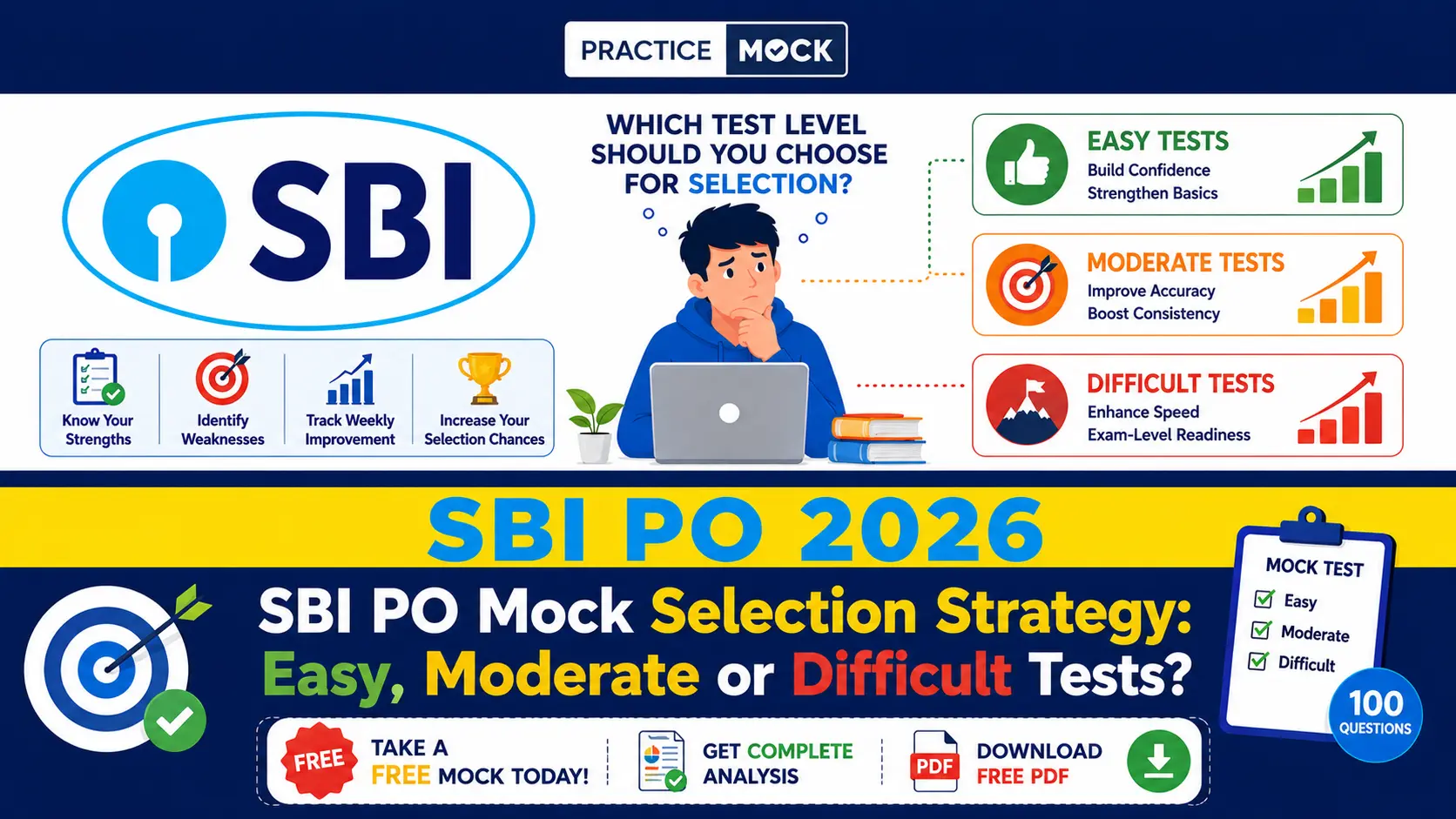
The right SBI PO mock selection strategy is to use a balanced combination of easy, moderate, and difficult tests rather than practising only one difficulty level. Easy mocks help candidates build speed and confidence, moderate mocks provide the most realistic preparation benchmark, and difficult mocks improve adaptability, question selection, and composure under pressure.
Most candidates should attempt a higher proportion of moderate-level tests because they offer a practical balance between speed, accuracy, and exam-level decision-making. However, your mock selection must depend on your preparation stage, current score, accuracy, and the weaknesses identified through previous test analysis.

SBI PO Mock Selection Strategy: Key Takeaways
- Do not attempt only easy mocks to maintain a high score.
- Use moderate mocks as the core of your preparation.
- Attempt difficult mocks to improve question selection and composure.
- Beginners should start with easy-to-moderate tests.
- Intermediate candidates should focus mainly on moderate mocks.
- Advanced candidates should combine moderate and difficult papers.
- Compare accuracy and selection, not only total marks.
- Adjust score expectations according to test difficulty.
- Analyse why difficult questions consumed excessive time.
- Avoid using unusually difficult mocks as your only readiness benchmark.
- Use easy mocks for speed practice, not for overconfidence.
- Maintain a difficulty-balanced weekly mock schedule.
A candidate’s preparation should develop across three areas: the ability to solve familiar questions quickly, the ability to handle exam-level questions accurately, and the judgement to skip unnecessarily difficult questions. Therefore, the correct mock mix should train all three abilities.

Should You Attempt Easy, Moderate or Difficult SBI PO Mocks?
Most SBI PO candidates should attempt moderate-level mocks regularly, while using easy and difficult mocks for specific purposes.
The role of each mock type is different:
| Mock Difficulty | Primary Purpose | Best Used For |
| Easy | Build speed and confidence | Beginners and speed practice |
| Moderate | Measure exam readiness | Regular preparation |
| Difficult | Improve selection and adaptability | Advanced practice |
| Mixed difficulty | Simulate unpredictable papers | Final preparation stage |
Moderate mocks should form the largest part of your test schedule because they provide a more dependable view of your preparation. Easy tests may increase your score without exposing weaknesses, while very difficult tests may reduce your marks without accurately representing your actual ability.
What Is an Easy SBI PO Mock Test?
An easy SBI PO mock contains a higher proportion of direct, familiar, and less time-consuming questions. The calculations may be manageable, Reasoning sets may involve fewer variables, and English questions may use clearer options.
Common Features of an Easy Mock
- Direct simplification and approximation
- Familiar arithmetic models
- Straightforward syllogism and inequality questions
- Manageable seating arrangements
- Simple fillers and error-detection questions
- Clear reading-comprehension options
- Fewer time-consuming sets
- Higher overall attempts by candidates
An easy test is not useless. It can help you develop speed, establish an attempt sequence, and practise avoiding careless mistakes.
However, attempting only easy tests can create an inaccurate impression of readiness.
When Should You Attempt Easy SBI PO Mocks?
Easy mocks are most useful during the early preparation stage and for targeted speed improvement.
Attempt an easy mock when:
- You are beginning full-length mock practice.
- Your syllabus coverage is still incomplete.
- You struggle to finish sections within 20 minutes.
- Your confidence has fallen after several low scores.
- You want to test calculation and reading speed.
- You need to reduce careless mistakes.
- You are returning to preparation after a break.
- You want to evaluate your maximum safe attempts.
What Should You Target in an Easy Mock?
An easy mock should produce a relatively high score and strong accuracy.
| Metric | Suggested Easy-Mock Target |
| Accuracy | 88–92% or above |
| Question selection | Most direct questions attempted |
| Time management | Minimal time wasted |
| Main objective | Maximise correct attempts |
| Error tolerance | Very low |
If your score remains low in an easy mock, the issue may involve basic concepts, slow calculations, or poor time management.
What Is a Moderate SBI PO Mock Test?
A moderate SBI PO mock generally contains a balanced combination of direct, calculative, conceptual, and time-consuming questions. It requires candidates to choose questions carefully rather than attempting everything.
Common Features of a Moderate Mock
- A mix of direct and application-based arithmetic
- Moderate-level Data Interpretation
- One or more manageable Reasoning sets
- Some lengthy or uncertain puzzles
- Mixed English grammar and comprehension questions
- Plausible answer options
- A realistic balance between attempts and accuracy
- The need to skip selected questions
Moderate mocks are valuable because they test both preparation and decision-making.
Why Should Moderate Mocks Form the Core of Your Strategy?
Moderate mocks provide the most useful weekly benchmark for many candidates.
They help you evaluate:
- Whether concepts can be applied under time pressure.
- Whether your question-selection strategy is working.
- Whether all three sections contribute to the total score.
- Whether accuracy remains stable when questions require thought.
- Whether you can recover after a difficult set.
- Whether your attempts are realistic and controlled.
A candidate who performs consistently across multiple moderate mocks is usually building a more dependable preparation base than someone who scores highly only in easy tests.
What Should You Target in a Moderate Mock?
| Metric | Suggested Moderate-Mock Target |
| Accuracy | Approximately 82–88% |
| Main objective | Balanced score and selection |
| Question selection | Attempt easy and manageable questions first |
| Time management | Avoid getting trapped in lengthy sets |
| Performance measure | Three-mock average |
The exact score will depend on the mock pattern and difficulty. Therefore, compare several moderate tests instead of judging yourself through one attempt.
What Is a Difficult SBI PO Mock Test?
A difficult mock includes more complex, lengthy, unfamiliar, or calculation-intensive questions. It may contain fewer clearly solvable questions and require candidates to abandon some sets quickly.
Common Features of a Difficult Mock
- Lengthy arithmetic calculations
- Unfamiliar Data Interpretation formats
- Multi-variable Reasoning puzzles
- Close or confusing English options
- Longer reading passages
- Fewer direct questions
- Greater pressure on question selection
- Lower average attempts and scores
The purpose of a difficult mock is not necessarily to produce a high score. It is to test whether you can remain calm, identify available marks, and avoid wasting time.
When Should You Attempt Difficult SBI PO Mocks?
Difficult tests are most useful after completing major topics and developing a stable moderate-mock performance.
Attempt difficult mocks when:
- Your concepts are mostly complete.
- You consistently score well in moderate tests.
- You want to improve question selection.
- You panic when the opening questions appear difficult.
- You spend too long on complex puzzles or DI.
- You need practice handling unexpected paper levels.
- The examination is approaching.
- You want to test emotional control under pressure.
Beginners should not attempt a high number of difficult mocks. Repeated low scores may create confusion and reduce time available for concept building.
Easy vs Moderate vs Difficult SBI PO Mocks
| Factor | Easy Mock | Moderate Mock | Difficult Mock |
| Best preparation stage | Beginner | Intermediate to advanced | Advanced |
| Main purpose | Speed and confidence | Readiness and consistency | Adaptability and selection |
| Expected attempts | High | Controlled | Lower and selective |
| Accuracy target | Very high | High | Stable despite difficulty |
| Analysis focus | Careless errors | Balance and strategy | Time traps and skipping |
| Score comparison | Limited value alone | Most useful benchmark | Must be difficulty-adjusted |
| Recommended frequency | Occasional | Regular | Limited but strategic |
Which Mock Difficulty Should Beginners Choose?
Beginners should begin with easy-to-moderate tests rather than directly attempting the hardest available mock.
Beginner Mock Mix
A suitable weekly distribution can be:
- One easy full-length mock
- One moderate full-length mock
- Two or three sectional tests
- Multiple topic-wise quizzes
- One error-revision session
At this stage, your main priorities should be:
- Understanding the exam format
- Completing sections within the timer
- Strengthening basic concepts
- Identifying easy questions
- Reducing random guesses
- Improving basic calculation speed
- Building test-taking confidence
After scores and accuracy become stable, gradually reduce easy mocks and increase moderate ones.
Which Mock Difficulty Should Intermediate Candidates Choose?
Intermediate candidates should make moderate mocks the main component of their test plan.
Intermediate Mock Mix
A practical weekly distribution is:
- Three moderate mocks
- One easy speed mock
- One difficult mock every one or two weeks
- Sectional tests for weak areas
- Detailed analysis after every full mock
This stage should focus on:
- Moving from concept knowledge to timed application
- Improving section-wise balance
- Raising the three-mock average
- Reducing easy questions left unattempted
- Improving puzzle and DI selection
- Maintaining accuracy while increasing attempts
Which Mock Difficulty Should Advanced Candidates Choose?
Advanced candidates should use both moderate and difficult tests while retaining occasional easy mocks for speed checks.
Advanced Mock Mix
A possible weekly plan is:
- Three or four moderate mocks
- One or two difficult mocks
- One easy mock for speed and accuracy
- Sectional practice based on analysis
- Previous-year or memory-based papers where available
Advanced candidates should not assume that difficult mocks are automatically better. Excessively difficult papers may distort the preparation benchmark and encourage unnecessarily defensive strategies.
Suggested Weekly SBI PO Mock Difficulty Plan
| Day | Mock Type | Main Objective |
| Monday | Moderate full mock | Establish weekly benchmark |
| Tuesday | Sectional tests | Correct Monday’s weaknesses |
| Wednesday | Easy or moderate mock | Improve speed and accuracy |
| Thursday | Topic revision | Strengthen weak concepts |
| Friday | Moderate full mock | Test corrected strategy |
| Saturday | Difficult mock | Improve selection and composure |
| Sunday | Moderate mock or previous paper | Review weekly consistency |
Beginners can replace the Saturday difficult mock with another moderate test. Advanced candidates can retain the difficult mock but should analyse it carefully.
What Should Be the Ideal Mock Difficulty Ratio?
A balanced four-week plan can use the following ratio:
For Beginners
- Easy mocks: 40%
- Moderate mocks: 60%
- Difficult mocks: 0–10%
For Intermediate Candidates
- Easy mocks: 20%
- Moderate mocks: 65%
- Difficult mocks: 15%
For Advanced Candidates
- Easy mocks: 10–15%
- Moderate mocks: 60%
- Difficult mocks: 25–30%
These are flexible preparation ratios, not fixed examination rules. Adjust them according to your performance.
How Should Your Score Target Change With Mock Difficulty?
A single fixed score target should not be applied to every mock.
For example:
| Mock Type | Possible Personal Benchmark |
| Easy mock | 60–70+ |
| Moderate mock | 50–60+ |
| Difficult mock | 40–50+ |
These numbers are illustrative preparation ranges, not official qualifying marks. Your correct benchmark should be based on your own recent performance.
Suppose your scores are:
| Mock Difficulty | Score | Accuracy |
| Easy | 66 | 91% |
| Moderate | 57 | 86% |
| Difficult | 47 | 84% |
This pattern may show stable preparation because the accuracy remains controlled as difficulty increases.
However, consider another pattern:
| Mock Difficulty | Score | Accuracy |
| Easy | 67 | 83% |
| Moderate | 50 | 72% |
| Difficult | 32 | 58% |
The second pattern may indicate excessive guessing, weak adaptability, or poor question selection.
How Should You Analyse an Easy Mock?
An easy mock should be analysed for lost opportunities.
Ask:
- Why did I miss direct questions?
- Which calculations took too long?
- Did I make avoidable reading errors?
- Could I have attempted more questions safely?
- Did I leave a simple set because I judged it incorrectly?
- Was my accuracy high enough for an easy paper?
The most important finding from an easy mock is often the number of marks lost through carelessness.
How Should You Analyse a Moderate Mock?
A moderate mock should be analysed as a readiness benchmark.
Review:
- Total and section-wise score
- Accuracy
- Questions attempted
- Easy questions left
- Selection of puzzles and DI sets
- Time spent on correct but slow answers
- Incorrect answers caused by pressure
- Performance compared with recent moderate mocks
Use a three-mock average to measure progress.
How Should You Analyse a Difficult Mock?
A difficult mock should be analysed primarily for decision-making.
Ask:
- Did I remain calm after seeing difficult questions?
- How quickly did I identify solvable questions?
- Which set should I have skipped earlier?
- How much time was lost on unproductive attempts?
- Did I guess because the paper appeared difficult?
- Did one difficult section affect the next section?
- Was my accuracy stable despite the lower score?
A successful difficult mock does not always produce high marks. It may demonstrate that you avoided negative marking and collected the available easy marks.
How Can You Identify the Difficulty Level of an SBI PO Mock?
Difficulty is partly relative to the candidate. A topic that is easy for one student may be difficult for another.
However, assess the paper using the following indicators:
| Indicator | Easy Paper | Moderate Paper | Difficult Paper |
| Direct questions | High | Balanced | Low |
| Calculation length | Short | Mixed | Lengthy |
| Puzzle complexity | Low | Manageable | High |
| Option similarity | Low | Moderate | High |
| Easy questions available | Many | Sufficient | Limited |
| Average attempts | High | Moderate | Lower |
| Time pressure | Manageable | Noticeable | High |
Do not label a complete test difficult only because one section was challenging. Review all three sections.
Why Should You Not Attempt Only Easy SBI PO Mocks?
Attempting only easy mocks can lead to:
- Inflated score expectations
- Weak handling of pressure
- Poor adaptability
- Overconfidence in attempts
- Inadequate puzzle selection
- Difficulty adjusting to lengthy questions
- A sudden score fall in moderate papers
Easy tests are useful for speed practice, but they cannot fully measure readiness.
Why Should You Not Attempt Only Difficult SBI PO Mocks?
Attempting only difficult tests can create a different set of problems:
- Unnecessarily low confidence
- Distorted score benchmarks
- Excessive focus on complex questions
- Neglect of direct scoring topics
- Mental fatigue
- Defensive test-taking
- Confusion about actual progress
SBI PO preparation should teach you to collect available marks, not to solve the hardest possible paper every day.
What Should You Do if Your Score Drops in a Difficult Mock?
Do not immediately conclude that your preparation has declined.
Follow this process:
- Compare the test with recent moderate mocks.
- Check the average attempts of other candidates, where available.
- Review the number of direct questions in each section.
- Measure your accuracy.
- Identify time lost on difficult sets.
- Count easy questions left unattempted.
- Reattempt the paper without the timer.
- Record the selection mistakes.
- Take a moderate mock next.
- Compare whether your normal performance returns.
A low difficult-mock score is useful when it reveals how your strategy changes under pressure.
SBI PO Mock Difficulty Performance Tracker
Maintain a tracker that separates mock levels.
| Metric | Easy Mock | Moderate Mock | Difficult Mock |
| Score | |||
| Attempts | |||
| Accuracy | |||
| English score | |||
| Quant score | |||
| Reasoning score | |||
| Easy questions missed | |||
| Time traps | |||
| Incorrect guesses | |||
| Main learning |
This tracker helps you understand whether the score drop is proportionate to the increased difficulty or caused by a weakness in your strategy.
Final SBI PO Mock Selection Strategy
The best SBI PO mock selection strategy combines easy, moderate, and difficult tests according to your preparation stage.
Beginners should use easy and moderate mocks to build concepts, speed, and confidence. Intermediate candidates should make moderate mocks their primary benchmark and add occasional difficult tests. Advanced candidates can use difficult mocks more frequently to strengthen adaptability and question selection, while continuing to measure consistency through moderate papers.
Do not choose a mock only because it is easy enough to produce a high score or difficult enough to feel advanced. Select each test for a clear purpose. Use easy mocks to maximise safe attempts, moderate mocks to evaluate readiness, and difficult mocks to practise remaining calm and selective.
Your final objective is not to master one mock level. It is to perform efficiently regardless of whether the actual paper feels easy, moderate, or difficult.
Take a Free SBI PO Prelims Mock Test and Get Complete Section-Wise Analysis
FAQs on SBI PO Mock Selection Strategy
Which SBI PO mocks should beginners attempt?
Beginners should start with easy-to-moderate mocks. These tests help them understand the pattern, improve basic speed, and identify concept gaps without creating unnecessary pressure.
Are difficult SBI PO mocks better for preparation?
Difficult mocks are useful for advanced preparation, question selection, and pressure handling. However, they are not automatically better than moderate mocks and should not be the only tests attempted.
How many difficult SBI PO mocks should I attempt per week?
Intermediate candidates may attempt one difficult mock every one or two weeks. Advanced candidates can attempt one or two per week, provided they analyse them properly.
Should I attempt easy SBI PO mocks?
Yes. Easy mocks help improve speed, maximise safe attempts, and reduce careless errors. However, they should be combined with moderate-level tests.
Which mock difficulty is closest to the actual SBI PO exam?
The actual difficulty can vary by examination and shift. Therefore, moderate mocks are generally the most practical regular benchmark, while mixed-level preparation helps candidates handle variation.
Why does my score fall sharply in difficult mocks?
Your score may fall because of poor question selection, excessive time spent on complex sets, lower accuracy, or pressure. Analyse these factors instead of considering only the total marks.
What accuracy should I target in a difficult SBI PO mock?
There is no fixed official accuracy target, but candidates should try to keep accuracy stable even when attempts decrease. Controlled attempts are better than guessing under pressure.
Should I compare scores across easy and difficult mocks?
Direct score comparison may be misleading. Compare accuracy, percentile, question selection, and performance across tests of similar difficulty.
Is a high score in an easy mock enough to show exam readiness?
No. A high easy-mock score shows speed and control over direct questions, but moderate and difficult tests are needed to evaluate adaptability and decision-making.
What is the ideal SBI PO mock difficulty ratio?
For most intermediate candidates, a practical mix is approximately 20% easy, 60–65% moderate, and 15–20% difficult mocks. Adjust the ratio according to your preparation level.
- Sign Up on Practicemock for Updated Current Affairs, Topic Tests and Mini Mocks
- Sign Up Here to Download Free Study Material
Free Mock Tests for the Upcoming Exams
- IBPS PO Free Mock Test
- RBI Grade B Free Mock Test
- IBPS SO Free Mock Test
- NABARD Grade A Free Mock Test
- SSC CGL Free Mock Test
- IBPS Clerk Free Mock Test
- IBPS RRB PO Free Mock Test
- IBPS RRB Clerk Free Mock Test
- RRB NTPC Free Mock Test
- SSC MTS Free Mock Test
- SSC Stenographer Free Mock Test
- GATE Mechanical Free Mock Test
- GATE Civil Free Mock Test
- RRB ALP Free Mock Test
- SSC CPO Free Mock Test
- AFCAT Free Mock Test
- SEBI Grade A Free Mock Test
- IFSCA Grade A Free Mock Test
- RRB JE Free Mock Test
- Free Banking Live Test
- Free SSC Live Test