


Quadratic Equations for SBI PO 2026 is one of the most scoring topics in the Quantitative Aptitude section. Mastering quadratic equation topics strengthens your algebra concepts for overall SBI PO Quant preparation. Every year, candidates can expect direct questions that test their speed, calculation skills, and understanding of quadratic equations. With the right shortcuts, sign rules, and regular practice, you can solve most questions in less than a minute. In this blog, you will learn the latest exam trend, solving techniques, important tricks, common mistakes, and get a free PDF to practise the most expected questions.
Before starting your preparation, candidates should carefully check the latest SBI PO Notification to understand the exam pattern, syllabus, eligibility, and important dates.

What are Quadratic Equations for SBI PO 2026?
Quadratic Equations are algebraic equations of degree two and are one of the easiest topics in the SBI PO Quantitative Aptitude syllabus. Unlike lengthy arithmetic questions, Quadratic Equations for SBI PO 2026 can be solved quickly if you follow the correct solving method and practise regularly.

In the SBI PO exam, you are usually given two quadratic equations—one containing x and the other containing y. After solving both equations, you have to compare their roots and choose the correct relationship between x and y.
The possible answers are generally:
- x > y
- x < y
- x ≥ y
- x ≤ y
- x = y or Relationship Cannot Be Determined (CND)
Types of Quadratic Equation questions asked in SBI PO PDF
There are certain types of questions that are asked in the exam. To have an idea about the types of questions asked, we have curated a PDF that is according to the SBI PO exam pattern. The link to the SBI PO Quadratic Equation questions pdf is given below.
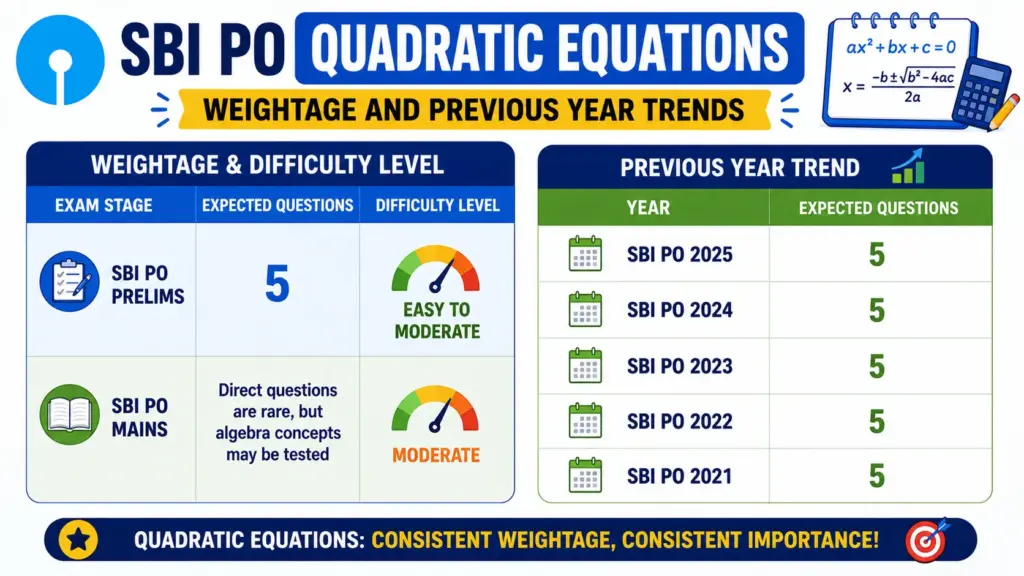
SBI PO Quadratic Equations Weightage and Previous Year Trends
One of the biggest reasons to prepare Quadratic Equations is their consistent appearance in the exam over the years. Direct quadratic equation questions are generally asked in the SBI PO Prelims exam, making this a highly scoring topic. In the Mains exam, the concepts of roots, equations, and algebra also help candidates solve advanced Quantitative Aptitude questions more accurately and efficiently.
Types of Quadratic Equation Questions Asked in SBI PO
The SBI PO exam usually asks comparison-based quadratic equation questions. However, the format can vary slightly every year. Candidates should practise different question types instead of relying on only one pattern. The most common types include:
1. Standard Quadratic Equation Comparison: You are given two equations. Solve both and compare the values of x and y.
Example:
- x² – 9x + 20 = 0
- y² – 11y + 30 = 0
2. Quadratic Equations with Coefficients: Sometimes the coefficient of x² or y² is greater than one. Candidates must remember to divide the roots by the coefficient after factorisation.
Example:
- 2x² – 14x + 24 = 0
3. Missing Middle Term Questions: These questions look difficult but become easy once you apply the identity method.
Example:
- x² – 49 = 0
4. Questions with Square Roots or Algebraic Values: These are more likely to appear in higher-level banking exams or advanced practice sets. Candidates should understand how to compare irrational roots carefully.
Example:
- If x = √5 and y = 2, then x > y because √5 ≈ 2.24.
Basic Formula Every Candidate Should Know for Quadratic Equations
Instead of directly applying lengthy formulas every time, SBI PO questions are usually solved faster using factorisation and sign analysis. Before learning shortcut tricks for Quadratic Equations for SBI PO 2026, every aspirant should know the standard quadratic equation:
ax² + bx + c = 0
where:
- a ≠ 0
- x is the unknown variable.
Golden Sign Rule for Quadratic Equations
One of the most useful Quadratic Equations for SBI PO 2026 tricks is the Golden Sign Rule. Before calculating the roots, observe the signs in the equation. It gives you an immediate idea about whether the roots will be positive or negative. Learning these simple rule helps eliminate wrong options quickly and reduces calculation time during the exam.
| Equation Pattern | Nature of Roots |
| – – | One Positive, One Negative |
| + + | Both Negative |
| – + | Both Positive |
| + – | One Positive, One Negative |
Important Concepts Before Solving Quadratic Equations
These simple concepts help improve both speed and accuracy in the SBI PO Quant section. Before solving any question, remember these important points:
- Always simplify the equation first.
- Factorise whenever possible instead of using lengthy formulas.
- Divide by the coefficient of x² or y² if required.
- Compare every possible root before selecting the answer.
- If the roots overlap, choose Relationship Cannot Be Determined (CND).
Shortcut Tricks to Solve Quadratic Equations Faster in SBI PO
Learning a few shortcuts can help you solve Quadratic Equations for SBI PO 2026 much faster in the exam. Instead of solving every equation from scratch, first identify the signs of the roots, factorise smartly, and compare the values carefully. These tricks save valuable time in both Prelims and Mains while reducing calculation errors.
1. Check the Sign of the Roots First: Before finding the actual roots, identify whether they are positive or negative. Such simple observation helps you eliminate options quickly.
| Equation Form | Nature of Roots |
| x² − bx + c = 0 | Both roots are positive |
| x² + bx + c = 0 | Both roots are negative |
| x² − bx − c = 0 | One positive, one negative |
| x² + bx − c = 0 | One positive, one negative |
2. Split the Middle Term Smartly: Once you identify these numbers, factorisation becomes easy and you can find the roots within seconds. Find two numbers that:
- Multiply to A × C
- Add up to B
3. Always Divide by the Coefficient: Many candidates forget this step and lose easy marks. If the coefficient of x² is not 1, remember to divide the obtained roots by that coefficient.
Example:
2x² − 10x + 12 = 0
Factorise:
2(x − 2)(x − 3) Roots = 2 and 3
4. Compare Every Possible Root: Never compare only one root. When comparing x and y, check every combination.
- If all x roots are greater than y roots → x > y
- If all x roots are smaller → x < y
- If comparisons overlap → Cannot Be Determined (CND)
Important Topics to Practise Along with Quadratic Equations
Although Quadratic Equations for SBI PO 2026 is an important scoring topic, it should be prepared alongside other SBI PO high-weightage Quant topics to maximise your score.
| Topic | Importance |
| Number Series | High |
| Simplification & Approximation | High |
| Quadratic Equations | High |
| Data Interpretation | Very High |
| Arithmetic Word Problems | Very High |
| Data Sufficiency | Moderate |
| Quantity Comparison | Moderate |
Common Mistakes Candidates Make in Quadratic Equations Questions
Many candidates understand the concept but still lose marks because of small calculation mistakes. Following the correct approach while solving Quadratic Equations for SBI PO 2026 can improve both speed and accuracy. Avoid these common mistakes:
- Forgetting to compare both roots.
- Ignoring the coefficient of x² before finding roots.
- Making calculation errors while factorising.
- Selecting an option after checking only one value.
- Spending too much time on difficult equations.
- Forgetting the possibility of Cannot Be Determined (CND).
- Not practising mixed-difficulty questions regularly.
Why are Quadratic Equations Important for SBI PO 2026?
Quadratic equations are among the highest-scoring topics in the SBI PO Quant section as they are direct, formula-based, and require very little calculation compared to Data Interpretation or Arithmetic. If your goal is to maximise attempts without sacrificing accuracy, quadratic equations should be one of the first topics in your preparation plan.
Here is why every banking aspirant should prepare this topic:
- Mostly asked every year in the SBI PO Prelims exam.
- Usually contains 5 direct comparison questions.
- Can be solved within 30–45 seconds after sufficient practice.
- Requires simple algebra and factorisation techniques.
- Improves overall speed in the Quantitative Aptitude section.
- Strengthens algebra concepts that are also useful for advanced Quant questions.
Do’s and Don’ts for Quadratic Equations in SBI PO Exam
Understanding a few basic habits can help you solve SBI PO quadratic equation questions more accurately in the exam.
| Do’s | Don’ts |
| Check the signs of roots first. | Start solving without analysing the equation. |
| Factorise carefully. | Ignore the coefficient of x². |
| Compare all possible roots. | Compare only one root. |
| Use shortcut techniques wherever possible. | Depend only on lengthy calculations. |
| Practice SBI PO previous year questions. | Skip revision of concepts. |
| Verify the final comparison once. | Rush to mark the answer. |
Preparation Tips for Quadratic Equations
Consistent practice is the best way to improve your performance in Quadratic Equations for SBI PO 2026. Since this topic is formula-based and highly scoring, regular revision can help you solve questions within a minute. Follow these preparation tips:
- Learn all basic factorisation techniques.
- Memorise common square numbers and multiplication tables.
- Practise at least 20–30 quadratic equation questions daily.
- Solve previous year SBI PO and IBPS PO questions.
- Attempt sectional mock tests regularly.
- Analyse every wrong answer to avoid repeating mistakes.
- Revise shortcut tricks every week.
Final Thoughts
Quadratic Equations for SBI PO 2026 remains one of the easiest scoring topics in the Quantitative Aptitude section. Candidates who understand factorisation, root comparison, and shortcut techniques can solve most questions in less than a minute. Stay consistent, revise the concepts frequently, and focus on accuracy to maximise your Quant score in both SBI PO Prelims and Mains.
Other Related Blogs on SBI PO
FAQs
1. How many Quadratic Equations questions are asked in SBI PO 2026?
Generally, around 5 questions are asked in the SBI PO Prelims exam. In Mains, the concept may appear in a more advanced or combined format.
2. Is Quadratic Equations an important topic for SBI PO Mains?
Yes. While direct comparison questions are more common in Prelims, the concepts of quadratic equations are also useful for solving higher-level algebra questions in SBI PO Mains.
3. What is the fastest way to solve Quadratic Equations for SBI PO 2026?
Use the sign rule, factorise quickly, compare all roots carefully, and apply shortcut techniques wherever possible.
4. Which method is best for solving SBI PO quadratic equation questions?
The factorisation method is the fastest for most exam questions. If factorisation is difficult, you can use the quadratic formula.
5. How much time should I spend on Quadratic Equations in the exam?
Ideally, each question should take 30–45 seconds if you have practised well.
6. Can I prepare Quadratic Equations without learning advanced algebra?
Yes. Most SBI PO questions are based on basic algebra concepts such as factorisation, root comparison, and sign analysis. Mastering these fundamentals is enough to score well.
- Sign Up on Practicemock for Updated Current Affairs, Topic Tests and Mini Mocks
- Sign Up Here to Download Free Study Material
Free Mock Tests for the Upcoming Exams
- IBPS PO Free Mock Test
- RBI Grade B Free Mock Test
- IBPS SO Free Mock Test
- NABARD Grade A Free Mock Test
- SSC CGL Free Mock Test
- IBPS Clerk Free Mock Test
- IBPS RRB PO Free Mock Test
- IBPS RRB Clerk Free Mock Test
- RRB NTPC Free Mock Test
- SSC MTS Free Mock Test
- SSC Stenographer Free Mock Test
- GATE Mechanical Free Mock Test
- GATE Civil Free Mock Test
- RRB ALP Free Mock Test
- SSC CPO Free Mock Test
- AFCAT Free Mock Test
- SEBI Grade A Free Mock Test
- IFSCA Grade A Free Mock Test
- RRB JE Free Mock Test
- Free Banking Live Test
- Free SSC Live Test