


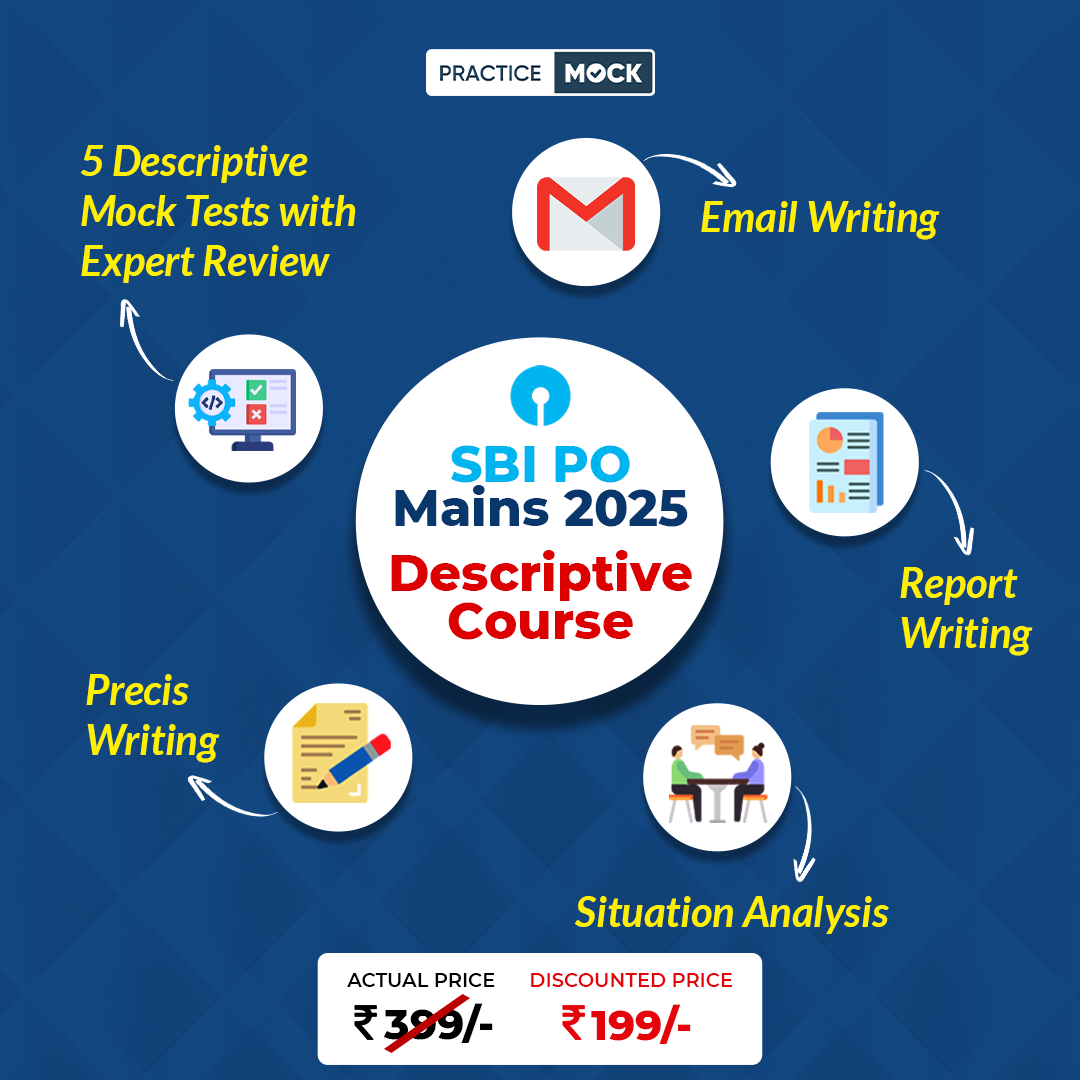
Candidates preparing through the latest SBI PO Notification 2026 should note that the SBI PO Mains Exam 2025 is scheduled for 13 September 2025, and along with the objective test, students will also face the Descriptive Paper. This part is very important as it checks how well you can write in a clear and professional way. As a future Probationary Officer, you will have to write reports, emails, and summaries in your job. The Descriptive Paper Pattern 2025 has three writing tasks: one email (choice-based), one report (choice-based), and one situation analysis or precis writing (choice-based). The paper carries 50 marks with a 30-minute time limit, and answers must be typed online.In this blog, we will provide the about the precis writing and sample questions for precis writing to help you prepare better.
What is Precis Writing?
The word precis comes from French and means “to make brief” or “precise.” A precis is basically a short summary of a longer passage, article, or essay. Its focus is to capture the main idea, important arguments, and overall structure of the original text, but in a much shorter form. It helps readers quickly understand the core message without reading the full content.In SBI PO, precis writing is asked to check how well you can understand a passage and present it in a clear, concise manner. It should not include personal opinions or extra details but only what the author has conveyed. Normally, the length of a precis is about one-third of the original passage.

Sample Questions that can be asked in the SBI PO Descriptive 2025 Exam
Question
Passage (≈300 words)
The rapid advancement of technology has significantly transformed human life in the past few decades. From the internet to artificial intelligence, innovations have reshaped communication, education, healthcare, and commerce. One of the most profound impacts has been on the way people access and share information. With smartphones and high-speed internet, knowledge is available instantly, making learning more flexible and accessible. Students can now attend virtual classes, professionals can upskill through online courses, and individuals from remote areas can connect with the rest of the world without leaving their homes.
Healthcare too has witnessed revolutionary changes. Telemedicine allows patients to consult doctors online, reducing the burden on hospitals and making healthcare more accessible in rural areas. Artificial intelligence aids in diagnosing diseases and personalising treatments, improving patient outcomes. Similarly, businesses have embraced e-commerce and digital payment systems, enabling global reach and financial inclusion. Small enterprises now have opportunities to compete with larger corporations by reaching customers worldwide through digital platforms.
However, these benefits come with challenges. The digital divide continues to exclude sections of society without internet access or digital literacy. Privacy concerns and cybercrime pose significant risks, as personal data can be misused. Moreover, overreliance on technology may lead to reduced human interaction, affecting mental health and social skills. Automation also threatens traditional jobs, raising concerns about unemployment and inequality.
Despite these drawbacks, technology’s role in human progress cannot be denied. The key lies in using it responsibly, bridging the digital gap, and ensuring that ethical considerations guide its application. If managed wisely, technology has the potential to create a more inclusive, efficient, and prosperous world.
Write a précis of the passage in about 100 words.
Answer (Précis – 100 words)
Technological advancements have revolutionised communication, education, healthcare, and commerce. The internet and smartphones have democratised access to information, enabling online learning and global connectivity. Telemedicine and artificial intelligence have improved healthcare, while e-commerce has expanded opportunities for businesses worldwide. Yet, challenges persist in the form of the digital divide, privacy risks, cybercrime, job losses, and declining social interaction. Despite these issues, technology remains vital for progress. Its benefits can be maximised by responsible use, bridging inequalities, and adhering to ethical principles, ensuring it serves as a driver of inclusive and sustainable development.
How to write a Precis for SBI PO Descriptive 2025 Exam
Precis writing is an important part of the SBI PO Descriptive Exam. It is a short summary of a long passage, written in your own words. Your task is to keep the main idea clear while removing all extra details. A precis should always be written in the third person and should not include your personal opinion. Unlike a critical analysis, it is not about giving views but about presenting the author’s thoughts in a simple and concise way.
A good precis should be short, complete, and easy to read. There is also a shorter form called a rhetorical precis, usually in four sentences, which also shows how the author presents ideas and who the target audience is. In the SBI PO exam, writing a good precis will show your ability to understand, organize, and express information clearly, skills that are very important for a future officer.
Rules of Precis Writing
- Read the passage carefully to understand the main theme.
- Note only the important points.
- Prepare a rough draft first in mind.
- Use simple and clear language.
- Write in the third person, not the first person.
- Avoid adding personal opinions or irrelevant details.
- Keep it short, logical, and to the point.
Here is what the Successful Candidates say about PracticeMock. Have a look. You never know, you may be the next one.
Join our exclusive Telegram group where our experts are ready to answer all your queries, guide you in banking exam preparation, and give personalized tips to boost your success. Get access to real-time solutions, expert advice, and valuable resources to improve your study journey.
Other Related Blogs on SBI PO 2025
FAQs
Q1. What is Precis Writing in SBI PO Descriptive Exam?
Precis Writing means writing a short, clear summary of a given passage in your own words
Q2. What is the ideal length of a Precis?
A Precis should be about one-third of the original passage length.
Q3. Can I use the same words from the passage in my Precis?
No, you must use your own words while keeping the meaning intact.
Q4. How to score well in Precis Writing?
Stick to the word limit, follow proper structure, and write in clear, concise language.
- Sign Up on Practicemock for Updated Current Affairs, Topic Tests and Mini Mocks
- Sign Up Here to Download Free Study Material
Free Mock Tests for the Upcoming Exams
- IBPS PO Free Mock Test
- RBI Grade B Free Mock Test
- IBPS SO Free Mock Test
- NABARD Grade A Free Mock Test
- SSC CGL Free Mock Test
- IBPS Clerk Free Mock Test
- IBPS RRB PO Free Mock Test
- IBPS RRB Clerk Free Mock Test
- RRB NTPC Free Mock Test
- SSC MTS Free Mock Test
- SSC Stenographer Free Mock Test
- GATE Mechanical Free Mock Test
- GATE Civil Free Mock Test
- RRB ALP Free Mock Test
- SSC CPO Free Mock Test
- AFCAT Free Mock Test
- SEBI Grade A Free Mock Test
- IFSCA Grade A Free Mock Test
- RRB JE Free Mock Test
- Free Banking Live Test
- Free SSC Live Test