


If you’re aiming to maximize your score in the Data Analysis & Interpretation section, mastering the Most Important DI Questions for SBI PO Mains 2026 is the single best way to secure a top rank. SBI has completely moved away from basic chart reading toward multi-layered, variable-based, and arithmetic-integrated DI sets. The most critical Data Interpretation (DI) types for SBI PO Mains are Caselet DI, Missing/Arithmetic Table DI, and Radar/Radar-Pie Mixed DI. The section contains 30 questions worth 60 marks, with each question worth 2 marks. Success on the Mains exam depends on strong logical reasoning, fundamental mathematical concepts (such as Time & Work, Profit & Loss, and Probability), and strategic variable elimination rather than being slowed down by artificially created mock exams. To help you master this high-weightage section, we analyzed the last 5 years of Previous Year Questions (PYQs) to bring you the top 30 expected DI sets, complete with step-by-step solutions and answer keys.
Most Important DI Questions for SBI PO Mains 2026: PYQ-Based Quiz
Below are 30 high-yield questions categorized across 6 primary Data Interpretation sets structured exactly like recent SBI PO Mains papers.

| Merchant | CP of P | Discount on P | MP of Q | Profit on Q |
|---|---|---|---|---|
| A | ₹400 | x% | ₹600 | 20% |
| B | ₹600 | 15% | ₹800 | y% |
| C | ₹500 | (x+10)% | ₹700 | 25% |
Note: For A, MP of P is 50% above CP, and SP of P equals CP of Q.
Q1. If Merchant A makes a total profit of ₹20 on Item P, what is x?
Explanation: Marked price of P for A = 400 × 1.5 = ₹600. Selling price = ₹400 + ₹20 = ₹420. Discount = ₹180. Therefore, x = 180/600 × 100 = 30%.
Q2. What is the cost price of Item Q for Merchant A under the condition in Q1?
Explanation: The note states that the selling price of Item P equals the cost price of Item Q. From Q1, selling price of P = ₹420. Therefore, cost price of Q = ₹420.
Q3. If Merchant B sells Item Q at a 10% discount on its marked price, what is y, the profit percentage on Item Q?
Explanation: Selling price of Q for B = 90% of ₹800 = ₹720. However, the cost price of Item Q for Merchant B is not given or derivable. Therefore, profit percentage y cannot be determined.
Q4. If x = 20, find the selling price of Item P for Merchant C when its marked price is ₹800.
Explanation: Discount for C = x + 10 = 30%, not 40%. Selling price = 70% of ₹800 = ₹560.
Q5. What is the ratio of the marked price of Item P for Merchant A to the marked price of Item Q for Merchant B?
Explanation: Marked price of P for A = ₹600 and marked price of Q for B = ₹800. Ratio = 600:800 = 3:4.
Q6. How many Auto Loan applications were received?
Explanation: Home Loans = 40% of 1200 = 480. Remaining applications = 720. Auto:Personal = 3:5, so Auto = 3/8 × 720 = 270.
Q7. How many Home Loan applications were approved?
Explanation: Approved Home Loans = 75% of 480 = 360.
Q8. What is the approval percentage for Auto Loans?
Explanation: Total approved = 65% of 1200 = 780. Approved Personal Loans = 60% of 450 = 270, and approved Home Loans = 360. Approved Auto Loans = 780 − 360 − 270 = 150. Approval rate = 150/270 × 100 = 55.56%.
Q9. What is the ratio of unapproved Personal Loans to unapproved Home Loans?
Explanation: Unapproved Personal Loans = 40% of 450 = 180. Unapproved Home Loans = 25% of 480 = 120. Ratio = 180:120 = 3:2.
Q10. If the average approved Auto Loan amount is ₹5 lakh, what is the total amount disbursed?
Explanation: Approved Auto Loans = 150. Total disbursed = 150 × ₹5 lakh = ₹750 lakh = ₹7.50 crore.
Q11. What is the river-current speed for Boat B1?
Explanation: Downstream speed = 120/4 = 30 km/h. Current speed = 30 − 25 = 5 km/h.
Q12. How long will Boat B2 take to cover 84 km upstream?
Explanation: Downstream speed = 120/5 = 24 km/h. Current = 24 − 18 = 6 km/h. Upstream speed = 18 − 6 = 12 km/h. Time = 84/12 = 7 hours.
Q13. What is the ratio of the upstream speed of B3 to the downstream speed of B4?
Explanation: For B3, downstream speed = 40 and current = 10, so upstream speed = 20. B4 downstream speed = 120/4.8 = 25. Ratio = 20:25 = 4:5.
Q14. B1 and B3 move toward each other from points 220 km apart in still water. When will they meet?
Explanation: Their still-water speeds are 25 and 30 km/h. Relative speed = 55 km/h. Time = 220/55 = 4 hours.
Q15. What is the average downstream speed of all four boats?
Explanation: Downstream speeds are 30, 24, 40, and 25 km/h. Average = 119/4 = 29.75 km/h.
Q16. Which parameter has the maximum percentage difference between X and Y relative to Y's score?
Explanation: Percentage differences relative to Y are: IT = 20/60 = 33.33%; Client = 10/80 = 12.5%; R&D = 20/80 = 25%; Retention = 20/70 = 28.57%; Profit = 20/70 = 28.57%. IT is highest.
Q17. What is Company X's average score across all five parameters?
Explanation: Average = (80 + 70 + 60 + 90 + 50)/5 = 350/5 = 70.
Q18. If Y's R&D expenditure is ₹160 crore for a score of 80, what is X's expected expenditure for a score of 60?
Explanation: Expenditure per score point = 160/80 = ₹2 crore. For 60 points, expenditure = 60 × 2 = ₹120 crore.
Q19. By what percentage is Y's Profit Margin score higher than X's?
Explanation: Difference = 70 − 50 = 20. Percentage higher relative to X = 20/50 × 100 = 40%.
Q20. What is the ratio of X's combined IT and Retention scores to Y's combined Client and R&D scores?
Explanation: X total = 80 + 90 = 170. Y total = 80 + 80 = 160. Ratio = 170:160 = 17:16.
Q21. How many female employees work in IT?
Explanation: IT employees = 35% of 5000 = 1750. Female share = 3/7, so females = 750.
Q22. How many post-graduate employees are in HR and Finance combined?
Explanation: HR PGs = 40% of 750 = 300. Finance PGs = 50% of 1000 = 500. Total = 800.
Q23. What is the ratio of male employees in HR to male employees in Marketing?
Explanation: HR males = 2/5 × 750 = 300. Marketing males = 1/2 × 1500 = 750. Ratio = 300:750 = 2:5.
Q24. If 20% of female IT employees leave, how many female IT employees remain?
Explanation: Initial female IT employees = 750. Remaining after 20% leave = 80% of 750 = 600.
Q25. What percentage of the total workforce are non-post-graduates in Marketing?
Explanation: Marketing employees = 30% of 5000 = 1500. Non-PGs = 70% of 1500 = 1050. Percentage of total workforce = 1050/5000 × 100 = 21%.
Q26. Quantity I: √144 × 15 − 40. Quantity II: Simple interest on ₹2,000 at 12% p.a. for 6 years.
Explanation: Quantity I = 12 × 15 − 40 = 140. Quantity II = 2000 × 12 × 6/100 = 1440. Therefore, Quantity I < Quantity II.
Q27. Quantity I: Time taken by A alone if A and B finish in 12 days and B alone in 20 days. Quantity II: Time to cover 180 km at 60 km/h.
Explanation: A's rate = 1/12 − 1/20 = 1/30, so A takes 30 days. Quantity II = 180/60 = 3 hours = 1/8 day. Hence Quantity I > Quantity II.
Q28. Find the marked price. I: Sold at 20% discount with 10% profit. II: Cost price is ₹400.
Explanation: Neither statement alone gives the marked price. Together, selling price = 110% of 400 = ₹440, and 80% of marked price = ₹440. Thus marked price = ₹550.
Q29. Find the stream speed. I: 48 km downstream in 3 hours. II: 32 km upstream in 4 hours.
Explanation: Downstream speed = 16 km/h and upstream speed = 8 km/h. Stream speed = (16 − 8)/2 = 4 km/h. Both statements are required.
Q30. Quantity I: Probability of exactly two heads in three fair-coin tosses. Quantity II: Probability of drawing a red card from 52 cards.
Explanation: Quantity I = 3/8 = 0.375. Quantity II = 26/52 = 1/2 = 0.5. Therefore, Quantity I < Quantity II.
Quiz Summary
High-Weightage DI Patterns & Trend Analysis for SBI PO Mains 2026
To clear the Mains section cut-off and maximize your score, you must understand the exact patterns SBI tests every year:

- Arithmetic-Based DI Sets: SBI PO Mains heavily weaves core arithmetic chapters into graphs and missing tables. You will rarely get direct chart questions; instead, you must apply formulas from Time & Work, Time, Speed & Distance, Boat & Stream, and Mixture & Alligation.
- Caselet Data Interpretation: Expect 1 to 2 dense caselets containing 5 to 10 questions. These are passage-based sets requiring quick categorization using Venn Diagrams, logical grids, or structured tables.
- Variable & Algebraic DI: A staple pattern in recent years where numerical values in charts are replaced by variables ($x, y, k$). Sub-questions provide algebraic conditions to find these variables first.
- Hybrid / Combination Graphs: These pair two different visual tools (e.g., Pie Chart + Table, Bar Graph + Line Chart) requiring data extraction from both sources.
Real Exam vs Mock Tests: What Toppers & Candidate Insights Reveal
A common complaint among banking aspirants on candidate forums and Reddit communities is that top mock test series make Mains DI sets excessively tough and unrealistic.
- The Reality of Mock Tests: Many mock tests rely on tedious, multi-digit calculations that waste time without testing core reasoning.
- The Reality of SBI PO Mains: The actual SBI PO Mains exam is logic-driven rather than purely calculation-heavy. While the sets look intimidating at first glance, cracking the initial logic or variable equation usually opens up all 5 sub-questions smoothly.
- Actionable Takeaway: Do not get discouraged by low scores in mock tests. Focus your practice on Previous Year Questions (PYQs) and high-quality standard sets from trusted sources like Guidely, Testbook, or Smartkeeda.
Topic-Wise Priority Matrix & Expected Weightage of DI for SBI PO Mains 2026
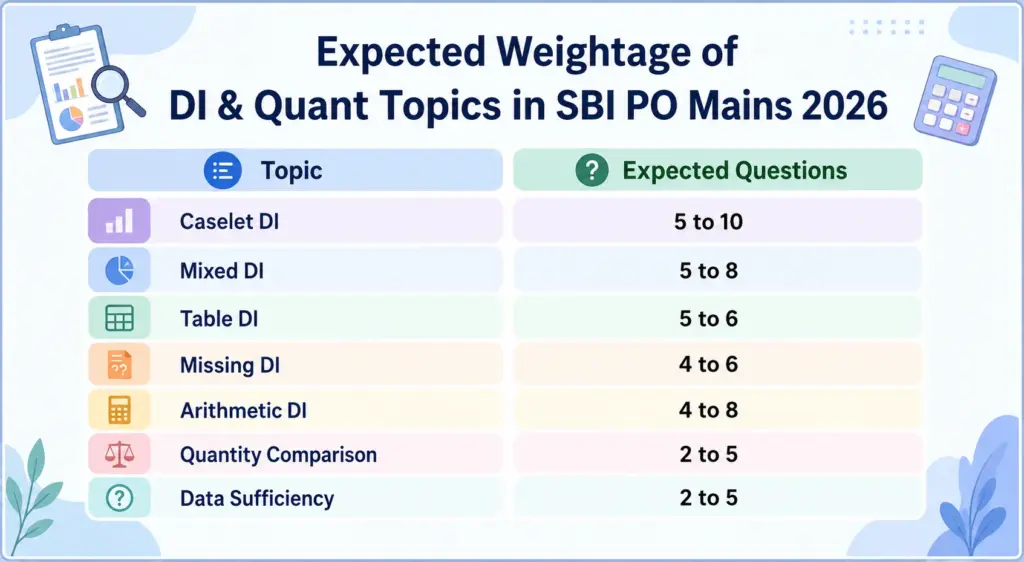
Check the expected weightage of the different types of DI for SBI PO Mains –
| DI Pattern / Topic | Expected Questions | Difficulty Level | Preparation Priority |
| Caselet DI (Paragraph/Venn) | 5 – 10 | High | Top Priority |
| Mixed DI (Pie + Table / Bar + Line) | 5 – 8 | Moderate – High | Top Priority |
| Missing & Variable Table DI | 4 – 6 | Moderate – High | High Priority |
| Arithmetic DI (Profit/Loss, TSD, T&W) | 4 – 8 | High | High Priority |
| Quantity Comparison (QA vs QB) | 2 – 5 | Moderate | Medium Priority |
| Data Sufficiency | 2 – 5 | Moderate | Medium Priority |
Proven Time Management & Set Selection Strategy for Mains DI
Attempting all 30 questions in 45 minutes under strict sectional timing is almost impossible for most candidates. The key to clearing Mains is smart selection:
- The First 2 Minutes (Scanning Phase): Quickly skim through all 30 questions. Identify the 2 or 3 DI sets that belong to your strongest arithmetic chapters.
- Prioritize Single/Double Variable Tables First: Missing tables and standard double charts (like Pie + Table) usually have a lower entry barrier than lengthy logical caselets.
- Target 12–15 High-Accuracy Questions: In SBI PO Mains, scoring 22–30 marks out of 60 puts you in the top percentile. Aim for 100% accuracy on 12 to 15 questions rather than rushing through 22 rushed attempts.
- Master Mental Math Shortcuts: Memorize percentage-to-fraction equivalents (up to 1/20), squares up to 50, and cubes up to 25 to cut down solving time per question.
| Related Articles | ||
| SBI PO Notification | SBI PO Syllabus | SBI PO Exam Date |
| SBI PO Eligibility Criteria | SBI PO Salary | SBI PO Cut Off |
| SBI PO Result | SBI PO Exam 2026 Prep | SBI PO PYQs |
Frequently Asked Questions (FAQs)
Q1. How many DI questions are asked in SBI PO Mains?
The Data Analysis & Interpretation section in SBI PO Mains contains 30 questions carrying 60 marks. The section has a fixed sectional timing of 45 minutes.
Q2. Is there sectional cut-off in SBI PO Mains Data Analysis & Interpretation?
Yes, SBI PO Mains maintains both sectional cut-offs and overall cut-offs. Candidates must qualify in each individual objective section as well as the descriptive paper.
Q3. Which arithmetic topics are most important for Mains DI?
The most high-weightage arithmetic chapters for Mains DI are Profit, Loss & Discount, Time & Work, Time, Speed & Distance, Boats & Streams, Simple & Compound Interest, and Probability.
Q4. Are actual SBI PO Mains DI questions harder than mock tests?
Usually, mock tests tend to be artificially calculation-heavy. Real SBI PO Mains questions focus more on conceptual clarity, variable solving, and logical linking rather than extremely lengthy manual calculations.
Q5. What is a good attempt score in SBI PO Mains Data Analysis & Interpretation?
Attempting 12 to 16 questions with 90%+ accuracy (yielding 24–30+ marks) is considered a very strong performance in the DAI section of SBI PO Mains.
- Sign Up on Practicemock for Updated Current Affairs, Topic Tests and Mini Mocks
- Sign Up Here to Download Free Study Material
Free Mock Tests for the Upcoming Exams
- IBPS PO Free Mock Test
- RBI Grade B Free Mock Test
- IBPS SO Free Mock Test
- NABARD Grade A Free Mock Test
- SSC CGL Free Mock Test
- IBPS Clerk Free Mock Test
- IBPS RRB PO Free Mock Test
- IBPS RRB Clerk Free Mock Test
- RRB NTPC Free Mock Test
- SSC MTS Free Mock Test
- SSC Stenographer Free Mock Test
- GATE Mechanical Free Mock Test
- GATE Civil Free Mock Test
- RRB ALP Free Mock Test
- SSC CPO Free Mock Test
- AFCAT Free Mock Test
- SEBI Grade A Free Mock Test
- IFSCA Grade A Free Mock Test
- RRB JE Free Mock Test
- Free Banking Live Test
- Free SSC Live Test