


In recent IBPS PO examinations, Mixtures & Alligations Questions for IBPS PO have become more application-based instead of testing only formulas. These questions test mean price, the rule of allegation, replacement of liquids, and ratio-based calculations. Regular practice through topic-wise quizzes, live mock tests, and downloadable PDFs helps improve both speed and accuracy. In this blog, you will get an exam-level quiz, important formulas, shortcut tricks, expert preparation tips, and a free PDF with detailed solutions to strengthen your preparation.
Mixtures & Alligations Practice Quiz with Answer Key: IBPS PO Prelims Exam-Level Questions
Here is a complete set of 10 exam-level Mixtures & Alligations Questions for IBPS PO designed according to the latest IBPS PO Preliminary exam pattern. These questions cover Mean Price, Rule of Allegation, Replacement of Liquids, and other important concepts frequently asked in the Quantitative Aptitude section.

IBPS PO Prelims: Mixtures & Alligations Practice Set
Q1. A shopkeeper mixes 20 kg of rice costing ₹40/kg with 30 kg costing ₹50/kg. Find the average cost.
Explanation: Average = [(20×40)+(30×50)]÷50 = 2300÷50 = ₹46/kg.
Q2. A milkman mixes 18 litres at ₹60/litre with 12 litres at ₹75/litre. Find the mean price.
Explanation: Mean = [(18×60)+(12×75)]÷30 = 1980÷30 = ₹66/litre.
Q3. Tea costing ₹240/kg and ₹300/kg is mixed in equal quantities. Find the average price.
Explanation: Equal quantities give average = (240+300)÷2 = ₹270/kg.
Q4. Rice costing ₹40/kg is mixed with rice costing ₹55/kg to obtain a mixture worth ₹46/kg. Find cheaper:costlier.
Explanation: By allegation, ratio = (55−46):(46−40) = 9:6 = 3:2.
Q5. Sugar worth ₹30/kg is mixed with sugar worth ₹45/kg. If the mixture costs ₹36/kg, find cheaper:costlier.
Explanation: By allegation, ratio = (45−36):(36−30) = 9:6 = 3:2.
Q6. Milk costing ₹50/litre is mixed with milk costing ₹70/litre in the ratio 2:3. Find the mixture price.
Explanation: Weighted mean = [(2×50)+(3×70)]÷5 = 310÷5 = ₹62/litre.
Q7. Tea costing ₹250/kg is mixed with tea costing ₹350/kg so that the mixture costs ₹310/kg. Find cheaper:costlier.
Explanation: By allegation, ratio = (350−310):(310−250) = 40:60 = 2:3.
Q8. A vessel contains 60 litres of milk. Twelve litres are removed and replaced with water once. How much milk remains?
Explanation: Milk remaining = 60×(1−12/60) = 60×4/5 = 48 litres.
Q9. A container contains 80 litres of pure milk. Eight litres are removed and replaced with water twice. Find pure milk left.
Explanation: Milk left = 80×(1−8/80)² = 80×(9/10)² = 64.8 litres.
Q10. A vessel contains 100 litres of juice. Twenty litres are removed and replaced with water three times. Find pure juice left.
Explanation: Juice left = 100×(1−20/100)³ = 100×(4/5)³ = 51.2 litres.
Quiz Summary
Mixtures & Alligations Questions for IBPS PO: Understanding the Exam Trend
In recent IBPS PO examinations, Mixtures & Alligations Questions for IBPS PO have become more concept-based rather than relying only on direct formulas. Most questions require candidates to apply concepts quickly and perform calculations accurately under time pressure. You can expect questions from:

- Mean Price Questions: Finding the average cost price of the final mixture.
- Rule of Allegation: Determining the ratio in which two ingredients should be mixed to obtain a desired mean price or concentration.
- Replacement Problems: Solving questions where a liquid is repeatedly removed and replaced.
- Mixture-Based Ratio Questions: Calculating the proportion of ingredients in a mixture.
- Application-Based Questions: Problems involving milk and water, chemicals, solutions, metals, and commodity mixtures.
Tip: Revise the allegation rule, replacement formula, and calculation shortcuts regularly. Strong calculation speed can help you solve these questions within a minute during the Quantitative Aptitude section.
Core Conceptual Guide: Important Mixtures & Alligations Concepts
Before solving Mixtures & Alligations Questions for IBPS PO, revise these important concepts and formulas. A strong understanding of the basics helps you solve questions faster and avoid calculation mistakes in the examination.
| Concept | Important Formula / Rule |
| Mean Price | Total Cost ÷ Total Quantity |
| Rule of Allegation | Difference method used to find the mixing ratio |
| Replacement Formula | Pure Liquid = x × (1 − y/x)ⁿ |
| Average Cost | Total Value of Mixture ÷ Total Quantity |
| Ratio Conversion | Convert ratios into actual quantities before solving |
| Percentage Mixture | Apply percentage concepts along with ratios wherever required |
Quick Revision Tip: Prepare a one-page formula sheet covering the allegation rule, replacement formula, mean price, and important ratio shortcuts. Revising these formulas daily can significantly improve your speed and accuracy during the IBPS PO exam.
Strategy Checklist to Master Mixtures & Alligations Questions for IBPS PO 2026
Scoring well in Mixtures & Alligations Questions for IBPS PO requires more than memorising formulas. You also need the right strategy to identify the correct approach quickly, minimise calculations, and manage your time effectively. Follow these simple preparation tips to improve your performance in both the Preliminary and Main examinations.
1. Learn the Important Formulas Thoroughly: Most questions are based on a few standard formulas. Revise these regularly before solving practice questions.
Focus on:
- Mean Price Formula
- Rule of Allegation
- Replacement Formula
- Ratio and Proportion
- Percentage Calculations
2. Understand Which Formula to Apply: Many students know the formulas but struggle to choose the correct one. Before solving any question:
- Read the complete question carefully.
- Identify whether it is based on Mean Price, Allegation, or Replacement.
- Apply only the relevant formula.
3. Improve Your Calculation Speed: Fast calculations can save valuable time during the Quantitative Aptitude section. Practise:
- Fraction to percentage conversions
- Multiplication shortcuts
- Division tricks
- Ratio simplification
- Percentage calculations
4. Use the Allegation Method: Whenever Possible” Instead of solving lengthy equations, apply the Rule of Allegation wherever applicable. It helps you:
- Find mixing ratios quickly.
- Reduce calculation time.
- Solve questions in fewer steps.
5. Practise Under Time Limits: Regular timed practice builds confidence and improves question selection. A good practice routine is:
- Easy Question: 30–40 seconds
- Moderate Question: 45–60 seconds
- Difficult Question: Skip initially and revisit later if time permits.
6. Attempt Daily Quantitative Aptitude Mock Tests: The best way to improve is through regular practice. Consistent practice helps improve both speed and accuracy. After every mock test:
- Check incorrect answers.
- Understand the concept behind each mistake.
- Revise important formulas.
- Reattempt similar questions.
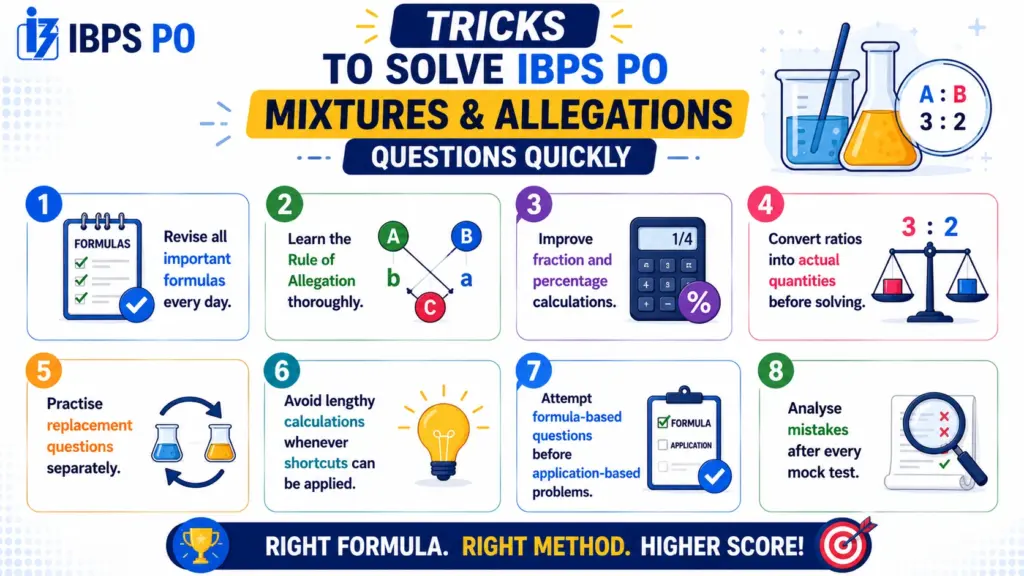
Tricks to Solve IBPS PO Mixtures & Alligations Questions Quickly
Following the right approach can improve both your speed and accuracy. Instead of depending only on formulas, learn to identify the question type first and apply the shortest solving method.
- Revise all important formulas every day.
- Learn the Rule of Allegation thoroughly.
- Improve fraction and percentage calculations.
- Convert ratios into actual quantities before solving.
- Practise replacement questions separately.
- Avoid lengthy calculations whenever shortcuts can be applied.
- Attempt formula-based questions before application-based problems.
- Analyse mistakes after every mock test.
Daily Practice Plan for IBPS PO Mixtures & Alligations Questions
A consistent practice routine improves formula retention, calculation speed, and overall Quantitative Aptitude performance. Following this schedule every day will strengthen your concepts and help you solve Mixtures & Alligations Questions for IBPS PO quickly and confidently in the actual exam.
| Time | Activity |
| 20 Minutes | Revise important formulas |
| 30 Minutes | Solve Mixtures & Alligations questions |
| 20 Minutes | Attempt Quant sectional quiz |
| 20 Minutes | Analyse mistakes and revise concepts |
| 15 Minutes | Practise calculation shortcuts and simplification |
Final Thoughts
Practising Mixtures & Alligations Questions for IBPS PO regularly can significantly improve your Quantitative Aptitude score. Start by learning the basic formulas, understand the Rule of Allegation, and practise replacement concepts until they become easy to apply. Focus on solving topic-wise questions before attempting full-length mock tests. After every practice session, analyse your mistakes and revise the formulas you find difficult. With regular revision, smart calculation techniques, and consistent mock test practice, you can solve Mixtures & Alligations questions quickly and confidently in the IBPS PO 2026 examination.
Related Blogs
FAQs
Q1. How many Mixtures & Alligations Questions are asked in the IBPS PO exam?
Ans: Candidates can generally expect 1–3 Mixtures & Alligations Questions in the IBPS PO Preliminary examination. Similar or slightly more application-based questions may also appear in the Main examination.
Q2. Which concepts are most important for Mixtures & Alligations Questions in the IBPS PO exam?
Ans: The most important concepts include Mean Price, Rule of Allegation, Replacement of Liquids, Ratio & Proportion, Percentage Calculations, and Mixture-Based Applications. These concepts form the foundation of most questions asked in recent IBPS PO exams.
Q3. How can I improve my accuracy in Mixtures & Alligations Questions for IBPS PO?
Ans: Improve your accuracy by revising formulas regularly, practising topic-wise questions, improving calculation speed, and analysing every mock test. Regular practice helps you identify the correct approach quickly and avoid common mistakes.
Q4. How much time should I spend on one Mixtures & Alligations question in the IBPS PO Prelims exam?
Ans: Try to solve an easy question within 30–40 seconds and a moderate question within 45–60 seconds. If a question seems lengthy, skip it initially and return to it later if time permits.
Q5. Is Mixtures & Alligations an important topic for the IBPS PO Quantitative Aptitude section?
Ans: Yes. Mixtures & Alligations Questions for IBPS PO are considered an important arithmetic topic because they are largely formula-based and can help candidates score quick marks with proper preparation.
Q6. Is mock test analysis important for Mixtures & Alligations preparation?
Ans: Absolutely. Mock test analysis helps you identify calculation mistakes, strengthen weak concepts, improve speed, and learn the most efficient solving methods for exam-level questions.
Q7. Can beginners score well in IBPS PO Mixtures & Alligations Questions?
Ans: Yes. Beginners can score well by first understanding the basic formulas and concepts, then practising topic-wise questions regularly. Consistent revision and sectional mock tests gradually improve both confidence and accuracy.
Q8. Where can I practise free IBPS PO Mixtures & Alligations Questions?
Ans: You can practise free Mixtures & Alligations Questions for IBPS PO through PracticeMock’s full-length mock tests, Quantitative Aptitude sectional tests, topic-wise quizzes, and downloadable PDFs. Regular practice on exam-level questions helps improve speed, accuracy, and overall performance before the examination.
- Sign Up on Practicemock for Updated Current Affairs, Topic Tests and Mini Mocks
- Sign Up Here to Download Free Study Material
Free Mock Tests for the Upcoming Exams
- IBPS PO Free Mock Test
- RBI Grade B Free Mock Test
- IBPS SO Free Mock Test
- NABARD Grade A Free Mock Test
- SSC CGL Free Mock Test
- IBPS Clerk Free Mock Test
- IBPS RRB PO Free Mock Test
- IBPS RRB Clerk Free Mock Test
- RRB NTPC Free Mock Test
- SSC MTS Free Mock Test
- SSC Stenographer Free Mock Test
- GATE Mechanical Free Mock Test
- GATE Civil Free Mock Test
- RRB ALP Free Mock Test
- SSC CPO Free Mock Test
- AFCAT Free Mock Test
- SEBI Grade A Free Mock Test
- IFSCA Grade A Free Mock Test
- RRB JE Free Mock Test
- Free Banking Live Test
- Free SSC Live Test