


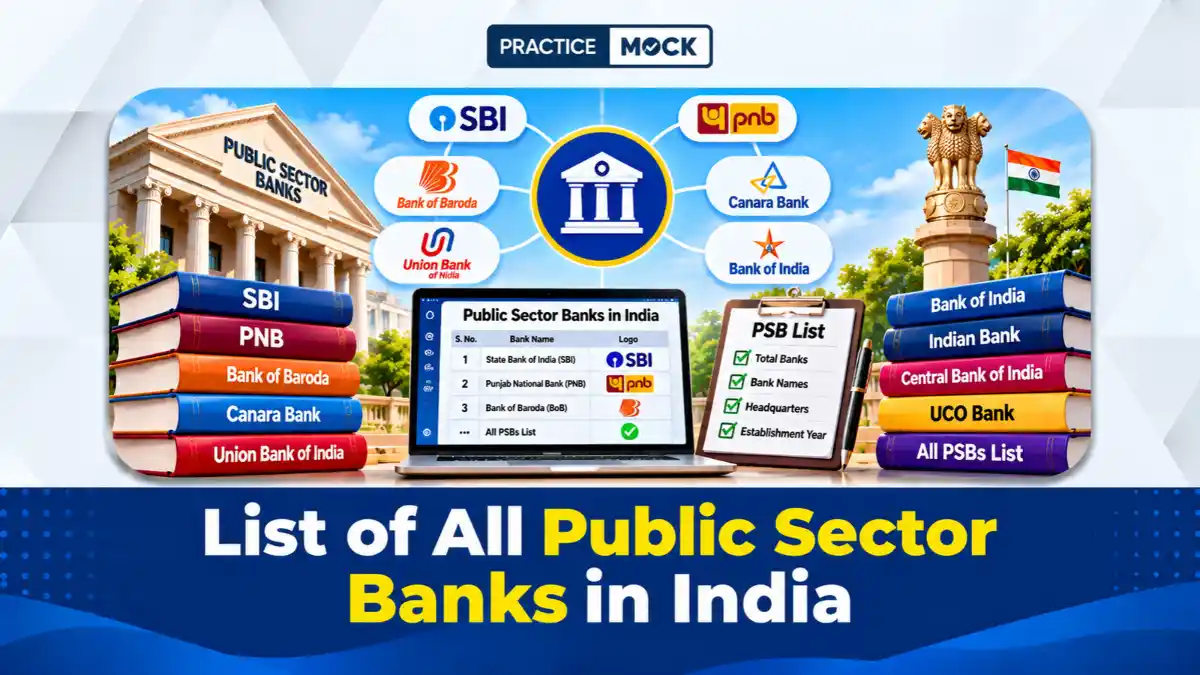
The List of All Public Sector Banks in India 2026 is an important topic for candidates preparing for banking examinations such as IBPS PO, IBPS Clerk, SBI PO, SBI Clerk, IBPS RRB PO, RBI Grade B and other competitive examinations. India currently has 12 Public Sector Banks (PSBs), including the State Bank of India and 11 other nationalised banks. These banks play an important role in the country’s financial system by providing banking services, supporting economic activities and implementing various government-backed financial initiatives.
The Department of Financial Services (DFS), Ministry of Finance, Government of India, maintains the official list of Public Sector Banks in India. Candidates preparing for Banking Awareness should remember the names of all 12 banks along with their headquarters, commonly associated taglines and establishment years. Questions based on bank headquarters, nationalisation, merger history and important banking facts frequently form part of static Banking Awareness preparation.

This article provides the complete List of All Public Sector Banks in India 2026, their headquarters and taglines. It also covers their establishment years, city-wise classification, important historical developments, major bank mergers and frequently asked questions for competitive examinations.
List of All Public Sector Banks in India 2026
There are 12 Public Sector Banks operating in India in 2026. These banks are under the public sector category, with the Government of India holding a majority ownership stake. The Reserve Bank of India (RBI) regulates and supervises their banking operations.
The table below provides the complete list of Public Sector Banks in India, along with their headquarters, establishment years and commonly associated taglines.
| No. | Public Sector Bank | Headquarters | Established | Tagline |
| 1 | State Bank of India (SBI) | Mumbai, Maharashtra | 1955 | The Banker to Every Indian |
| 2 | Punjab National Bank (PNB) | New Delhi | 1894 | The Name You Can Bank Upon |
| 3 | Bank of Baroda (BoB) | Vadodara, Gujarat | 1908 | India’s International Bank |
| 4 | Canara Bank | Bengaluru, Karnataka | 1906 | Together We Can |
| 5 | Union Bank of India | Mumbai, Maharashtra | 1919 | Good People to Bank With |
| 6 | Bank of India (BOI) | Mumbai, Maharashtra | 1906 | Relationship Beyond Banking |
| 7 | Indian Bank | Chennai, Tamil Nadu | 1907 | Your Own Bank, Always with You |
| 8 | Central Bank of India | Mumbai, Maharashtra | 1911 | Central to You Since 1911 |
| 9 | Indian Overseas Bank (IOB) | Chennai, Tamil Nadu | 1937 | Good People to Grow With |
| 10 | UCO Bank | Kolkata, West Bengal | 1943 | Honours Your Trust |
| 11 | Bank of Maharashtra | Pune, Maharashtra | 1935 | One Family, One Bank |
| 12 | Punjab & Sind Bank | New Delhi | 1908 | Where Service is a Way of Life |
Note: The taglines mentioned above are the commonly associated brand lines used in Banking Awareness preparation. Banks may also use additional promotional slogans for specific campaigns. For example, SBI has historically used the line “Pure Banking, Nothing Else”, while Indian Bank’s current brand line is “Your Own Bank, Always with You”.
Headquarters clarification: Bank of Baroda’s head office is in Vadodara, Gujarat, while its Corporate Centre is in Mumbai. Candidates should remember Vadodara as its headquarters rather than confusing it with the location of its Corporate Centre.
Key Facts About Public Sector Banks in India 2026
Candidates should remember the following important facts about Public Sector Banks in India for quick revision before banking and government examinations:
- Total Public Sector Banks in India: 12
- Largest Public Sector Bank in India: State Bank of India (SBI)
- Banks Headquartered in Mumbai: 4
- Banks Headquartered in New Delhi: 2
- Banks Headquartered in Chennai: 2
- Banks Headquartered in Vadodara: 1
- Banks Headquartered in Bengaluru: 1
- Banks Headquartered in Pune: 1
- Banks Headquartered in Kolkata: 1
- Regulatory Authority: Reserve Bank of India (RBI)
- Administrative Department: Department of Financial Services, Ministry of Finance
- First Major Bank Nationalisation: 19 July 1969
- Second Phase of Bank Nationalisation: 15 April 1980
- Latest Major Public Sector Bank Consolidation: 2020
- Number of Public Sector Banks After Consolidation: 12
City-Wise List of Public Sector Banks in India
Remembering the headquarters of all 12 Public Sector Banks can be easier when they are grouped according to their respective cities. Mumbai has the highest number of public sector banks headquartered within it, followed by New Delhi and Chennai.
The following table provides a city-wise list of Public Sector Banks in India for quick revision.
| City | Public Sector Banks | Number of Banks |
| Mumbai | State Bank of India, Bank of India, Central Bank of India, Union Bank of India | 4 |
| New Delhi | Punjab National Bank, Punjab & Sind Bank | 2 |
| Chennai | Indian Bank, Indian Overseas Bank | 2 |
| Vadodara | Bank of Baroda | 1 |
| Bengaluru | Canara Bank | 1 |
| Pune | Bank of Maharashtra | 1 |
| Kolkata | UCO Bank | 1 |
| Total | 12 Public Sector Banks | 12 |
Important City-Wise Headquarters Facts
- Mumbai has the headquarters of four Public Sector Banks: SBI, Bank of India, Central Bank of India and Union Bank of India.
- New Delhi has two Public Sector Banks: Punjab National Bank and Punjab & Sind Bank.
- Chennai has two Public Sector Banks: Indian Bank and Indian Overseas Bank.
- Bank of Baroda is headquartered in Vadodara, Gujarat.
- Canara Bank is headquartered in Bengaluru, Karnataka.
- Bank of Maharashtra is headquartered in Pune, Maharashtra.
- UCO Bank is headquartered in Kolkata, West Bengal.
Quick Revision Trick: Remember the two banks beginning with “Indian” under Chennai: Indian Bank and Indian Overseas Bank. Similarly, the two banks beginning with “Punjab” under New Delhi are Punjab National Bank and Punjab & Sind Bank.
Establishment Year of All 12 Public Sector Banks in India
The establishment years of Public Sector Banks are important for Static GK and Banking Awareness questions. Candidates should revise the founding years along with the headquarters and taglines of these banks.
The following table provides the establishment years in chronological order.
| Year | Public Sector Bank |
| 1894 | Punjab National Bank |
| 1906 | Canara Bank and Bank of India |
| 1907 | Indian Bank |
| 1908 | Bank of Baroda and Punjab & Sind Bank |
| 1911 | Central Bank of India |
| 1919 | Union Bank of India |
| 1935 | Bank of Maharashtra |
| 1937 | Indian Overseas Bank |
| 1943 | UCO Bank |
| 1955 | State Bank of India |
Important: The establishment year and the year a bank began business may differ. For example, Punjab National Bank was founded in 1894 and commenced business in 1895, while Indian Bank was incorporated on 5 March 1907 and began its business on 15 August 1907.
Important Facts About Each Public Sector Bank in India
Apart from headquarters and taglines, candidates should also understand the historical background of major Public Sector Banks. Questions may be asked about their founders, establishment years, nationalisation and merger history.
The following points provide important information about all 12 Public Sector Banks in India.
1. State Bank of India (SBI)
The State Bank of India is the largest public sector bank in India and one of the country’s most prominent financial institutions. It was constituted on 1 July 1955, following the nationalisation of the Imperial Bank of India. Its institutional history goes back further to the Bank of Calcutta, established in 1806.
- Headquarters: Mumbai, Maharashtra
- Established as SBI: 1 July 1955
- Historical Predecessor: Bank of Calcutta (1806)
- Tagline: The Banker to Every Indian
- Important Fact: SBI is the largest commercial bank in India in terms of assets, deposits, branches and customer base.
2. Punjab National Bank (PNB)
Punjab National Bank was established on 19 May 1894 with the objective of creating a truly national bank to support India’s economic interests. It commenced its banking operations on 12 April 1895 in Lahore. PNB has expanded significantly over the years and absorbed other banks as part of India’s public sector banking consolidation.
- Headquarters: New Delhi
- Established: 1894
- Tagline: The Name You Can Bank Upon
- Important Fact: PNB is one of the oldest Indian banks founded with Indian capital.
- Major Merger: Oriental Bank of Commerce and United Bank of India were amalgamated with PNB on 1 April 2020.
3. Bank of Baroda (BoB)
Bank of Baroda was established on 20 July 1908 by Maharaja Sayajirao Gaekwad III in Baroda, now known as Vadodara, Gujarat. It was nationalised in 1969 along with 13 other major commercial banks. The bank later expanded through domestic and international operations.
- Headquarters: Vadodara, Gujarat
- Established: 1908
- Founder: Maharaja Sayajirao Gaekwad III
- Tagline: India’s International Bank
- Important Fact: Dena Bank and Vijaya Bank were amalgamated with Bank of Baroda on 1 April 2019.
4. Canara Bank
Canara Bank was founded in July 1906 by Shri Ammembal Subba Rao Pai in Mangalore, Karnataka. It grew from a regional banking institution into a major public sector bank after nationalisation in 1969. The bank has its headquarters in Bengaluru, Karnataka.
- Headquarters: Bengaluru, Karnataka
- Established: 1906
- Founder: Ammembal Subba Rao Pai
- Tagline: Together We Can
- Important Fact: Syndicate Bank was amalgamated with Canara Bank on 1 April 2020.
5. Union Bank of India
Union Bank of India was registered on 11 November 1919 and was inaugurated by Mahatma Gandhi in 1919. The bank has its headquarters in Mumbai, Maharashtra. It became a major public sector bank after nationalisation in 1969 and expanded its operations through the amalgamation of other banks.
- Headquarters: Mumbai, Maharashtra
- Established: 1919
- Tagline: Good People to Bank With
- Important Fact: Andhra Bank and Corporation Bank were amalgamated with Union Bank of India on 1 April 2020.
6. Bank of India (BOI)
Bank of India was established on 7 September 1906 by a group of eminent businessmen from Mumbai. It initially operated as a privately owned bank and was nationalised in July 1969 along with 13 other major commercial banks.
- Headquarters: Mumbai, Maharashtra
- Established: 1906
- Tagline: Relationship Beyond Banking
- Important Fact: Bank of India is one of the banks nationalised during the first phase of bank nationalisation in 1969.
7. Indian Bank
Indian Bank was incorporated on 5 March 1907 and commenced its banking business on 15 August 1907. It was established with an authorised capital of ₹20 lakh. The bank has its headquarters in Chennai, Tamil Nadu, and operates across different regions of India.
- Headquarters: Chennai, Tamil Nadu
- Established: 1907
- Tagline: Your Own Bank, Always with You
- Important Fact: Allahabad Bank was amalgamated with Indian Bank on 1 April 2020.
8. Central Bank of India
Central Bank of India was established in 1911 and was the first Indian commercial bank to be wholly owned and managed by Indians. It was founded by Sir Sorabji Pochkhanawala, while Sir Pherozeshah Mehta became its first Chairman. The bank is headquartered in Mumbai, Maharashtra.
- Headquarters: Mumbai, Maharashtra
- Established: 1911
- Founder: Sir Sorabji Pochkhanawala
- Tagline: Central to You Since 1911
- Important Fact: It is widely recognised as the first Indian commercial bank wholly owned and managed by Indians.
9. Indian Overseas Bank (IOB)
Indian Overseas Bank was established on 10 February 1937 by Shri M.Ct.M. Chidambaram Chettyar. The bank was founded with the objective of specialising in foreign exchange business and overseas banking. It began operations simultaneously at Karaikudi, Chennai and Rangoon in Burma, now Myanmar.
- Headquarters: Chennai, Tamil Nadu
- Established: 10 February 1937
- Founder: M.Ct.M. Chidambaram Chettyar
- Tagline: Good People to Grow With
- Important Fact: Indian Overseas Bank was nationalised in 1969.
10. UCO Bank
UCO Bank was established on 6 January 1943 as United Commercial Bank Limited. It was founded by industrialist Ghanshyam Das Birla, with its registered and head office in Kolkata. The bank was nationalised in 1969 and renamed UCO Bank with effect from 30 December 1985.
- Headquarters: Kolkata, West Bengal
- Established: 6 January 1943
- Founder: Ghanshyam Das Birla
- Original Name: United Commercial Bank
- Tagline: Honours Your Trust
- Important Fact: The bank’s name changed from United Commercial Bank to UCO Bank in 1985.
11. Bank of Maharashtra
Bank of Maharashtra was registered on 16 September 1935 in Pune, Maharashtra. It was established by a group of visionaries with the objective of providing banking services to sections of society that had limited access to formal banking facilities. The bank was nationalised in 1969.
- Headquarters: Pune, Maharashtra
- Established: 1935
- Tagline: One Family, One Bank
- Important Fact: The bank was registered in Pune and continues to have its head office in the city.
12. Punjab & Sind Bank
Punjab & Sind Bank was established on 24 June 1908 with the vision of supporting economically weaker sections of society. Its founding vision was associated with prominent personalities such as Bhai Vir Singh, Sir Sunder Singh Majitha and Sardar Tarlochan Singh. The bank was nationalised in 1980.
- Headquarters: New Delhi
- Established: 1908
- Tagline: Where Service is a Way of Life
- Important Fact: Punjab & Sind Bank was among the six banks nationalised in the second phase of bank nationalisation in 1980.
What Are Public Sector Banks?
Public Sector Banks (PSBs) are banking institutions in which the Government of India holds a majority ownership stake. They operate under the regulatory and supervisory framework of the Reserve Bank of India and provide a wide range of financial services to individuals, businesses, farmers and other customers.
Public Sector Banks are an important part of India’s banking system because they support financial inclusion, provide credit to different sectors and help implement government-backed financial schemes. They serve customers through branches, ATMs, digital banking platforms and other banking channels.
The main functions of Public Sector Banks include:
- Accepting Deposits: Public Sector Banks accept deposits from individuals, businesses and institutions through savings accounts, current accounts, fixed deposits and recurring deposits.
- Providing Loans and Advances: These banks offer different credit facilities to individuals, farmers, small businesses, MSMEs and large industries. Their lending activities support consumption, business expansion and economic development.
- Promoting Financial Inclusion: Public Sector Banks help expand banking access to rural, semi-urban and underserved areas. They support initiatives designed to bring more people into the formal banking system.
- Implementing Government Schemes: PSBs play an important role in implementing government-backed financial programmes, including direct benefit transfers and eligible loan or financial inclusion schemes.
- Supporting Agriculture and MSMEs: Public Sector Banks provide credit to farmers, self-help groups, micro-enterprises and small businesses. These services help support employment, income generation and economic activity.
- Facilitating Digital Payments: PSBs provide digital banking facilities such as internet banking, mobile banking, UPI, NEFT, RTGS and IMPS, enabling customers to make transactions conveniently.
Importance of Public Sector Banks for Banking Exams
Public Sector Banks are an important part of Static General Awareness and Banking Awareness preparation. Questions may be asked about their headquarters, taglines, establishment years, mergers, nationalisation and important historical developments.
Candidates preparing for the following examinations should revise this topic:
- IBPS PO
- IBPS Clerk
- IBPS RRB PO
- IBPS RRB Clerk
- SBI PO
- SBI Clerk
- RBI Grade B
- RBI Assistant
- NABARD Grade A
- Other banking and insurance examinations
Important Topics to Prepare
Candidates should give special attention to the following areas while preparing the topic of Public Sector Banks in India:
- Names of all 12 Public Sector Banks.
- Headquarters of all Public Sector Banks.
- Taglines and brand slogans of banks.
- Establishment years and founders of major banks.
- Bank nationalisation dates in 1969 and 1980.
- Major bank mergers in 2017, 2019 and 2020.
- Largest Public Sector Bank in India.
- RBI’s role as the regulator and supervisor of banks.
- Department of Financial Services and its administrative role.
- Differences between Public Sector Banks, Private Sector Banks and Regional Rural Banks.
Candidates should practise recalling the bank names along with their headquarters and taglines instead of memorising these details separately. This makes it easier to solve match-the-following and direct factual questions in competitive examinations.
How Many Public Sector Banks Are There in India in 2026?
There are 12 Public Sector Banks in India in 2026, according to the Department of Financial Services, Ministry of Finance, Government of India.
These 12 banks comprise the State Bank of India and 11 other nationalised banks. The RBI’s banking directory also lists SBI separately from the nationalised banks, which is an important distinction for Banking Awareness preparation.
The current list includes:
- State Bank of India
- Punjab National Bank
- Bank of Baroda
- Canara Bank
- Union Bank of India
- Bank of India
- Indian Bank
- Central Bank of India
- Indian Overseas Bank
- UCO Bank
- Bank of Maharashtra
- Punjab & Sind Bank
Candidates should use the current official list rather than older lists containing banks that have since been merged into other institutions.
Difference Between Public Sector Banks and Nationalised Banks
Public Sector Banks and nationalised banks are closely related terms, but they are not always interchangeable. A Public Sector Bank is a broader category based on public ownership, while a nationalised bank refers to a bank brought under government ownership through the nationalisation process.
In the current list of 12 Public Sector Banks, the State Bank of India is included as a PSB, although it was constituted under the State Bank of India Act, 1955 rather than being nationalised in the 1969 or 1980 phases.
| Basis | Public Sector Banks | Nationalised Banks |
| Meaning | Banks where the government holds a majority ownership stake | Banks brought under government ownership through nationalisation |
| Ownership | Majority government ownership | Government ownership following nationalisation |
| Coverage | Includes SBI and nationalised banks in the current PSB list | Refers to banks nationalised under the applicable legislation |
| Current Exam Context | 12 Public Sector Banks | SBI is usually listed separately from the nationalised banks |
Important for Exams: India has 12 Public Sector Banks, including SBI. Do not incorrectly describe SBI as one of the 14 banks nationalised on 19 July 1969.
Nationalisation of Banks in India
Bank nationalisation was an important turning point in the development of the Indian banking system. The government introduced nationalisation to expand access to banking services, support priority sectors and align the banking system with the country’s development objectives.
India witnessed two major phases of bank nationalisation.
First Phase of Bank Nationalisation – 19 July 1969
On 19 July 1969, the Government of India nationalised 14 major commercial banks with deposits exceeding the prescribed threshold. The move aimed to make banking services more accessible and direct credit towards sectors that required greater financial support.
Some important objectives of the first phase included:
- Expanding banking facilities in rural and semi-urban areas.
- Mobilising household savings through formal banking channels.
- Increasing credit availability to agriculture and small businesses.
- Reducing the concentration of economic power.
- Supporting balanced economic development.
Second Phase of Bank Nationalisation – 15 April 1980
The second phase of bank nationalisation took place on 15 April 1980, when the Government of India nationalised six additional commercial banks.
The second phase further expanded the public sector’s role in the banking industry and strengthened the government’s control over the allocation of banking credit.
Important Exam Facts:
| Particulars | Details |
| First Phase of Nationalisation | 19 July 1969 |
| Number of Banks Nationalised in 1969 | 14 |
| Second Phase of Nationalisation | 15 April 1980 |
| Number of Banks Nationalised in 1980 | 6 |
| Number of Banks Nationalised in Both Phases | 20 |
Public Sector Banks Merger List in India
The consolidation of Public Sector Banks was undertaken to create stronger banking institutions with wider branch networks, improved operational capacity and greater ability to support large-scale lending.
Several banks were amalgamated with larger public sector banks between 1993 and 2020. These mergers reduced the number of standalone Public Sector Banks and reshaped India’s banking landscape.
The following table provides the major bank mergers relevant to Banking Awareness examinations.
| Effective Date | Merged Bank / Banks | Merged Into |
| 4 September 1993 | New Bank of India | Punjab National Bank |
| 1 April 2017 | State Bank of Bikaner and Jaipur | State Bank of India |
| 1 April 2017 | State Bank of Hyderabad | State Bank of India |
| 1 April 2017 | State Bank of Mysore | State Bank of India |
| 1 April 2017 | State Bank of Patiala | State Bank of India |
| 1 April 2017 | State Bank of Travancore | State Bank of India |
| 1 April 2017 | Bharatiya Mahila Bank | State Bank of India |
| 1 April 2019 | Dena Bank and Vijaya Bank | Bank of Baroda |
| 1 April 2020 | Oriental Bank of Commerce and United Bank of India | Punjab National Bank |
| 1 April 2020 | Andhra Bank and Corporation Bank | Union Bank of India |
| 1 April 2020 | Syndicate Bank | Canara Bank |
| 1 April 2020 | Allahabad Bank | Indian Bank |
Major Public Sector Bank Merger in 2020
The major consolidation phase took effect on 1 April 2020, when 10 Public Sector Banks were amalgamated into four larger banks.
The four major amalgamations were:
- Punjab National Bank: Oriental Bank of Commerce and United Bank of India merged with PNB.
- Canara Bank: Syndicate Bank merged with Canara Bank.
- Union Bank of India: Andhra Bank and Corporation Bank merged with Union Bank.
- Indian Bank: Allahabad Bank merged with Indian Bank.
Following the consolidation process, the number of Public Sector Banks in India came down from 27 in 2017 to 12 by 2020.
Public Sector Banks vs Private Sector Banks
Public Sector Banks and Private Sector Banks are two major categories of commercial banks in India. The main difference between them relates to ownership and control.
| Basis | Public Sector Banks | Private Sector Banks |
| Ownership | Government holds a majority stake | Ownership is mainly with private shareholders |
| Management | Operate under public-sector ownership and governance structures | Operate under private-sector ownership and governance structures |
| Regulation | Regulated by RBI | Regulated by RBI |
| Main Objective | Commercial banking along with public-sector and financial inclusion responsibilities | Commercial banking and financial services |
| Examples | SBI, PNB, Bank of Baroda, Canara Bank | HDFC Bank, ICICI Bank, Axis Bank, Kotak Mahindra Bank |
Both Public Sector Banks and Private Sector Banks operate under the applicable banking laws and RBI regulatory framework.
Difference Between Public Sector Banks and Regional Rural Banks
Regional Rural Banks (RRBs) are different from Public Sector Banks. They were established to improve access to banking and credit facilities in rural areas, particularly for small farmers, agricultural labourers, artisans and small entrepreneurs.
| Basis | Public Sector Banks | Regional Rural Banks |
| Main Objective | Provide broad commercial banking services | Focus on banking and credit requirements in rural areas |
| Area of Operation | Nationwide and other authorised locations | Primarily rural and semi-urban areas within their notified regions |
| Establishment Framework | Different banking laws and statutes, depending on the bank | Regional Rural Banks Act, 1976 |
| Customer Focus | Individuals, businesses, farmers and institutions | Small farmers, agricultural labourers, artisans and rural customers |
| Examples | SBI, PNB, Canara Bank | Uttar Pradesh Gramin Bank, Rajasthan Gramin Bank |
Important: Regional Rural Banks are a separate category and are not included in the list of 12 Public Sector Banks in India.
Conclusion
The List of All Public Sector Banks in India 2026 is an important topic for Banking Awareness and General Awareness preparation. India currently has 12 Public Sector Banks, including SBI and 11 other nationalised banks. Candidates should remember their headquarters, taglines, establishment years and major merger history to strengthen their preparation for banking examinations. Revising the city-wise classification and nationalisation timeline can also help with quick factual questions. For more banking awareness notes, exam-oriented study material and practice resources, visit PracticeMock.
Also Read:
| Daily Current Affairs for Banking & Govt Exams | Weekly Current Affairs PDF 2026 |
| Daily Current Affairs Quizzes | The Hindu Editorial Vocabulary |
Attempt a Free Banking Mock Test Today
| IBPS Clerk Mock Test | SBI PO Mock Test | IBPS RRB PO Mock Test |
| IBPS PO Mock Test | SBI Clerk Mock Test | IBPS RRB Clerk Mock Test |
Powerful Courses for Banking Exams:

FAQs on List of All Public Sector Banks in India 2026
1. How many Public Sector Banks are there in India in 2026?
There are 12 Public Sector Banks in India in 2026, according to the Department of Financial Services, Ministry of Finance, Government of India.
2. Which are the 12 Public Sector Banks in India?
The 12 Public Sector Banks are State Bank of India, Punjab National Bank, Bank of Baroda, Canara Bank, Union Bank of India, Bank of India, Indian Bank, Central Bank of India, Indian Overseas Bank, UCO Bank, Bank of Maharashtra and Punjab & Sind Bank.
3. Which is the largest Public Sector Bank in India?
The State Bank of India (SBI) is the largest Public Sector Bank in India. It is also the country’s largest commercial bank in terms of assets, deposits, branches and customer base.
4. Which Public Sector Banks have their headquarters in Mumbai?
Four Public Sector Banks have their headquarters in Mumbai: State Bank of India, Bank of India, Central Bank of India and Union Bank of India.
5. Which Public Sector Banks are headquartered in New Delhi?
Punjab National Bank and Punjab & Sind Bank have their headquarters in New Delhi.
6. Which Public Sector Banks are headquartered in Chennai?
Indian Bank and Indian Overseas Bank have their headquarters in Chennai, Tamil Nadu.
7. What is the tagline of State Bank of India?
The commonly associated tagline of State Bank of India is “The Banker to Every Indian.” The bank has also used other promotional lines, including “Pure Banking, Nothing Else”.
8. What is the tagline of Punjab National Bank?
The tagline of Punjab National Bank is “The Name You Can Bank Upon.”
9. What is the tagline of Bank of Baroda?
The commonly associated tagline of Bank of Baroda is “India’s International Bank.”
10. What is the tagline of Canara Bank?
The tagline of Canara Bank is “Together We Can.”
11. What is the tagline of Indian Bank?
Indian Bank’s current brand line is “Your Own Bank, Always with You.”
12. Which Public Sector Bank was established in 1911?
Central Bank of India was established in 1911. It is known as the first Indian commercial bank wholly owned and managed by Indians.
13. When were banks nationalised in India?
The first major phase of bank nationalisation took place on 19 July 1969, when 14 commercial banks were nationalised. The second phase took place on 15 April 1980, when six additional banks were nationalised.
14. Which banks merged with Punjab National Bank in 2020?
Oriental Bank of Commerce and United Bank of India were amalgamated with Punjab National Bank on 1 April 2020.
15. Which banks merged with Union Bank of India?
Andhra Bank and Corporation Bank were amalgamated with Union Bank of India on 1 April 2020.
16. Which bank merged with Canara Bank in 2020?
Syndicate Bank was amalgamated with Canara Bank on 1 April 2020.
17. Which bank merged with Indian Bank in 2020?
Allahabad Bank was amalgamated with Indian Bank on 1 April 2020.
18. Which banks merged with Bank of Baroda in 2019?
Vijaya Bank and Dena Bank were amalgamated with Bank of Baroda on 1 April 2019.
19. Is SBI a nationalised bank?
SBI is a Public Sector Bank, but it was constituted under the State Bank of India Act, 1955. It was not part of the 14 banks nationalised on 19 July 1969. For Banking Awareness, remember that the current list of 12 PSBs includes SBI and 11 other nationalised banks.
20. Is IDBI Bank included in the list of 12 Public Sector Banks?
No. IDBI Bank is not included in the current official list of 12 Public Sector Banks published by the Department of Financial Services. The RBI’s bank directory lists IDBI Bank under Private Sector Banks.
21. Which authority regulates Public Sector Banks in India?
The Reserve Bank of India (RBI) is the regulator and supervisor of banks functioning in India, including Public Sector Banks.
22. Which department maintains the government list of Public Sector Banks?
The Department of Financial Services (DFS), under the Ministry of Finance, Government of India, publishes the official list of Public Sector Banks.
23. When did the number of Public Sector Banks in India become 12?
Following the bank consolidation process completed by 2020, the number of Public Sector Banks in India came down from 27 in 2017 to 12.
- Sign Up on Practicemock for Updated Current Affairs, Topic Tests and Mini Mocks
- Sign Up Here to Download Free Study Material
Free Mock Tests for the Upcoming Exams
- IBPS PO Free Mock Test
- RBI Grade B Free Mock Test
- IBPS SO Free Mock Test
- NABARD Grade A Free Mock Test
- SSC CGL Free Mock Test
- IBPS Clerk Free Mock Test
- IBPS RRB PO Free Mock Test
- IBPS RRB Clerk Free Mock Test
- RRB NTPC Free Mock Test
- SSC MTS Free Mock Test
- SSC Stenographer Free Mock Test
- GATE Mechanical Free Mock Test
- GATE Civil Free Mock Test
- RRB ALP Free Mock Test
- SSC CPO Free Mock Test
- AFCAT Free Mock Test
- SEBI Grade A Free Mock Test
- IFSCA Grade A Free Mock Test
- RRB JE Free Mock Test
- Free Banking Live Test
- Free SSC Live Test