


The IBPS PO Last 7 Days Mock Test Challenge 2026 for Prelims gives you a focused 7-day execution plan to sharpen speed, accuracy, question selection, and exam temperament before the IBPS PO Prelims on 22 and 23 August 2026. Follow one full-length mock daily at your exam-time slot, analyse it for around 90 minutes, revise formulas and weak areas, and avoid starting new topics. The plan also covers what to attempt, what to analyse, what to revise, and what to avoid each day while maintaining the 20-minute sectional timing.
IBPS PO Last 7 Days Mock Test Challenge 2026 Key Highlights
- IBPS PO/MT-XVI Prelims 2026 is scheduled for 22 and 23 August 2026, with 100 questions for 100 marks to be attempted in 60 minutes.
- Each section has a 20-minute sectional time limit, making speed, accuracy and question selection essential.
- The 7-day challenge focuses on one mock or sectional practice session daily, followed by detailed analysis and targeted revision.
- The final day should be dedicated to light revision, confidence-building, document preparation, and adequate sleep.
IBPS PO Last 7 Days Mock Test Challenge: Daily Plan Overview
The IBPS PO last 7 days mock test challenge should not mean attempting as many tests as possible. Each mock must have a purpose: identify mistakes, improve selection and fine-tune your section-wise timing. Here is a practical seven-day schedule you can follow before Prelims.

| Day | Mock Test Plan | Analysis & Revision Focus |
| Day 7 | Full-Length Mock 1 | Establish baseline; identify conceptual, calculation and selection errors |
| Day 6 | Full-Length Mock 2 | Focus on Reasoning puzzles, seating arrangements and time-consuming sets |
| Day 5 | Full-Length Mock 3 | Improve Quant speed; practise simplification, approximation and number series |
| Day 4 | Full-Length Mock 4 | Strengthen English accuracy; review grammar and RC mistakes |
| Day 3 | Full-Length Mock 5 | Execute your final question-selection and section-order strategy |
| Day 2 | Light/Moderate Mock or Sectional Test | Revise formulas, shortcuts and recurring errors |
| Day 1 | No Heavy Mock | Light revision, document check, relaxation and proper sleep |
The source research similarly recommends five days of full-length mock practice followed by lighter revision and a final rest-focused day.
Detailed 7-Day IBPS PO Mock Test Strategy
- Day 7 to Day 3: Take one full-length mock daily at your planned exam-time slot and analyse it thoroughly.
- Day 2: Take a light/moderate mock or sectional test and focus on formulas, shortcuts and recurring mistakes.
- Day 1: Avoid heavy mocks and focus on light revision, document preparation, confidence and proper sleep.
Day-by-Day Execution Plan
Day 7: Baseline Assessment & Strategy Audit
- Goal: Establish your current score, accuracy and time-management pattern.
- Action: Take Mock Test 1 under strict exam conditions.
- After the Mock:
- Identify conceptual, calculation and question-selection errors.
- Note questions that consumed too much time.
- Identify your weakest section and top priority for improvement.
Day 6: Reasoning Speed & Question Selection
- Goal: Improve speed while avoiding lengthy puzzle traps.
- Action: Take Mock Test 2 at your planned exam slot.
- After the Mock:
- Revise Syllogism, Inequality, Coding-Decoding and other scoring topics.
- Practise moderate puzzles and seating arrangements.
- Identify which sets should be attempted or skipped quickly.
Day 5: Quantitative Aptitude Speed & Accuracy
- Goal: Improve calculation speed without compromising accuracy.
- Action: Take Mock Test 3.
- After the Mock:
- Practise Simplification, Approximation, Number Series and Quadratic Equations.
- Revise key arithmetic formulas and shortcuts.
- Analyse calculation mistakes and time-consuming DI questions.
Day 4: English Language Accuracy
- Goal: Improve accuracy and question selection in English.
- Action: Take Mock Test 4.
- After the Mock:
- Revise recurring grammar and vocabulary errors.
- Practise RC, Cloze Test, Fillers and Error Detection.
- Identify question types where you lose unnecessary time or marks.
Day 3: Final Strategy Simulation
- Goal: Test your final exam strategy under realistic conditions.
- Action: Take Mock Test 5 as a complete exam simulation.
- After the Mock:
- Finalise your section-wise question-selection approach.
- Review attempts, accuracy and recurring errors.
- Decide which question types to attempt first and which to skip.
Day 2: Light Practice & Final Revision
- Goal: Consolidate preparation without creating fatigue.
- Action: Take one light/moderate mock or sectional test if required.
- Revision Focus:
- Revise formulas, shortcuts and important concepts.
- Review your error notebook from previous mocks.
- Revisit frequently repeated mistakes and weak areas.
- Avoid starting new or difficult topics.
Day 1: Pre-Exam Readiness
- Goal: Stay calm, confident and mentally fresh.
- Action: Avoid full-length mocks and heavy practice.
- Final Checklist:
- Revise formulas, shortcuts and your error log briefly.
- Keep your admit card and required documents ready.
- Check the exam-centre location and travel plan.
- Follow your normal sleep schedule and get adequate rest.
Sectional Time Management Blueprint
| Section | First 7 Minutes | Next 10 Minutes | Final 3 Minutes |
| Quant | Simplification, Approximation, Series, Quadratic | DI and manageable Arithmetic | High-confidence questions |
| Reasoning | Inequality, Syllogism, Miscellaneous | Puzzles & Seating Arrangement | Revisit doable questions |
| English | Error Detection, Fillers, Cloze, Vocabulary | Reading Comprehension | Remaining easy questions |
IBPS PO Prelims Mock Test Strategy for the Final Week
The IBPS PO Prelims mock test strategy should replicate the actual examination environment as closely as possible. The 2026 recruitment schedule places the Prelims on 22 and 23 August, so candidates should now practise under strict sectional timing rather than solving papers casually.
Follow these rules during every mock:
- Attempt the mock at your planned exam-time slot whenever possible.
- Keep your phone and distractions away.
- Follow the 20-minute sectional limit strictly.
- Do not pause or restart a mock because the score is low.
- Record attempts, correct answers, incorrect answers and unattempted questions.
- Note every question that consumed excessive time.
- Analyse the paper immediately after completion.
Most importantly, do not judge a mock only by its score. A lower score with better question selection and fewer mistakes can be more useful than a higher score achieved through risky attempts.
Golden Rules for the Last Week
- Follow Your Exam Slot: Take mocks around your actual exam time to build a consistent routine and improve focus.
- Avoid New Topics: Stick to revision and familiar concepts instead of starting difficult or unfamiliar chapters.
- Analyse Every Mock: Spend enough time reviewing wrong, skipped and guessed questions rather than focusing only on your score.
- Prioritize Accuracy: Skip lengthy puzzles, DI sets or calculations when they consume too much time, and focus on high-confidence questions first.
IBPS PO Mock Test Analysis: What to Check
IBPS PO mock test analysis is where most of your improvement will happen during these seven days. The source research recommends categorising mistakes and checking whether time was wasted on lengthy puzzles or DI sets.
After every test, divide your mistakes into four categories:
- Conceptual errors: You did not know the method or rule.
- Calculation errors: You knew the concept but made a mathematical or reading mistake.
- Selection errors: You attempted a question that was too lengthy or unsuitable.
- Time-management errors: You spent too long on one question or set.
Also maintain a simple mock analysis tracker containing:
| Parameter | What to Record |
| Total Attempts | Number of questions attempted |
| Accuracy | Correct answers ÷ attempts |
| Section-wise Attempts | English, Reasoning and Quant |
| Wrong Questions | Topic and reason for error |
| Time Wasters | Questions/sets taking excessive time |
| Improvement Area | One priority for the next mock |
This approach is more valuable than taking several mocks without analysing them. Community research also repeatedly emphasizes daily mock practice, sectional tests, question selection and accuracy over blind attempts.
IBPS PO Question Selection Strategy
IBPS PO sectional timing should become automatic by the final week. Since each Prelims section has its own 20-minute window, you cannot compensate for poor time management in one section by borrowing time from another.
Reasoning Ability
Start with your high-confidence miscellaneous questions before committing to lengthy puzzles. If a puzzle does not show a clear entry point quickly, move ahead and return only if time permits.
Final-week priority:
- Syllogism
- Inequality
- Coding-Decoding
- Alphanumeric Series
- Blood Relations
- Seating Arrangement
- Puzzles
Quantitative Aptitude
Use the opening minutes to identify quick-scoring questions. Do not allow one DI set or lengthy arithmetic question to consume a disproportionate amount of your 20-minute window.
Final-week priority:
- Simplification
- Approximation
- Number Series
- Quadratic Equations
- Data Interpretation
- Percentage
- Ratio
- Profit & Loss
- Time & Work
English Language
English should be approached selectively. Attempt questions where the answer is clear rather than forcing yourself through every uncertain option.
Final-week priority:
- Error Detection
- Fillers
- Cloze Test
- Vocabulary
- Reading Comprehension
- Para Jumbles
The source research also recommends prioritising easier scoring areas, skipping lengthy sets, and protecting accuracy rather than chasing maximum attempts.
IBPS PO Speed and Accuracy Mock Challenge
The IBPS PO speed and accuracy mock challenge should have one measurable objective each day. Increasing attempts is useful only when accuracy remains stable.
Use this progression:
- Days 7–5: Discover your current score, weak areas and time traps.
- Days 4–3: Improve speed in your weakest section.
- Day 2: Consolidate shortcuts, formulas and frequently repeated mistakes.
- Day 1: Stop chasing scores and protect your confidence.
Avoid setting an arbitrary attempt target simply because another candidate achieved it. Your ideal attempt level depends on your accuracy, question selection and mock difficulty.
IBPS PO Last Week Preparation Strategy: What to Avoid
The IBPS PO last week preparation strategy should become simpler as the exam approaches. Do not overload the final week with new books, new teachers or unfamiliar study sources.
Avoid:
- Starting completely new chapters.
- Taking multiple mocks without analysis.
- Repeatedly changing your attempt order.
- Comparing every mock score with other candidates.
- Spending hours on extremely difficult questions.
- Studying late into the night before the examination.
The research also stresses avoiding new topics, analysing mistakes deeply and leaving lengthy questions when they cross your personal time limit.
IBPS PO Prelims Final Revision Plan for the Last Day
The IBPS PO Prelims final revision plan for Day 1 should be deliberately light. Your objective is to enter the examination mentally fresh, not exhausted from another full-length test.
Revise only your high-value material:
- Quantitative Aptitude formulas and shortcuts
- Common calculation values
- Reasoning concepts and common puzzle approaches
- English grammar rules and vocabulary mistakes
- Your mock-test error notebook
- Your final section-wise attempt strategy
Also check your admit card, valid ID proof, photographs and examination-centre details in advance. Most importantly, maintain your normal sleep schedule and get adequate rest.
How to Score Better in IBPS PO Prelims in the Last 7 Days
If you are wondering how to score 65+ in IBPS PO Prelims in the last 7 days, focus on converting your existing preparation into marks rather than trying to rebuild your syllabus.
Use this simple formula:
Mock – > Analyse – > Identify One Weakness – > Practise – > Revise – > Repeat
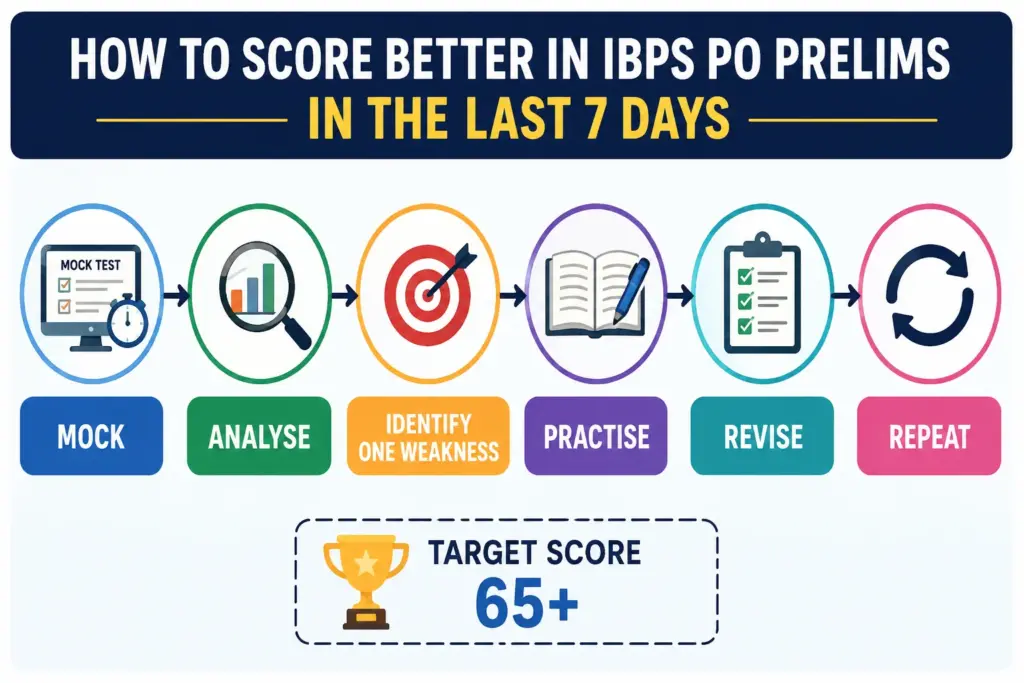
Your score can improve significantly when you stop repeating the same mistakes. A candidate who learns from every mock is likely to gain more from the final week than someone who simply attempts test after test.
IBPS PO Last 7 Days Mock Challenge: Smart Study Guide
The IBPS PO last 7 days mock test challenge works best when every day has one clear outcome. Do not measure success only through your final mock score.
Your daily routine
1. Take the test: Follow the exact sectional timing.
2. Analyse: Identify why questions went wrong.
3. Practise: Work only on the identified weak areas.
4. Revise: Update your formula or error notebook.
5. Reset: Stop studying at a reasonable time and sleep properly.
This creates a focused cycle of practice and correction instead of random last-minute preparation.
IBPS PO Mock Test Challenge 2026: Final Checklist
Before the exam, make sure you can answer “yes” to these questions:
- Have I completed enough full-length mocks to understand my strategy?
- Do I know my strongest and weakest section?
- Do I know which question types I should skip?
- Have I analysed my recurring mistakes?
- Is my section-wise timing fixed?
- Have I revised my formulas and error notebook?
- Are my examination documents ready?
- Am I following a normal sleep schedule?
Conclusion
The IBPS PO Last 7 Days Mock Test Challenge 2026: Daily Plan Before Prelims is ultimately about execution, not last-minute syllabus completion. Use the first few days to identify and correct weaknesses, the middle days to sharpen speed and selection, and the final day to stay calm and rested.
The official IBPS schedule confirms that Prelims are scheduled for 22 and 23 August 2026, so use these final days wisely. Your goal should be simple: attempt the right questions, maintain accuracy and avoid wasting time on questions that do not deserve it.
IBPS PO Last 7 Days Mock Test Challenge 2026 FAQs
How many mock tests should I attempt in the last 7 days of IBPS PO?
Attempting one full-length mock daily for the first five days can provide useful exam practice, provided you analyse each test thoroughly. In the final two days, shift towards lighter mocks, sectional practice, revision, and maintaining confidence.
Is one mock test enough for IBPS PO Prelims each day?
One mock test can be enough when followed by detailed analysis and targeted practice. Attempting multiple tests without reviewing mistakes may provide less benefit. Focus on identifying time-consuming questions, accuracy issues and weak topics after every mock.
How can I improve my IBPS PO Prelims score in 7 days?
To improve your IBPS PO Prelims score in seven days, attempt focused mocks, analyse every mistake, practise weak areas, revise formulas and improve question selection. Avoid new topics and prioritise accuracy, speed and consistent sectional timing during the final week.
Should I take a mock test one day before IBPS PO Prelims?
A full mock is generally unnecessary on the final day. Use Day 1 for light revision, error-log review, formulas, documents and mental preparation. Avoid heavy practice that can create fatigue or anxiety immediately before the examination.
What should I analyse after an IBPS PO mock test?
After an IBPS PO mock test, analyse your attempts, accuracy, incorrect answers, skipped questions, time spent on lengthy problems and selection mistakes. Categorise errors as conceptual, calculation, selection or time-management issues, then target the most frequent problem.
- Sign Up on Practicemock for Updated Current Affairs, Topic Tests and Mini Mocks
- Sign Up Here to Download Free Study Material
Free Mock Tests for the Upcoming Exams
- IBPS PO Free Mock Test
- RBI Grade B Free Mock Test
- IBPS SO Free Mock Test
- NABARD Grade A Free Mock Test
- SSC CGL Free Mock Test
- IBPS Clerk Free Mock Test
- IBPS RRB PO Free Mock Test
- IBPS RRB Clerk Free Mock Test
- RRB NTPC Free Mock Test
- SSC MTS Free Mock Test
- SSC Stenographer Free Mock Test
- GATE Mechanical Free Mock Test
- GATE Civil Free Mock Test
- RRB ALP Free Mock Test
- SSC CPO Free Mock Test
- AFCAT Free Mock Test
- SEBI Grade A Free Mock Test
- IFSCA Grade A Free Mock Test
- RRB JE Free Mock Test
- Free Banking Live Test
- Free SSC Live Test