



For most aspirants, the Quantitative Aptitude section of the RBI Assistant exam feels like the toughest hurdle. Yet, with the right strategy, smart practice, and disciplined time management, aspirants can aim for a perfect 35/35 score. In this blog, we’ll give you a practical roadmap, based on proven exam strategies and expert guidance, to achieve that target practically and maximize the overall score.
Know the Exam Mindset
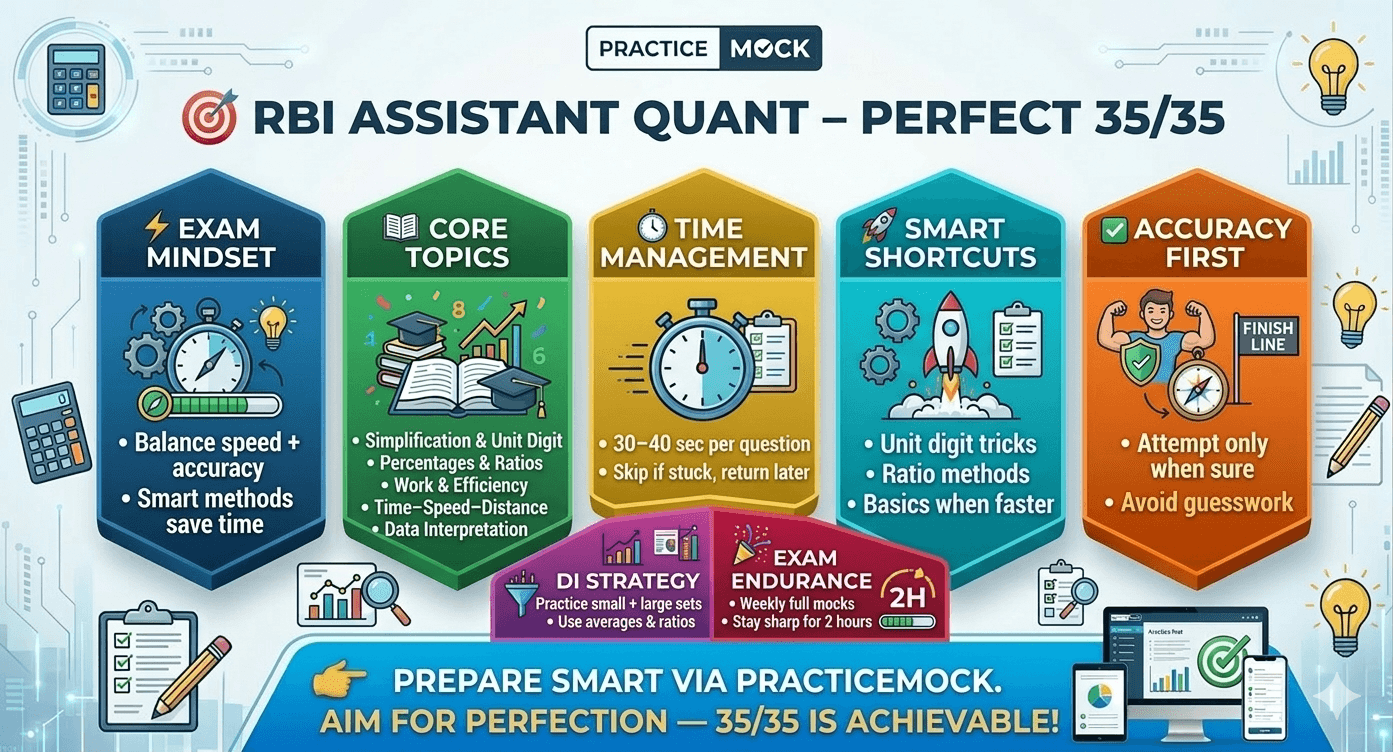
Before diving into preparation, aspirants must understand the exam’s psychology. RBI Assistant quant is designed to test both speed and accuracy, making balance the ultimate key to success. Many aspirants fall into the trap of focusing only on speed, rushing through questions, and compromising accuracy. Others spend too much time on complex problems, losing precious minutes. The exam rewards those who can strike the right balance.

- Speed ensures maximum attempts.
- Accuracy ensures every attempt counts.
- Smart methods save time without compromising correctness.
Think of quant as a race where every second matters, but finishing with the wrong answers won’t get you anywhere.
Here are the tips you need to follow to score 35 marks in this section:
Tip 1: Master the Core Topics
The quant section revolves around predictable topics. By mastering these areas, aspirants can secure easy marks and build confidence for tougher questions.
| Topic | Why It Matters | Key Techniques |
| Simplification & Unit Digit | Quick scoring | Unit digit logic, cancellation tricks |
| Percentages & Ratios | Foundation for DI | Shortcut conversions, ratio balance |
| Work & Efficiency | Common in prelims/mains | Fractional efficiency, algebraic approach |
| Time-Speed-Distance | Train/boat problems | Relative speed formulas, ratio tricks |
| Data Interpretation (DI) | High-weightage | Assumed average, deviation balancing |
These topics form the backbone of the quant section. For example, simplification and unit digit problems can be solved in under 20 seconds if practiced well. Ratios and percentages are not only standalone topics but also the foundation for DI sets. Work and efficiency problems test logical structuring, while time-speed-distance questions often involve trains, boats, or relative speed scenarios.
PracticeMock’s sectional tests cover these areas with exam-level difficulty, ensuring you’re never surprised in the actual paper.
Tip 2: Time Management is Everything
Time is the biggest weapon in quant. Managing seconds per question can make or break your score. Aspirants must train themselves to solve within strict time limits.
- Target per question: 30–40 seconds.
- Avoid overthinking; move on if stuck.
- Track timing per topic during practice.
- Simulate exam conditions with rough sheets.
For instance, if you spend 60 seconds on a single simplification problem, you’re already behind. The exam is unforgiving when it comes to time wastage. PracticeMock’s timed mocks help aspirants develop the discipline to move on when stuck and return later if time permits.
Tip 3: Smart Use of Shortcuts
Shortcuts are powerful but dangerous if misused. The trick is knowing when to apply them and when to stick to basics for faster, safer solutions.
- Use unit digit tricks when options allow elimination.
- Apply ratio methods in mixture/speed problems.
- Stick to basics when shortcuts complicate.
- Comfort over complexity — choose what works best.
For example, in a unit digit problem, calculating only the last digit of each term can save 20–30 seconds. But in a complex DI set, shortcuts may confuse more than help. The golden rule: use shortcuts selectively, not blindly.
Tip 4: Accuracy Over Guesswork
Negative marking makes accuracy non-negotiable. Guesswork can destroy your score. Build accuracy through repeated practice and confidence in methods, not random attempts.
- Attempt only when confident.
- Avoid random guessing.
- Build accuracy through consistent practice.
- Focus on precision over quantity.
Remember, attempting 28 questions with 100% accuracy is better than attempting 35 with 10 wrong answers. Accuracy builds trust in your preparation and ensures your score reflects your true ability.
Step 5: Data Interpretation (DI) Strategy
DI is the scoring engine of quant. With smart techniques, aspirants can solve complex sets quickly and accurately, turning DI into a strength instead of a hurdle.
- Practice small and large DI sets.
- Use assumed averages for simplification.
- Balance deviations for quick approximations.
- Focus on ratios and percentage analysis.
For example, when faced with a bar graph showing monthly sales, assume an average value to simplify calculations instead of working out each number individually. This saves time and reduces calculation errors. PracticeMock’s DI sets replicate exam-level complexity, training aspirants to handle pressure.
Tip 6: Build Exam Endurance
Quant isn’t just about solving problems — it’s about sustaining focus for two hours. Endurance ensures accuracy doesn’t drop in the final stretch of the exam.
- Practice full-length mocks weekly.
- Train brain for 2-hour focus.
- Balance all sections equally.
- Maintain accuracy till the last question.
Think of it like running a marathon. You may start strong, but without stamina, you’ll falter near the end. Regular full-length mocks build the mental stamina needed to stay sharp throughout the exam.
Tip 7: Analyze Every Mock Test
Mock tests are only useful if analyzed. Reviewing mistakes and tracking progress helps aspirants refine strategies and avoid repeating errors in the actual exam.
- Review every mistake.
- Identify weak areas.
- Track progress across attempts.
- Adjust strategy based on analysis.
For example, if you consistently lose marks in time-speed-distance, dedicate extra practice to that topic. PracticeMock’s detailed analysis reports highlight these weak areas, helping aspirants focus where it matters most.
Expert Tips to Score 35/35
Beyond techniques, mindset and discipline matter most. These expert tips ensure aspirants stay sharp, confident, and exam-ready.
- Start early; don’t wait for notification. Early preparation builds confidence.
- Mix shortcuts and basics wisely. Flexibility is key.
- Simulate exam conditions during practice. Train like it’s the real exam.
- Stay calm and confident. Panic ruins accuracy.
- Consistency builds speed and stamina. Daily practice compounds into mastery.
Final Word
Scoring 35/35 in RBI Assistant 2026 Quant isn’t about genius-level math. It’s about smart practice, time management, and exam temperament.
Therefore, scoring 35/35 in RBI Assistant 2026 Quant isn’t about being a math genius. It’s about:
- Practicing smartly.
- Managing time effectively.
- Using the right mix of shortcuts and basics.
- Building exam temperament through mocks.
With PracticeMock’s free RBI Assistant mock test, you can start today, test your current level, and steadily climb towards perfection.
Prepare smart, avoid traps, and aim for perfection. 35/35 is achievable with the right strategy.
- Sign Up on Practicemock for Updated Current Affairs, Topic Tests and Mini Mocks
- Sign Up Here to Download Free Study Material
Free Mock Tests for the Upcoming Exams
- IBPS PO Free Mock Test
- RBI Grade B Free Mock Test
- IBPS SO Free Mock Test
- NABARD Grade A Free Mock Test
- SSC CGL Free Mock Test
- IBPS Clerk Free Mock Test
- IBPS RRB PO Free Mock Test
- IBPS RRB Clerk Free Mock Test
- RRB NTPC Free Mock Test
- SSC MTS Free Mock Test
- SSC Stenographer Free Mock Test
- GATE Mechanical Free Mock Test
- GATE Civil Free Mock Test
- RRB ALP Free Mock Test
- SSC CPO Free Mock Test
- AFCAT Free Mock Test
- SEBI Grade A Free Mock Test
- IFSCA Grade A Free Mock Test
- RRB JE Free Mock Test
- Free Banking Live Test
- Free SSC Live Test