


Day Based Puzzles for IBPS PO 2026 are an important part of the Reasoning Ability section, where candidates arrange people, events, subjects, cities, or other items across days from Monday to Sunday using interlinked clues. These questions test logical thinking, sequencing, arrangement skills, and the ability to connect multiple conditions.
In Prelims, puzzles generally involve 1–2 variables, while Mains may include 2–3 variables with more complex conditions. Regular practice with structured grids, elimination techniques, and exam-level sets can help improve accuracy and solving speed. This guide covers useful shortcuts, step-by-step practice questions, and common solving mistakes for IBPS PO 2026. Candidates should also check and give the free IBPS PO prelims ready mock test.

Day Based Puzzles for IBPS PO with Solutions Quiz
Practice these Day Based Puzzles for IBPS PO through exam-level questions designed around weekly scheduling and logical clues.
Test your accuracy, speed, and puzzle-solving approach with this quick quiz.
Seven persons—A, B, C, D, E, F, and G—attend a seminar from Monday to Sunday.
• C attends on Wednesday.
• Exactly two persons attend between C and G.
• D attends immediately before B.
• A attends after E, but not on Saturday.
• F does not attend on Monday or Sunday.
• B does not attend on Friday.
• Added for uniqueness: E attends immediately before F.
Q1. Who attends the seminar on Monday?
Explanation: The unique corrected arrangement is Monday-D, Tuesday-B, Wednesday-C, Thursday-E, Friday-F, Saturday-G, Sunday-A. Therefore D attends on Monday.
Q2. Who attends immediately after C?
Explanation: C attends on Wednesday and E attends on Thursday. Hence E attends immediately after C.
Q3. On which day does G attend the seminar?
Explanation: C is on Wednesday and exactly two persons attend between C and G. Therefore G is on Saturday.
Q4. How many persons attend between B and F?
Explanation: B attends on Tuesday and F on Friday. C and E attend on Wednesday and Thursday, so two persons attend between B and F.
Q5. Who attends the seminar on Sunday?
Explanation: After placing D-B, C, E-F and G, the remaining Sunday slot goes to A. This also satisfies A attending after E and not on Saturday.
Seven professors—P, Q, R, S, T, U, and V—teach Physics, Chemistry, Maths, Biology, English, History, and Civics from Monday to Sunday.
• R teaches English on Monday.
• Maths is taught on Thursday.
• Exactly one professor teaches between Maths and History, and History is taught after Maths.
• Q teaches Civics on Wednesday.
• S teaches Chemistry on Tuesday.
• Physics is taught immediately before T’s lecture.
• P teaches Maths.
• V teaches Biology.
Q6. Which subject does Q teach?
Explanation: In the corrected Mains set, Q teaches Civics on Wednesday.
Q7. On which day is History taught?
Explanation: Maths is on Thursday and exactly one professor teaches between Maths and History, with History after Maths. Therefore History is taught on Saturday.
Q8. Who teaches Physics?
Explanation: Physics is taught immediately before T's lecture. T teaches History on Saturday, so Physics is on Friday. With P fixed to Maths on Thursday and V to Biology on Sunday, U teaches Physics on Friday.
Q9. Who teaches Maths?
Explanation: Maths is taught on Thursday and the corrected clue fixes P as the Maths professor. Therefore P teaches Maths.
Q10. Which Person–Day–Subject combination is correct?
Explanation: The verified arrangement includes S teaching Chemistry on Tuesday. The other combinations conflict with the corrected schedule.
Quiz Summary
What are Day Based Puzzles in IBPS PO 2026?
Day based puzzles in IBPS PO 2026 are logical arrangement problems where candidates must map a group of elements across consecutive days of the week based on positive and negative conditions. These questions test your ability to process multiple constraints simultaneously under strict sectional time limits.
In puzzle and seating arrangement for IBPS PO, scheduling puzzles stand out because the timeline provides a fixed, linear anchor. Unlike linear or circular seating arrangements, the sequential order of days (Monday through Sunday) never changes, giving you an immediate starting grid for your rough work.
Types of Day Based Puzzles Asked in IBPS PO
Bank exams feature three major variations of week-based scheduling puzzles, ranging from simple direct arrangements to multi-variable complex sets.
- Standard 7-Day Single Variable (Prelims Level): Maps 7 individuals or events directly to 7 days from Monday to Sunday.
- Two-Variable Day Based Puzzles (Prelims/Mains Level): Pairs 7 persons with an additional attribute, such as their favorite color, city of origin, or academic subject.
- Shift-Based Day Puzzles (Mains Level): Combines days of the week with multiple daily time slots (e.g., Morning and Evening shifts across Monday to Thursday).
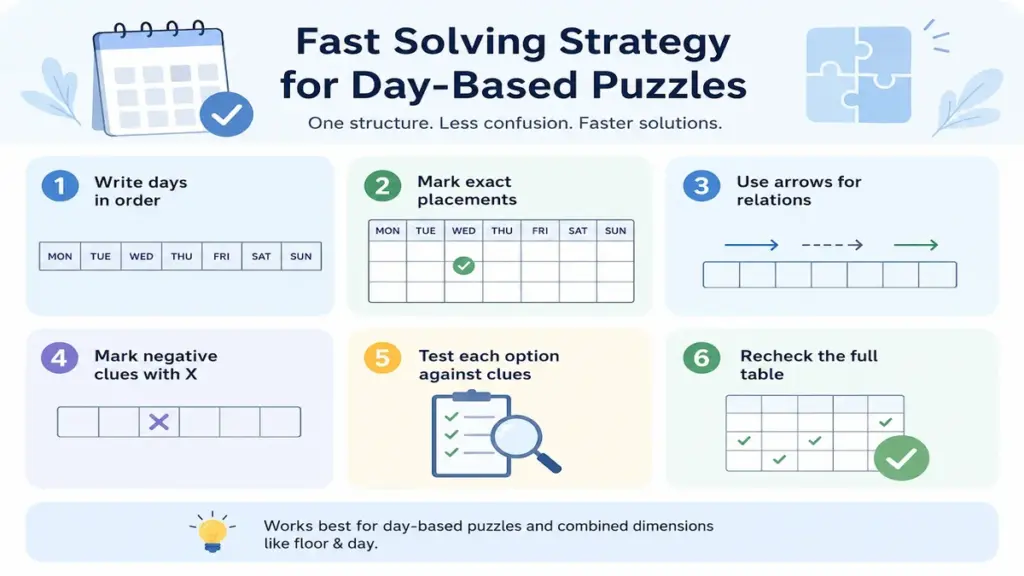
Fast Solving Strategy for Day-Based Puzzles
Day-based puzzles become easy when you follow one fixed structure every time.
The most reliable method is to create a day-wise table first, then place direct clues, and finally solve the relative clues by elimination.
- Step 1: Write the days in order: Monday to Sunday.
- Step 2: Mark exact placements first.
- Step 3: Use arrows for before, after, and immediate relations.
- Step 4: Mark negative clues with X.
- Step 5: Test each option against all clues.
- Step 6: Recheck the full table before answering.
This method works especially well for day-based puzzles for bank exams because it reduces confusion. It also helps with bank PO floor and day puzzle rules when the puzzle combines two dimensions.
Step-by-Step Shortcut Strategy to Solve Day Based Puzzles
To solve scheduling puzzles for bank exams accurately within 3 minutes, follow this structured 5-step framework:
Fix the Base Anchor Grid: Always list days vertically from Monday to Sunday in your rough sheet. Never alter the day sequence.
Fill Direct Positive Clues First: Instantly place absolute statements into the grid (e.g., “C attends the seminar on Wednesday”).
Block Consecutive Slots: Group elements that must occur immediately before or after one another (e.g., “D attends immediately before B” $\rightarrow$ D-B block).
Use Parallel Cases Immediately: If a clue splits possibilities into two valid options, draw Case 1 and Case 2 side-by-side right away instead of mentally guessing.
Apply Negative Elimination: Note down negative conditions right beside the target day row (e.g., “F $\neq$ Mon/Sun”).
Common Traps and Mistakes to Avoid while Solving Day Based Puzzle
Misinterpreting “Between”: “Two days between A and B” means there are two distinct day rows separating them, not that B is on the 2nd day.
Confusing “Immediately Before” vs. “Before”: “A attends before B” means A can sit on any day preceding B. “A attends immediately before B” means they form a contiguous block.
Ignoring the Week Start: Pay close attention to whether the puzzle specifies Monday to Sunday or Sunday to Saturday.
Over-relying on Mental Tracking: Trying to keep multiple possibilities in your head wastes time. Always draw secondary tables for split cases.
Practice Plan & Speed Targets for IBPS PO 2026
To achieve maximum speed and accuracy in expected day based puzzle questions for ibps po 2026 prelims, adhere to these recommended benchmark timings:
| Exam Phase | Complexity Level | Target Time Limit | Expected Accuracy |
| IBPS PO Prelims | 1 Variable (7 Days + Persons) | 2.5 – 3.5 Minutes | 100% |
| IBPS PO Prelims | 2 Variables (7 Days + Persons + Attributes) | 3.5 – 4.5 Minutes | 100% |
| IBPS PO Mains | Multi-Variable / Shift-Based | 6.0 – 8.0 Minutes | 90%+ |
To build speed, practice daily sectional tests and attempt dedicated reasoning quizzes on PracticeMock. You can also attempt free day based puzzle quiz ibps po to test your readiness against standard exam benchmarks.
Day-Based Puzzles for IBPS PO 2026 Final Tips
Fix the Timeline: Always use the days of the week as your primary static column.
Manage Parallel Tables: Work with 2 cases side-by-side to solve split clues quickly without confusion.
Focus on Linkages: Connect relative clues to established anchors before filling isolated data.
Consistency is Key: Solve 3–5 high level reasoning puzzles for bank po daily to build visual recognition of common puzzle patterns.
Day Based Puzzles for IBPS PO 2026 Frequently Asked Questions
1. How many day-based puzzles are expected in IBPS PO 2026 Prelims?
Typically, 1 set containing 5 questions appears in the Prelims exam. It usually features a 1-variable or 2-variable weekly schedule.
2. What is the ideal starting point for day-based puzzles?
Start by drawing a vertical grid of days from Monday to Sunday. Immediately place direct, unconditional clues into this grid before analyzing conditional statements.
3. How can I solve day-based puzzles in under 3 minutes?
Master negative elimination rules, use parallel case tables for uncertain positions, and avoid mental calculation. Consistent practice on timed mock tests helps refine this approach.
4. Are shift-based day puzzles asked in IBPS PO Prelims?
No, shift-based day puzzles (combining days with morning/evening timeslots) are primarily featured in the IBPS PO Mains examination.
5. Where can I find day-based puzzle questions PDF with solutions?
You can access full-length practice sets, subject-wise quizzes, and downloadable PDFs directly on the PracticeMock platform.
- Sign Up on Practicemock for Updated Current Affairs, Topic Tests and Mini Mocks
- Sign Up Here to Download Free Study Material
Free Mock Tests for the Upcoming Exams
- IBPS PO Free Mock Test
- RBI Grade B Free Mock Test
- IBPS SO Free Mock Test
- NABARD Grade A Free Mock Test
- SSC CGL Free Mock Test
- IBPS Clerk Free Mock Test
- IBPS RRB PO Free Mock Test
- IBPS RRB Clerk Free Mock Test
- RRB NTPC Free Mock Test
- SSC MTS Free Mock Test
- SSC Stenographer Free Mock Test
- GATE Mechanical Free Mock Test
- GATE Civil Free Mock Test
- RRB ALP Free Mock Test
- SSC CPO Free Mock Test
- AFCAT Free Mock Test
- SEBI Grade A Free Mock Test
- IFSCA Grade A Free Mock Test
- RRB JE Free Mock Test
- Free Banking Live Test
- Free SSC Live Test