


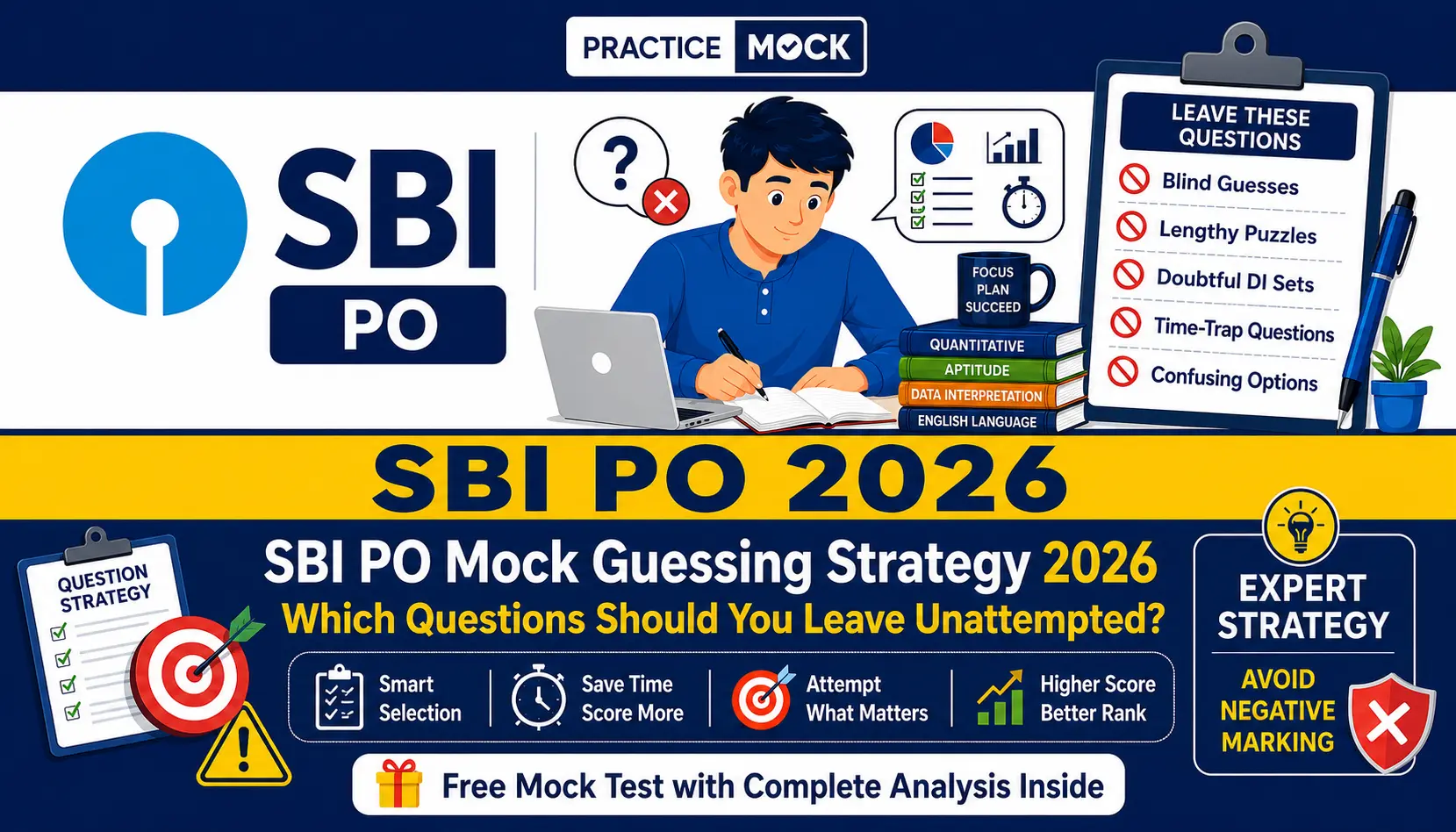
SBI PO Mock Guessing Strategy: Preparing for the SBI PO Prelims 2026 is not just about solving more questions. It is about making smart decisions under pressure. Many aspirants lose valuable marks because they attempt questions they are unsure about, leading to negative marking. Since every incorrect answer attracts a penalty of 0.25 marks, knowing which questions to skip can significantly improve your final score.
The SBI PO Prelims exam rewards accuracy more than reckless attempts. Toppers consistently focus on maintaining a high accuracy rate while maximizing attempts in easy and moderate questions. In this article, we will discuss the best SBI PO mock guessing strategy, identify questions that should be left unattempted, and help you improve your mock test scores through smarter decision-making.

SBI PO Mock Guessing Strategy 2026 : Key Takeaways
If you are looking for the most important guessing strategy for SBI PO practice tests, follow these rules:

Leave a question unattempted when:
- You cannot eliminate at least two options.
- You are unfamiliar with the concept being tested.
- A puzzle or DI set seems too lengthy.
- You cannot identify the solving approach within 20–30 seconds.
- The question requires excessive calculations.
- You are making a completely random guess.
- The question consumes more time than expected.
Golden Rule: Maintain an accuracy rate above 85% instead of chasing maximum attempts.
SBI PO Mock Guessing Strategy Key Highlights
Before discussing the SBI PO mock test strategy, here are the important details aspirants should know.
| Particulars | Details |
| Exam Name | SBI PO 2026 |
| Conducting Body | State Bank of India |
| Exam Stage | Prelims, Mains, Interview |
| Prelims Duration | 60 Minutes |
| Total Questions | 100 |
| Total Marks | 100 |
| Negative Marking | 0.25 Marks for Every Wrong Answer |
| Sections | English Language, Reasoning Ability, Quantitative Aptitude |
| Selection Process | Prelims → Mains → Interview |
As per the SBI PO notification pattern, there is negative marking in the Preliminary Examination. Therefore, blind guessing can reduce your overall score significantly.
Also Read, SBI PO Mock Strategy for Beginners
Also Check: Latest SBI PO Notification 2026
Why Leaving Questions Can Increase Your SBI PO Score
Many aspirants believe that attempting more questions automatically leads to higher marks. However, SBI PO Prelims 2026 is a speed-and-accuracy exam.
For example:
| Scenario | Attempts | Accuracy | Correct Answers | Wrong Answers | Net Score |
| Smart Attempt Strategy | 70 | 90% | 63 | 7 | 61.25 |
| Blind Guessing Strategy | 85 | 75% | 64 | 21 | 58.75 |
The table clearly shows that a candidate with fewer attempts but higher accuracy can score better than someone who attempts almost every question.
This is why mock tests should be used to build decision-making skills rather than just increasing attempts.
Also, practice SBI PO Previous Year Question Papers (free PDF)
The 20 / 30 Second Rule: Your Best SBI PO Mock Test Strategy
One of the most effective SBI PO preparation strategies is the 20–30 second rule.
When you read a question:
- If you immediately recognize the concept, solve it.
- If you can identify the approach within 20–30 seconds, continue.
- If you are still confused after 30 seconds, skip and move ahead.
This prevents unnecessary time wastage and helps you maximize easy marks first.
Many SBI PO toppers use this rule to maintain momentum throughout the exam.
Also Read: SBI PO Mock Revision Strategy 2026
Which SBI PO Questions Should You Leave Unattempted?
Not every question deserves your time. Some questions are designed to consume more time than the marks they offer.
Long and Complex Seating Arrangement Puzzles
Puzzles often carry multiple conditions and variables.
You should skip them initially if:
- More than 5–6 conditions are involved.
- The arrangement appears unclear after the first reading.
- You cannot establish a starting point quickly.
Attempt these only after securing easy and moderate questions.
Difficult Data Interpretation Sets
Data Interpretation is often a scoring area, but some sets become calculation-intensive.
Leave the set if:
- The calculations are lengthy.
- Multiple charts need comparison.
- You cannot identify shortcuts.
Remember, spending four minutes on one DI set can cost several easier questions.
Advanced Arithmetic Questions
Questions from topics like:
- Probability
- Permutation and Combination
- Advanced Partnership
- Complex Time and Work
should be skipped if the method does not strike immediately.
The exam rewards quick problem-solving, not lengthy calculations.
Unfamiliar Reading Comprehension Questions
Reading Comprehension often includes difficult inference-based questions.
Leave them if:
- The passage is highly technical.
- The answer choices seem almost identical.
- You are repeatedly rereading the same paragraph.
Instead, focus on vocabulary-based and direct factual questions first.
Unknown Vocabulary and Idioms
Many candidates lose marks by guessing vocabulary questions.
Avoid blind attempts when:
- You have never seen the word before.
- None of the options seem familiar.
- You are relying purely on intuition.
Random guessing rarely works in vocabulary-based questions.
Section-Wise SBI PO Skipping Strategy
Every section requires a slightly different approach.
SBI PO Reasoning Ability Strategy
Prioritize:
- Syllogism
- Inequality
- Coding-Decoding
- Direction Sense
- Number Series
Consider skipping:
- Complex Floor-Based Puzzles
- Multi-Layer Seating Arrangements
- Difficult Logical Reasoning Sets
These questions often consume disproportionate time.
SBI PO Quantitative Aptitude Strategy
Prioritize:
- Simplification
- Approximation
- Number Series
- Quadratic Equations
Consider skipping:
- Lengthy DI Sets
- Probability Questions
- Advanced Arithmetic Problems
Quick calculations generally provide better returns.
SBI PO English Language Strategy
Prioritize:
- Error Detection
- Fillers
- Sentence Improvement
- Cloze Tests
Consider skipping:
- Highly inferential RC questions
- Unfamiliar vocabulary-based questions
- Ambiguous sentence rearrangement questions
Accuracy matters the most in English.
Smart Guessing vs Blind Guessing
There is a significant difference between intelligent elimination and random guessing.
| Smart Guessing | Blind Guessing |
| Eliminate 2 or more options | No elimination |
| Based on logic | Based on luck |
| Higher probability of success | Very low probability |
| Controlled risk | High negative-marking risk |
Use smart guessing only when you can confidently remove multiple incorrect options.
Otherwise, leave the question unattempted.
Common SBI PO Mock Test Mistakes Aspirants Make
Even well-prepared candidates often repeat these errors during mock tests.
Chasing High Attempts
Many aspirants compare their attempts with those of others.
Instead, compare:
- Accuracy percentage
- Time utilization
- Question selection quality
A score matters more than attempts.
Getting Emotionally Attached to Questions
Sometimes candidates spend three minutes on a single question simply because they studied that chapter extensively.
Do not let ego affect your strategy.
Move ahead and return later if time permits.
Ignoring Mock Test Analysis
A mock test is valuable only when analyzed properly.
After every mock:
- Check skipped questions.
- Identify unnecessary guesses.
- Review incorrect attempts.
- Track accuracy trends.
This process helps improve scores consistently.
Also Read: SBI PO Mock Analysis Strategy: What to Check After Every Attempt
SBI PO Mock Review Framework: Analyze Every Skipped Question
After every mock test, categorize skipped questions into:
| Category | Action Required |
| Correctly Skipped | Continue the same strategy |
| Concept Not Known | Study the topic |
| Time-Consuming | Practice shortcuts |
| Avoidable Skip | Build confidence through practice |
This simple framework helps convert weaknesses into strengths over time.
Final Strategy for SBI PO Prelims 2026
The best SBI PO mock guessing strategy is not about attempting every question. It is about maximizing your net score through intelligent decision-making.
Remember these rules:
- Target accuracy above 85%.
- Follow the 20–30 second rule.
- Skip lengthy puzzles and DI sets initially.
- Avoid blind guessing.
- Use option elimination whenever possible.
- Analyze every mock test thoroughly.
- Focus on score optimization, not attempt count.
The candidates who qualify for SBI PO Prelims are usually not the ones who attempt the most questions. They are the ones who make the smartest choices under pressure.
| Related Articles | ||
| SBI PO Notification | SBI PO Syllabus | SBI PO Exam Date |
| SBI PO Eligibility Criteria | SBI PO Salary | SBI PO Cut Off |
| SBI PO Result | SBI PO Exam 2026 Prep | SBI PO PYQs |
FAQs on SBI PO Mock Guessing Strategy
1. Is it better to leave questions unattempted in SBI PO Prelims?
Yes. Since there is a penalty of 0.25 marks for every incorrect answer, leaving doubtful questions can often improve your net score.
2. How many questions should I attempt in SBI PO Prelims?
There is no fixed number. Focus on maintaining 85–90% accuracy while maximizing good attempts.
3. Should I guess answers in SBI PO mock tests?
Use smart guessing only when you can eliminate at least two options. Avoid random guessing.
4. Which questions should be skipped first in SBI PO Prelims?
Complex puzzles, lengthy DI sets, advanced arithmetic questions, and unfamiliar vocabulary questions should generally be skipped initially.
5. What is the ideal accuracy rate in SBI PO mock tests?
Aspirants targeting SBI PO Prelims should aim for an accuracy rate of 85% or higher to stay competitive.
- Sign Up on Practicemock for Updated Current Affairs, Topic Tests and Mini Mocks
- Sign Up Here to Download Free Study Material
Free Mock Tests for the Upcoming Exams
- IBPS PO Free Mock Test
- RBI Grade B Free Mock Test
- IBPS SO Free Mock Test
- NABARD Grade A Free Mock Test
- SSC CGL Free Mock Test
- IBPS Clerk Free Mock Test
- IBPS RRB PO Free Mock Test
- IBPS RRB Clerk Free Mock Test
- RRB NTPC Free Mock Test
- SSC MTS Free Mock Test
- SSC Stenographer Free Mock Test
- GATE Mechanical Free Mock Test
- GATE Civil Free Mock Test
- RRB ALP Free Mock Test
- SSC CPO Free Mock Test
- AFCAT Free Mock Test
- SEBI Grade A Free Mock Test
- IFSCA Grade A Free Mock Test
- RRB JE Free Mock Test
- Free Banking Live Test
- Free SSC Live Test