


The RBI Assistant exam 2026 is one of the most competitive banking exams, attracting thousands of aspirants across the country. With limited vacancies and high cut-offs, cracking it in the first attempt requires not just knowledge but a well-structured strategy. The key lies in mastering speed, accuracy, and smart preparation rather than drowning in syllabus overload. This blog provides a complete roadmap—covering exam pattern, cut-offs, section-wise strategy, mock test approach, and revision techniques—to help you clear RBI Assistant 2026 confidently in your first attempt.
The Main Challenge
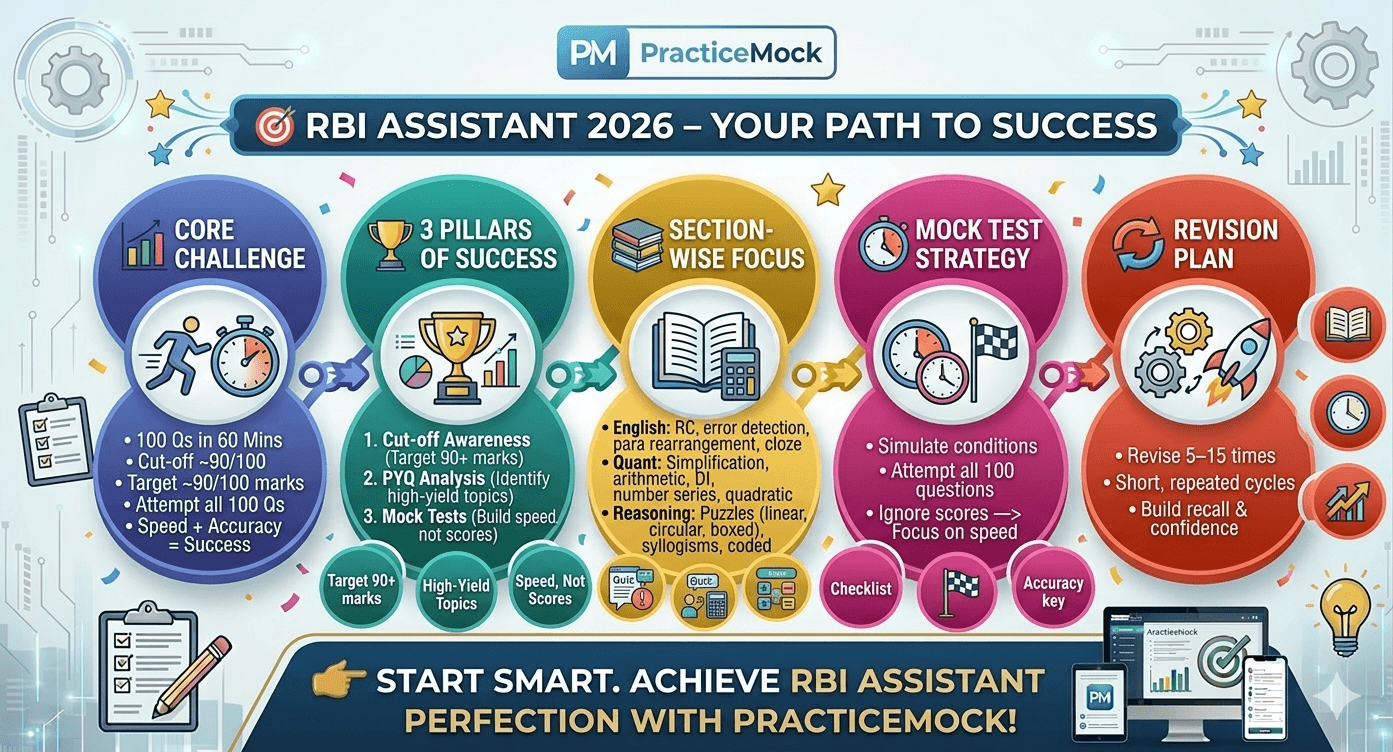
The RBI Assistant exam is unique because it demands 100 questions in 60 minutes. Many aspirants fail not due to lack of knowledge but because they cannot manage time effectively.

- Cut-off Reality: The cut-off usually hovers around 90/100, meaning partial attempts or selective answering drastically reduce chances of success.
- Implication: You must attempt nearly all questions with accuracy.
- Strategy: Cover the syllabus quickly (within 15 days) and spend the rest of the time sharpening speed and accuracy.
The Three Pillars of Success
Every successful candidate builds their preparation on three pillars:
- Cut-off Awareness: Know the benchmark—90 marks is the minimum target.
- Previous Year Questions (PYQs): Analyze patterns to identify high-yield topics.
- Mock Tests: Use them to train speed and endurance, not to chase scores.
Together, these pillars ensure focused preparation and exam readiness.
Section-Wise Preparation Strategy
Preparing for the RBI Assistant 2026 exam requires more than just syllabus coverage—it demands speed, accuracy, and smart strategy. With cut-offs hovering around 90/100, aspirants must attempt nearly all questions confidently. This section explains why mastering time management and precision is the ultimate challenge, and how focused preparation can help you clear the exam in your first attempt.
English Language
The English section is predictable, with a handful of topics dominating the paper. Focus on:
- Reading Comprehension
- Error Detection
- Fillers
- Paragraph Rearrangement
- Cloze Tests
Tip: Beginners should master these high-yield topics first. Advanced aspirants can expand scope for higher scores.
Quantitative Aptitude
Quant is practice-driven and largely predictable. Key areas include:
- Simplification
- Arithmetic (ratios, percentages, speed-distance, profit-loss)
- Data Interpretation
- Number Series
- Quadratic Equations
Tip: Daily practice of simplification and arithmetic ensures speed. DI and number series require pattern recognition, which improves with repeated exposure.
Reasoning Ability
Reasoning is dynamic, with puzzles forming the bulk of questions. Focus on:
- Puzzles (linear, circular, boxed)
- Syllogisms
- Blood Relations
- Directions
- Coding-Decoding
Flexibility is crucial. Exam shifts vary puzzle types, so practice all formats to avoid surprises.
Mock Test Strategy for Speed Training
Mock tests are the backbone of preparation, but they must be used wisely.
- Purpose: Not to measure scores, but to build speed and accuracy.
- Approach: Simulate exam conditions and attempt all 100 questions.
- Mindset: Ignore mock scores; real exam questions are often easier.
- Outcome: Reduced anxiety, improved reflexes, and confidence in attempting the full paper.
Revision as The Confidence Multiplier
Revision is the most underrated yet powerful tool. Covering the syllabus once is not enough.
- Frequency: Revise 5–15 times depending on strengths and weaknesses.
- Goal: Build recall speed and accuracy.
- Method: Short, repeated revisions rather than long, exhaustive sessions.
Tip: Treat revision as speed training. The more times you revisit topics, the faster you recall them during the exam.
PYQ Analysis for Smart Preparation
Since RBI does not officially release past papers, PYQs are inferred from multiple sources. While not perfect, they provide valuable insights into recurring topics.
- Benefit: Identify high-yield areas and question types.
- Caution: Cross-check multiple sources to avoid inconsistencies.
- Application: Use PYQs to prioritize practice on frequently asked topics.
High Cut-Off Demands Perfection
With cut-offs around 90 marks, perfection is non-negotiable. Attempting fewer than 100 questions drastically reduces chances of selection.
- Mindset: Treat every question as an opportunity.
- Practice: Build stamina to attempt all questions under time pressure.
- Accuracy: Speed without accuracy is futile; balance both.
Expert Guidance for Aspirants
- Understand the exam’s nature: It’s speed-driven, not syllabus-heavy.
- Set realistic targets: Aim for 100 attempts with 90+ accuracy.
- Use mocks strategically: Focus on process, not scores.
- Revise relentlessly: Multiple revisions build confidence and recall speed.
- Stay positive: Avoid negativity and believe in your preparation.
Final Word
Cracking the RBI Assistant 2026 in your first attempt is absolutely achievable with the right mindset and strategy. Remember:
- Cover the syllabus quickly.
- Focus on speed and accuracy.
- Analyze PYQs smartly.
- Use mocks to train, not to stress.
- Revise multiple times for confidence.
The exam is easier compared to other RBI exams, but the high cut-off makes it unforgiving. Success depends on your ability to attempt all 100 questions with precision. Stay disciplined, practice consistently, and trust your preparation—you can clear RBI Assistant 2026 in your very first attempt.
FAQs
By mastering speed and accuracy, analyzing PYQs, practicing mocks daily, and revising the syllabus multiple times to ensure confidence and quick recall.
The cut-off usually hovers around 90 out of 100. Candidates must attempt nearly all questions with high accuracy to secure selection.
Focus on reading comprehension, error detection, fillers, paragraph rearrangement, and cloze tests. These dominate the English section.
Practice simplification, arithmetic, DI, number series, and quadratic equations daily. Speed and familiarity with patterns are crucial.
Yes. Mock tests are essential for building speed and endurance. They should be used to simulate exam conditions, not to stress over scores.
- Sign Up on Practicemock for Updated Current Affairs, Topic Tests and Mini Mocks
- Sign Up Here to Download Free Study Material
Free Mock Tests for the Upcoming Exams
- IBPS PO Free Mock Test
- RBI Grade B Free Mock Test
- IBPS SO Free Mock Test
- NABARD Grade A Free Mock Test
- SSC CGL Free Mock Test
- IBPS Clerk Free Mock Test
- IBPS RRB PO Free Mock Test
- IBPS RRB Clerk Free Mock Test
- RRB NTPC Free Mock Test
- SSC MTS Free Mock Test
- SSC Stenographer Free Mock Test
- GATE Mechanical Free Mock Test
- GATE Civil Free Mock Test
- RRB ALP Free Mock Test
- SSC CPO Free Mock Test
- AFCAT Free Mock Test
- SEBI Grade A Free Mock Test
- IFSCA Grade A Free Mock Test
- RRB JE Free Mock Test
- Free Banking Live Test
- Free SSC Live Test