


Unpaid domestic work is one of the most overlooked contributors to India’s economy. A landmark Supreme Court judgment in June 2026 recognized this contribution by assigning a notional value to homemakers’ services and introducing compensation for the loss of domestic care. Using data from national surveys and research studies, this article explores the scale of unpaid care work, its impact on women’s labour force participation, and the policy challenges India must address to move from recognition to meaningful economic inclusion.
The women behind India’s economy—and the price of invisible work
Context: On June 11, 2026, the Supreme Court placed a notional value of ₹30,000 per month on unpaid domestic services by homemakers, creating a new compensation head titled ‘loss of domestic care’ — the first judicial quantification of unpaid domestic labour in India’s legal history. The article, authored by the HowIndiaLives data team at Mint (June 30, 2026), uses this judgment to examine the scale, measurement, and policy implications of unpaid care work, drawing on the NSO Time Use Survey 2024, PLFS 2025, NFHS 2019–21, SBI EcoWrap 2023, EPW 2024, and the Axis Bank–Ipsos study (March 2026). The core argument: unpaid domestic labour — estimated at 15–26% of GDP depending on methodology — is structurally excluding women from the paid economy, and India has only just reached the first of three policy milestones needed to address it.
Link to the Article: Mint
The Supreme Court Judgment — What It Actually Said
- The judgment was delivered on June 11, 2026, in a road accident appeal concerning the death of a homemaker more than two decades ago — the case had been pending in the judicial system since before India’s current GDP accounting framework was last revised.
- The Court placed a notional minimum value of ₹30,000 per month on unpaid domestic services rendered by homemakers — a figure that functions as a floor, not a ceiling, for compensation purposes.
- It created a new, separate head of compensation titled ‘loss of domestic care’, covering: household management, maternal support for children, spousal support, and parental support.
- Critically, the Court directed that this notional minimum value applies even to women with independent external incomes — establishing that domestic labour is compensable irrespective of whether the woman also participates in the paid labour market.
- The judgment explicitly described homemakers as “nation builders” whose labour and household management enable other family members to contribute productively to the economy — a characterisation that mirrors the theoretical framing of unpaid work in feminist economics.
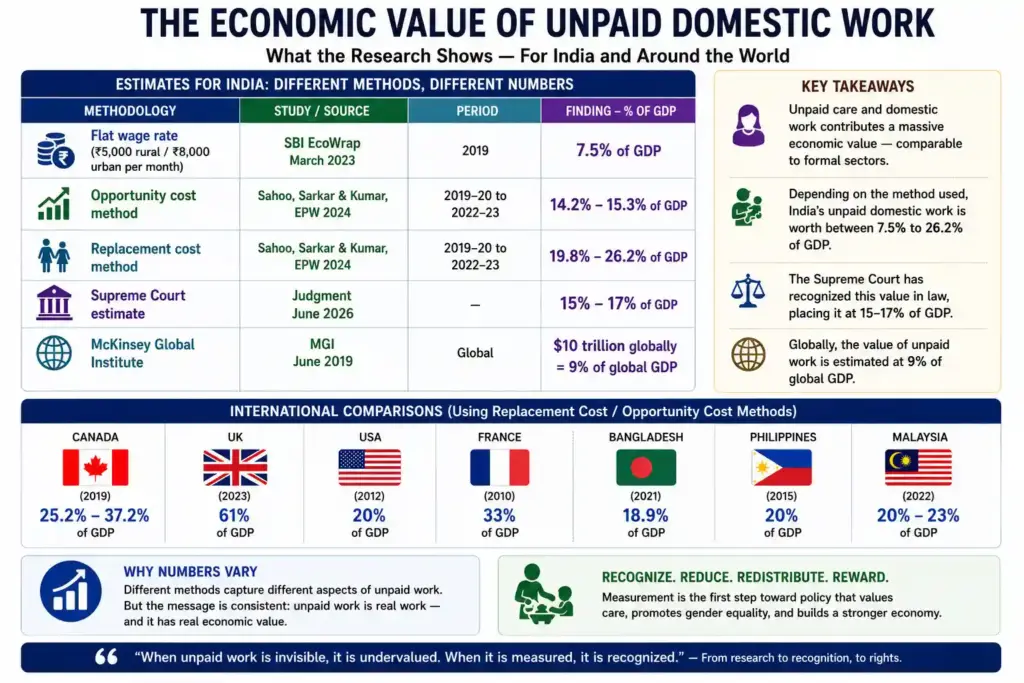
- The Supreme Court separately placed the value of women’s unpaid domestic work at 15–17% of India’s GDP — at the upper end of peer-reviewed academic estimates for India.
The Scale of Unpaid Work — What the Data Shows
Time Poverty: NSO Time Use Survey 2024
- A married woman spends over 5 hours every day on domestic labour and another 1 hour in caregiving — a combined daily unpaid work burden of over 6 hours.
- Married men, by comparison, spend less than 1 hour on both activities combined — a gap of more than 5 hours per day between married men and women in unpaid work.
- The load of domestic work for women shoots up sharply after marriage; for men, the change after marriage is marginal — confirming that marriage is the structural inflection point for gendered time poverty in India.
- The years when the burden of childcare and housework is highest (ages 25–40) are precisely the peak years for career building, skill accumulation, and professional advancement — creating a structural lock-out of women from the labour market at the most economically consequential stage of their working lives.
Labour Force Exclusion: PLFS 2025
- Among women not in the labour force: 52.5% in urban areas and 40% in rural areas cite childcare and home commitments as the primary reason for not seeking employment.
- The corresponding figure for men: 0.4% in rural areas and 0.6% in urban areas — a 100x difference in the degree to which domestic responsibilities exclude men versus women from the labour market.
- State-level data reveals a direct inverse relationship: in states with low Female Labour Force Participation Rate (FLFPR), a larger share of women cite domestic responsibilities as the primary reason for being outside the labour force — confirming that this is a structural, not incidental, barrier.
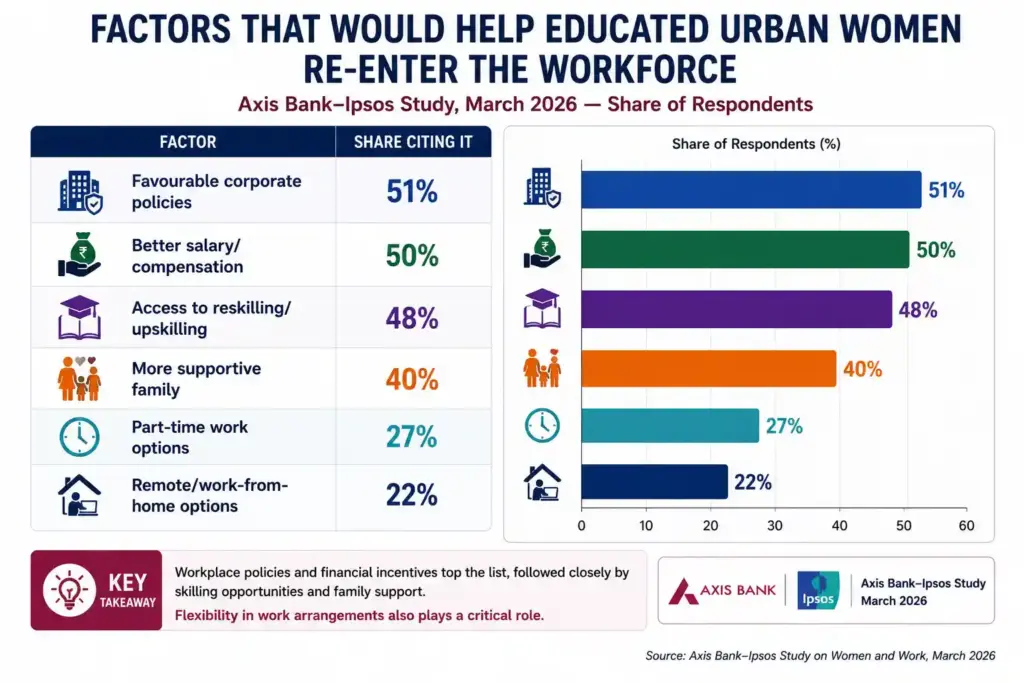
- Approximately 125 million women in India with secondary or higher education are currently outside the labour force (Axis Bank–Ipsos study, March 2026) — a reservoir of educated, trained human capital excluded from the paid economy primarily by unpaid care burdens.
Agency Deficit: NFHS 2019–21
- Women who work outside the home are measurably more likely than homemakers to be actively involved in major household decisions: large purchases, healthcare decisions, visits to relatives.
- This confirms that economic participation is not merely a financial outcome — it is a direct determinant of within-household bargaining power and decision-making agency.
- Systematic undervaluation of unpaid domestic work thus creates a compounding disadvantage: homemakers are excluded from paid work, which reduces their decision-making power, which reinforces domestic role assignment, which perpetuates the next generation’s gender stereotypes.
Valuation Methodologies — The Numbers and Their Limits
The 3R Framework — UNDP’s Policy Architecture
- The 3R Framework for unpaid domestic work was initially conceptualised by Professor Diane Elson of the University of Essex and formally adopted by the UNDP in 2009 as the global policy framework for addressing unpaid care work.
- Recognition: Acknowledging that unpaid domestic labour and care work has economic value and social significance — the Supreme Court’s June 2026 judgment directly advances this dimension.
- Reduction: Policy initiatives that reduce the total hours and energy burden of unpaid work — rural roads, LPG access, piped water, sanitation, public transport, time-saving appliances. These are simultaneously growth-positive and care-burden-reducing.
- Redistribution: Achieving more equitable distribution of unpaid work — between men and women within households, and between private citizens and the state through professional care infrastructure.
- India’s Supreme Court judgment moves the needle on Recognition (the first R) but does not structurally address Reduction or Redistribution — where the bulk of the policy work remains undone.
Decoding the Article: Analysis
1. The ₹30,000 Floor Is Judicially Significant but Economically Arbitrary — and the Gap Matters
- The Supreme Court’s ₹30,000/month figure translates to ₹3.6 lakh per year. At India’s current GDP per capita of approximately ₹2.1 lakh (nominal, 2025–26), this notional floor actually places the homemaker’s monthly contribution above the average Indian citizen’s annual per capita income — a figure that is simultaneously defensible and impossible to operationalise at scale.
- The SBI EcoWrap (2023) used ₹5,000/month rural and ₹8,000/month urban flat rates and still arrived at 7.5% of GDP. The Court’s ₹30,000/month floor is nearly 4–6x these wage assumptions — meaning the Court’s own 15–17% GDP estimate likely requires a significant upward revision of the input wage assumptions used in the SBI study.
- More importantly, the judgment creates a compensation precedent in tort law, not a policy mandate in labour law or national accounts. Its practical impact is limited to motor accident and wrongful death compensation — it does not alter tax treatment of homemakers, social security eligibility, or MGNREGA-equivalent support for unpaid care. The gap between judicial recognition and policy operationalisation is wide, and the article does not measure it.
2. The 125 Million Educated Non-Working Women Represent the Single Largest Untapped Productivity Reserve in the Indian Economy — and the Policy Response Is Underpowered
- 125 million educated women outside the labour force is not a welfare statistic — it is a macroeconomic measurement. IMF research (2018, Elborgh-Woytek et al.) estimates that closing the gender gap in labour force participation in India could add 27% to GDP. Even a partial closure — bringing 20–25% of these 125 million women back into the paid economy — would represent tens of millions of skilled workers entering the labour force.
- The article’s data on re-entry factors is revealing: corporate policies (51%) and reskilling (48%) outrank remote work (22%) as drivers of re-entry — which directly contradicts the post-COVID assumption that work-from-home flexibility is the primary solution to women’s labour force exclusion. The barriers are structural (care burden, skill gap, wage expectations) not merely spatial (location of work).
- India has no national paid maternity leave policy that covers informal workers, no universal childcare infrastructure, and no tax incentive framework for employer-provided creche facilities at the scale required. The National Crèche Scheme (Ministry of Women and Child Development) covers fewer than 1 million beneficiaries — against a need that runs into tens of millions of families with young children.
3. The 3R Framework Has Been UNDP Policy for 17 Years — India Has Only Just Reached Recognition
- The UNDP formally adopted the 3R Framework in 2009. India’s Supreme Court judgment in 2026 advances the Recognition dimension — the first of three Rs — seventeen years after this framework was established as global policy standard.
- The article presents this positively as India “moving closer to the first milestone.” A more direct assessment: India is at the beginning of a three-stage framework whose first stage took 17 years of judicial evolution to reach — even partially. Reduction (infrastructure, appliances, LPG, piped water) is partly underway through schemes like PM Ujjwala Yojana and Jal Jeevan Mission, but access gaps remain large in tribal, coastal and northeastern districts. Redistribution — the most structurally difficult R, requiring both household norm change and state-financed professional care infrastructure — has no major national programme directly addressed to it.
- The missing policy link is a National Care Economy Framework — a dedicated institutional architecture that treats professional care work (childcare, elder care, disability support) as a sector requiring investment, regulation, workforce training and public financing. Several OECD countries have such frameworks; India does not.
The Fine Print — What the Article Does Not Say Loudly Enough
- The ₹30,000/month figure will primarily benefit middle and upper-middle class families in compensation litigation — not the households where care burden is most acute. Road accident compensation claims reach the Supreme Court after years of litigation, requiring legal representation and procedural persistence. The poorest homemakers — informal workers in rural areas, women in low-income urban households — are least likely to access this judicial precedent in practice. The article presents the judgment as universally beneficial without acknowledging this access-to-justice gap.
- India’s Female Labour Force Participation Rate (FLFPR) anomaly is not fully explained by care burden alone. India’s FLFPR has actually been rising in recent years — from 23.3% in 2017–18 to 41.7% in 2023–24 (PLFS data) — driven largely by a surge in rural female agricultural labour and self-employment, not by reduction in care burden. The article uses 2025 PLFS data on women outside the labour force but does not contextualise this against the FLFPR rise — creating an incomplete picture of the direction of travel.
- The replacement cost method (19.8–26.2% of GDP) used in the EPW 2024 study has a fundamental conceptual problem the article mentions but does not resolve. If all unpaid care work were valued at market replacement rates and added to GDP, it would simultaneously require recognising that the households consuming these services cannot pay for them at market rates — meaning the “GDP gain” is a statistical artefact, not a real resource increase. The article acknowledges measurement difficulty but does not flag this double-counting risk.
- “Developing a professional care industry” — the article’s most important policy recommendation — receives one paragraph and no specifics. No target workforce size, no financing model, no regulatory framework, no existing scheme to build on. South Korea’s Long-Term Care Insurance system, Japan’s Kaigo system, and Germany’s Pflegeversicherung are the international templates. India has no equivalent. The recommendation is correct in direction but empty of substance.
- The Axis Bank–Ipsos study (March 2026) covers only educated urban women with prior work experience — a small and unrepresentative slice of India’s 125 million non-working educated women. The study’s finding that 51% want favourable corporate policies cannot be generalised to rural, semi-urban, or informally employed women — for whom corporate policy is an irrelevant variable. The article uses this finding to frame national policy recommendations without flagging the sample’s limitations.
What to Watch
| Indicator | Source | What It Signals |
| MoWCD National Crèche Scheme allocation in Revised Estimates 2026–27 (December 2026) — whether the Supreme Court judgment triggers any upward revision in crèche funding beyond the current sub-1 million beneficiary coverage | Ministry of Finance Revised Estimates Statement, MoWCD Expenditure Report (December 2026) | If allocation rises meaningfully, it signals Recognition (R1) is translating into Reduction (R2) in government policy. If allocation is flat, the judgment’s impact is confined to tort compensation and has not moved policy |
| PLFS 2026–27 Female LFPR (15–59 years) — whether the urban FLFPR shows improvement attributable to corporate re-entry policies, and whether rural FLFPR continues its upward trajectory from 41.7% (2023–24) | MoSPI PLFS Annual Report 2027 | A sustained 1–2 percentage point annual rise confirms structural barriers are easing; stagnation in urban FLFPR specifically signals that corporate policy change — the top-cited re-entry factor (51%) — has not been acted on at scale |
| Union Budget 2027–28 (February 2027) — whether a dedicated care economy budget line or expanded National Crèche Scheme is announced, and whether MoSPI is directed to institutionalise a Satellite Account for Household Production | Ministry of Finance Annual Budget, MoSPI Annual Report 2027 | A new care economy scheme with ₹5,000+ crore allocation or a formal Satellite Account directive would signal that judicial Recognition has moved into policy Reduction. Absence confirms the Supreme Court ruling has not altered the fiscal architecture for unpaid care |
- Sign Up on Practicemock for Updated Current Affairs, Topic Tests and Mini Mocks
- Sign Up Here to Download Free Study Material
Free Mock Tests for the Upcoming Exams
- IBPS PO Free Mock Test
- RBI Grade B Free Mock Test
- IBPS SO Free Mock Test
- NABARD Grade A Free Mock Test
- SSC CGL Free Mock Test
- IBPS Clerk Free Mock Test
- IBPS RRB PO Free Mock Test
- IBPS RRB Clerk Free Mock Test
- RRB NTPC Free Mock Test
- SSC MTS Free Mock Test
- SSC Stenographer Free Mock Test
- GATE Mechanical Free Mock Test
- GATE Civil Free Mock Test
- RRB ALP Free Mock Test
- SSC CPO Free Mock Test
- AFCAT Free Mock Test
- SEBI Grade A Free Mock Test
- IFSCA Grade A Free Mock Test
- RRB JE Free Mock Test
- Free Banking Live Test
- Free SSC Live Test