



All those candidates who are eyeing exams like RBI, SEBI, or NABARD exams will have to stay updated with all the important economic and regulatory updates. In today’s edition of Vishleshan, we’ll discuss the New Swadeshi Movement and Job Creation. These issues are highly relevant for all the upcoming competitive exams mentioned above. Keep reading to stay ahead with a clear understanding of today’s topic.
From Charkha to Semiconductors: India’s Neo-Swadeshi Movement
Context: Amidst global trade wars, the call for Swadeshi returns. But today’s focus is on integrating into global supply chains, not boycotting them. It’s a pragmatic push for self-reliance that values Indian labour in producing globally competitive goods.
Link to the Article: Mint
Prime Minister Narendra Modi’s recent reinterpretation of “swadeshi” as a pragmatic, job-generating economic philosophy is a strategic move to navigate a world increasingly marked by protectionism and geopolitical tensions. This modern interpretation, which encourages foreign investment and integration into global supply chains while promoting local value addition, is a far cry from the original, anti-colonial spirit of the movement. By embracing this approach, India aims to build a globally competitive, resilient economy that is not inward-looking but instead uses its domestic strengths to leverage a strong position in the world economy.
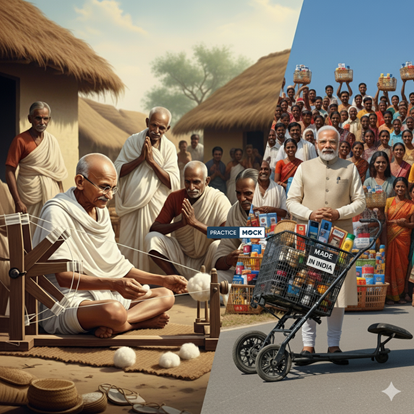
Background of the Swadeshi Movement:
- Reason: The Swadeshi Movement, which emerged in the early 20th century, was a political and economic protest against the British partition of Bengal in 1905. It was based on the principles of self-reliance and economic nationalism.
- Response of Indians: The movement urged Indians to boycott British goods and use domestically produced goods instead. It was characterized by mass protests, public burnings of foreign cloth, and the promotion of indigenous industries. Key leaders included Mahatma Gandhi, who later made the charkha (spinning wheel) a symbol of economic self-sufficiency, and other nationalist leaders who encouraged the use of Indian-made products.
- Impact: The movement had a significant impact on India’s struggle for independence, as it fostered a sense of national unity and economic empowerment. It also laid the foundation for indigenous industrial development and inspired future generations of leaders to prioritize self-reliance.
Why India Needs to Go for Another Swadeshi Movement:
Modi’s recent reinterpretation of “swadeshi” is not a call for autarky, but a strategic economic and geopolitical tool for modern India.
- To Keep India a Consumption-Driven Economy: India’s GDP is largely driven by domestic consumption, which accounts for over 60% of output. The new “swadeshi” philosophy is a rhetorical device that urges Indians to buy locally-produced goods, which can boost domestic consumption and insulate the economy from global shocks.
- Increased Share of Manufacturing in GDP: India’s share of manufacturing in gross value added (GVA) is around 13.89% as of 2024-25. A literal push for indigenous supply chains would be impractical and could actually shrink this share. Instead, Modi’s reinterpretation encourages foreign investment in local manufacturing to generate jobs and increase India’s industrial base.
- Making India a Circular Economy: The focus on “Make in India” and “vocal for local” also has a link to making India a more circular economy by encouraging local production and consumption.
- Bringing Global Businesses to India: By welcoming foreign investors, the new “swadeshi” philosophy aims to use India’s large domestic consumption as a magnet to attract global businesses to set up factories and employ local talent. This creates jobs and integrates India into global value chains.
- Having Leverage over other Countries: The new “swadeshi” is a savvy geopolitical move. In the face of US tariffs, instead of calling for a boycott of US goods, which could be seen as an aggressive act, Modi’s call to “buy Indian products targets nobody”. This sends a signal to global investors and other countries that India is open for business and will not give in to unreasonable demands, while using its domestic market as a source of leverage.
How Swadeshi May Transform the Indian Economy:
- GDP (FY 2024-25):
- India’s nominal GDP in 2024-25 is estimated at ₹330.68 lakh crore.
- The services sector is the largest contributor to GVA, with its share rising from 50.6% in FY14 to 55.3% in FY25. It provides employment to approximately 30% of the workforce.
- The manufacturing sector’s share in GVA is 13.89% in 2024-25.
- Trade and GDP (FY 2024-25):
- India’s total exports of goods and services reached a record $824.9 billion in 2024-25.
- The total value of merchandise and services imports in April-February 2024-25 was $839.89 billion.
- The ratio of India’s exports and imports to its GDP is in the 45-50% range.
- Impact of “Swadeshi” on the Economy: Modi’s reinterpretation of “swadeshi” as a non-autarkic, globally-integrated philosophy is a pragmatic approach that can transform the Indian economy by:
- Increasing the Share of Manufacturing: By welcoming foreign investment and technology for job creation, India can increase the share of its manufacturing sector in GVA, which is currently “stubbornly below 14%”.
- Job Generation: The emphasis is on job creation, as foreign businesses setting up export-focused factories in India will generate employment for Indian workers. This is a core part of the new “swadeshi”.
- Integration into Global Supply Chains: By allowing for imports and leveraging foreign investment, this outlook helps local producers “wedge themselves into transnational supply chains”.
- Boosting Domestic Consumption: The call to “buy Indian products” strengthens domestic demand, which is the primary driver of India’s economic growth. A strong, consumption-driven domestic economy is a crucial counterweight to global trade shocks.
Analysis of the Article: Decoding the New “Swadeshi”
The article analyses Prime Minister Modi’s reinterpretation of “swadeshi” as a pragmatic and modern policy, arguing that it is a strategic response to both domestic economic needs and global geopolitical challenges.
- A Pragmatic Reinterpretation: Modi’s new definition of “swadeshi” is a departure from the anti-colonial spirit of the original movement. It is not a call for a closed economy or “autarky” but a pragmatic approach that seeks to leverage foreign investment for job generation. The message is that “it doesn’t matter whose money is invested,” as long as it creates jobs for Indians.
- Savvy Geopolitics: In the face of US tariffs, a call to boycott US goods would be impolitic. Instead, urging citizens to buy Indian products is a strategic move that targets nobody but sends a strong signal to global investors that India is a viable market for production. This allows India to affirm its openness while simultaneously resisting “unreasonable demands” from other countries.
- Learning from China: The article draws a parallel with Chinese leader Deng Xiaoping’s dictum that “the colour of the cat did not matter so long as it caught the mice,” which drove China’s economic rise. Modi’s “colour-blind red carpet for investors” suggests a similar pragmatism.
- Not an Inward Turn: The article concludes that this new “swadeshi” is not an inward-looking policy, and India’s policy has not “come full circle” to its closed-economy past. Instead, it is a strategic approach that acknowledges the reality of India’s gains from globalization while using nationalist rhetoric to build a more resilient and self-reliant economy.
In conclusion, Prime Minister Modi’s reinterpretation of “swadeshi” is a strategic move that reframes a traditional concept of self-reliance for a modern, globalized world. It is a pragmatic economic and geopolitical tool that aims to attract foreign investment for job creation, strengthen domestic supply chains, and use India’s immense consumer market as a source of leverage in a world of increasing protectionism. This approach, which is not an inward turn but a strategic alignment, could be crucial for India’s journey to becoming a global economic powerhouse.
- Sign Up on Practicemock for Updated Current Affairs, Topic Tests and Mini Mocks
- Sign Up Here to Download Free Study Material
Free Mock Tests for the Upcoming Exams
- IBPS PO Free Mock Test
- RBI Grade B Free Mock Test
- IBPS SO Free Mock Test
- NABARD Grade A Free Mock Test
- SSC CGL Free Mock Test
- IBPS Clerk Free Mock Test
- IBPS RRB PO Free Mock Test
- IBPS RRB Clerk Free Mock Test
- RRB NTPC Free Mock Test
- SSC MTS Free Mock Test
- SSC Stenographer Free Mock Test
- GATE Mechanical Free Mock Test
- GATE Civil Free Mock Test
- RRB ALP Free Mock Test
- SSC CPO Free Mock Test
- AFCAT Free Mock Test
- SEBI Grade A Free Mock Test
- IFSCA Grade A Free Mock Test
- RRB JE Free Mock Test
- Free Banking Live Test
- Free SSC Live Test