



All those candidates who are eyeing exams like RBI, SEBI, or NABARD exams will have to stay updated with all the important economic and regulatory updates. In today’s edition of Vishleshan, we’ll discuss how India’s GDP Q1 FY26 Surpasses RBI Projections. These issues are highly relevant for all the upcoming competitive exams mentioned above. Keep reading to stay ahead with a clear understanding of today’s topic.
The ‘Dead Economy’ Roars: A 7.8% Reality Check
Context: Brushing aside predictions of a slowdown and remarks of a “dead economy,” India posted a roaring 7.8% GDP growth. This unexpected surge demonstrates underlying resilience, even as the nation braces for the impact of steep US tariffs ahead.
Links to the Articles: Article 1 (Mint), Article 2 (Mint), Article 3 (Mint)
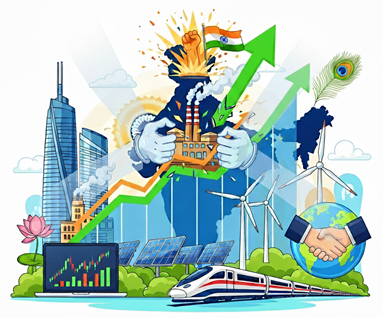
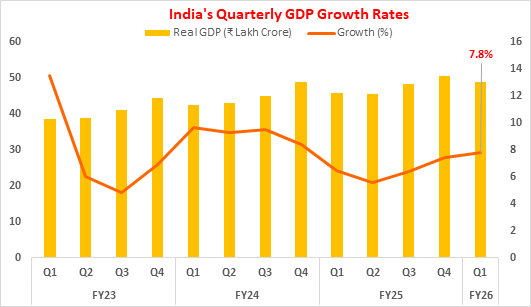
India’s economy registered a surprising 7.8% real GDP growth in the first quarter of FY26, defying expectations of a slowdown and marking its best pace in five quarters. This strong performance, driven by a surge in government spending and benign inflation, suggests a robust resilience. However, this positive momentum is overshadowed by concerns about a sharp slowdown in nominal GDP growth (8.8%) and the looming threat of US tariffs, which could create significant fiscal challenges and disrupt India’s economic game plan for the rest of the year.
Gross Domestic Product:
Gross Domestic Product (GDP): The total monetary or market value of all the finished goods and services produced within a country’s borders in a specific time period. It serves as a broad measure of a country’s overall economic health.
Calculation at Current and Constant Prices:
- Nominal GDP (at current prices): Measures a country’s economic output using the current prices in the market. It includes the effects of inflation. The nominal GDP growth in Q1 FY26 was 8.8%.
- Real GDP (at constant prices): Measures a country’s economic output by adjusting for inflation. It uses a base year’s prices to calculate the value of goods and services, providing a more accurate measure of economic growth. The real GDP growth in Q1 FY26 was 7.8%.
Real vs. Nominal GDP:
- Real GDP is considered a better measure of economic growth because it removes the distortion of inflation.
- Nominal GDP is crucial for government’s budget math and is often used to calculate key fiscal ratios, such as the fiscal deficit or debt as a percentage of GDP.
Context of Q1 GDP Numbers:
The surprising Q1 FY26 GDP numbers emerged against a backdrop of geopolitical tensions, new US tariffs, and weak domestic demand. The article also mentions a lack of sufficient private capital expenditure (capex).
Reasons for the Surprise:
- Low GDP Deflator: The surprise was caused by a low inflation rate, which gave a “technical boost” to the calculation of real GDP growth. The GDP deflator was at a 23-quarter low of 0.9% in Q1 FY26, which is the tool used to adjust nominal GDP for inflation.
- Surge in Government Spending: A key role was played by a “surge in spending by the government”. This was in sharp contrast to the election-strapped first quarter of FY25.
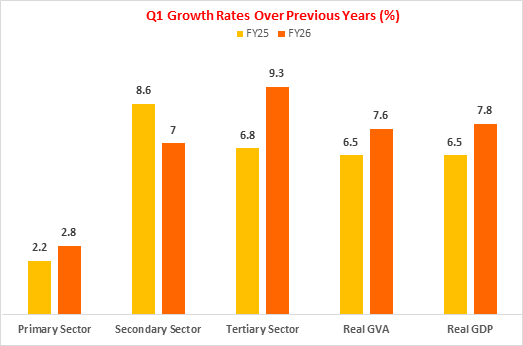
- Broad-based Growth: The 7.8% real expansion was notable for its “broad sweep of sectors from farms and factories to services”.
President Trump’s “Dead Economy” Remarks Fell Flat:
The recent numbers implicitly refute any such notion by showcasing India’s strong economic performance in Q1 FY26.
- Strongest Growth Among Peers: India’s real GDP growth of 7.8% in Q1 FY26 was the highest among leading global economies, including China (5.2%), Indonesia (5.1%), the USA (2.1%), Japan (1.2%), the UK (1.2%), and Germany (-0.2%).
- Defying Projections: The 7.8% growth rate defied expectations of a slowdown, surpassing the RBI’s projection of 6.5% and a poll of 22 economists by Mint that indicated a 6.7% expansion.
- Resilience Amid Global Headwinds: The article highlights India’s “resilience” despite facing “trade headwinds from here on”. This is a direct contradiction of any claim that India’s economy is not performing well.
Comparative Study of Q1 FY26 GDP Growth:
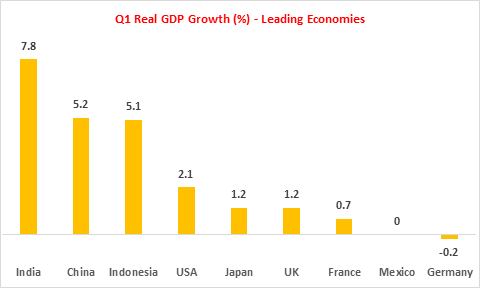
The provided graph offers a clear comparative view of the real GDP growth rates of leading global economies in the April-June 2025 quarter.
- India: India’s real GDP growth was 7.8%.
- China: China’s real GDP growth was 5.2%.
- Indonesia: Indonesia’s real GDP growth was 5.1%.
- USA: The US recorded a real GDP growth of 2.1%.
- Japan: Japan’s real GDP growth was 1.2%.
- UK: The UK recorded a real GDP growth of 1.2%.
- France: France’s real GDP growth was 0.7%.
- Mexico: Mexico’s real GDP growth was 0%.
- Germany: Germany was the only major economy to show a contraction, with its real GDP growth at -0.2%.
Analysis of the Article: Decoding the Q1 FY26 GDP Numbers
The article analyses the Q1 FY26 GDP numbers, highlighting the encouraging signs and the “red flags” that require careful policy management for the rest of the year.
- Positive Cues and Encouraging Signs:
- Broad-based Private Consumption: The Q1 numbers showed that private consumption is “getting broad based on account of strong formal sector and rural wage growth”.
- Government Capex: Both the central and state governments have “front-loaded their capital expenditure,” which grew by 33%. This was on a low base due to the elections in Q1 of the previous year.
- Improving Private Capex: The Index of Industrial Production (IIP) numbers are an indication that private capex is also improving.
- Red Flags and Challenges:
- Slower Nominal GDP Growth: The nominal GDP growth of 8.8% in Q1 FY26 is a drop from 9.6% in the same period last fiscal and is a “clear indication that there is still some slackness in the economy”.
- Impact on Budget Math: A slower nominal GDP growth will make it difficult for the government to meet its revenue targets, which could force it to “tighten its belt and cut expenses” to maintain its fiscal deficit and debt ratios. For example, if nominal GDP growth slides to 7.5%, the government will have to cut its fiscal deficit by ₹6,578 crore and its debt by ₹83,919 crore to keep the ratio estimates intact.
- External Headwinds: The looming threat of 50% US tariffs on Indian exports is expected to have a “half a percentage point shaven off” this fiscal year’s growth rate. This could lead to “layoffs” in tariff-hit sectors like apparel, textiles, gems, and jewellery.
- Policy Prescriptions: To navigate this period of chaos, the article suggests a broader reform thrust aimed at a “more efficient economy full of competitive businesses that exude export optimism”. Reforming the GST regime and updating Indian statistics are highlighted as key steps.
In conclusion, India’s Q1 FY26 GDP numbers are a positive sign of the economy’s resilience. However, the real story lies in the details—a sharp slowdown in nominal growth and the looming US tariffs pose significant fiscal and economic challenges for the rest of the year. The article suggests that a combination of domestic reforms, a simplified GST, and a strategic response to the trade hit will be crucial for India to sustain its growth momentum and turn this setback into a strategic opportunity.
CoP-30: The Climate Compass Points South
Context: With the US turning isolationist and the EU timid, the world’s climate compass is shifting. This article explores whether the Global South, led by the BRICS nations, can seize this moment to steer the world towards an equitable green transition.
Link to the Article: Mint
The upcoming 30th session of the Conference of the Parties (COP) in Belém, Brazil, will convene against a backdrop of a deteriorating global climate situation and a growing distrust between developed and developing nations. The global accumulation of greenhouse gases, a challenge that no single country can solve alone, requires effective global cooperation. However, the international climate mitigation framework is under strain due to the shift by developed countries away from their historical commitments and the principle of “common but differentiated responsibilities” (CBDR). This has created a vacuum that could empower the Global South—especially Brazil, South Africa, India, and China—to lead a more equitable and inclusive clean-energy transition.
United Nations Framework Convention on Climate Change (UNFCCC):
- Origin: The UNFCCC was signed at the Earth Summit in Rio in 1992. It entered into force on March 21, 1994.
- Purpose: The central aim of the Convention is to stabilize greenhouse gas (GHG) concentrations in the atmosphere at a level that would prevent dangerous human interference with the climate system.
- Members: The Convention has a near-universal membership, with 197 Parties as of today. The countries that have ratified the convention are called the UNFCCC Conference of Parties (COP).
- Key Developments and Milestones:
- 1997 – Kyoto Protocol (COP3): A landmark agreement that legally bound developed countries (Annex 1) to emission reduction targets.
- 2005: The Kyoto Protocol entered into force.
- 2011 – Durban Platform: Accepted by COP17, this platform drafted a new agreement for enhanced action.
- 2015 – Paris Agreement (COP21): A new legally binding agreement to keep global temperature rise “well below 2 degrees Celsius above pre-industrial levels and to pursue efforts to limit the temperature increase even further to 1.5 degrees Celsius”.
- India’s Relation: India has been a strong champion of the principles of equity and CBDR-RC (Common but Differentiated Responsibilities and Respective Capabilities) at the Convention. India submits Biennial Update Reports (BURs) to the UNFCCC to track its progress on climate actions. India was also instrumental in the formation of global initiatives like the Coalition for Disaster Resilient Infrastructure (CDRI) and the International Solar Alliance (ISA). India has also repeatedly voiced the concerns of the Global South regarding climate aid. India has even been a potential host for COP33.
The UNFCCC, the foundational treaty for global climate action, classifies its parties into different Annex categories to reflect the principle of “CBDR”. This classification, based on a country’s economic status and historical emissions, determines its obligations under the Convention. India is placed in the Non-Annex I category, which is a justifiable position given its developmental needs, low per capita emissions, and minimal historical contribution to the climate problem.
Annex Categories in the UNFCCC:
The UNFCCC classifies its member countries into three main categories: Annex I, Annex II, and Non-Annex I. This classification was established to operationalize the principle of CBDR by placing a heavier burden on developed nations.
- Annex I Parties:
- Composition: This group comprises industrialized (developed) countries and “economies in transition” (EITs) from Central and Eastern Europe and the former Soviet Union. There are 43 parties in this category, including the European Union.
- Rationale and Obligations: These countries are expected to lead the way in climate mitigation because they are the source of most past and current greenhouse gas emissions due to more than 150 years of industrial activity. Under the original Convention, they were obliged to reduce GHG emissions, protect and develop sinks, and submit regular, detailed reports on their climate policies and emissions inventories. The Kyoto Protocol, for example, set legally binding targets for a reduction of 5% against 1990 levels for these countries over the 2008-2012 period.
- Annex II Parties:
- Composition: This is a subset of Annex I parties and consists of members of the Organisation for Economic Co-operation and Development (OECD) as of 1992, minus Turkey, plus the European Union. There are 24 parties in this category.
- Rationale and Obligations: In addition to their Annex I obligations to reduce emissions, Annex II countries are specifically required to provide financial and technical support to EITs and developing countries (Non-Annex I). This is to assist them in both reducing their greenhouse gas emissions (mitigation) and managing the impacts of climate change (adaptation). They are also expected to share environmentally friendly technologies to help developing nations progress towards sustainable development.
- Non-Annex I Parties:
- Composition: This group includes all countries not listed in Annex I, primarily low-income developing countries. This is the largest group, with over 150 countries, including India and China.
- Rationale and Obligations: The Convention recognizes that economic development is essential for these countries to progress, and their share of greenhouse gas emissions will grow. Therefore, their obligations are more general and flexible. They are encouraged to take actions to limit emissions and cooperate on research and technology, but are not bound by the same strict, legally binding targets as Annex I countries. Their reporting obligations are also less regular and are often contingent on receiving financial support for their preparation.
India’s Position in Non-Annex I
India’s placement in the Non-Annex I category is justifiably based on a strong and consistent set of arguments rooted in the core principles of the UNFCCC.
- Low Per Capita Emissions: India’s per capita CO₂ emissions are among the lowest in the world, a key argument India consistently makes in global climate discourse. In 2023, India’s per capita emissions were only 2.1 tonnes of CO₂. This is significantly lower than developed countries like the US (14.3 tonnes), Russia (12.5 tonnes), Japan (7.9 tonnes), and the EU (5.4 tonnes).
- Minimal Historical Responsibility: India’s historical contribution to the cumulative global GHG emissions is minimal, estimated at around 4%, despite having around 17% of the world’s population. This contrasts sharply with developed countries, which have a much higher historical share due to their earlier industrialization. The current high levels of GHG in the atmosphere are a result of over 150 years of industrial activity in developed nations.
- Developmental Imperatives: As a developing country, India’s priority is to address its vast population’s developmental needs, including poverty eradication and providing energy access. India has a large proportion of the global poor and its per capita energy consumption is around one-third of the world’s average. Placing India in Annex I would require a rapid and costly decarbonization, which could hinder its ability to achieve sustainable economic development, a consideration that the Convention itself acknowledges.
- Proactive Climate Action: Despite not being an Annex I country, India has been a proactive participant in global climate action. It is one of the few G20 nations that is on track to meet its Nationally Determined Contribution (NDC) goals. For example, India has already reduced the emission intensity of its GDP by 24% between 2005 and 2016, ahead of its 2030 target. India also achieved its target of having 40% of its electricity capacity from non-fossil fuel sources nine years ahead of schedule.
- Conclusion: Given its low per capita emissions, minimal historical responsibility, and ongoing developmental needs, India is rightly categorized as a Non-Annex I party. India’s argument, consistent with the foundational principles of the UNFCCC, is that developed countries must take the lead in mitigation and provide the means of implementation to developing countries.
Conference of the Parties (COP):
- History and Link to UNFCCC: The Conference of the Parties (COP) is the supreme decision-making body of the UNFCCC. The first COP took place in Berlin in 1995. COPs are held annually and serve as a platform for countries to negotiate and agree on new commitments and policies to address climate change. The upcoming COP30 will be held in Belem, Brazil, in November 2025.
- Impact: COPs have led to several key milestones, including the Kyoto Protocol and the Paris Agreement. India’s participation has been crucial in ensuring that the concerns of developing countries are heard and in pushing for a more equitable approach to climate action.
- India’s Participation: India has actively participated in COPs, showcasing its commitment to climate action and promoting initiatives that support the Global South. India’s Prime Minister, Narendra Modi, announced India’s ambitious climate vision at COP26 in Glasgow, including the goal of achieving net-zero emissions by 2070.
CBDR and NDC:
Common but Differentiated Responsibilities (CBDR):
- What it is: A foundational principle of the UNFCCC that recognizes that while all countries share the common responsibility to address climate change, their contributions should be differentiated based on their historical contributions to the problem and their respective capabilities. The original UNFCCC placed primary responsibility for mitigation on developed countries (Annex 1).
- Need for the Concept: This principle is based on the belief that developed countries, having industrialized earlier, are largely responsible for the high levels of accumulated GHGs in the atmosphere. It allows developing countries leeway to prioritize poverty eradication and other developmental needs.
- High Per Capita Emissions of Developed vs. Developing Countries: Today’s article highlights the stark per capita emissions gap.
- Developed Countries (2023): US: 14.3 tonnes. Russia: 12.5 tonnes. Japan: 7.9 tonnes. EU: 5.4 tonnes.
- Developing Countries (2023): China: 8.4 tonnes. India: 2.1 tonnes.
Nationally Determined Contributions (NDC):
- Origin: NDCs are at the heart of the Paris Agreement. They represent each country’s voluntary, non-binding climate action plan to reduce emissions and adapt to climate change.
- India’s Updated NDC (2022) and Progress:
- India submitted its updated NDC in August 2022.
- Target 1 (Emission Intensity): To reduce the Emissions Intensity of its GDP by 45% by 2030, from 2005 levels. Progress: India has already reduced its emission intensity by 36% between 2005 and 2020.
- Target 2 (Non-Fossil Fuel Capacity): To achieve about 50% cumulative electric power installed capacity from non-fossil fuel-based energy resources by 2030. Progress: India has already achieved this goal as of June 2025, five years ahead of its 2030 timeline, with 50% of its installed power capacity now from non-fossil fuel sources. The installed solar energy capacity has increased more than 41 times from 2.82 GW in 2014 to 116.25 GW in June 2025.
- Target 3 (Carbon Sink): To create an additional carbon sink of 2.5 to 3 billion tonnes of CO₂ equivalent through forest and tree cover by 2030.
- Comparison: Having one of the lowest per capita emissions in the world, India is one of the few G20 nations that is on track to fulfill or even surpass its NDC goals.
Unresolved Issues and Roadblocks:
- Inadequate Global Commitments: The current commitments from all countries are insufficient to meet the 2°C limit, with projections pointing to a temperature rise of 2.6-2.8°C. If no additional action is taken, the rise could be 3.1°C.
- Diluted Commitments by Developed Countries: Developed countries have diluted their commitments and moved away from the CBDR principle. They are shifting the emphasis from cumulative to current emissions, which places the burden on developing countries.
- The US Withdrawal from Paris Agreement: US President Donald Trump withdrew the US from the Paris Agreement. This action has reduced the US’s promised emission cuts by 2030 from 40% to just 3%, representing an increase of about 2 billion tonnes of CO₂ in 2030 relative to its original pledge. This has “undone the compromises reached 10 years ago between developed and developing countries”.
- Lack of Financial Commitments: A major unresolved issue is the lack of sufficient financial and technical support from developed to developing countries. Many pledges are not new or additional, and there are significant gaps in replenishing funds like the Loss and Damage Fund.
Analysis of the Article
The article argues that the global climate governance landscape is at a critical inflection point, with the traditional leadership of the West declining and a new opportunity emerging for the Global South to take the lead.
- The West’s Retreat from Climate Leadership:
- The US: Under President Donald Trump’s second administration, the US has become “more aggressive and more isolationist”. His administration has “mocked climate science, propped up the fossil-fuel industry and denounced the UN’s 2030 Agenda for Sustainable Development”. The US’s withdrawal from the Kyoto Protocol in 2001 and President Trump’s second withdrawal from the Paris Agreement have brought an end to an era where the West, despite stumbles, was a leading voice in shaping the climate agenda.
- The EU: The European Union has “grown timid, fragmented and inward-looking,” weakened by the rise of the far right and lacking the political will and economic means to lead on international climate cooperation.
- Erosion of Trust: Financial support from the rich world has been well below what is needed, which has hindered climate action in developing countries and eroded trust in Western leaders. The US pulling out of the Paris Agreement also increases pressure on other developed countries to fill the climate finance gap.
- The Global South’s Opportunity:
- Bearing the Brunt of Climate Shocks: The Global South “bears the brunt of climate shocks” and has an opening to lead a more equitable and inclusive clean-energy transition.
- Emerging Leadership: Countries like Brazil, India, South Africa, and China are building on their roles in shaping the Sustainable Development Goals and the Paris pact to forge a cohesive climate agenda for COP30.
- China’s Green Tech Dominance: China has become the “undisputed global leader in green tech,” with a surplus of solar panels, batteries, and wind turbines that could be redirected to developing countries to strengthen their energy sovereignty. China accounted for three-quarters of investment in clean technology production in 2023.
- South-South Cooperation: In a fragmented world, South-South cooperation on climate targets offers a powerful platform to revitalize multilateralism and lead “plurilateral initiatives” that counter the US administration’s bullying tactics. Brazil is leveraging its BRICS+ presidency and South Africa its G-20 presidency to build momentum for COP30.
- The Central Debate on “Common but Differentiated Responsibilities” (CBDR):
- The developed countries have moved against the idea of CBDR, which is an explicit part of the UNFCCC. This principle acknowledges that while all states have a shared obligation, their responsibilities differ based on their level of industrialization and historical contribution to climate change.
- The article highlights the significant disparity in per capita CO₂ emissions as of 2023.
- Developed countries: US (14.3 tonnes), Russia (12.5 tonnes), Japan (7.9 tonnes), and the EU (5.4 tonnes).
- Developing countries: China (8.4 tonnes) and India (2.1 tonnes).
- The article suggests that Brazil and India can join forces with other large low-emitter developing countries like Indonesia and Egypt to “reassert the importance of the CBDR principle” at COP30.
- The Inadequacy of Current Global Efforts:
- The Paris Agreement set a goal to limit global temperature rise to well below 2°C, and preferably 1.5°C, above pre-industrial levels.
- However, the UNEP Emissions Gap Report 2024 states that current commitments will only keep the global temperature rise in a range of 2.6-2.8°C. Policies currently in place are insufficient to meet even these commitments, and if no additional action is implemented, the world could experience a temperature rise of 3.1°C.
- The US withdrawal from the Paris Agreement, which reduced its promised emission cuts by 2030 from 40% to just 3%, has “undone the compromises reached 10 years ago” between developed and developing countries and made climate prospects even worse.
Conclusion: The upcoming COP30 represents a “vital opportunity” for the Global South to demonstrate that climate and development goals are not mutually exclusive. By presenting a “clear-eyed vision of an energy transition that uplifts their people and protects the planet,” these countries can demonstrate leadership in the face of the West’s decline in climate governance.
- Sign Up on Practicemock for Updated Current Affairs, Topic Tests and Mini Mocks
- Sign Up Here to Download Free Study Material
Free Mock Tests for the Upcoming Exams
- IBPS PO Free Mock Test
- RBI Grade B Free Mock Test
- IBPS SO Free Mock Test
- NABARD Grade A Free Mock Test
- SSC CGL Free Mock Test
- IBPS Clerk Free Mock Test
- IBPS RRB PO Free Mock Test
- IBPS RRB Clerk Free Mock Test
- RRB NTPC Free Mock Test
- SSC MTS Free Mock Test
- SSC Stenographer Free Mock Test
- GATE Mechanical Free Mock Test
- GATE Civil Free Mock Test
- RRB ALP Free Mock Test
- SSC CPO Free Mock Test
- AFCAT Free Mock Test
- SEBI Grade A Free Mock Test
- IFSCA Grade A Free Mock Test
- RRB JE Free Mock Test
- Free Banking Live Test
- Free SSC Live Test