


India’s economic transformation since liberalisation has lifted millions out of poverty and expanded access to basic services, finance, and infrastructure. Yet beneath the headline growth story lies a deeper structural concern: the steady erosion of the middle class. Distributional data suggests that while overall wealth and income have grown, the share accruing to middle-income households has consistently declined over the past three decades. This contraction has implications far beyond inequality alone. In a consumption-driven economy like India, a weakening middle class affects domestic demand, employment generation, and long-term economic stability. Strengthening the middle segment is therefore central not only to equity, but to sustaining India’s growth trajectory itself.
India’s shrinking middle class: policy must double down on strengthening the economy’s backbone
Context: India’s income Gini coefficient has risen from 0.46 in 1990 to 0.64 in 2024, and the top 10% currently account for nearly 59% of total income and 65% of total wealth. Growth over the past three decades has been substantive, but its distribution across income segments has been uneven. The domestic demand base, which India’s growth model relies on, rests increasingly on a narrowing middle. The article traces this to three causes: services-led jobless growth, a fragmented labour market, and low educational mobility. It warns that without a strong middle, India’s domestic demand cycle — which drives growth in the absence of an export engine — will weaken and become self-reinforcing.
Link to the Article: Mint
Growth Gains and Their Distribution
India’s post-1991 structural transformation produced measurable improvements in living standards. Financial inclusion widened, welfare delivery became better targeted, and access to basic amenities reached previously excluded populations. These are substantive outcomes. However, aggregate growth figures do not fully reflect the internal distribution of those gains. Distributional data from the World Inequality Lab for 2024 indicates that the middle class — broadly defined as the middle 30–70% of earners — has seen its share of both income and wealth decline consistently since 1989.
How the Compression Occurred
The contraction of the middle class reflects three structural factors that have operated simultaneously over the post-liberalisation period.
Factor 1 — The Composition of Growth
India’s economic expansion has been concentrated in capital- and skill-intensive services sectors. Manufacturing, which has historically supported middle-income employment in most developing economies, has remained a limited share of total employment.
Returns in services-led growth tend to accrue to asset owners and high-skill workers. Wages grow incrementally, while wealth compounds through equity, real estate, and business ownership — producing a widening gap between labour income and asset income over time.
Factor 2 — Labour Market Structure
A significant share of India’s workforce remains employed in low-productivity agriculture and informal services. The formal manufacturing sector — the conventional pathway between low-income and middle-income status — has not expanded at a scale sufficient to absorb this population.
The outcome is a segmented labour market, with high-income formal employment at the upper end and low-productivity self-employment at the lower end, with limited middle-income employment in between.
Factor 3 — Educational Mobility
Research by Asher et al. (2022) indicates that intergenerational mobility along the educational ladder has been low and broadly unchanged since 1991. A study by Bharti and Yang (2024) further finds that educational inequality accounts for approximately one-quarter of wage inequality in India. Where the education system does not produce broad-based, quality outcomes, the structural conditions for upward mobility across generations remain limited.
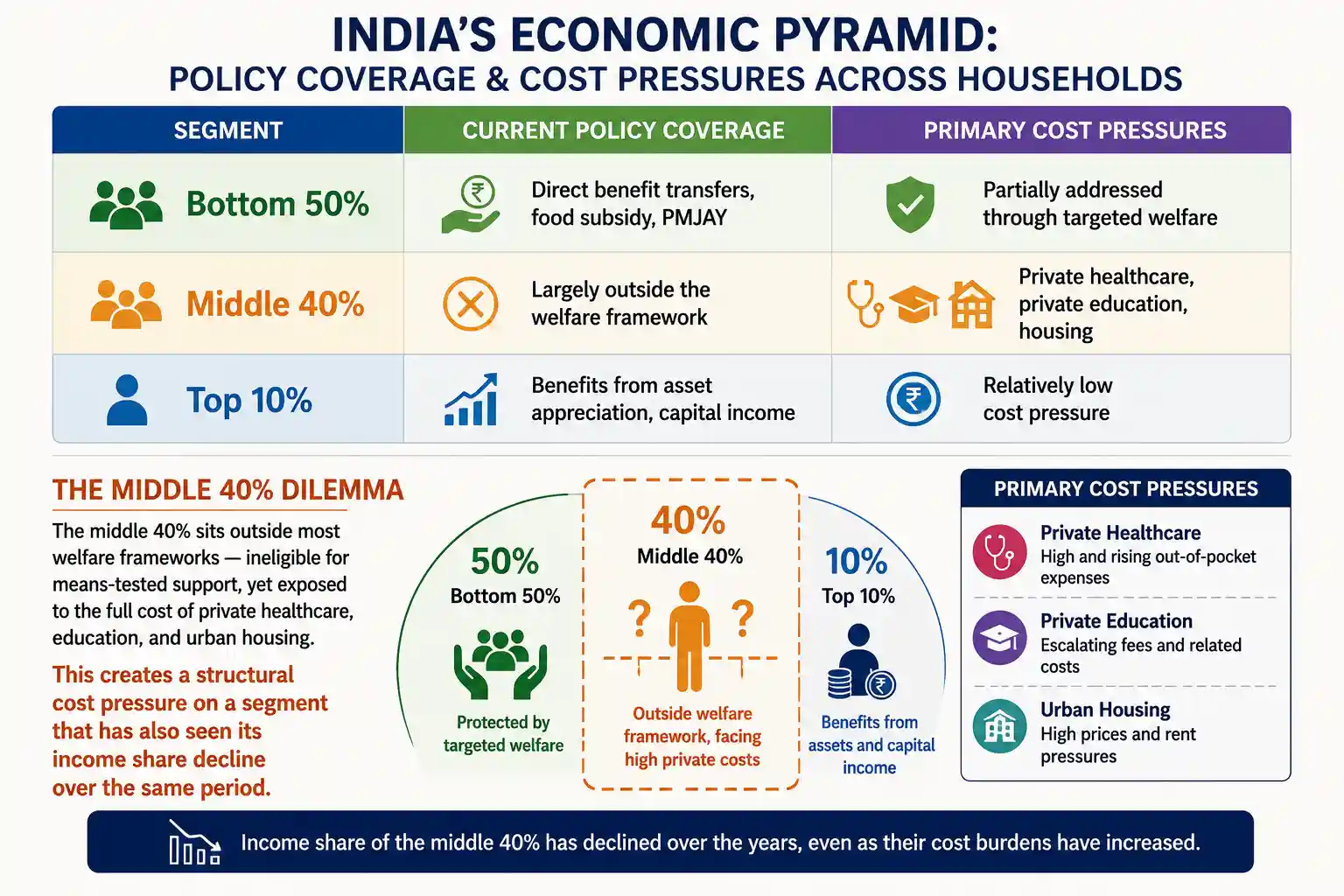
Policy Coverage Across Income Segments
Implications for Domestic Demand
India’s growth model since 1991 has operated on a domestic demand cycle: middle-class consumption supports demand, demand sustains employment, and employment feeds back into consumption. This is structurally different from the export-oriented models followed in East Asia, which were designed to expand the middle class through manufacturing employment and wage-linked growth. As the middle’s income share has declined — from 28.9% in 1989 to 18.8% in 2024 — the sustainability of this demand cycle warrants closer attention.
The AI Dimension
The article notes that artificial intelligence poses an additional consideration. Routine mid-skill roles — which have historically served as entry points into formal middle-income employment — are among the first to be affected by automation. If displacement in this segment accelerates without a corresponding expansion in reskilling and quality education, the conditions for middle-class formation may become more constrained over time. The job categories most exposed include data processing, back-office transaction roles, and routine service functions — precisely the roles that have historically absorbed workers moving out of agriculture into the formal economy. A credible policy response would require an accelerated push on vocational retraining linked to emerging formal sectors, rather than a reliance on the education system alone to self-correct.
Policy Directions
| Area | Current Gap | Suggested Direction | Rationale |
| Manufacturing employment | Services-led growth has not generated middle-income jobs at scale | Link PLI scheme incentives to direct employment outcomes, not output alone | Manufacturing remains the most reliable path to broad-based middle-income creation |
| Labour formalisation | Large informal workforce excluded from stable income and wealth-building | Expand ESIC and EPFO coverage; create incentives for formal hiring in MSMEs | Formal employment provides income stability and access to social protection |
| Education quality | Intergenerational mobility low since 1991 | Increase public investment in secondary and vocational education | Educational inequality accounts for 25% of wage inequality |
| Middle-class support | Middle 40% outside welfare net | Design support for households above BPL but below income tax threshold | Addresses the cost squeeze without expanding universal welfare coverage |
| Wealth distribution | Wealth Gini at 0.75 | Examine progressive property and inheritance frameworks to fund public goods | Reduces the compounding wealth advantage accruing to the top segment |
The article focuses on the distributional dimension of the problem. A related structural consideration is that India’s growth model — unlike East Asia’s — does not have an export engine that independently drives middle-class expansion. Domestic consumption is the primary mechanism. If the income share of the middle continues to decline, the feedback loop between consumption, demand, and employment will face increasing strain. Addressing middle-class income is therefore not only a distributional concern but also a question relevant to the medium-term sustainability of the growth model itself.
The distributional data from 2024 indicates that sustaining that progress will require attention not only to aggregate growth rates but to the conditions under which the middle segment can stabilise — because a growth model built on domestic consumption cannot remain durable if the consuming class continues to contract.
- Sign Up on Practicemock for Updated Current Affairs, Topic Tests and Mini Mocks
- Sign Up Here to Download Free Study Material
Free Mock Tests for the Upcoming Exams
- IBPS PO Free Mock Test
- RBI Grade B Free Mock Test
- IBPS SO Free Mock Test
- NABARD Grade A Free Mock Test
- SSC CGL Free Mock Test
- IBPS Clerk Free Mock Test
- IBPS RRB PO Free Mock Test
- IBPS RRB Clerk Free Mock Test
- RRB NTPC Free Mock Test
- SSC MTS Free Mock Test
- SSC Stenographer Free Mock Test
- GATE Mechanical Free Mock Test
- GATE Civil Free Mock Test
- RRB ALP Free Mock Test
- SSC CPO Free Mock Test
- AFCAT Free Mock Test
- SEBI Grade A Free Mock Test
- IFSCA Grade A Free Mock Test
- RRB JE Free Mock Test
- Free Banking Live Test
- Free SSC Live Test