


If you prepare for any SSC exams, then you must be familiar with the “Normalization”. Mostly, SSC conducts the SSC exams in multiple shifts, due to which there is a slight difference in terms of the difficulty level. One shift may be tough while another can be easier. To ensure fairness and equal opportunity for every candidate, the Staff Selection Commission (SSC) uses a process called normalization. As per the latest updates, SSC has released a notice regarding “SSC Exam Normalization Process 2025,” In which they have implemented a new method of normalization called the Equipercentile Method. Read this blog to know what is different from the old process and how this will impact your results.
What is Normalization in SSC Exams?
Normalization is a method used by the Staff Selection Commission (SSC) to make exam scores fair for all candidates. As we know that SSC conducts the exam in many shifts, so it may be possible that some papers may be easier and some tougher. To balance this, SSC adjusts the marks of candidates so that everyone is compared on the same scale, so this is known as normalization.

Old Method of Normalization (2019 System)
SSC implemented its first normalization method in February 2019 to ensure fairness across exam shifts. Under this method, they compare marks based on the average marks, top marks, and variation of scores under each shift. According to this, if a candidate appeared in a tougher shift, their marks were increased to match the level of an easier shift. This system works well, but there were limitations too, because it was only focused on averages and positions not on the actual rank of an aspirant. To avoid this issue, they implemented a new SSC exam normalization method on 2nd June 2025. Below, we have explained the new normalization method in detail.
New Normalization Method: Equipercentile System (2025)
As we have discussed above that due to some limitations, SSC has implemented a new normalization method. Unlike the old system, which focuses on the average marks of a candidate, this method works on the percentile of a candidate.
A percentile shows how many candidates you performed better than in your shift.

Example: If you are in the 80th percentile, you did better than 80% of candidates in that shift.
The advantage of implementing this new process is that it has provided a more accurate and fair comparison across all shifts.
Step-by-Step Procedure for Converting Raw Scores into Normalised Marks
1) Exams happen in different shifts: Different shifts can have different difficulty. Normalization makes comparisons fair across shifts.
2) SSC will collect raw marks for every shift.
3) For each candidate, they will find your percentile in their own shift
- Percentile = the percentage of people in the same shift whom you scored better than.
- Formula:
- percentile = (number of candidates with marks less than you ÷ total candidates in shift) × 100
- Example (showing arithmetic):
- Shift A has 10 candidates with scores (descending): 95,90,85,80,75,70,65,60,55,50.
- A candidate scored 80.
- Number below 80 = 6 (75,70,65,60,55,50).
- 6 ÷ 10 = 0.6 → 0.6 × 100 = 60 → 60th percentile.
4) SSC will combine scores of every shift into one sorted list (ascending). This pooled list is the reference for normalized marks.
5) Map the candidate’s percentile to the marks scale
- Calculate position = percentile fraction × total candidates in pooled list.
- percentile_fraction = percentile ÷ 100.
- Example (continued):
- Shift B scores (10 people) are: 92,88,84,83,78,72,68,64,58,52.
- Pooled (20 scores) sorted ascending:
[50,52,55,58,60,64,65,68,70,72,75,78,80,83,84,85,88,90,92,95] - Candidate’s percentile fraction = 60 ÷ 100 = 0.6.
- Position = 0.6 × 20 = 12.
- The 12th value in the pooled list is 78 → normalized score = 78.
6) If the position is not a whole number, interpolate
- If position = 12.5, take the 12th and 13th scores and interpolate partway between them.
- Example of interpolation:
- Suppose position = 12.5, 12th = 78, 13th = 80.
- Fractional part = 0.5. Difference = 80 − 78 = 2.
- Interpolated value = 78 + 0.5 × 2 = 78 + 1 = 79.
- Normalized score = 79.
7) Repeat for every candidate
- Do steps 3–6 for each candidate to produce normalized scores for all.
8) Use normalized scores for merit list and cut-offs: Final ranks, shortlists, and cut-offs are determined from normalized scores, not raw marks.
Calculation of Normalised Score Formula Image
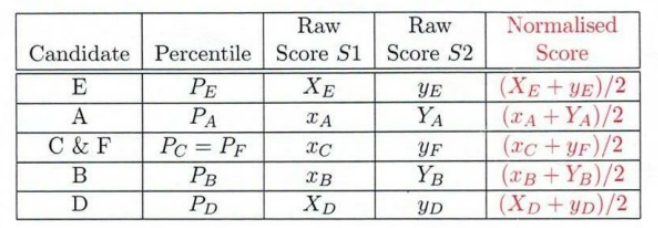
In short: Raw Marks ➝ Percentile in Shift ➝ Match Percentiles Across Shifts ➝ Convert to Normalized Score ➝ Final Merit List
Old vs New SSC Exam Normalization Process 2025
Here, we have provided a comparison between the old and new SSC exam normalization process in a table format. This will help you to know how the new process is different from the old process based on different features. Features on which SSC has made changes include, basis of calculation, how it worked, the fairness approach, etc. You should be aware of this information if you are an SSC exam aspirant.
| Feature | Old Method (2019) | New Method (2025 – Equipercentile) |
|---|---|---|
| Basis of Calculation | Based on average marks, top scores, and variation of each shift | Based on percentile (relative performance) of candidates in each shift |
| How It Worked | Candidate’s raw marks were adjusted using averages and standard deviation | Candidate’s position (rank) in their shift is matched with the same percentile in other shifts |
| Fairness Approach | Balanced scores by considering difficulty level through averages | Balances scores by comparing relative rank, not raw marks |
| Example | If your paper was tougher, your marks were adjusted upward using averages | If you are in 80th percentile in your shift, you are matched with 80th percentile in another shift |
| Limitation | May not fully capture differences in performance distribution | Provides a more accurate and fair comparison across shifts |
SSC Exam Normalization Process 2025: Summary
Earlier, SSC used the 2019 normalization method under which they adjusted candidates’ marks based on the average score, top score, and variation of each shift. This system mainly focuses on averages and is unable to reflect true performance. To avoid this issue, SSC has implemented a new SSC exam normalization process. As per the new process, SSC will use the percentile scores instead of averages. This will ensure a fairer and more accurate comparison across all shifts.
FAQs: SSC Exam Normalization Process 2025
Normalization is the process of adjusting scores to ensure fairness across multiple exam shifts.
The 2019 method used average marks, top marks, and variation of scores to adjust raw marks.
SSC has adopted the Equipercentile Method, which uses percentiles instead of averages for score adjustment.
The new SSC Exam Normalization Process 2025 was implemented on 2nd June 2025.
The percentile shows the percentage of candidates you performed better than in your exam shift.
Yes, the Equipercentile Method ensures a more accurate comparison of candidates from different exam shifts.
- Sign Up on Practicemock for Updated Current Affairs, Topic Tests and Mini Mocks
- Sign Up Here to Download Free Study Material
Free Mock Tests for the Upcoming Exams
- IBPS PO Free Mock Test
- RBI Grade B Free Mock Test
- IBPS SO Free Mock Test
- NABARD Grade A Free Mock Test
- SSC CGL Free Mock Test
- IBPS Clerk Free Mock Test
- IBPS RRB PO Free Mock Test
- IBPS RRB Clerk Free Mock Test
- RRB NTPC Free Mock Test
- SSC MTS Free Mock Test
- SSC Stenographer Free Mock Test
- GATE Mechanical Free Mock Test
- GATE Civil Free Mock Test
- RRB ALP Free Mock Test
- SSC CPO Free Mock Test
- AFCAT Free Mock Test
- SEBI Grade A Free Mock Test
- IFSCA Grade A Free Mock Test
- RRB JE Free Mock Test
- Free Banking Live Test
- Free SSC Live Test