


RRB PO 2025 Exam is all about speed and accuracy. It is considered one of the toughest banking exams. Talking about the quantitative aptitude section, you can see 1-2 questions based on speed, time and distance. It might seem complex and tricky, but once you practice the concepts well, it can be the easiest and scoring part in the exam. In this blog, we will discuss this topic in detail to help you understand it for better performance in the exam.
Download Speed, Time and Distance Questions for RRB PO Exam 2025
In this section, we are providing Speed, Time and Distance Questions for RRB PO Exam 2025 questions for the RRB PO Exam 2025. Our experts curate these after analysing previous years’ patterns. Download Now and practice as many questions as you can.

Speed, Distance and Time – Important Rules
Almost all the problems related to speed, distance and time contain this golden rule. It is something that you need to incorporate while solving questions.
Common Units You’ll See
- Speed: km/hr or m/s
- Distance: km or m
- Time: hr or sec
Examples to understand the golden rules
In this section, we are providing examples that can help you to understand the above given golden rules in a better way.
Example 1 – Direct Question
A car travels 120 km in 3 hours. Find its speed.
Solution:
Speed = Distance ÷ Time = 120 ÷ 3 = 40 km/hr
Example 2 – Time Calculation
A train runs at 90 km/hr. How much time will it take to cover 270 km?
Solution:
Time = Distance ÷ Speed = 270 ÷ 90 = 3 hours
Example 3 – Distance Calculation
A person walks at 6 km/hr for 2.5 hours. How far does he go?
Solution:
Distance = Speed × Time = 6 × 2.5 = 15 km
How to calculate Relative Speed?
In this section, we are talking about the concept of relative speed when two objects are moving in the same or opposite direction.
- When two objects move in the same direction,
Relative speed = Difference of speeds. - When they move in opposite directions,
Relative speed = Sum of speeds.
Example:
Two trains, 50 m and 70 m long, are moving in opposite directions at 36 km/hr and 54 km/hr. Find the time they take to cross each other.
Convert to m/s:
36 km/hr = 10 m/s, 54 km/hr = 15 m/s
Total distance = 50 + 70 = 120 m
Relative speed = 10 + 15 = 25 m/s
Time = 120 ÷ 25 = 4.8 seconds
How to calculate Average Speed?
A common mistake many students make is using the simple average (S₁ + S₂)/2.
But that’s wrong unless the time taken for both speeds is the same.
The correct formula is:
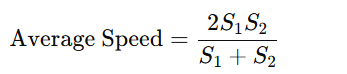
(only when the same distance is covered at two different speeds)
Example:
A man travels to his office at 30 km/hr and returns at 60 km/hr.
Speed, Distance and Time calculation for Trains/Platforms
Trains often appear as a favourite subtopic.
Just remember:
- When a train passes a pole: distance = length of train.
- When a train passes a platform: distance = length of train + length of platform.
- When two trains cross: distance = sum of both train lengths.
Example:
A 180 m long train passes a platform in 20 seconds at a speed of 54 km/hr. Find the length of the platform.
Convert speed to m/s: 54 × 5/18 = 15 m/s
Distance = Speed × Time = 15 × 20 = 300 m
So, platform length = 300 – 180 = 120 m
Speed, Distance and Time calculation for Boats and Streams
When a boat moves:
- Downstream (with current): Effective speed = (Boat speed + Stream speed)
- Upstream (against current): Effective speed = (Boat speed – Stream speed)
Example:
A boat goes 20 km downstream in 2 hours and returns in 5 hours. Find the speed of the boat in still water and the speed of the stream.
Let boat speed = B, stream speed = S.
Downstream: 20 = (B + S) × 2 → B + S = 10
Upstream: 20 = (B – S) × 5 → B – S = 4
Solve both → B = 7 km/hr, S = 3 km/hr.
Tips to Solve Speed, Distance and Time Related Questions
- Use Ratio Method: Compare speeds and times using ratios to simplify calculations.
Example – If the time ratio is 2:3, then the speed ratio will be 3:2, as speed and time are inversely proportional to each other. - Be Comfortable with Unit Conversion: Regularly practice converting between km/hr and m/s for quick problem-solving.
- Write Given Data Clearly: Always list what’s provided and what’s required before solving. This avoids confusion between distance, speed, and time.
- Use Approximation in Mock Tests: When options differ widely, approximate smartly instead of doing lengthy calculations.
- Visualise the Movement: Imagine the scenario, especially in train and relative speed problems, to understand direction and distance better.
Common Mistakes to Avoid
- Skipping Unit Conversion: Forgetting to convert km/hr into m/s (or vice versa) leads to incorrect answers.
- Mixing Up Formulas: Confusing average speed with relative speed is a common error.
- Incorrect Train Length Addition: Always add the lengths of both trains when they cross each other.
- Ignoring Fraction Simplification: Simplify ratios and fractions early to save time during final steps.
- Relying Only on Memorisation: Focus on understanding the core relationship between speed, time, and distance instead of rote learning.
Conclusion
In this article, we have discussed all the important details regarding speed, distance and time. To solve questions from more such topics, you can buy our test series, where you can reattempt the full-length mock tests and get a Detailed Comparison with the Topper, compare your Time, Score, Accuracy, Correct/Wrong Answers, and even the Average Performance side-by-side.
Join our exclusive Telegram group where our experts are ready to answer all your queries, guide you in banking exam preparation, and give personalised tips to boost your success. Get access to real-time solutions, expert advice, and valuable resources to improve your study journey. [Click here to join now
IBPS RRB PO 2025 Related Link
| IBPS RRB PO Salary | IBPS RRB PO Exam Pattern |
| IBPS RRB PO Cut Off | IBPS RRB PO Previous Year Question Papers |

FAQs
You can expect questions based on basic formulas, relative speed, trains, boats and streams, and circular tracks. Most questions test conceptual clarity and the quick application of ratios and unit conversions.
Practice using a formula sheet and solve topic-wise quizzes. Focus on maintaining unit consistency (km/hr to m/s) and use rough diagrams to visualise the problem.
In Prelims, the questions are direct and formula-based.
Ideally, aim to solve each question within 45–60 seconds in Prelims and around 1.5 minutes in Mains, depending on complexity.
- Sign Up on Practicemock for Updated Current Affairs, Topic Tests and Mini Mocks
- Sign Up Here to Download Free Study Material
Free Mock Tests for the Upcoming Exams
- IBPS PO Free Mock Test
- RBI Grade B Free Mock Test
- IBPS SO Free Mock Test
- NABARD Grade A Free Mock Test
- SSC CGL Free Mock Test
- IBPS Clerk Free Mock Test
- IBPS RRB PO Free Mock Test
- IBPS RRB Clerk Free Mock Test
- RRB NTPC Free Mock Test
- SSC MTS Free Mock Test
- SSC Stenographer Free Mock Test
- GATE Mechanical Free Mock Test
- GATE Civil Free Mock Test
- RRB ALP Free Mock Test
- SSC CPO Free Mock Test
- AFCAT Free Mock Test
- SEBI Grade A Free Mock Test
- IFSCA Grade A Free Mock Test
- RRB JE Free Mock Test
- Free Banking Live Test
- Free SSC Live Test