


SBI PO Prelims Trap Questions Strategy is one of the most effective ways to improve your score in the exam. These trap questions slow you down, break your momentum, and often lead to negative marking.
A well-planned SBI PO Prelims Trap Questions Strategy helps you identify such questions quickly, focus on speed and accuracy, and avoid unnecessary risks. This article will help you identify trap questions, avoid common mistakes, and improve your SBI PO Prelims score.

SBI PO Prelims Trap Questions Strategy: Key Takeaways
- A well-planned SBI PO Prelims Trap Questions Strategy helps you focus on speed, accuracy, and smart question selection rather than attempting every question.
- Apply the 10-second rule to identify whether a question deserves your time.
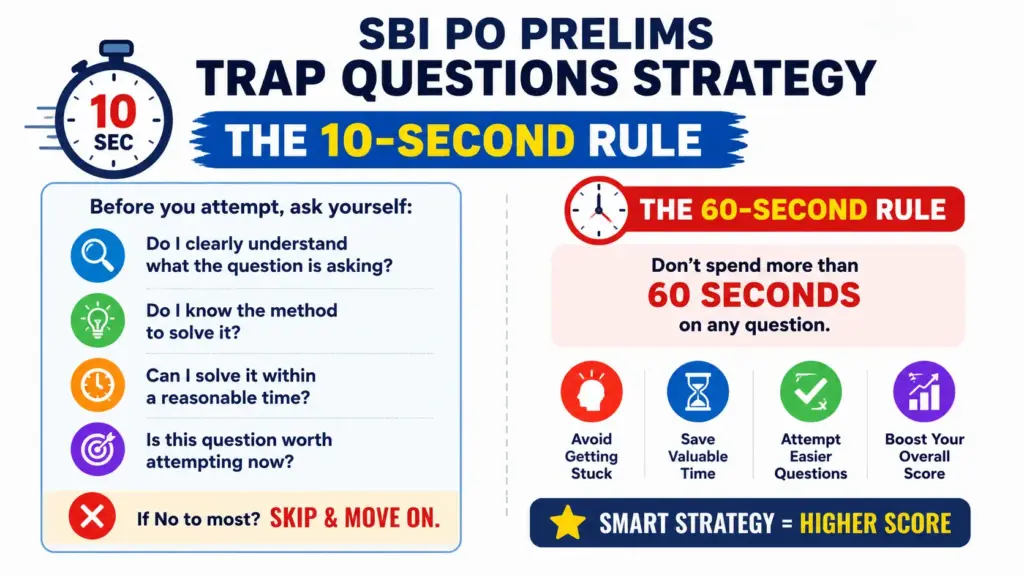
- Never spend more than 60 seconds on a question unless you are close to solving it.
- Prioritise direct and high-confidence questions before lengthy or calculation-intensive ones.
- Skip trap questions initially and revisit them only if sufficient time remains.
- Learn to identify section-wise traps in Quantitative Aptitude, Reasoning Ability, and English Language.
- Analyse every mock test to understand which trap questions consume the most time.
The 10-Second Rule in SBI PO Prelims Trap Questions Strategy
One of the most effective techniques in an SBI PO Prelims Trap Questions Strategy is the 10-second rule. Before attempting any question, spend the first few seconds deciding whether it deserves your time.

SBI PO Prelims Trap Questions Strategy for Quantitative Aptitude
The Quantitative Aptitude section contains several questions that look straightforward but become lengthy during calculations. An effective SBI PO Prelims Trap Questions Strategy focuses on identifying these time-consuming questions early and securing marks before attempting lengthy problems.
Attempt First: These topics usually require less time and help build confidence early in the section.
| Simplification | Approximation |
| Number Series | Quadratic Equations |
Trap Questions to Skip Initially
- Lengthy Data Interpretation sets involving multiple percentage calculations.
- Miscellaneous Arithmetic questions with long statements.
- Probability and Permutation & Combination questions.
- Mensuration questions requiring multiple formula applications.
- Wrong Number Series where the pattern is not visible quickly.
Strategy
For Data Interpretation sets, avoid solving the questions in order. Instead, scan the entire set and identify direct questions involving ratios, totals, or simple comparisons before attempting calculation-heavy questions.
SBI PO Prelims Trap Questions Strategy for Reasoning Ability
Reasoning Ability is one of the highest-scoring sections, but it also contains some of the biggest time traps. A smart SBI PO Prelims Trap Questions Strategy helps you identify difficult puzzles early and focus on quick-scoring questions first.
Attempt First: These standalone topics usually require less time and allow candidates to collect quick marks before moving to puzzles.
| Inequality | Syllogism |
| Coding-Decoding | Blood Relations |
| Direction Sense | |
Trap Questions to Skip Initially
- Complex Seating Arrangements.
- Three-variable puzzles.
- Uncertain linear arrangements.
- Multi-condition floor puzzles.
- Puzzles with no obvious starting point.
Strategy
Never begin the Reasoning section with a puzzle. Instead, solve all standalone questions first. For Blood Relations and Direction Sense questions with lengthy statements, read the final question first.
SBI PO Prelims Trap Questions Strategy for English Language
Many English questions appear simple but become confusing because multiple options seem correct. Following an SBI PO Prelims Trap Questions Strategy helps you avoid spending unnecessary time on such questions and improves your overall accuracy.
Attempt First: These questions are generally quicker and require less reading time.
| Error Detection | Sentence Improvement |
| Fillers | Vocabulary-based Questions |
| Synonyms and Antonyms | |
Trap Questions to Skip Initially
- Reading Comprehension inference questions.
- Para Jumbles with multiple close options.
- Questions involving the author’s tone or opinion.
- Grammar questions where two options appear almost identical.
Strategy
For Reading Comprehension, solve vocabulary and direct factual questions before attempting inference-based questions. Similarly, rely on grammar rules instead of intuition while solving Error Detection or Fillers.
Why Smart Question Selection Is More Important Than Maximum Attempts
The objective of the SBI PO Prelims Trap Questions Strategy is not to maximise attempts but to maximise correct attempts. Many aspirants believe that attempting more questions automatically increases their chances of clearing the SBI PO cut-off. In reality, the SBI PO Prelims rewards candidates who maintain the right balance between attempts and accuracy.
Consider the following example:
| Candidate | Attempts | Accuracy |
| Candidate A | 84 | 70% |
| Candidate B | 73 | 90% |
Despite attempting fewer questions, Candidate B is more likely to score higher because fewer incorrect answers mean lower negative marking and a stronger net score.
How to Identify Time-Trap Questions in the SBI PO Prelims Exam?
The SBI PO Prelims Trap Questions Strategy becomes effective only when you can recognise trap questions within 10 seconds. Most trap questions are not difficult because of the concept—they are difficult as they demand more time than they are worth.
Characteristics of Trap Questions
- Lengthy question statements with multiple conditions.
- Heavy calculations involving percentages, fractions, or averages.
- Multiple variables in puzzles or seating arrangements.
- Options that appear very similar.
- No obvious starting point.
- Questions that require repeated calculations.
Common Trap Questions Across Sections
Learning to identify these patterns early helps you save valuable time for easier scoring opportunities.
| Question Type | Risk Level |
| Complex Seating Arrangement | High |
| Lengthy Data Interpretation | High |
| Reading Comprehension Inference | High |
| Wrong Number Series | Medium |
| Advanced Arithmetic | Medium |
| Close Grammar Options | Medium |
Should You Return to Trap Questions Later in the SBI PO Prelims Exam?
The SBI PO Prelims Trap Questions Strategy recommends revisiting skipped questions only after completing all easy and moderate questions.
Return to a Question If
- Easy questions have already been attempted.
- You have sufficient time remaining.
- The question now appears more manageable.
- Your confidence and accuracy remain high.
Avoid Returning If
- Less than a few minutes remain in the section.
- The question still appears confusing.
- It requires lengthy calculations.
- You would have to guess the answer.
How to Analyse Trap Questions After Every SBI PO Mock Test?
The SBI PO Prelims Trap Questions Strategy becomes stronger when you analyse your decisions after every mock test. Simply checking your score is not enough—you must understand where you wasted time and why.
After every SBI PO mock, review the following:
| Analysis Area | Questions to Ask |
| Time Wasted | Which question consumed the most time? |
| Trap Questions Attempted | Should I have skipped them earlier? |
| Easy Questions Missed | Did I lose marks because I was stuck elsewhere? |
| Wrong Attempts | Were they caused by rushing or guessing? |
| Skipped Questions | Could I have solved any of them later? |
Common Mistakes Candidates Make While Handling SBI PO Prelims Trap Questions Strategy
Following an SBI PO Prelims Trap Questions Strategy is not just about identifying difficult questions—it is also about avoiding common mistakes to reduce your overall score. Even well-prepared aspirants lose marks as they make poor decisions under exam pressure. Here are some of the most common mistakes to avoid.
Spending Too Much Time on One Question
Many candidates continue solving a difficult question simply because they have already invested time in it. This usually leads to further time loss and unnecessary pressure.
Starting with the Toughest Questions
Beginning with a lengthy puzzle, Data Interpretation set, or Reading Comprehension passage often breaks your momentum. Always secure easy marks first.
Guessing Instead of Skipping
Random guessing increases negative marking and lowers your net score. If you cannot eliminate at least one or two options confidently, it is better to leave the question.
Restarting Difficult Puzzles Repeatedly
Candidates often redraw puzzle diagrams multiple times hoping to find the correct arrangement. If a puzzle reaches a dead end, move ahead and return only if time permits.
Ignoring Mock Test Analysis
Many aspirants focus only on solving more mocks without reviewing the trap questions they attempted. Improvement comes from analysing mistakes, not just increasing practice.
Weekly Practice Plan to Improve SBI PO Prelims Trap Question Identification
The SBI PO Prelims Trap Questions Strategy should be practised regularly until identifying trap questions becomes automatic. Consistent practice helps you develop faster decision-making and better time management.
Follow the weekly practice plan tabulated below to enhance your SBI PO Prelims trap question identification.
| Day | Activity |
| Monday | Full-Length SBI PO Mock Test |
| Tuesday | Analyse Trap Questions & Time Usage |
| Wednesday | Sectional Tests |
| Thursday | Error Log & Revision |
| Friday | Weak Topic Practice |
| Saturday | Full-Length Mock Test |
| Sunday | Performance Review & Strategy Improvement |
SBI PO Prelims Trap Questions Strategy Tips
The SBI PO Prelims Trap Questions Strategy becomes more effective when combined with disciplined exam habits. Small improvements in question selection can result in a significant increase in your overall score.
- Apply the 10-second rule before attempting every difficult question.
- Prioritise easy and high-confidence questions first.
- Never spend more than 60 seconds on a single question without progress.
- Solve standalone Reasoning topics before puzzles.
- Attempt direct Reading Comprehension questions before inference-based ones.
- Scan the entire Data Interpretation set before solving individual questions.
- Avoid ego-based attempts just to complete every question.
- Analyse every mock test to identify recurring time traps.
- Maintain an error log for trap questions.
- Practise under actual exam conditions to improve decision-making.
Final Thoughts on SBI PO Prelims Trap Questions Strategy
The SBI PO Prelims Trap Questions Strategy teaches aspirants that success in the exam is not about solving every question—it is about making smart decisions within a limited time. Trap questions are designed to test your judgment, patience, and question-selection skills as much as your subject knowledge. Regular mock practice and detailed performance analysis will help you build this habit, making you more confident and exam-ready for the SBI PO Prelims.
Also Read:
FAQs on SBI PO Prelims Trap Questions Strategy
Q1. What are trap questions in the SBI PO Prelims exam?
Trap questions are those that appear easy initially but consume excessive time because of lengthy calculations, multiple conditions, or confusing options. Identifying them early helps improve speed and accuracy.
Q2. What is the 10-second rule in the SBI PO Prelims Trap Questions Strategy?
The 10-second rule suggests evaluating a question within the first 10 seconds. If you cannot understand the approach or the question seems too lengthy, skip it and move ahead.
Q3. Should I skip difficult questions in the SBI PO Prelims?
Yes. It is better to skip lengthy or confusing questions initially and complete easy, high-confidence questions first. You can revisit difficult questions later if time permits.
Q4. Which questions are most likely to become time traps in SBI PO Prelims?
Complex Seating Arrangements, lengthy Data Interpretation sets, Wrong Number Series, Reading Comprehension inference questions, and advanced Arithmetic problems are among the most common trap questions.
Q5. How can mock tests improve my trap question strategy?
Mock tests help you identify the types of questions that consume the most time, improve question selection, and build the habit of making quicker decisions under exam pressure.
Q6. Can avoiding trap questions improve my SBI PO score?
Yes. Avoiding unnecessary time traps allows you to attempt more easy and moderate questions accurately, reduces negative marking, and improves your overall score.
- Sign Up on Practicemock for Updated Current Affairs, Topic Tests and Mini Mocks
- Sign Up Here to Download Free Study Material
Free Mock Tests for the Upcoming Exams
- IBPS PO Free Mock Test
- RBI Grade B Free Mock Test
- IBPS SO Free Mock Test
- NABARD Grade A Free Mock Test
- SSC CGL Free Mock Test
- IBPS Clerk Free Mock Test
- IBPS RRB PO Free Mock Test
- IBPS RRB Clerk Free Mock Test
- RRB NTPC Free Mock Test
- SSC MTS Free Mock Test
- SSC Stenographer Free Mock Test
- GATE Mechanical Free Mock Test
- GATE Civil Free Mock Test
- RRB ALP Free Mock Test
- SSC CPO Free Mock Test
- AFCAT Free Mock Test
- SEBI Grade A Free Mock Test
- IFSCA Grade A Free Mock Test
- RRB JE Free Mock Test
- Free Banking Live Test
- Free SSC Live Test