


SBI PO Fill in the Blanks Strategy helps candidates solve vocabulary and context-based questions quickly and accurately in the English section. These questions test your understanding of grammar, sentence flow, and word usage rather than difficult vocabulary alone. Instead of memorising long word lists, learn how to identify context clues, eliminate incorrect options, and choose the most suitable answer. This blog covers proven solving strategies, vocabulary-building tips, common mistakes, and a practical practice plan to help you score higher in SBI PO 2026.
SBI PO Fill in the Blanks Strategy: Overview
Candidates who Master English for SBI PO usually score well in filling in the blanks because they understand sentence meaning instead of guessing the answer. Before learning the techniques, understand what this topic tests in the SBI PO exam.

| Feature | Details |
| Topic | Fill in the Blanks |
| Difficulty Level | Easy to Moderate |
| Questions Asked | 3–8 (varies every year) |
| Skills Tested | Vocabulary, Grammar, Context Understanding |
| Time Required | 3–4 minutes |
| Best Preparation Method | Daily reading + regular practice |
Types of Fill in the Blanks Questions Asked in SBI PO Exam
SBI PO fill in the blanks strategy becomes more effective when you understand the different question formats asked in the exam. The English section includes single fillers, double fillers, triple fillers, contextual vocabulary questions, and Cloze Tests. Each type checks your grammar, vocabulary, and ability to understand the meaning of a sentence or passage. Practising all these formats regularly helps improve both your accuracy and speed in the actual exam.
1. Single Fillers: A sentence contains one blank and five options. You need to choose the word that completes the sentence correctly.
These questions mainly test:
- Vocabulary
- Grammar
- Sentence meaning
2. Double Fillers: Two blanks are given in one sentence. Candidates must choose the pair of words that fits both blanks logically and grammatically. These questions require better contextual understanding than single fillers.
3. Triple Fillers: Triple Fillers are comparatively difficult because three blanks must be filled correctly. Candidates should first understand the overall meaning before selecting any option.
4. Context-Based Vocabulary Questions: Many options may have similar meanings. Only one word fits the context correctly. These questions test whether candidates understand word usage rather than dictionary meanings.
5. Cloze Test Fillers: Cloze Tests contain an entire passage with multiple blanks. Instead of solving one sentence separately, candidates must understand the complete passage before answering. Strong vocabulary and reading habits make these questions much easier.
How to Solve SBI PO Fill in the Blanks Questions
The best SBI PO fill in the blanks strategy is to understand the sentence first and check the options later. Read the complete sentence carefully to identify its meaning, tone, and grammar. Once you understand the context, eliminate options that do not fit grammatically or logically. This approach reduces confusion and helps you choose the correct answer with greater accuracy.
Follow these simple steps.
Step 1: Read the Complete Sentence: Never look at the options immediately. Many wrong answers can be avoided just by understanding the sentence.
First understand:
- What is the sentence talking about?
- Is it positive or negative?
- What idea is missing?
Step 2: Guess the Missing Word: Before checking the options, think of a suitable word yourself. This reduces confusion between similar-looking choices. Even if your word is different from the options, it helps you understand the expected meaning.
Step 3: Identify the Sentence Tone: Words like however, although, despite, therefore, moreover, and consequently change the direction of the sentence. Understanding these connectors helps eliminate wrong options quickly.
For example:
- However → Contrast
- Therefore → Result
- Moreover → Addition
Step 4: Check Grammar Rules: The correct word must also match the grammar of the sentence. Many options are grammatically incorrect even if they look meaningful.
Quick check:
- Verb tense
- Subject-verb agreement
- Singular and plural forms
- Correct part of speech
Step 5: Use the Elimination Method: Never try to prove one option correct first. This improves both speed and accuracy.
Instead, eliminate options that are:
- Grammatically incorrect
- Contextually wrong
- Opposite in meaning
- Awkward in sentence flow
Build Vocabulary Through Context Instead of Word Lists
Many candidates spend hours memorising vocabulary lists but forget the words within a few days. A better SBI PO fill in the blanks strategy is to learn words through reading. Write down unfamiliar words along with their meanings and example sentences. This method helps you remember vocabulary naturally and improves your understanding of word usage.
Whenever you read:
- Newspaper editorials
- Banking articles
- Financial news
- Business magazines
Daily Reading Improves SBI PO Fill in the Blanks Strategy
Daily reading is one of the most effective ways to strengthen your SBI PO fill in the blanks strategy. It improves vocabulary, grammar, and contextual understanding together. These skills are useful not only for Fill in the Blanks but also for Reading Comprehension, Cloze Test questions, and other vocabulary-based topics in the SBI PO English section.
Spend 20–30 minutes reading:
- The Hindu Editorial
- Indian Express Editorial
- Banking news
- RBI updates
- Economy articles
Daily reading helps candidates:
- Learn new words naturally
- Understand sentence structure
- Improve contextual understanding
- Increase reading speed
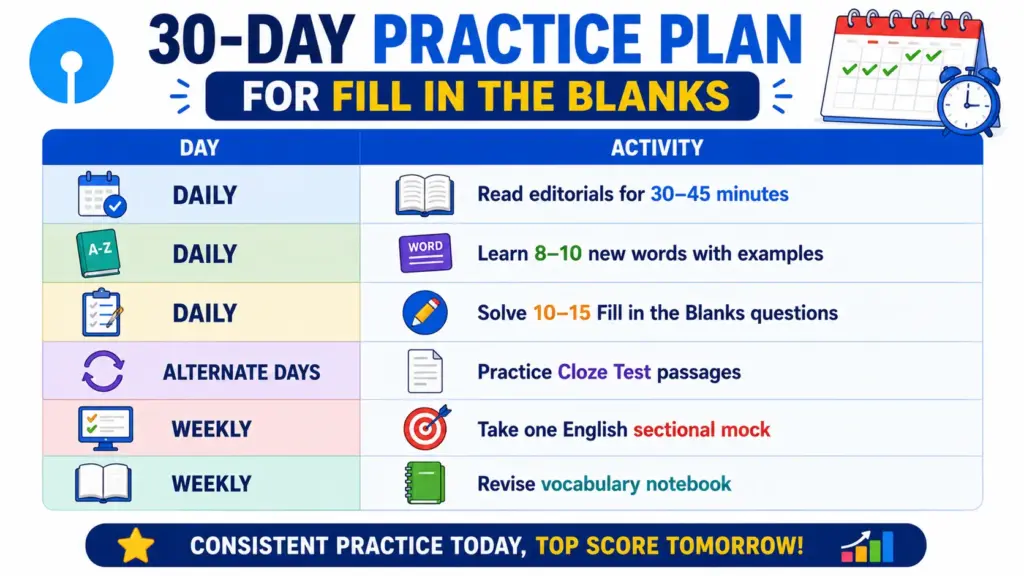
30-Day Practice Plan for SBI PO Fill in the Blanks
A structured routine gives better results than random practice. Following this 30 days practice plan consistently can significantly improve vocabulary and accuracy before the SBI PO exam.
Common Grammar Rules You Should Know for SBI PO
A strong SBI PO fill in the blanks strategy is not only about vocabulary. Grammar rules are equally important because many options are eliminated based on grammar alone. The better your grammar fundamentals, the faster you can eliminate incorrect options. Pay special attention to:
- Subject-Verb Agreement
- Verb Tenses
- Articles (A, An, The)
- Prepositions
- Conjunctions
- Parts of Speech
- Singular and Plural Forms
SBI PO Time Management Strategy for Fill in the Blanks
An ideal SBI PO time management strategy is to complete all fill in the blanks questions within 3–4 minutes in the English section. Fill in the blanks is a scoring topic, but spending too much time on one question can affect your overall performance.
Follow this simple approach:
| Time | Task |
| 30–40 seconds | Read the complete sentence carefully |
| 20–30 seconds | Eliminate incorrect options |
| 10–20 seconds | Verify the final answer |
Common Mistakes Candidates Make in SBI PO Fill in the Blanks
Many candidates know the vocabulary but still lose marks because of small but common mistakes. Following the right SBI PO Fill in the Blanks Strategy helps you identify these errors early, improve accuracy, and save valuable time during the exam.
Some common mistakes are:
- Reading only the blank instead of the complete sentence.
- Choosing an option only because the word looks familiar.
- Ignoring transition words like however or although.
- Not checking grammar after selecting an option.
- Depending completely on guesswork.
- Memorising word lists without learning their usage.
- Spending too much time on one difficult question.
Do’s and Don’ts for Fill in the Blanks in the SBI PO Exam
Following the right SBI PO Fill in the Blanks Strategy is not only about learning new words but also about using them correctly in a sentence. Keeping these simple do’s and don’ts in mind will help you solve questions faster, improve accuracy, and avoid common mistakes in the SBI PO English section.
| Do’s | Don’ts |
| Read the entire sentence first. | Read only the blank. |
| Understand the sentence context. | Depend only on vocabulary. |
| Eliminate wrong options. | Guess immediately. |
| Check grammar rules. | Ignore verb tense and agreement. |
| Practice daily from editorials. | Memorise long word lists without context. |
| Revise new words regularly. | Skip vocabulary revision. |
Why Fill in the Blanks is Important for SBI PO
Fill in the Blanks is one of the fastest scoring topics in the SBI PO English section. Questions are usually short and can be solved quickly if your vocabulary and grammar basics are clear. Since many English topics depend on contextual understanding, improving this section automatically strengthens your overall English preparation.
This topic also improves your performance in:
- Cloze Test
- Reading Comprehension
- Phrase Replacement
- Error Detection
- Vocabulary-based questions
Final Thoughts
The SBI PO fill in the blanks strategy is not about memorising difficult words. It is about understanding sentence meaning, applying grammar rules, and improving vocabulary through regular reading. Build the habit of learning words in context, practise different filler types every day, and analyse your mistakes after each mock test. With consistent practice and the right preparation plan, Fill in the Blanks can become one of the easiest scoring topics in the SBI PO English section.
Other Related Blogs on SBI PO 2026
FAQs
1. How can I improve Fill in the Blanks for SBI PO?
The best SBI PO Fill in the Blanks Strategy is to read editorials daily, learn vocabulary through context, practise grammar rules, and solve topic-wise questions regularly.
2. Which vocabulary is important for SBI PO Fill in the Blanks?
Banking terms, editorial vocabulary, economy-related words, phrasal verbs, and commonly used English words are important.
3. How much time should I spend on Fill in the Blanks in SBI PO Prelims?
Ideally, complete all Fill in the Blanks questions within 3–4 minutes to save time for Reading Comprehension and Cloze Test.
4. Are Fill in the Blanks questions asked in SBI PO Mains?
Yes. The SBI PO fill in the blanks strategy is useful for Mains as well because vocabulary and context-based questions are tested directly or through Cloze Tests, Reading Comprehension, and other English topics.
5. Is vocabulary enough to solve Fill in the Blanks?
No. Along with vocabulary, candidates must understand grammar rules and sentence context to choose the correct answer.
- Sign Up on Practicemock for Updated Current Affairs, Topic Tests and Mini Mocks
- Sign Up Here to Download Free Study Material
Free Mock Tests for the Upcoming Exams
- IBPS PO Free Mock Test
- RBI Grade B Free Mock Test
- IBPS SO Free Mock Test
- NABARD Grade A Free Mock Test
- SSC CGL Free Mock Test
- IBPS Clerk Free Mock Test
- IBPS RRB PO Free Mock Test
- IBPS RRB Clerk Free Mock Test
- RRB NTPC Free Mock Test
- SSC MTS Free Mock Test
- SSC Stenographer Free Mock Test
- GATE Mechanical Free Mock Test
- GATE Civil Free Mock Test
- RRB ALP Free Mock Test
- SSC CPO Free Mock Test
- AFCAT Free Mock Test
- SEBI Grade A Free Mock Test
- IFSCA Grade A Free Mock Test
- RRB JE Free Mock Test
- Free Banking Live Test
- Free SSC Live Test