


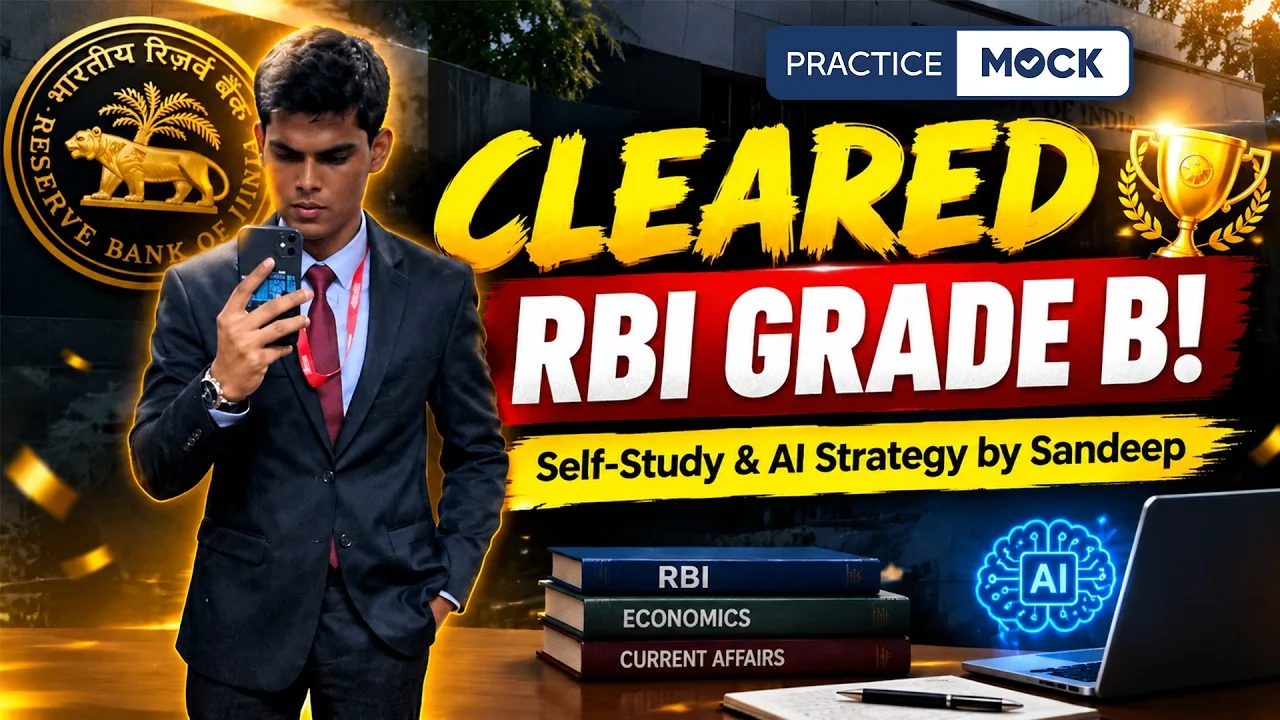
Sandeep Bharti’s RBI Grade B success story highlights how self-study, consistent revision, mock tests and AI-assisted practice can help aspirants prepare for one of India’s most competitive regulatory examinations. After missing the Phase 1 cutoff in an earlier attempt, Sandeep improved his approach and eventually cleared the examination through a focused preparation strategy.
A commerce background, CAT preparation and a strong interest in economics helped him build his foundation. Instead of depending on multiple coaching classes, he used books, newspapers, handwritten notes, previous years’ questions and NotebookLM to prepare for Phase 1 and Phase 2. His journey offers practical lessons on using AI effectively, improving descriptive writing and staying consistent despite setbacks.

Sandeep Bharti’s Educational Background and Preparation Journey
Early life and education
Sandeep Bharti’s journey towards becoming an RBI Grade B Officer was not straightforward. Born in Delhi, he spent most of his school years in Kolkata at his grandmother’s home. After completing Class 12, he returned to Delhi in 2020 and pursued his graduation from Guru Gobind Singh Indraprastha University, completing his three-year course in 2023.
Initial plan to pursue an MBA
His initial career plan was to pursue an MBA. He prepared for CAT and secured approximately 95–96 percentile. However, he could not secure admission to a college that matched his expectations, particularly in terms of return on investment.
Why he chose RBI Grade B
During this period, he explored different career opportunities and became more interested in the Reserve Bank of India because of its role in the country’s economy and financial system.
His commerce background also gave him an advantage in understanding economics, finance and management. He decided to prepare for RBI Grade B, although his first attempt did not go as planned.
His biggest learning from the unsuccessful attempt
What went wrong in his first attempt?
Sandeep could not clear Phase 1 in his earlier attempt because his Reasoning Ability score fell short by approximately 1.5–1.75 marks. This setback helped him understand that having a good foundation in Quantitative Aptitude, Reasoning and English was not enough. He also needed to understand the specific question patterns of RBI Grade B.
How he approached his next attempt
He returned to preparation with a stronger mindset and decided to give his best rather than postpone an attempt because of limited vacancies.
His message to aspirants
His message was simple: candidates should focus on their preparation and believe that they can secure a seat, irrespective of the number of vacancies.
It is an important part of understanding the recruitment process and the responsibilities associated with the post. Candidates can also check the RBI Grade B Syllabus to understand the subjects covered in the examination.
PracticeMock interview with Sandeep Bharti, Watch the complete interview.
RBI Grade B Phase 1 Preparation Strategy Followed by Sandeep Bharti
Sandeep’s RBI Grade B Phase 1 preparation strategy focused on strengthening his existing aptitude skills, understanding the examination pattern and practising questions regularly. His earlier CAT preparation helped him in Quantitative Aptitude, Reasoning and English.
However, he did not assume that CAT-level preparation alone would be sufficient for RBI Grade B.
1. Used CAT preparation books for Quant, Reasoning and English
Since Sandeep had already prepared for CAT, he did not spend excessive time watching basic lectures. Instead, he preferred practising questions from books and mock tests.
Preparation resources he followed:
- Arun Sharma’s CAT preparation books.
- Nishant K. Sinha’s Quantitative Aptitude books.
- Banking examination prelims mock tests for additional practice.
- Previous years’ RBI Grade B questions to understand the examination pattern.
Daily question practice
He regularly practised around 10–40 questions, depending on the subject and his preparation requirements.
His important advice: Do not assume that preparing for CAT, GMAT or another aptitude examination automatically prepares you for RBI Grade B. Understand the actual examination pattern and practise accordingly.
Understanding the salary structure can help candidates evaluate the financial benefits associated with the post. Aspirants can also explore the RBI Grade B Salary for details about the recruitment process and examination stages.
2. Read newspapers and government updates for General Awareness
For General Awareness, Sandeep followed newspapers and official information sources to develop his understanding of economic and financial developments.
Resources he used for General Awareness:
| Resource | How he used it |
| Economic Times | Developed basic understanding of economic and financial news |
| Mint | Followed detailed financial developments and business news |
| PIB | Covered government announcements and schemes |
| RBI updates | Followed important circulars and financial developments |
| YouTube monthly revisions | Revised current affairs and added missing information to his notes |
How his newspaper reading evolved
He initially preferred Economic Times because he found its language easy to understand. Later, he started reading Mint for more detailed financial information.
Preparing personal notes
He also prepared his own notes on government schemes, reports and important developments.
The RBI Grade B job profile includes responsibilities related to financial regulation, economic analysis and central banking. Candidates can explore the RBI Grade B Preparation Tips to understand how to approach preparation for this competitive role.
3. Followed a seven-day revision technique
One of the most useful aspects of Sandeep’s RBI Grade B preparation strategy was his revision method.
Instead of simply reading current affairs repeatedly, he tested how much information he could recall without looking at his notes.
His seven-day revision process:
- Read the previous seven days’ important news, RBI updates and financial developments.
- Take a blank sheet of paper and write down everything he could remember.
- Use a different-coloured sheet to record the information he forgot.
- Compare both sheets with his original notes.
- Give additional attention to the topics he could not recall.
Longer revision cycles
He also followed longer revision cycles of 14 and 21 days.
This approach helped him identify the difference between information he had actually remembered and information he only recognised while reading.
For aspirants, this is a practical active-recall technique that can improve retention and make General Awareness revision more effective.
Read RBI Grade B 2026 Preparation Strategy for more guidance on balancing Phase 1 and Phase 2.
RBI Grade B Phase 2 Preparation Strategy for ESI and FM
Sandeep approached Phase 2 differently from Phase 1. Instead of relying heavily on coaching classes, he used his academic knowledge, handwritten notes, newspapers, government schemes and AI-generated practice questions.
His main focus areas were:
- Understanding concepts rather than memorising definitions.
- Connecting current developments with static topics.
- Preparing handwritten notes for revision.
- Practising descriptive answers alongside objective questions.
1. Economic and Social Issues preparation
Sandeep already had a basic understanding of economics from his school and graduation studies. However, he understood that remembering definitions was not enough to perform well in the ESI paper.
He focused on understanding the real-world application of economic and social concepts.
His ESI preparation included:
- Reading articles on economic and social developments.
- Understanding government schemes and their objectives.
- Preparing handwritten notes for important topics.
- Connecting current affairs with static economic concepts.
- Revising reports, schemes and important developments regularly.
Theme-wise government scheme preparation
He also organised government schemes according to themes.
For example, while preparing topics related to women’s development, he collected information about five to six relevant government schemes. Similarly, he maintained separate notes for poverty, economically weaker sections, artificial intelligence and other important themes.
How this helped in descriptive answers
This approach helped him collect useful examples and solutions that he could use while writing descriptive answers.
2. Finance and Management preparation
Sandeep found some parts of Finance and Management familiar because he had studied these subjects during graduation.
Instead of starting everything from scratch, he revised his existing knowledge and prepared structured notes.
How he prepared Management topics
For Management, he focused on remembering important concepts through pointers. Topics such as leadership, communication, ethics and decision-making became easier to revise when he organised their key features.
His topic-wise practice method:
- Study one or two topics.
- Prepare short notes containing important concepts.
- Practise objective questions on the same topics.
- Attempt descriptive questions without postponing them.
- Revise the information through written recall.
His advice to aspirants
He advised aspirants not to leave descriptive practice until the final preparation stage. Practising both objective and descriptive questions together helped him understand and retain the concepts better.
For a more structured approach, refer to PracticeMock’s guide to preparing for RBI Grade B Phase 1 and Phase 2 together.
How Sandeep Bharti Used AI and NotebookLM for RBI Grade B Preparation
A key highlight of his strategy
One of the most interesting aspects of Sandeep’s preparation was his use of AI for generating practice questions. He used a NotebookLM-based workflow to convert his study material and previous years’ questions into additional practice exercises.
Rather than using AI only to explain concepts, he used it as a practice assistant.
His AI-powered study method
Sandeep uploaded RBI Grade B previous years’ questions to his AI workspace. This helped the tool understand the type and level of questions asked in the examination.
What he asked AI to generate
Whenever he studied a topic from his notes on his laptop, he used prompts to generate:
- 10–20 objective questions from the selected topic.
- Two to three descriptive questions based on previous years’ question patterns.
- Practice questions that allowed him to test his understanding immediately.
Example of his approach
After studying a Management topic such as leadership, he would ask the AI tool to generate objective and descriptive questions from that particular topic.
He then attempted those questions immediately instead of waiting until he had completed the entire syllabus.
How RBI Grade B aspirants can use AI effectively
Sandeep’s approach offers a useful model for aspirants who want to integrate AI into their self-study routine.
| Preparation task | How to use AI |
| Topic-wise practice | Generate 10–20 MCQs from a completed topic |
| Descriptive preparation | Generate two to three analytical questions |
| PYQ analysis | Study question patterns using uploaded previous years’ papers |
| Revision | Create short quizzes from personal notes |
| Answer practice | Generate questions that require structured, analytical responses |
Important point to remember
AI should support preparation rather than replace reliable study material. Always verify generated answers, facts, figures and explanations against RBI publications, official reports and trusted resources. AI-generated questions are practice material, not confirmed predictions of the actual examination.
Descriptive English Preparation and the Importance of Keyboard Practice
Sandeep considered descriptive writing an important part of Phase 2 preparation. His experience with essay competitions during school and college helped him develop his writing skills. However, he also understood that good writing knowledge alone would not guarantee good performance in a computer-based examination.
Why he recommended practising on a mechanical keyboard
His mistake with keyboard practice
One of his biggest mistakes was starting mechanical keyboard practice only around 20–25 days before the Phase 2 examination.
He had previously practised typing casually on his laptop while sitting comfortably. When he switched to a mechanical keyboard, his typing speed dropped considerably.
Why keyboard practice matters
He explained that writing with a pen and typing with ten fingers require different levels of practice. Even when you know what to write, unfamiliarity with the keyboard can affect your typing speed.
His advice for aspirants:
- Start practising on a mechanical keyboard from the beginning.
- Write essays and descriptive answers regularly.
- Practise typing with all ten fingers.
- Sit in one place and complete timed writing exercises.
- Get comfortable with keyboard sounds and distractions.
- Simulate the examination environment as closely as possible.
Prepare for the actual examination environment
He also highlighted that candidates may experience keyboard noise and distractions when many students type simultaneously in the examination hall. Practising in a similar environment can help reduce nervousness.
Importance of Mock Tests in Sandeep Bharti’s RBI Grade B Success Story
Mock tests played an important role in Sandeep’s preparation for both examination phases. He believed that reading and revising information were not enough because the actual examination tested how quickly candidates could recall and apply their knowledge under time pressure.
He regularly attempted different mock tests and analysed the questions where he lost time or made mistakes.
Why he emphasised regular mock practice
Sandeep explained that candidates might understand a topic after reading it several times, but a timed examination creates a different challenge.
How mock tests helped him:
- Improve speed and accuracy in objective sections.
- Identify weak areas before the actual examination.
- Develop the ability to recall information quickly.
- Understand which questions consumed unnecessary time.
- Become comfortable with examination pressure.
- Improve question selection and time management.
Importance of practising a large number of questions
He also highlighted the importance of practising a large number of questions. During his preparation, he met candidates who had practised thousands of questions across Quantitative Aptitude, Reasoning and English.
His takeaway was that aspirants should not limit themselves to solving only a few questions from each topic. Consistent practice helps build the experience needed to handle different question patterns.
For additional practice, aspirants can attempt the RBI Grade B Free Mock Test by PracticeMock.
Key Lessons from Sandeep Bharti’s RBI Grade B Preparation Strategy
Sandeep’s journey offers several practical lessons for both beginners and repeat candidates. His strategy was based on self-study, regular practice and using available resources according to individual requirements.
| Preparation area | Important lesson from Sandeep |
| Exam pattern | Understand RBI Grade B PYQs before starting preparation |
| Quant, Reasoning and English | Practise regularly using books and mock tests |
| General Awareness | Read newspapers, RBI updates and government schemes |
| Revision | Use active recall and revise every seven days |
| ESI | Connect economic and social issues with current developments |
| Finance and Management | Prepare short notes and practise topic-wise questions |
| AI preparation | Use NotebookLM to generate additional MCQs and descriptive questions |
| Descriptive English | Start answer writing early and practise on a mechanical keyboard |
| Mock tests | Attempt mocks regularly and analyse mistakes |
| Study resources | Stick to one or two reliable sources instead of collecting too much material |
Advice for working professionals
Do not copy a full-time aspirant’s timetable blindly
Sandeep also clarified that his preparation schedule was not suitable for everyone. He was unemployed during much of his preparation and could devote considerably more time to studying.
He advised working professionals to consider their available study hours before adopting another candidate’s timetable.
How working professionals can adapt the strategy
If you are working, you can use concise study material, structured courses and recorded classes to save time. He also recommended reviewing demo classes and course material before choosing a preparation source.
His final message
His message was not to copy his strategy blindly but to understand the requirements of the examination and create a routine that matches your circumstances.
Conclusion
Sandeep Bharti’s RBI Grade B success story demonstrates the importance of self-study, consistent revision, extensive practice and smart use of AI tools. His journey from missing the Phase 1 cutoff to clearing the examination shows how identifying weaknesses and improving preparation methods can make a difference.
Every aspirant has different strengths, academic backgrounds and time constraints. Build a preparation strategy around your requirements instead of copying someone else’s timetable. With the right resources and consistent practice, you can make your RBI Grade B preparation more focused. Start your preparation with PracticeMock and use regular mock tests to assess your progress.
Related Articles on RBI Grade B
| RBI Grade B 2026 Without Coaching | RBI Grade B Study Plan 2026 For 60 Days |
| RBI Grade B Syllabus | RBI Grade B Previous Year Question Papers |
| RBI Grade B Important MCQs | |
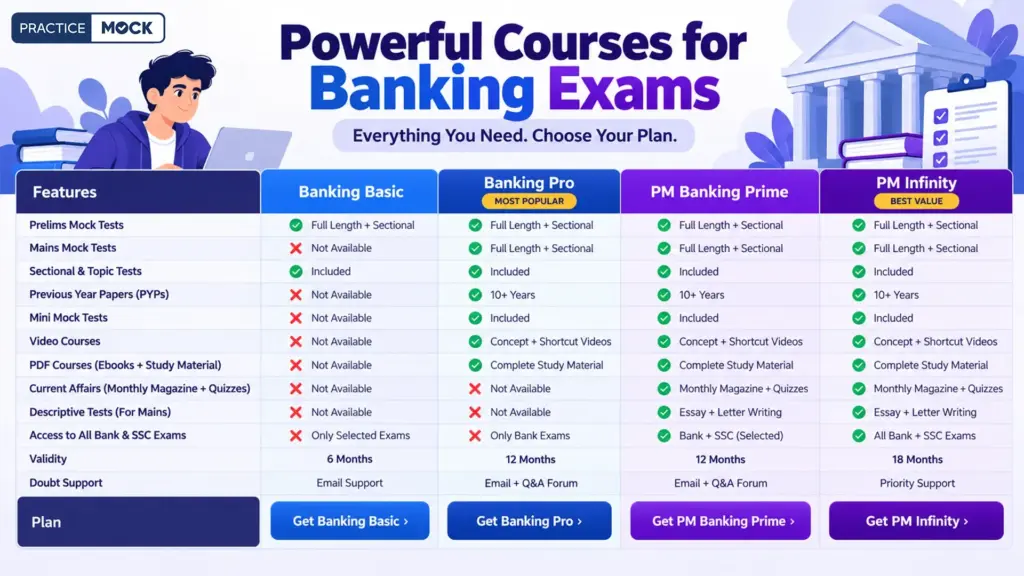
Powerful Courses for Banking Exams
FAQs on Sandeep Bharti RBI Grade B Success Story
1. Who is Sandeep Bharti?
Sandeep Bharti is an RBI Grade B exam qualifier who shared his preparation journey in a PracticeMock interview. He cleared the examination through self-study, regular practice, handwritten notes and AI-assisted preparation.
2. Did Sandeep Bharti clear RBI Grade B through self-study?
Yes. He primarily relied on self-study rather than coaching classes. He used books, newspapers, handwritten notes, previous years’ questions, mock tests and AI-generated practice questions.
3. Which books did Sandeep Bharti use for Quantitative Aptitude?
He used Arun Sharma’s CAT preparation books and Nishant K. Sinha’s Quantitative Aptitude books. He also practised questions through banking examination mock tests.
4. How did Sandeep prepare for RBI Grade B General Awareness?
He read Economic Times and Mint, followed PIB and RBI updates, prepared notes on government schemes and revised current affairs through weekly and longer revision cycles.
5. How did Sandeep Bharti use AI for RBI Grade B preparation?
He used NotebookLM to generate 10–20 objective questions and two to three descriptive questions from his study material. He also uploaded previous years’ questions to help the tool understand RBI Grade B question patterns.
6. What was Sandeep Bharti’s ESI preparation strategy?
He prepared handwritten notes, read economic and social articles, studied government schemes theme-wise and connected static concepts with current developments to improve his objective and descriptive preparation.
7. Why did Sandeep recommend mechanical keyboard practice?
He experienced a drop in typing speed after switching to a mechanical keyboard shortly before Phase 2. Therefore, he recommended practising on a mechanical keyboard from the beginning to develop typing familiarity and speed.
8. How important were mock tests in his preparation?
Mock tests helped him improve speed, accuracy, question selection and recall under time pressure. He also used mock analysis to identify weak areas and understand where he was losing time.
9. How did Sandeep revise current affairs?
He followed a seven-day active-recall method. He read the week’s news, wrote everything he remembered on paper and separately noted forgotten information for focused revision.
10. What is the biggest lesson from Sandeep Bharti’s RBI Grade B success story?
The biggest lesson is to understand the examination pattern, practise consistently, revise regularly and start descriptive writing early. Aspirants should also use AI as a supporting tool rather than depending on it for all their preparation.
- Sign Up on Practicemock for Updated Current Affairs, Topic Tests and Mini Mocks
- Sign Up Here to Download Free Study Material
Free Mock Tests for the Upcoming Exams
- IBPS PO Free Mock Test
- RBI Grade B Free Mock Test
- IBPS SO Free Mock Test
- NABARD Grade A Free Mock Test
- SSC CGL Free Mock Test
- IBPS Clerk Free Mock Test
- IBPS RRB PO Free Mock Test
- IBPS RRB Clerk Free Mock Test
- RRB NTPC Free Mock Test
- SSC MTS Free Mock Test
- SSC Stenographer Free Mock Test
- GATE Mechanical Free Mock Test
- GATE Civil Free Mock Test
- RRB ALP Free Mock Test
- SSC CPO Free Mock Test
- AFCAT Free Mock Test
- SEBI Grade A Free Mock Test
- IFSCA Grade A Free Mock Test
- RRB JE Free Mock Test
- Free Banking Live Test
- Free SSC Live Test