


An effective RBI Grade B 2027 6 Month Study Plan requires an integrated approach that balances Phase 1 speed tests with Phase 2 subject depth right from day one. Cracking this competitive exam on your first attempt depends on covering core subjects like Economic & Social Issues (ESI), Finance & Management (FM), Quantitative Aptitude, Reasoning, English, and General Awareness in a structured, phased manner. This comprehensive 6-month roadmap offers a month-by-month blueprint, daily schedules, subject-wise priorities, and revision techniques tailored to the latest examination trends.
How to Start RBI Grade B Preparation From Scratch
Starting your RBI Grade B 2027 preparation demands a clear understanding of the exam pattern, cutoff trends, and marking schemes before diving into books. Beginners must avoid studying Phase 1 and Phase 2 in isolation, as the short gap between the two phases leaves insufficient time to build Phase 2 concepts from scratch.

- Understand the Exam Pattern: Phase 1 is an objective, time-bound filter worth 200 marks, while Phase 2 combines objective MCQs and descriptive typing papers worth 300 marks.
- Analyze Previous Year Question Papers (PYQs): Review the last 5 years of PYQs to understand the changing difficulty level of Phase 1 Reasoning and Quant, as well as the analytical depth required for Phase 2 ESI and FM essays.
- Integrate Current Affairs Daily: Start reading financial newspapers (such as The Hindu or Business Standard) alongside regular tracking of Press Information Bureau (PIB) releases and RBI notifications.
| Exam Stage | Paper / Subject | Mode | Marks | Duration |
| Phase 1 | General Awareness, Reasoning, Quant, English | Objective MCQs | 200 | 120 Minutes |
| Phase 2 – Paper 1 | Economic & Social Issues (ESI) | 50% Objective + 50% Descriptive | 100 | 120 Minutes |
| Phase 2 – Paper 2 | Descriptive English | Typing Test (Essay, Precis, RC) | 100 | 90 Minutes |
| Phase 2 – Paper 3 | Finance & Management (FM) | 50% Objective + 50% Descriptive | 100 | 120 Minutes |
| Phase 3 | Interview | Personality Assessment | 75 | N/A |
To build a strong base, check out our step-by-step roadmap for beginners on RBI Grade B Preparation for Beginners.
RBI Grade B Month Wise Study Plan for 6 Months
Executing an RBI Grade B Month Wise Study Plan ensures complete coverage of the extensive syllabus without last-minute burnout. Divide your 6-month preparation into distinct learning, practice, and revision phases.
Month 1: Foundation Building & Core Concepts
Focus on establishing strong conceptual foundations across both phases. Dedicate maximum time to Phase 2 static concepts, as they form the backbone for descriptive writing later.
- ESI Static Topics: Macroeconomic concepts, national income accounting, inflation, unemployment, poverty alleviation, and the Indian tax structure.
- FM Static Topics: Functions of RBI, financial market structure, banking systems, management theories (leadership, motivation, communication), and corporate governance.
- Phase 1 Fundamentals: Revisit basic concepts in Quantitative Aptitude (percentages, ratios, average, number systems) and Reasoning (syllogisms, inequalities, basic arrangements).
- Daily Current Affairs Routine: Start tracking daily current affairs, focusing on banking, financial, and economic developments.
Month 2: Subject Expansion & Descriptive Intro
Expand your subject domain to technical financial management while introducing preliminary typing and descriptive drafting exercises.
- Finance Deep-Dive: Basics of accounting, financial statements, ratio analysis, primary and secondary markets, and Basel norms.
- ESI Expansion: Social structures, demographic trends, sustainable development goals (SDGs), and flagship government welfare schemes.
- Phase 1 Level-Up: Solve moderate-to-high level Data Interpretation (DI) sets, complex Puzzles, and Reading Comprehension passages.
- Descriptive Writing Intro: Draft 1 to 2 short practice answers weekly on core ESI and FM static topics to get used to structured typing on a computer keyboard.
Month 3: Syllabus Completion & Sectional Testing
Aim to finish 90% of the static syllabus during this month while incorporating official government reports into your reading list.
- Specialized Topics: FinTech developments, digital payment systems, alternate sources of finance, and recent amendments to corporate laws.
- Reports & Publications: Study the latest Union Budget highlights, Economic Survey key takeaways, RBI Annual Report, and summary indices.
- Phase 1 Speed Drills: Solve timed sectional tests for Quant, Reasoning, and English to identify weak chapters and improve time distribution.
- Diagnostic Mocks: Take full-length diagnostic mock tests for Phase 1 and Phase 2 to evaluate benchmark scores.
Month 4: Current Affairs Consolidation & Answer Writing
Shift focus toward heavy current affairs integration, typing practice, and speed building across descriptive sections.
- Current Affairs Consolidation: Revise 4 to 6 months of current affairs, PIB summaries, and RBI circulars thoroughly.
- Descriptive English & Technical Typing: Draft complete essays, precis, and reading comprehension passages under strict time limits. Practice typing answers directly to build typing speed.
- General Awareness Drills: Practice monthly MCQ compilations, schemes summaries, and economic policy updates.
- Mock Testing: Take 2 full-length Phase 1 and Phase 2 tests every week and spend equal time analyzing incorrect answers.
Month 5: Phase 1 Specialization & Speed Maximization
With the Phase 1 exam approaching, shift 70% of your daily time toward Phase 1 speed, accuracy, and sectional cutoffs.
- GA Dominance: General Awareness carries 80 out of 200 marks in Phase 1. Dedicate 2 to 3 hours daily to revising schemes, banking news, and financial indices.
- Previous Year Questions: Solve actual Phase 1 PYQs under strict 120-minute sectional timer constraints.
- Phase 2 Maintenance: Keep Phase 2 concepts fresh using short revision notes and flashcards, avoiding heavy new textbooks.
- Sectional Strategy: Finalize your order of attempting questions in Quant and Reasoning to ensure you cross sectional cutoffs easily.
Month 6: Exam Simulation, Mocks & Final Revision
The final month requires full exam simulation, strict time management, and continuous revision of high-yield data points.
- Phase 1 Simulation: Attempt daily full-length Phase 1 mock tests during your actual exam shift hours.
- Revision Rule: Rely exclusively on self-made short notes, formula sheets, scheme tables, and RBI circular summaries.
- Phase 2 Pivot: Immediately after completing Phase 1, pivot completely to intensive descriptive answer writing, reviewing economic reports, and practicing English essays.
Follow a disciplined study schedule with our detailed guide on RBI Grade B Self Study Plan.
RBI Grade B Daily Timetable 2027
Following a balanced RBI Grade B Daily Timetable 2027 keeps your preparation consistent over 6 months. A dedicated commitment of 5 to 6 hours daily is ideal for working professionals and full-time aspirants alike.
| Time Slot | Duration | Focus Area | Activity / Deliverable |
| Morning Slot 1 | 1.5 Hours | Phase 2 Core (ESI / FM) | Read static concepts, take chapter notes, or practice descriptive typing. |
| Morning Slot 2 | 1.0 Hour | Current Affairs & PIB | Read daily news, PIB releases, and RBI circular summaries. |
| Afternoon Slot | 1.5 Hours | Phase 1 Aptitude (Quant / Reasoning) | Concept practice, high-level DI sets, puzzles, and grammar rules. |
| Evening Slot | 1.0 Hour | English & Descriptive Writing | Practice typing essays, precis, or solving Reading Comprehension passages. |
| Night Slot | 1.0 Hour | Revision & Sectional Tests | Attempt 1 sectional test or review daily current affairs notes. |
Optimize your daily routine using actionable insights from RBI Grade B Practical Tips for Success.
RBI Grade B Phase 1 and Phase 2 Preparation Strategy
Executing an integrated RBI Grade B Phase 1 and Phase 2 Preparation Strategy prevents the common trap of clearing Phase 1 only to fail in Phase 2 due to lack of time.
| Timeline | Focus Area | Key Components | Strategy & Shift |
| Months 1–3 | Integrated Prep | • Phase 1 Concepts • Phase 2 Static ESI / FM | Build static ESI and FM concepts simultaneously while solving Phase 1 Quant and Reasoning problems. Do not wait for Phase 1 results to begin Phase 2 prep. |
| Months 4–5 | Speed Drills & Descriptive Writing | • Phase 1 Focus (70%) • Phase 2 Maintenance (30%) | Shift 70% focus to Phase 1 speed, General Awareness, and sectional cutoffs while keeping Phase 2 active via weekend answer-writing. |
| Month 6 | Final Sprint | • Mocks & Exam Simulation | Pivot 100% to Phase 2 descriptive answer structure, financial report revisions, and typing practice during the 20–30 days between Phase 1 and Phase 2. |
Master Mains concepts early with our comprehensive strategy guide on RBI Grade B Phase 2 Preparation.
RBI Grade B Subject Wise Preparation Strategy
A targeted RBI Grade B Subject Wise Preparation Strategy helps you tackle every section according to its weightage and unique demands.
Economic and Social Issues (ESI)
- Combine static economics (growth, inflation, monetary policy) with dynamic current events (Union Budget, Economic Survey, government schemes).
- Focus on social structures, poverty alleviation programs, health and education schemes, and international economic bodies (IMF, World Bank, WTO).
- Structure descriptive answers with clear introductions, data points from reports, bulleted core points, and constructive conclusions.
Finance and Management (FM)
- Finance: Master the Indian financial system, RBI’s functions, money and capital markets, financial inclusion, FinTech, and corporate governance.
- Management: Focus on scoring areas like leadership theories, motivation models, communication channels, and organizational behavior concepts.
- Descriptive Approach: Management questions are often direct, allowing you to score high marks by presenting structured answers with clear headings and real-world examples.
General Awareness (GA)
- General Awareness holds 80 marks in Phase 1 and forms a core component of ESI/FM in Phase 2.
- Cover 6 months of current affairs prior to the exam date, prioritizing financial news, banking updates, RBI notifications, reports, and national indices.
- Maintain consolidated notes on flagship government schemes, including budget allocations, launching ministries, and target beneficiary groups.
Quantitative Aptitude, Reasoning, and English
- Reasoning (60 Marks): Practice high-level seating arrangements, multi-variable puzzles, critical reasoning, and input-output problems daily.
- Quantitative Aptitude (30 Marks): Focus on Data Interpretation (caselets, missing DI, radar charts), arithmetic concepts, and quadratic equations.
- English Language (30 Marks): Build vocabulary, practice reading comprehension passages, error spotters, and cloze tests to clear sectional cutoffs with confidence.
Explore complete subject syllabus details on RBI Grade B 2027 Syllabus and Exam Pattern.
Common Preparation Mistakes to Avoid
Avoiding common preparation errors saves critical study hours and ensures consistent score growth throughout your 6-month journey.
- Ignoring Descriptive Typing Practice: Writing answers on paper is not enough. You must practice typing on a standard computer keyboard to build speed and accuracy.
- Neglecting Phase 1 Cutoffs: Don’t focus so heavily on Phase 2 that you fail to clear the tight sectional cutoffs in Phase 1 Quant or Reasoning.
- Overloading on Study Resources: Stick to standard, limited reference materials and revise them multiple times instead of buying every book on the market.
- Skipping Mock Test Analysis: Taking a mock test without spending 1 to 2 hours analyzing your errors renders the practice incomplete.
Refine your strategy and avoid exam traps using insightful test analytics on RBI Grade B Ultimate Strategy Guide.
Conclusion
Cracking the RBI Grade B 2027 exam requires discipline, systematic planning, and consistent evaluation over a 6-month period. By following a structured month-wise blueprint, dedicating equal attention to Phase 1 speed and Phase 2 descriptive depth, and refining your skills through regular mock tests, you can navigate this competitive selection process successfully. Start your preparation today, track your performance continuously, and maintain steady momentum throughout your journey.
For top-tier mock tests, sectional quizzes, and expert study materials, kickstart your journey with PracticeMock to prepare with confidence.
Related Articles on RBI Grade B
| RBI Grade B 2026 Without Coaching | RBI Grade B Study Plan 2026 For 60 Days |
| RBI Grade B Syllabus | RBI Grade B Previous Year Question Papers |
| RBI Grade B Important MCQs | |
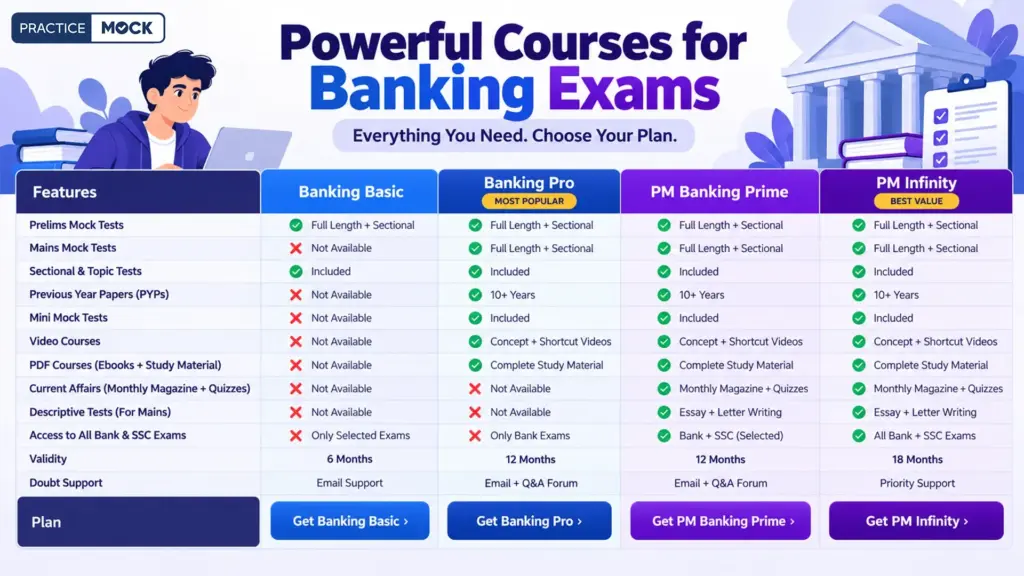
Powerful Courses for Banking Exams
RBI Grade B 2027 6 Month Study Plan FAQs
How to prepare for RBI Grade B 2027 using this 6 month study plan?
Follow a phased approach by covering Phase 2 static concepts (ESI and FM) alongside Phase 1 Aptitude during the first 3 months. Dedicate months 4 and 5 to intensive current affairs, descriptive typing, and speed drills, followed by full-length exam simulations in month 6.
Can a beginner clear RBI Grade B in 6 months?
Yes, a beginner can clear RBI Grade B in 6 months with a dedicated study routine of 5 to 6 hours daily, covering Phase 1 and Phase 2 simultaneously while practicing mock tests regularly.
Should I prepare for RBI Grade B Phase 1 and Phase 2 together?
Yes, preparing Phase 1 and Phase 2 together is necessary because the gap between Phase 1 and Phase 2 is usually only 20 to 30 days, which is not enough to cover the Phase 2 syllabus from scratch.
How many hours should I study daily for RBI Grade B 2027?
An average of 5 to 6 hours of focused daily study is recommended for full-time candidates, while working professionals should aim for 3 to 4 focused hours on weekdays and 7 to 8 hours on weekends.
How to prepare for RBI Grade B General Awareness effectively?
Cover current affairs from the past 6 months before the exam, focusing on RBI notifications, PIB releases, financial news, union budget highlights, economic survey reports, and flagship government welfare schemes.
How important is descriptive answer typing for RBI Grade B Phase 2?
Descriptive typing is crucial because Phase 2 contains 50% subjective questions in ESI and FM, as well as a full Descriptive English paper. Practicing directly on a computer keyboard is necessary to build speed and structure answers within the time limit.
What is the weightage of General Awareness in the RBI Grade B Phase 1 exam?
General Awareness carries 80 marks out of the total 200 marks in Phase 1, making it the highest-weightage section in the preliminary paper.
How to balance RBI Grade B preparation while working full-time?
Working professionals should utilize early morning hours for Phase 2 static reading, commute hours for current affairs updates, and late evenings for Quant or Reasoning practice, while dedicating weekends to full-length mock tests.
How many mock tests should I attempt before the RBI Grade B exam?
Attempt at least 10 to 15 full-length Phase 1 mock tests and 8 to 10 Phase 2 sectional/full-length tests, ensuring thorough analysis after every test to fix weak spots.
What are the main subjects in RBI Grade B Phase 2?
Phase 2 consists of three papers: Paper 1 – Economic and Social Issues (ESI), Paper 2 – Descriptive English (Writing Skills), and Paper 3 – Finance and Management (FM).
- Sign Up on Practicemock for Updated Current Affairs, Topic Tests and Mini Mocks
- Sign Up Here to Download Free Study Material
Free Mock Tests for the Upcoming Exams
- IBPS PO Free Mock Test
- RBI Grade B Free Mock Test
- IBPS SO Free Mock Test
- NABARD Grade A Free Mock Test
- SSC CGL Free Mock Test
- IBPS Clerk Free Mock Test
- IBPS RRB PO Free Mock Test
- IBPS RRB Clerk Free Mock Test
- RRB NTPC Free Mock Test
- SSC MTS Free Mock Test
- SSC Stenographer Free Mock Test
- GATE Mechanical Free Mock Test
- GATE Civil Free Mock Test
- RRB ALP Free Mock Test
- SSC CPO Free Mock Test
- AFCAT Free Mock Test
- SEBI Grade A Free Mock Test
- IFSCA Grade A Free Mock Test
- RRB JE Free Mock Test
- Free Banking Live Test
- Free SSC Live Test
[…] RBI Grade B Study Plan […]