


Puzzle & Seating Arrangement Questions for IBPS Clerk 2026 are one of the most important topics in the Reasoning Ability section. Every year, these questions test your logical thinking, analytical ability, and speed. Regular practice helps you identify patterns, solve complex arrangements faster, and improve your overall reasoning score. You can strengthen your preparation by attempting free quizzes, puzzle sets, and downloadable PDFs that match the latest IBPS Clerk exam pattern. In this blog, you’ll learn the latest question trends, important puzzle types, expert solving tips, and attempt a free quiz with detailed solutions.
Puzzle & Seating Arrangement Questions for IBPS Clerk: Overview
Puzzle & Seating Arrangement Questions for IBPS Clerk evaluate your ability to arrange people or objects based on given clues and arrive at the correct conclusion. Since these questions often carry high weightage in the exam, mastering different puzzle types can significantly improve your Reasoning score.

| Particulars | Details |
| Exam | IBPS Clerk |
| Section | Reasoning Ability |
| Expected Weightage | 10–15 Marks |
| Difficulty Level | Easy to Moderate |
| Skills Tested | Logical Reasoning, Analytical Thinking, Arrangement Skills |
| Common Question Types | Linear, Circular, Floor, Box & Scheduling Puzzles |
| Best Practice | Daily Puzzle Sets, Topic Tests & Mock Tests |
| Free Practice | PracticeMock Puzzle & Seating Arrangement Quiz |
Puzzle & Seating Arrangement Questions for IBPS Clerk: Free Practice Quiz
Practice the following 10 exam-level Puzzle & Seating Arrangement Questions for IBPS Clerk. Each question is followed by its correct answer and a detailed explanation to help you understand the logic behind the solution.
- C sits third to the left of F.
- H sits at one end.
- Only two persons sit between H and B.
- A sits immediately to the right of B.
- D sits second to the right of A.
- G is not an immediate neighbour of D.
- E sits at the remaining end.
Q1. Who sits immediately to the left of D?
Explanation: The unique arrangement is H – G – C – B – A – F – D – E. Therefore, F sits immediately to the left of D.
Q2. How many persons sit between F and B?
Explanation: In the arrangement H – G – C – B – A – F – D – E, only A sits between B and F. Therefore, one person sits between them.
Q3. Who sits at the extreme right end?
Explanation: E occupies the eighth position, which is the extreme right end.
Q4. Who is the immediate neighbour of both A and C?
Explanation: B sits between C and A in the sequence C – B – A. Therefore, B is an immediate neighbour of both.
Q5. Which pair sits at the two ends of the row?
Explanation: H sits at the extreme left and E sits at the extreme right.
- R lives on Floor 6.
- T lives immediately below R.
- P lives on an even-numbered floor.
- Only one person lives between P and Q.
- U lives above S.
- Corrected clue: S lives on Floor 1.
Q6. On which floor does T live?
Explanation: R lives on Floor 6 and T lives immediately below R. Therefore, T lives on Floor 5.
Q7. Who lives on the highest floor?
Explanation: R is directly stated to live on Floor 6, the highest floor.
Q8. Which statement is definitely true?
Explanation: The clue directly states that U lives above S.
Q9. If P lives on Floor 2, then on which floor does Q live?
Explanation: Only one person lives between P and Q, so their floor numbers differ by 2. If P is on Floor 2, Q must be on Floor 4.
Q10. Which puzzle type is represented in Questions 6–10?
Explanation: The clues assign people to different floors of a building, so this is a Floor Puzzle.
Quiz Summary
Types of Puzzle & Seating Arrangement Questions for IBPS Clerk
The IBPS Clerk exam includes different types of puzzles. Becoming familiar with each pattern helps you solve questions faster during the exam.
1. Linear Seating Arrangement: People are seated in a single row or double row while facing north, south, or opposite directions. You must identify each person’s exact position using the given clues.
2. Circular Seating Arrangement: In these questions, people sit around a circular table while facing either the centre or outside. Some questions may also combine additional information such as professions, colours, or hobbies.
3. Square and Rectangular Arrangement: Candidates arrange people around a square or rectangular table. These questions often involve people sitting at corners and sides while facing inside or outside.
4. Floor-Based Puzzle: People are assigned to different floors of a building. Along with floor positions, additional details like professions, favourite colours, or cities may also be included.
5. Box-Based Puzzle: Boxes are placed one above another in a stack. You must determine the correct order of the boxes using the given conditions.
6. Scheduling Puzzle: These puzzles involve arranging events, meetings, or tasks across different days, dates, or months based on the provided clues.
Why are Puzzle & Seating Arrangement Questions Important?
Puzzle & Seating Arrangement Questions form one of the highest-scoring areas of the IBPS Clerk Reasoning section. A single puzzle generally contains multiple questions, allowing candidates to score several marks by solving one arrangement correctly. Regular practice of Puzzle & Seating Arrangement Questions for IBPS Clerk can significantly improve both speed and accuracy in the exam.
Daily practice helps you:
- Improve logical thinking.
- Increase solving speed.
- Strengthen analytical skills.
- Build confidence for complex reasoning questions.
- Score better in the Reasoning Ability section.
Common Clues Used in Puzzle & Seating Arrangement Questions
Most puzzles are based on a few standard clue types. Learning these patterns will help you solve questions more quickly. Regular practice of Puzzle & Seating Arrangement Questions for IBPS Clerk also helps you recognise these patterns instantly during the exam, improving both speed and accuracy.
- Left and right positions
- Immediate neighbours
- Facing towards or away from the centre
- Corner and middle positions
- Above and below (Floor Puzzle)
- Top and bottom (Box Puzzle)
- Before and after (Scheduling Puzzle)
- Positive and negative clues
How to Solve IBPS Clerk Puzzle & Seating Arrangement Questions Faster
A proper strategy can save valuable time during the exam. Follow these simple steps while solving any puzzle.
1. Read the Question Carefully: First, identify whether it is a linear, circular, floor, box, or scheduling puzzle.
2. Start with Definite Clues: Place the people or objects whose positions are clearly mentioned. These clues help build the basic arrangement quickly.
3. Use Positive Statements First: Clues like “A sits immediately to the left of B” are easier to place than negative statements such as “A does not sit next to B.”
4. Draw a Rough Diagram: Always make a simple diagram instead of solving mentally. It reduces confusion and improves accuracy.
5. Handle Dual Cases Separately: If a clue creates two possible arrangements, draw both cases. Eliminate the incorrect one as you get more information.
6. Verify the Final Arrangement: Before answering the questions, quickly check whether every clue has been satisfied.
IBPS Clerk Puzzle & Seating Arrangement Attempt Strategy
Managing time is very important in the Reasoning section. A good solving strategy for Puzzle & Seating Arrangement Questions for IBPS Clerk helps you attempt more questions with better accuracy and improve your overall score.
| Strategy | Benefit |
| Identify the puzzle type first | Faster understanding |
| Start with definite clues | Builds the arrangement quickly |
| Draw a rough diagram | Reduces mistakes |
| Solve positive clues before negative clues | Saves time |
| Keep separate diagrams for dual cases | Avoids confusion |
| Verify all clues before answering | Improves accuracy |
Benefits of Practising IBPS Clerk Puzzle & Seating Arrangement Questions
Regular practice helps you become faster and more accurate in the Reasoning section. Consistent practice of Puzzle & Seating Arrangement Questions for IBPS Clerk improves your speed, confidence, and problem-solving approach.
- Improves logical thinking.
- Builds analytical ability.
- Increases solving speed.
- Improves accuracy under time pressure.
- Boosts confidence for complex reasoning questions.
- Helps score multiple marks from a single puzzle set.
- Strengthens overall Reasoning preparation.
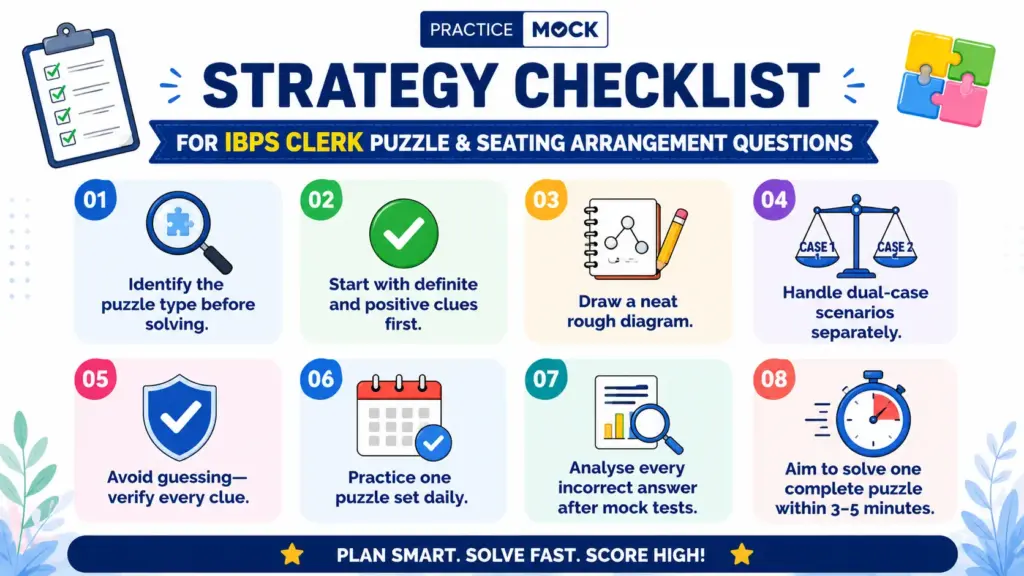
Strategy Checklist for IBPS Clerk Puzzle & Seating Arrangement Questions
Before the exam, make sure you follow this checklist to improve your speed and accuracy in Puzzle & Seating Arrangement Questions.
Final Thoughts
Puzzle & Seating Arrangement Questions for IBPS Clerk can help you score well in the Reasoning section if you practise regularly and follow the right approach. These questions test your logical thinking, observation, and time management skills. Start with simple puzzles, gradually move to difficult ones, and solve sectional mock tests consistently. With daily practice, proper diagram-making, and smart elimination techniques, you can solve even lengthy puzzles quickly and confidently in the IBPS Clerk exam.
Related IBPS Clerk Blogs
FAQs
1. How many Puzzle & Seating Arrangement Questions for IBPS Clerk are asked in the exam?
Usually, 10–15 marks in the Reasoning section come from Puzzle & Seating Arrangement Questions for IBPS Clerk, although the exact number may vary every year.
2. What are the most common puzzle types asked in the IBPS Clerk exam?
The most common types include linear seating arrangement, circular seating arrangement, floor puzzles, box puzzles, and scheduling puzzles.
3. How can I improve IBPS Clerk Puzzle & Seating Arrangement Questions?
Practice one puzzle daily, learn common patterns, draw rough diagrams, solve previous year questions, and attempt regular sectional mock tests.
4. Where can I practice IBPS Clerk Puzzle & Seating Arrangement Questions for free?
You can practise free quizzes, topic tests, downloadable PDFs, and full-length mock tests on PracticeMock.
5. What is the best strategy to solve Puzzle & Seating Arrangement questions quickly?
Start with definite clues, place fixed positions first, draw a rough diagram, solve positive clues before negative ones, and verify the final arrangement before answering.
6. Is Puzzle & Seating Arrangement an important topic for IBPS Clerk?
Yes. It is one of the highest-weightage topics in the Reasoning section and can help you score multiple marks from a single puzzle set.
7. How much time should I spend on one puzzle during the exam?
Ideally, you should aim to complete one puzzle or seating arrangement set within 3–5 minutes to manage your overall Reasoning section efficiently.
- Sign Up on Practicemock for Updated Current Affairs, Topic Tests and Mini Mocks
- Sign Up Here to Download Free Study Material
Free Mock Tests for the Upcoming Exams
- IBPS PO Free Mock Test
- RBI Grade B Free Mock Test
- IBPS SO Free Mock Test
- NABARD Grade A Free Mock Test
- SSC CGL Free Mock Test
- IBPS Clerk Free Mock Test
- IBPS RRB PO Free Mock Test
- IBPS RRB Clerk Free Mock Test
- RRB NTPC Free Mock Test
- SSC MTS Free Mock Test
- SSC Stenographer Free Mock Test
- GATE Mechanical Free Mock Test
- GATE Civil Free Mock Test
- RRB ALP Free Mock Test
- SSC CPO Free Mock Test
- AFCAT Free Mock Test
- SEBI Grade A Free Mock Test
- IFSCA Grade A Free Mock Test
- RRB JE Free Mock Test
- Free Banking Live Test
- Free SSC Live Test