


Mensuration Questions for IBPS PO are an important part of the Quantitative Aptitude section and can help you score quick marks with the right preparation. These questions test your understanding of area, perimeter, surface area, volume, and practical applications. To prepare effectively, practise free topic-wise quizzes, live mock tests, and downloadable PDFs that cover both 2D and 3D mensuration problems. In this blog, you will get exam-level quizzes, important formulas, expert preparation tips, and a free PDF with detailed solutions to strengthen your preparation.
Mensuration Questions for IBPS PO: Understanding the Exam Trend
In recent IBPS PO examinations, Mensuration Questions for IBPS PO have become more application-based rather than focusing only on direct formula questions. Candidates are expected to solve problems quickly by applying concepts related to 2D and 3D shapes, ratios, and calculations. This will help you improve your calculation speed and accuracy.

You can expect questions from:

- 2D Shapes: Area and perimeter of squares, rectangles, circles, triangles, trapeziums, and rhombuses.
- 3D Shapes: Surface area and volume of cubes, cuboids, cylinders, cones, and spheres.
- Mixed Mensuration Problems: Combined solids, ratio-based dimension changes, and real-life application questions.
- Formula-Based Questions: Direct questions based on standard mensuration formulas.
- Application-Based Questions: Questions involving painting, fencing, tiling, water tanks, pipes, and storage capacity.
Tip: Revise all important mensuration formulas regularly and practise simplification tricks to save time during the Quantitative Aptitude section.
Mensuration Practice Quiz with Answer Key: IBPS PO Prelims Exam-Level Questions
Here is a complete set of 10 exam-level Mensuration Questions for IBPS PO prepared according to the latest IBPS PO Preliminary examination pattern.These questions cover 2D and 3D mensuration, area, perimeter, surface area, volume, and application-based problems commonly asked in the Quantitative Aptitude section.
Q1. The length of a rectangle is 24 cm and its breadth is 18 cm. What is its area?
Explanation: Area of a rectangle = Length × Breadth = 24 × 18 = 432 cm².
Q2. The perimeter of a square is 64 cm. What is its area?
Explanation: Side of the square = Perimeter ÷ 4 = 64 ÷ 4 = 16 cm. Area = Side² = 16² = 256 cm².
Q3. The radius of a circle is 7 cm. Find its area. Take π = 22/7.
Explanation: Area of a circle = πr² = 22/7 × 7 × 7 = 154 cm².
Q4. A cube has an edge of 8 cm. What is its volume?
Explanation: Volume of a cube = Side³ = 8³ = 512 cm³.
Q5. A cylinder has a radius of 5 cm and a height of 10 cm. Find its volume. Take π = 3.14.
Explanation: Volume of a cylinder = πr²h = 3.14 × 5² × 10 = 3.14 × 25 × 10 = 785 cm³.
Q6. The length, breadth, and height of a cuboid are 10 cm, 8 cm, and 6 cm respectively. Find its volume.
Explanation: Volume of a cuboid = Length × Breadth × Height = 10 × 8 × 6 = 480 cm³.
Q7. A sphere has a radius of 3 cm. What is its volume? Take π = 22/7.
Explanation: Volume of a sphere = 4/3 × πr³ = 4/3 × 22/7 × 3³ = 4/3 × 22/7 × 27 = 792/7 ≈ 113.14 cm³.
Q8. The length of a rectangle is increased by 20% while its breadth remains unchanged. By what percentage will its area increase?
Explanation: Area = Length × Breadth. When breadth remains constant, area changes in the same proportion as length. Therefore, a 20% increase in length causes a 20% increase in area.
Q9. The radius of a circle is doubled. The area of the new circle becomes:
Explanation: Original area = πr². New radius = 2r, so new area = π(2r)² = 4πr². Therefore, the area becomes four times the original.
Q10. A square park has a side of 30 metres. A fence is to be built around it. How much fencing is required?
Explanation: Required fencing equals the perimeter of the square. Perimeter = 4 × Side = 4 × 30 = 120 metres.
Quiz Summary
Core Conceptual Guide: Important Mensuration Formulas
Before solving Mensuration Questions for IBPS PO, make sure you remember the most important formulas. Most questions can be solved quickly if your formulas are clear. Keep a one-page formula sheet and revise it daily before solving practice questions. This simple habit can improve both speed and accuracy in the IBPS PO exam.
| Shape | Important Formula |
| Square | Area = Side², Perimeter = 4 × Side |
| Rectangle | Area = Length × Breadth, Perimeter = 2(L + B) |
| Circle | Area = πr², Circumference = 2πr |
| Triangle | Area = ½ × Base × Height |
| Cube | Surface Area = 6a², Volume = a³ |
| Cuboid | Volume = Length × Breadth × Height |
| Cylinder | Volume = πr²h |
| Cone | Volume = ⅓πr²h |
| Sphere | Volume = ⁴⁄₃πr³ |
Strategy Checklist to Master Mensuration Questions for IBPS PO 2026
Scoring well in Mensuration Questions for IBPS PO requires more than memorising formulas. You also need quick calculations, strong conceptual understanding, and regular practice. Follow these simple strategies to improve your speed and accuracy in the Quantitative Aptitude section.
1. Memorise All Important Formulas: Most mensuration questions can be solved within seconds if you know the formulas well. Revise formulas for:
- Area and Perimeter of 2D Shapes
- Surface Area and Volume of 3D Shapes
- Circles, Triangles, Squares, and Rectangles
- Cubes, Cuboids, Cylinders, Cones, and Spheres
2. Focus on Concept-Based Learning: Instead of memorising formulas only, understand where and how they are used. Many Mensuration Questions for IBPS PO are application-based and require logical thinking. Practise questions based on:
- Area and perimeter
- Surface area and volume
- Ratio-based increase or decrease in dimensions
- Combined solids
- Real-life applications such as fencing, painting, flooring, and water tanks
3. Improve Your Calculation Speed: Fast calculations help you save valuable time during the exam. Improve your speed by practising:
- Multiplication shortcuts
- Fraction simplification
- Percentage calculations
- Square and cube values
- Approximation techniques
4. Practise Mixed Application Questions: IBPS PO often asks questions where two or more concepts are combined. Regularly solve questions involving:
- Change in dimensions
- Volume and capacity
- Surface area comparisons
- Cost based on area or perimeter
- Combined geometric figures
5. Solve Questions Under Time Limits: Time management is very important in the Quantitative Aptitude section. Follow this strategy:
- Easy Question: 25–35 seconds
- Moderate Question: 40–50 seconds
- Lengthy Question: Skip initially and revisit later if time permits.
6. Attempt Daily Quantitative Aptitude Mock Tests: The best way to improve IBPS PO Mensuration Questions is through regular mock test practice. After every mock test:
- Analyse incorrect answers.
- Revise the formula used.
- Identify calculation mistakes.
- Reattempt similar questions.
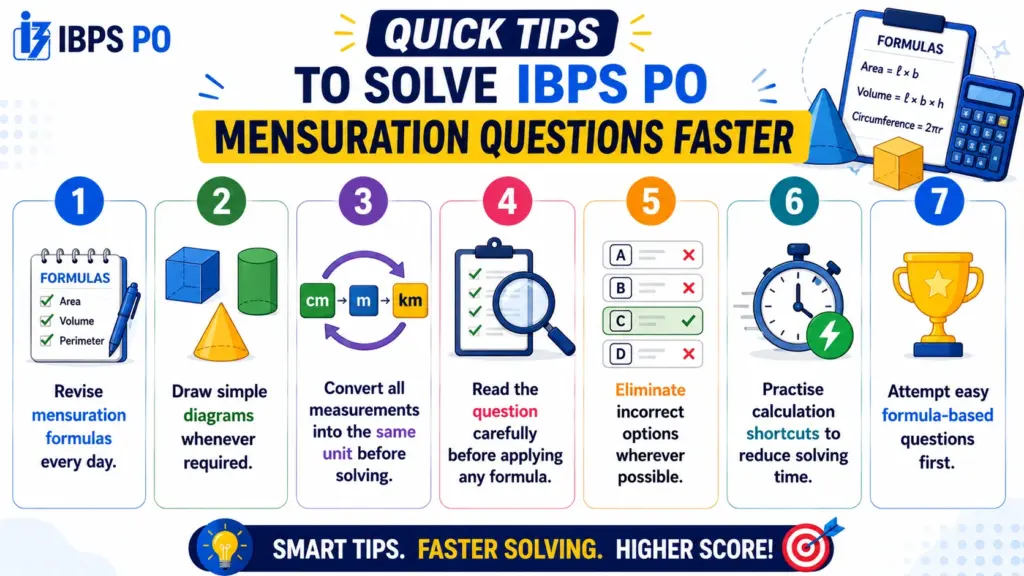
Quick Tips to Solve IBPS PO Mensuration Questions
Following the right approach can improve both your speed and accuracy. Focus on selecting the correct formula first, as it saves time and reduces calculation errors.
Daily Practice Plan for IBPS PO Mensuration Questions
A consistent practice routine improves formula retention, calculation speed, and overall accuracy. Following this schedule every day while solving Mensuration Questions for IBPS PO will strengthen your Quantitative Aptitude preparation and help you solve questions quickly.
| Time | Activity |
| 20 Minutes | Revise mensuration formulas |
| 30 Minutes | Solve IBPS PO Mensuration Questions |
| 20 Minutes | Attempt Quantitative Aptitude sectional quiz |
| 20 Minutes | Analyse mistakes and revise solutions |
| 15 Minutes | Practise calculation shortcuts and simplification |
Final Thoughts
Practising Mensuration Questions for IBPS PO regularly can help you score quick and easy marks in the Quantitative Aptitude section. Start by learning the basic formulas for 2D and 3D shapes, then solve topic-wise questions every day. Focus on understanding the concepts instead of memorising formulas blindly. Analyse your mistakes after every mock test and revise important formulas regularly. With consistent practice, smart time management, and regular sectional tests, you can solve mensuration questions quickly and confidently in the IBPS PO 2026 examination.
Also Read
FAQs
Q1. How many Mensuration Questions are asked in the IBPS PO exam?
Ans: In the IBPS PO Preliminary examination, candidates can generally expect 1–3 Mensuration Questions in the Quantitative Aptitude section. In some years, these questions may also appear as part of Data Interpretation or mixed arithmetic sets.
Q2. Which Mensuration topics are most important for the IBPS PO exam?
Ans: Candidates should focus on the most frequently asked topics such as Area, Perimeter, Surface Area, Volume, Circles, Triangles, Squares, Rectangles, Cubes, Cuboids, Cylinders, Cones, and Spheres. Questions based on ratio changes and application-based problems are also important.
Q3. How can I improve my accuracy in Mensuration Questions for IBPS PO?
Ans: Improve your accuracy by revising formulas daily, practising topic-wise questions, improving calculation speed, solving sectional mock tests, and analysing every incorrect answer. Regular revision helps you apply formulas quickly during the examination.
Q4. How much time should I spend on one Mensuration question in the IBPS PO Prelims exam?
Ans: Try to solve an easy formula-based question within 25–35 seconds. If a question involves lengthy calculations, skip it initially and return later if time permits.
Q5. Is Mensuration an important topic for the IBPS PO Quantitative Aptitude section?
Ans: Yes. Although the number of questions may be limited, Mensuration Questions for IBPS PO are considered scoring because they are mostly formula-based. A good understanding of concepts can help you secure easy marks.
Q6. Is mock test analysis important for Mensuration preparation?
Ans: Absolutely. Mock test analysis helps you identify formula mistakes, improve calculation speed, understand weak concepts, and develop better question selection strategies. Reviewing every mock test is one of the best ways to improve your Quantitative Aptitude score.
Q7. Can beginners score well in IBPS PO Mensuration Questions?
Ans: Yes. Beginners can score well by first learning the basic formulas and understanding the concepts behind them. After that, they should practise Mensuration Questions regularly through quizzes, sectional tests, and mock tests to improve speed and confidence.
Q8. Where can I practise free IBPS PO Mensuration Questions?
Ans: You can practise IBPS PO Mensuration Questions through PracticeMock’s full-length mock tests, Quantitative Aptitude sectional tests, topic-wise quizzes, live practice sessions, and downloadable PDFs with detailed solutions. Regular practice on exam-level questions helps improve speed, accuracy, and confidence before the examination.
- Sign Up on Practicemock for Updated Current Affairs, Topic Tests and Mini Mocks
- Sign Up Here to Download Free Study Material
Free Mock Tests for the Upcoming Exams
- IBPS PO Free Mock Test
- RBI Grade B Free Mock Test
- IBPS SO Free Mock Test
- NABARD Grade A Free Mock Test
- SSC CGL Free Mock Test
- IBPS Clerk Free Mock Test
- IBPS RRB PO Free Mock Test
- IBPS RRB Clerk Free Mock Test
- RRB NTPC Free Mock Test
- SSC MTS Free Mock Test
- SSC Stenographer Free Mock Test
- GATE Mechanical Free Mock Test
- GATE Civil Free Mock Test
- RRB ALP Free Mock Test
- SSC CPO Free Mock Test
- AFCAT Free Mock Test
- SEBI Grade A Free Mock Test
- IFSCA Grade A Free Mock Test
- RRB JE Free Mock Test
- Free Banking Live Test
- Free SSC Live Test