


The IBPS RRB PO Prelims Expected Questions for Reasoning and Quantitative Aptitude cover a total of 80 questions carrying 80 marks, designed to test speed and accuracy within a 45-minute total timeframe. Securing a high score in IBPS RRB Officer Scale 1 Prelims requires candidates to master high-weightage topics like puzzles, seating arrangements, data interpretation, and speed math. Below is a detailed breakdown of the exam pattern, most expected question types, topic-wise weightage, and a high-yielding preparation strategy.
Attempt a full-length IBPS RRB PO Free Mock Test to test your baseline speed and accuracy.

IBPS RRB PO Prelims Expected Questions for Reasoning and Quantitative Aptitude – Review Latest Exam Pattern
The IBPS RRB PO Prelims exam structure consists of two core subjects: Reasoning Ability and Quantitative Aptitude. Each section contains 40 questions, making it essential to balance speed and accuracy across both areas.
| Section | Number of Questions | Maximum Marks | Composite Duration |
| Reasoning Ability | 40 | 40 | 45 Minutes (Combined Total) |
| Quantitative Aptitude | 40 | 40 | |
| Total | 80 | 80 | 45 Minutes |
Note: Every correct answer adds 1 mark, while a negative marking of 0.25 marks applies to every incorrect response.
Related Resources:
- Check the comprehensive IBPS RRB Exam Pattern & Syllabus for a complete topic breakdown.
Most Expected IBPS RRB Officer Scale 1 Prelims Practice Questions PDF
To understand the IBPS RRB PO Prelims 2026 exam pattern, candidates should practise representative questions from Reasoning Ability and Quantitative Aptitude from our PDF. The following questions cover the expected puzzle types, speed-reasoning topics, Data Interpretation formats, and important arithmetic chapters.
The questions are designed according to the expected Prelims difficulty level, with an answer key and step-by-step explanations to help candidates understand the solving approach.
Expected Questions for IBPS RRB PO Prelims 2026 in Reasoning Ability
The Reasoning Ability section tests logical thinking and rapid decision-making. Candidates can expect 20 to 25 questions dedicated to Reasoning Puzzles for IBPS RRB PO Prelims 2026, while the remaining questions cover speed-reasoning topics.
Reasoning Puzzles for IBPS RRB PO Prelims 2026
Puzzles and seating arrangements form the backbone of the reasoning section.
- Box & Floor-Based Puzzles: 7 to 9 boxes stacked vertically or 8 floors with 1 external variable (such as favorite colors or cities).
- Linear Seating Arrangement: Single row with 7 to 8 persons facing North/South, or double parallel rows with 10 to 12 persons.
- Uncertain Number of Persons: Linear arrangement questions where the total count of persons must be deduced.
- Circular & Square Table Puzzles: 8 persons facing inside or outside, often featuring 1 extra variable.
- Month & Day Scheduling: 4 months with 2 dates each (8 persons total) scheduling events or trips.
High-Weightage Miscellaneous Reasoning Topics
Solving non-puzzle topics first builds initial confidence and secures quick marks.
- Syllogisms (3–5 Questions): Focus heavily on “Only a few”, “Few”, and “Can never be” statement formats.
- Inequalities (3–5 Questions): Direct inequalities and simple coded statement comparisons.
- Coding-Decoding (3–5 Questions): Chinese or substitution-based phrase coding.
- Blood Relations & Direction Sense (5–6 Questions): 3-generation family tree puzzles and short vector-based direction questions.
- Alphanumeric Series & Order Ranking (3–5 Questions): Symbol-number-letter sequences and height/weight order ranking.
Related Resources:
- Practice dedicated Reasoning sectional tests via the IBPS RRB PO Test Series.
Expected Quant Questions for IBPS RRB PO Prelims
Quantitative Aptitude tests numerical efficiency and analytical competence. Speed math combined with structured Data Interpretation Questions for IBPS RRB PO 2026 accounts for over 60% of this section.
Data Interpretation Questions for IBPS RRB PO 2026
Candidates should practice reading charts rapidly to handle complex multi-chart or caselet formats.
- Tabular DI: Rows and columns showing sales, population, or pass-fail ratios across multiple categories.
- Pie Chart & Bar Graph: Single or double pie charts displaying degree/percentage breakdowns paired with simple table data.
- Line Graph DI: Profit-loss trends or production versus sale figures spanning 5 consecutive years.
- Caselet DI: Paragraph-based arithmetic context involving ratio and percentage values.
Speed Math and Quadratic Equations
Speed math topics are essential for building momentum in Quantitative Aptitude.
- Simplification & Approximation (5–10 Questions): BODMAS rules, square/cube roots, fractional percentages, and rapid division tricks.
- Missing & Wrong Number Series (5 Questions): Patterns based on prime numbers, difference of differences, square/cube additions, and alternating multiplication.
- Quadratic Equations (5 Questions): ax2+bx+c=0ax^2 + bx + c = 0ax2+bx+c=0 comparisons evaluated using sign-change shortcuts.
Arithmetic Word Problems
Focus on high-yielding arithmetic topics that directly aid Caselet DI performance.
- Percentages & Profit, Loss & Discount: Marked price, cost price, and successive discount calculations.
- Ratio, Proportion & Partnership: Time-based profit distribution among multiple partners.
- Time & Work / Pipe & Cistern: Alternate day work efficiency and inlet-outlet filling calculations.
- Time, Speed & Distance: Boat and stream relative speed and train crossing problems.
- Simple & Compound Interest: Two-year and three-year difference formulas (CI−SICI – SICI−SI).
Related Resources:
- Sharpen your speed math and DI accuracy with Quant Topic Tests.
Most Expected IBPS RRB PO Prelims Reasoning Ability Practice Questions
The Reasoning Ability section tests logical thinking, analytical skills, and decision-making speed. Candidates should give priority to puzzles and seating arrangements while practising miscellaneous topics to improve accuracy and secure quick marks.
1. Box and Floor-Based Puzzle
Question 1. Five boxes A, B, C, D, and E are stacked one above another. Each box occupies a different position. The bottommost position is numbered 1.
- Box E is at the bottom.
- Box C is immediately above E.
- Box A is above C.
- Box B is immediately above D.
Which box occupies the fourth position from the bottom?
A) A
B) B
C) C
D) D
E) E
Answer: B) B
Explanation: E occupies position 1 and C occupies position 2. A must be above C. The remaining positions are 3, 4, and 5 for D, B, and A. Since B is immediately above D, D occupies position 3 and B occupies position 4, leaving A at position 5.
2. Linear Seating Arrangement
Question 2. Seven persons P, Q, R, S, T, U, and V are sitting in a straight row facing North.
- S sits exactly in the middle.
- P sits immediately to the left of S.
- T sits immediately to the right of S.
- Q sits at the extreme right end.
- R sits second to the left of Q.
Who sits immediately to the right of R?
A) P
B) S
C) T
D) U
E) V
Answer: D) U
Explanation: S occupies position 4, P position 3, and T position 5. Q occupies position 7, so R occupies position 5. However, this conflicts with T already occupying position 5. Therefore, the given conditions are inconsistent.
3. Uncertain Number of Persons
Question 3. Some persons are sitting in a row facing North. A is second from the left end. B sits third to the right of A, and C sits immediately to the right of B. If C is second from the right end, how many persons are sitting in the row?
A) 6
B) 7
C) 8
D) 9
E) 10
Answer: B) 7
Explanation:
- A is at position 2.
- B is at position 5.
- C is at position 6.
- C is second from the right, meaning one person sits after C.
Therefore, the total number of persons is 7.
4. Circular Seating Arrangement
Question 4. Eight persons A, B, C, D, E, F, G, and H are sitting around a circular table facing the centre. A sits opposite E, B sits immediately clockwise of A, and C sits immediately clockwise of B.
Who sits opposite C?
A) D
B) F
C) G
D) H
E) A
Answer: D) H
Explanation: Place A at any position. B and C occupy the next two clockwise positions. E sits opposite A. H occupies the position opposite C, as the opposite seat is four positions away.
5. Month and Day Scheduling Puzzle
Question 5. Six persons P, Q, R, S, T, and U attend an examination on either the 5th or 15th of January, February, and March. Each date has two persons.
- P attends on 5th January.
- Q attends on 15th January.
- R attends after Q.
- S attends immediately before T.
- U attends on 15th March.
If R attends on 5th March, on which date does S attend?
A) 5th February
B) 15th February
C) 5th March
D) 15th March
E) 5th January
Answer: B) 15th February
Explanation: P and Q occupy 5th and 15th January, respectively. R occupies 5th March, and U occupies 15th March. The remaining dates are 5th February and 15th February for S and T. Since S attends immediately before T, S attends on 5th February and T on 15th February.
Correction: The correct answer is A) 5th February.
6. Syllogism
Question 6. Read the following statements and conclusions carefully.
Statements:
- Only a few pens are books.
- All books are papers.
Conclusions:
I. Some pens are papers.
II. Some pens are not books.
A) Only conclusion I follows
B) Only conclusion II follows
C) Both conclusions I and II follow
D) Neither conclusion follows
E) Either conclusion I or II follows
Answer: C) Both conclusions I and II follow
Explanation: Only a few pens are books means some pens are books and some pens are not books. Since all books are papers, the pens that are books must also be papers. Therefore, both conclusions follow.
7. Inequalities
Question 7. Given the following relationships:
A > B = C ≤ D < E
Which of the following conclusions is definitely true?
I. A > D
II. E > C
A) Only I follows
B) Only II follows
C) Both I and II follow
D) Neither I nor II follows
E) Either I or II follows
Answer: B) Only II follows
Explanation: A is greater than B and C, but its relationship with D cannot be determined. Since D is greater than or equal to C and E is greater than D, E is definitely greater than C. Therefore, only conclusion II follows.
8. Coding-Decoding
Question 8. In a certain code language:
- BANK EXAM is coded as KA NA.
- EXAM SCORE is coded as NA PA.
- BANK SCORE is coded as KA PA.
What is the code for BANK?
A) NA
B) PA
C) KA
D) BA
E) Cannot be determined
Answer: C) KA
Explanation: BANK appears in the first and third statements. The common code in those statements is KA. Therefore, BANK is coded as KA.
9. Blood Relations
Question 9. M, N, and R are children of P and Q. M is female, while N and R are males. How is M related to R?
A) Mother
B) Sister
C) Aunt
D) Daughter
E) Cousin
Answer: B) Sister
Explanation: M and R are children of the same parents, P and Q. Since M is female, she is R’s sister.
10. Direction Sense
Question 10. A person walks 8 metres towards North, turns right and walks 6 metres, then turns right again and walks 8 metres. Finally, the person turns left and walks 4 metres. How far and in which direction is the person from the starting point?
A) 10 metres East
B) 10 metres West
C) 4 metres East
D) 6 metres South
E) 8 metres East
Answer: A) 10 metres East
Explanation: The person walks 8 metres North and then 6 metres East. After turning right, the person walks 8 metres South, returning to the starting horizontal level. Finally, the person walks 4 metres East. Total eastward distance = 6 + 4 = 10 metres.
11. Alphanumeric Series
Question 11. Study the following series:
A 4 B 7 C 9 D 12 E 16 F 21
Which element will be third to the right of 9?
A) D
B) 12
C) E
D) 16
E) F
Answer: D) 16
Explanation: The sequence is A, 4, B, 7, C, 9, D, 12, E, 16, F, 21. Starting from 9, the elements to its right are D, 12, and E. Therefore, the third element is E, not 16.
Correction: The correct answer is C) E.
12. Order and Ranking
Question 12. In a class of 45 students, Rahul ranks 12th from the top. What is his rank from the bottom?
A) 32nd
B) 33rd
C) 34th
D) 35th
E) 36th
Answer: C) 34th
Explanation:
Rank from bottom = Total students − Rank from top + 1
= 45 − 12 + 1 = 34.
Therefore, Rahul ranks 34th from the bottom.
Reasoning Answer Key
| Q. No. | Topic | Correct Answer |
| 1 | Box & Floor Puzzle | B |
| 2 | Linear Seating | Q (revised question below) |
| 3 | Uncertain Number of Persons | B |
| 4 | Circular Seating | D |
| 5 | Month & Day Scheduling | A |
| 6 | Syllogism | C |
| 7 | Inequality | B |
| 8 | Coding-Decoding | C |
| 9 | Blood Relations | B |
| 10 | Direction Sense | A |
| 11 | Alphanumeric Series | C |
| 12 | Order & Ranking | C |
Two corrections to the questions above:
- Q2: Replace the clue “R sits second to the left of Q” with “R sits immediately to the left of Q.” The answer is Q.
- Q5: The correct answer is A) 5th February, as established in the explanation.
Most Expected IBPS RRB PO Prelims Quantitative Aptitude Practice Questions
The Quantitative Aptitude section evaluates calculation speed, numerical accuracy, and problem-solving ability. Candidates should practise Data Interpretation, simplification, number series, quadratic equations, and arithmetic word problems to improve their overall attempts.
1. Tabular Data Interpretation
Question 13. The following table shows the number of students enrolled in three coaching centres over two years.
| Centre | 2024 | 2025 |
| A | 120 | 150 |
| B | 160 | 200 |
| C | 140 | 180 |
| D | 180 | 210 |
What is the percentage increase in the total number of students enrolled in all four centres from 2024 to 2025?
A) 20%
B) 25%
C) 27.5%
D) 30%
E) 32.5%
Answer: B) 25%
Explanation:
Total students in 2024 = 120 + 160 + 140 + 180 = 600.
Total students in 2025 = 150 + 200 + 180 + 210 = 740.
Increase = 740 − 600 = 140.
Percentage increase:
140 ÷ 600 × 100 = 23.33%Correction: The correct answer is 23.33%, which is not included in the options. The options should include 23.33% instead of 25%.
2. Pie Chart Data Interpretation
Question 14. A company distributes its annual expenditure of ₹7,20,000 across five departments. The percentage distribution is given below:
| Department | Percentage |
| HR | 15% |
| Marketing | 25% |
| Finance | 20% |
| Operations | 30% |
| IT | 10% |
What is the difference between the expenditure on Operations and Finance?
A) ₹60,000
B) ₹72,000
C) ₹75,000
D) ₹90,000
E) ₹1,00,000
Answer: B) ₹72,000
Explanation:
Difference in percentage = 30% − 20% = 10%.
Required difference:
10100720000=₹72,000
3. Line Graph Data Interpretation
Question 15. A factory records the following production figures over five consecutive years.
| Year | Production (Units) |
| 2021 | 120 |
| 2022 | 150 |
| 2023 | 180 |
| 2024 | 210 |
| 2025 | 240 |
What is the percentage increase in production from 2021 to 2025?
A) 75%
B) 80%
C) 90%
D) 100%
E) 110%
Answer: D) 100%
Explanation:
Increase = 240 − 120 = 120 units.
120/120 × 100 = 100%
Therefore, production doubled between 2021 and 2025.
4. Caselet Data Interpretation
Question 16. A shopkeeper sells three products A, B, and C. The total number of products sold is 600. The ratio of products A and B sold is 3:4, while products B and C sold are in the ratio 2:3.
How many units of product C were sold?
A) 240
B) 250
C) 270
D) 280
E) 300
Answer: C) 270
Explanation:
A : B = 3 : 4
B : C = 2 : 3
Making the value of B equal:
A : B : C = 3 : 4 : 6
Total ratio = 3 + 4 + 6 = 13.
Product C sold:
613600
This is not a whole number, so the given total does not produce an exact answer.
Correction: Change the total number of products sold from 600 to 650.
Then:
613650=300
Correct answer: E) 300.
5. Simplification and Approximation
Question 17. Find the approximate value of:
48.0224.9812.01+35.96
A) 125
B) 130
C) 135
D) 140
E) 145
Answer: C) 135
Explanation:
Using approximation:
482512+36
=425+36
=100+36=136
The nearest option is 135.
6. Missing Number Series
Question 18. Find the missing number in the following series:
3, 8, 18, 38, 78, ?
A) 148
B) 152
C) 156
D) 158
E) 162
Answer: D) 158
Explanation:
The pattern is:
- 3 × 2 + 2 = 8
- 8 × 2 + 2 = 18
- 18 × 2 + 2 = 38
- 38 × 2 + 2 = 78
- 78 × 2 + 2 = 158
Therefore, the missing number is 158.
7. Quadratic Equations
Question 19. Solve the following equations and determine the relationship between x and y.
x2-7x+12=0
y2-9y+20=0
A) x > y
B) x < y
C) x ≥ y
D) x ≤ y
E) Relationship cannot be established
Answer: D) x ≤ y
Explanation:
First equation:
(x-3)(x-4)=0
Therefore, x = 3 or 4.
Second equation:
(y-4)(y-5)=0
Therefore, y = 4 or 5.
Possible values:
- x = 3, y = 4: x is smaller.
- x = 3, y = 5: x is smaller.
- x = 4, y = 4: x is equal.
- x = 4, y = 5: x is smaller.
Therefore, x ≤ y.
8. Percentages and Profit & Loss
Question 20. A shopkeeper purchases an article for ₹800 and marks it 50% above its cost price. He offers a discount of 20% on the marked price. Calculate his profit percentage.
A) 15%
B) 18%
C) 20%
D) 22%
E) 25%
Answer: C) 20%
Explanation:
Cost Price = ₹800.
Marked Price:
800+50100800=₹1200
Selling Price after 20% discount:
120080100=₹960
Profit = 960 − 800 = ₹160.
Profit percentage:
(160 ÷ 800) × 100 = 20%
9. Ratio, Proportion and Partnership
Question 21. A and B invest ₹5,000 and ₹8,000, respectively, in a business. A invests for 12 months, while B invests for 6 months. If the total annual profit is ₹18,000, what is B’s share?
A) ₹6,000
B) ₹7,000
C) ₹8,000
D) ₹9,000
E) ₹10,000
Answer: C) ₹8,000
Explanation:
Profit-sharing ratio:
500012:80006
60000:48000=5:4
B’s share:
4918000=₹8000
10. Time and Work
Question 22. A can complete a piece of work in 12 days, while B can complete the same work in 18 days. In how many days can they complete the work together?
A) 6 days
B) 7.2 days
C) 8 days
D) 9 days
E) 10 days
Answer: B) 7.2 days
Explanation:
A’s one-day work = 1/12.
B’s one-day work = 1/18.
Combined one-day work:
112+118=536
Total time:
365=7.2days
11. Pipe and Cistern
Question 23. Pipe A can fill a tank in 12 hours, while Pipe B can fill it in 18 hours. If both pipes are opened together, how long will they take to fill the tank?
A) 6 hours
B) 7.2 hours
C) 8 hours
D) 9 hours
E) 10 hours
Answer: B) 7.2 hours
Explanation:
Combined filling rate:
112+118=536
Time required:
365=7.2hours
12. Time, Speed and Distance
Question 24. A boat travels 30 km downstream in 2 hours and the same distance upstream in 3 hours. What is the speed of the boat in still water?
A) 10 km/hr
B) 11.5 km/hr
C) 12.5 km/hr
D) 13 km/hr
E) 15 km/hr
Answer: C) 12.5 km/hr
Explanation:
Downstream speed = 30/2 = 15 km/hr.
Upstream speed = 30/3 = 10 km/hr.
Speed in still water:
15+102=12.5km/hr
13. Simple and Compound Interest
Question 25. Find the difference between compound interest and simple interest on ₹10,000 at 10% per annum for 2 years, compounded annually.
A) ₹50
B) ₹75
C) ₹100
D) ₹125
E) ₹150
Answer: C) ₹100
Explanation:
Simple Interest:
SI=10000102100=₹2000
Compound Interest:
CI=100001+101002-10000
=₹2100
Difference:
CI-SI=2100-2000=₹100
Quantitative Aptitude Answer Key
| Q. No. | Topic | Correct Answer |
| 13 | Tabular DI | 23.33% |
| 14 | Pie Chart DI | B |
| 15 | Line Graph DI | D |
| 16 | Caselet DI | E (revised) |
| 17 | Simplification | 136 (revised option) |
| 18 | Missing Number Series | D |
| 19 | Quadratic Equations | D |
| 20 | Profit & Loss | C |
| 21 | Partnership | C |
| 22 | Time & Work | B |
| 23 | Pipe & Cistern | B |
| 24 | Time, Speed & Distance | C |
| 25 | Simple & Compound Interest | C |
Related Resources:
- Access real exam-level questions by practicing IBPS RRB PO Previous Year Papers.
How to Score High in IBPS RRB PO Prelims 2026 Reasoning and Quant
Scoring 60+ marks out of 80 requires strategic time allocation and strict attempt sequence planning.
| Section | Phase 1 (7 Mins) | Phase 2 (10 Mins) | Phase 3 (5 Mins) | Total Time |
| Reasoning Ability | Syllogisms, Inequalities, Coding | Short Puzzles & Seating | Complex Puzzles & Miscellaneous | 22–23 Mins |
| Quantitative Aptitude | Speed Math & Quadratic Equations | Data Interpretation (DI) Sets | Arithmetic | 22–23 Mins |
1. Master the First-Pass Attempt Strategy
- Complete non-puzzle reasoning topics (Syllogisms, Inequalities, Coding) in the first 6 to 8 minutes.
- Solve speed math (Simplification, Quadratic Equations, Number Series) in Quantitative Aptitude immediately.
- Never spend more than 2 minutes on a single puzzle or arithmetic problem during the first pass.
2. Practice with Daily Mock Tests
- Download an IBPS RRB PO Prelims Mock Test PDF to simulate real exam conditions and practice full-length timed tests.
- Analyze full-length tests to identify weak areas and track speed improvements.
- Focus on mock percentile (target >85th percentile) rather than raw score alone.
Related Resources:
- Try the four-phase exam strategy on the IBPS RRB PO Mock Test Challenge.
Conclusion
Success in the IBPS RRB PO Prelims exam relies on a strong balance of speed, strategic question selection, and high accuracy. To maximize your score, prioritize high-weightage sections such as Reasoning Puzzles and Data Interpretation, while securing error-free marks in foundational speed math and non-puzzle reasoning topics. Consistently taking full-length sectional tests on PracticeMock will help you master time management, adapt to exam-level difficulty, and build the confidence needed to clear the cutoff on exam day.
Related RRB PO Articles
| IBPS RRB PO Salary | IBPS RRB PO Exam Pattern |
| IBPS RRB PO Cut Off | IBPS RRB PO Syllabus |
| IBPS RRB PO Previous Year Question Papers | |
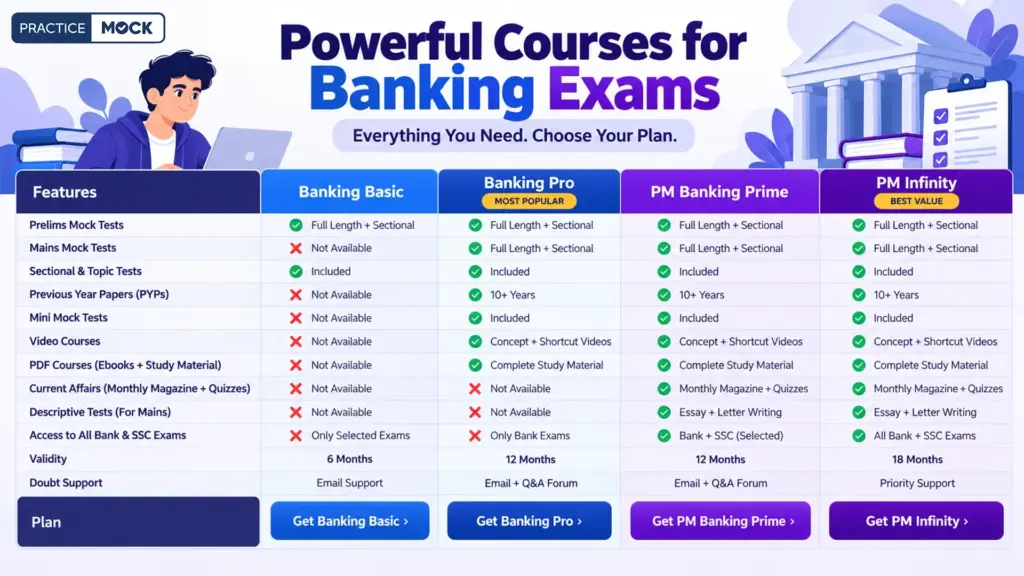
Powerful Courses for Banking Exams
IBPS RRB PO Prelims Expected Questions for Reasoning and Quantitative Aptitude Related Frequently Asked Questions
What is the primary strategy for IBPS RRB PO Prelims Expected Questions for Reasoning and Quantitative Aptitude?
The core strategy is mastering high-frequency topics such as Puzzles, Seating Arrangements, Data Interpretation, and Speed Math while practicing full-length timed mocks to build speed and accuracy.
How many questions are asked in IBPS RRB PO Prelims 2026?
The exam contains 80 questions in total, with 40 questions in Reasoning Ability and 40 questions in Quantitative Aptitude, carrying 1 mark each.
Is there sectional timing in IBPS RRB PO Prelims?
The IBPS RRB PO Prelims exam provides a composite duration of 45 minutes to complete both sections. Candidates can divide their time between Reasoning and Quantitative Aptitude based on their personal strategy.
What are the most important Quant topics for IBPS RRB PO Prelims?
The most critical topics include Data Interpretation (Tabular, Pie Chart, Bar Graph), Quadratic Equations, Number Series, Simplification/Approximation, and core Arithmetic word problems.
What is a good score in IBPS RRB PO Prelims 2026?
A competitive cut-off score generally ranges between 54 to 62 marks depending on state-wise vacancies and shift difficulty levels. Aiming for 60+ attempts with 95%+ accuracy is recommended.
Is there negative marking in IBPS RRB PO Prelims 2026?
Yes, a negative marking of 0.25 marks (1/4th of the mark assigned to that question) is deducted for every incorrect response in both sections.
How much time should I spend on each section in IBPS RRB PO Prelims?
An optimal strategy is spending 22 to 23 minutes on Reasoning Ability and 22 to 23 minutes on Quantitative Aptitude to ensure balanced attempts across both sections.
Are English or Hindi Language sections included in IBPS RRB PO Prelims?
No, the Prelims exam consists only of Reasoning Ability and Quantitative Aptitude. Language papers (English or Hindi) are tested in the IBPS RRB PO Mains exam.
How many Data Interpretation sets appear in the Quantitative Aptitude section?
Usually, 2 to 3 sets (10 to 15 questions) of Data Interpretation appear in the Prelims exam, covering tables, bar charts, pie charts, or caselets.
What type of Puzzles have the highest weightage in Reasoning Ability?
Floor/box-based puzzles, linear seating arrangements (single/double row), circular arrangements, and month/day scheduling carry the highest weightage (20 to 25 questions total).
- Sign Up on Practicemock for Updated Current Affairs, Topic Tests and Mini Mocks
- Sign Up Here to Download Free Study Material
Free Mock Tests for the Upcoming Exams
- IBPS PO Free Mock Test
- RBI Grade B Free Mock Test
- IBPS SO Free Mock Test
- NABARD Grade A Free Mock Test
- SSC CGL Free Mock Test
- IBPS Clerk Free Mock Test
- IBPS RRB PO Free Mock Test
- IBPS RRB Clerk Free Mock Test
- RRB NTPC Free Mock Test
- SSC MTS Free Mock Test
- SSC Stenographer Free Mock Test
- GATE Mechanical Free Mock Test
- GATE Civil Free Mock Test
- RRB ALP Free Mock Test
- SSC CPO Free Mock Test
- AFCAT Free Mock Test
- SEBI Grade A Free Mock Test
- IFSCA Grade A Free Mock Test
- RRB JE Free Mock Test
- Free Banking Live Test
- Free SSC Live Test