


Error Detection Questions for IBPS PO are one of the most important in the English Language section of the IBPS PO examination. Candidates can expect grammar-based questions in both the Preliminary and Main exams. These questions check your understanding of English grammar, sentence structure, and vocabulary. A strong command of grammar rules helps you answer these questions quickly with better accuracy. To strengthen your preparation, we have compiled an exam-level Error Detection Quiz for IBPS PO along with a free downloadable PDF with detailed solutions for offline practice.
Error Detection Practice Quiz with Answer Key: IBPS PO Prelims Exam-Level Questions
Here is a complete set of 10 exam-level Error Detection Questions for IBPS PO based on the latest IBPS PO Preliminary examination pattern. These questions cover Subject-Verb Agreement, Tenses, Articles, Pronouns, Prepositions, Conjunctions, Modifiers, and Vocabulary Usage to help you practise the question types most frequently asked in the examination.

Q1. The list of candidates / have been uploaded / on the official website / No Error
Explanation: The main subject is the singular noun “list”, not the plural noun “candidates”. Therefore, the singular verb form is required: “The list of candidates has been uploaded on the official website.”
Q2. Neither the manager nor the employees / was willing / to accept the proposal / No Error
Explanation: With “neither…nor”, the verb usually agrees with the subject nearest to it. The nearer subject “employees” is plural, so “was willing” should be “were willing”.
Q3. Each of the students / have submitted / the assignment on time / No Error
Explanation: The subject “Each” is singular, even though it is followed by the plural noun “students”. Therefore, “have submitted” should be “has submitted”.
Q4. She has completed / the project yesterday / and submitted it / No Error
Explanation: The present perfect tense is not normally used with a finished past-time expression such as “yesterday”. Use the simple past: “She completed the project yesterday and submitted it.”
Q5. He is / an university student / who prepares for bank exams / No Error
Explanation: The article depends on the initial sound, not the first letter. “University” begins with the consonant sound /juː/, so the correct phrase is “a university student”.
Q6. The meeting will begin / at Monday morning / without any delay / No Error
Explanation: Use “on” with days and specific day-based expressions. Therefore, “at Monday morning” should be “on Monday morning”.
Q7. She is good / in Mathematics / and also teaches students / No Error
Explanation: The standard expression is “good at” a subject or activity. Therefore, “in Mathematics” should be “at Mathematics”.
Q8. Everyone should submit / their application form / before the deadline / No Error
Explanation: There is no error in modern standard English. Singular “they/their” is widely accepted with indefinite pronouns such as “everyone”. The sentence is grammatically correct as written.
Q9. Although he was tired / but he completed / all the questions / No Error
Explanation: “Although” already introduces a contrast, so it should not be paired with “but” in the same construction. Correct sentence: “Although he was tired, he completed all the questions.”
Q10. Walking towards the examination hall / the admit card fell / from his pocket / No Error
Explanation: The introductory phrase must logically modify the subject that follows it. Here, “the admit card” appears to be walking, creating a dangling modifier. Correct sentence: “While he was walking towards the examination hall, the admit card fell from his pocket.”
Quiz Summary
Error Detection Questions for IBPS PO: Understanding the Exam Trend
In recent IBPS PO examinations, Error Detection Questions for IBPS PO have become more concept-based rather than depending only on simple grammar rules. Most questions test your knowledge of grammar, sentence structure, vocabulary usage, and contextual understanding within a limited time.
You can expect questions based on the following topics:
- Subject-Verb Agreement: Matching the subject with the correct verb.
- Tenses: Identifying incorrect verb forms and tense consistency.
- Articles: Correct use of a, an, and the.
- Prepositions: Choosing the correct preposition according to the sentence.
- Pronouns: Finding incorrect pronoun references.
- Conjunctions: Identifying errors in sentence connectors.
- Modifiers: Detecting misplaced or dangling modifiers.
- Vocabulary Usage: Selecting the correct word according to the sentence context.
Tip: Read the entire sentence once before identifying the error. Many candidates lose marks because they focus only on one phrase instead of understanding the complete meaning.
Core Conceptual Guide: Important Grammar Rules
Before attempting Error Detection Questions for IBPS PO, revise these important grammar rules. Most exam questions are directly based on these concepts. A good understanding of these rules helps you identify sentence errors quickly and accurately during the examination.
| Grammar Topic | Important Rule |
| Subject-Verb Agreement | Singular subjects take singular verbs, while plural subjects take plural verbs. |
| Tenses | Maintain the correct tense throughout the sentence unless the context changes. |
| Articles | Use a before consonant sounds, an before vowel sounds, and the for specific nouns. |
| Prepositions | Use the correct preposition according to the verb or expression. |
| Pronouns | Pronouns should clearly refer to the correct noun. |
| Conjunctions | Use conjunctions correctly to connect words, phrases, or clauses. |
| Modifiers | Place modifiers close to the word they describe. |
| Parallelism | Maintain the same grammatical structure in a series of words or phrases. |
Strategy Checklist to Master Error Detection Questions for IBPS PO 2026
Scoring well in Error Detection Questions for IBPS PO requires more than memorising grammar rules. You also need the right strategy to identify errors quickly, manage time, and avoid common mistakes. Follow these simple tips to improve your performance in both the Preliminary and Main examinations.
1. Build Strong Grammar Fundamentals: Most Error Detection questions are based on basic grammar concepts. A clear understanding of these concepts helps you identify errors without guessing. Before solving practice questions, revise the rules of:
- Subject-Verb Agreement
- Tenses
- Articles
- Prepositions
- Pronouns
- Conjunctions
- Modifiers
- Parallelism
2. Read the Complete Sentence First: Many candidates immediately start checking each phrase separately. This approach helps you avoid unnecessary confusion. Instead:
- Read the complete sentence once.
- Understand its meaning.
- Then identify the grammatical mistake.
3. Eliminate Correct Options: If you are unsure about the answer, eliminate the parts that are grammatically correct first. This increases your chances of selecting the correct option. A process of elimination is often faster than checking every grammar rule one by one.
4. Improve Your Reading Speed: Reading quickly while maintaining accuracy is important in the English section. Better reading speed allows you to attempt more questions during the examination.
To improve your speed:
- Read English newspapers daily.
- Solve grammar-based exercises regularly.
- Attempt Error Detection quizzes with a timer.
5. Practise Under Time Limits: Time management is very important in the IBPS PO English section. Regular timed practice improves both speed and confidence.
Try to follow this practice routine:
- Easy Error Detection Question – 20–30 seconds
- Moderate Question – 30–40 seconds
- Difficult Question – Skip initially and revisit later
6. Attempt Daily Sectional Mock Tests: The best way to improve Error Detection Questions for IBPS PO is through regular practice. Consistent sectional practice gradually improves both accuracy and confidence. After every sectional mock:
- Check incorrect answers.
- Understand why the error occurred.
- Revise the grammar rule involved.
- Reattempt similar questions.
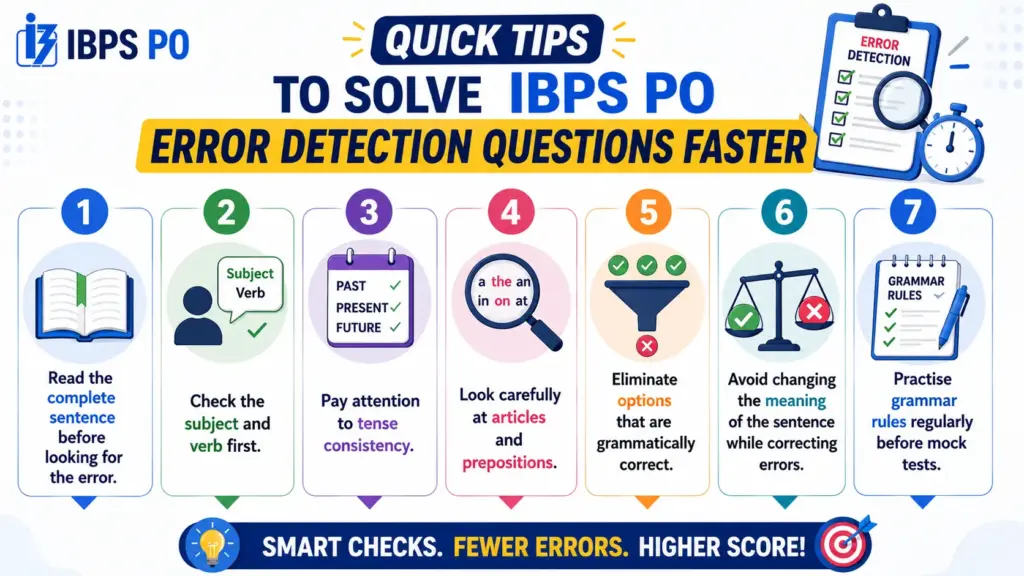
Quick Tips to Solve IBPS PO Error Detection Questions Faster
Regular practice is important, but following the right strategy helps you improve your accuracy much faster. These simple habits can help you solve Error Detection questions more confidently during the examination.
Daily Practice Plan for IBPS PO Error Detection Questions
A consistent practice routine helps improve grammar concepts, reading speed, and accuracy. Following this schedule daily will strengthen your preparation. Following this routine consistently will help you improve your performance in Error Detection Questions for IBPS PO before the examination.
| Time | Activity |
| 20 Minutes | Revise grammar rules |
| 30 Minutes | Solve Error Detection questions |
| 20 Minutes | Attempt English sectional quiz |
| 20 Minutes | Analyse mistakes and revise explanations |
| 15 Minutes | Read an English editorial or article |
Final Thoughts
Practising Error Detection Questions for IBPS PO regularly can significantly improve your English Language score. Start by strengthening your grammar basics and then solve topic-wise questions daily. Focus on understanding why an answer is correct instead of memorising grammar rules. Analyse every mock test, revise your mistakes, and improve your reading speed. With consistent practice, regular sectional tests, and a smart preparation strategy, you can solve Error Detection questions quickly and confidently in the IBPS PO 2026 examination.
Also Read
| IBPS PO Exam Pattern | IBPS PO Salary |
| IBPS PO Previous Year Question Paper | IBPS PO Cut Off |
| IBPS PO Study Plan | IBPS PO Syllabus PDF |
FAQs
Q1. How many Error Detection Questions are asked in the IBPS PO exam?
Ans: In the IBPS PO Preliminary exam, candidates can generally expect 3–5 Error Detection questions in the English Language section. In the Main examination, the number may vary depending on the overall paper pattern.
Q2. Which grammar topics are most important for Error Detection Questions for IBPS PO?
Ans: Candidates should regularly revise grammar topics such as Subject-Verb Agreement, Tenses, Articles, Prepositions, Pronouns, Conjunctions, Modifiers, and Parallelism. These concepts form the basis of most Error Detection questions in recent IBPS PO examinations.
Q3. How can I improve my accuracy in Error Detection Questions for IBPS PO?
Ans: Improve your accuracy by revising grammar rules daily, solving topic-wise practice questions, reading English newspapers, and analysing every mock test. Regular practice helps you recognise common grammatical errors quickly.
Q4. How much time should I spend on one Error Detection question in the IBPS PO Prelims exam?
Ans: Try to solve an easy Error Detection question within 20–30 seconds. If a question takes too much time, skip it initially and return later if time permits.
Q5. Is Error Detection an important topic for the IBPS PO English section?
Ans: Yes. Error Detection is one of the most frequently asked grammar topics in the IBPS PO English section. A good understanding of grammar rules can help candidates score quick marks with high accuracy.
Q6. Is mock test analysis important for Error Detection preparation?
Ans: Absolutely. Mock test analysis helps you identify recurring grammar mistakes, understand weak concepts, improve question selection, and increase your overall English Language score.
Q7. Can beginners score well in the IBPS PO Error Detection Questions?
Ans: Yes. Beginners can score well by first learning basic grammar rules and then practising Error Detection questions regularly. Daily revision and sectional quizzes gradually improve both speed and confidence.
Q8. Where can I practise free IBPS PO Error Detection Questions?
Ans: You can practise free IBPS PO Error Detection Questions through PracticeMock’s full-length mock tests, English sectional tests, topic-wise quizzes, and downloadable PDFs. Regular practice on exam-level questions helps improve grammar accuracy, speed, and confidence before the examination.
- Sign Up on Practicemock for Updated Current Affairs, Topic Tests and Mini Mocks
- Sign Up Here to Download Free Study Material
Free Mock Tests for the Upcoming Exams
- IBPS PO Free Mock Test
- RBI Grade B Free Mock Test
- IBPS SO Free Mock Test
- NABARD Grade A Free Mock Test
- SSC CGL Free Mock Test
- IBPS Clerk Free Mock Test
- IBPS RRB PO Free Mock Test
- IBPS RRB Clerk Free Mock Test
- RRB NTPC Free Mock Test
- SSC MTS Free Mock Test
- SSC Stenographer Free Mock Test
- GATE Mechanical Free Mock Test
- GATE Civil Free Mock Test
- RRB ALP Free Mock Test
- SSC CPO Free Mock Test
- AFCAT Free Mock Test
- SEBI Grade A Free Mock Test
- IFSCA Grade A Free Mock Test
- RRB JE Free Mock Test
- Free Banking Live Test
- Free SSC Live Test