


Data Interpretation Questions for IBPS PO are one of the most scoring topics in the Quantitative Aptitude section of the IBPS PO examination. According to the latest IBPS PO exam pattern, candidates can expect questions based on Table DI, Pie Chart DI, Bar Graph DI, Line Graph DI, and Caselet DI in both the Preliminary and Main examinations. Strong calculation speed and proper question selection can help candidates score quickly in this section. To help you prepare better, we have compiled an exam-level Data Interpretation Quiz for IBPS PO.
Free Data Interpretation Practice Quiz with Answer Key: IBPS PO Prelims Exam-Level Questions
Here is a complete set of 10 exam-level Data Interpretation Questions for IBPS PO based on the latest IBPS PO Prelims pattern. These questions cover Table DI, Pie Chart DI, Caselet DI, and Bar Graph DI to help you practise different question types that are commonly asked in the exam.

| Branch | Home Loan | Car Loan | Education Loan |
|---|---|---|---|
| A | 120 | 80 | 50 |
| B | 150 | 100 | 70 |
| C | 180 | 90 | 60 |
| D | 140 | 110 | 80 |
| E | 160 | 120 | 90 |
Q1. What is the total number of loans sanctioned by Branch C?
Explanation: Branch C sanctioned 180 hundred Home Loans, 90 hundred Car Loans, and 60 hundred Education Loans. Total = 180 + 90 + 60 = 330 hundred loans.
Q2. Education loans sanctioned by Branch D are what percentage of its Home Loans?
Explanation: Required percentage = (80 ÷ 140) × 100 = 57.142857…%, which is approximately 57.14%.
Q3. Which branch sanctioned the highest total number of loans?
Explanation: A = 250, B = 320, C = 330, D = 330, and E = 370. Therefore, Branch E sanctioned the highest total number of loans.
| Department | Percentage | Employees |
|---|---|---|
| HR | 15% | 120 |
| Finance | 20% | 160 |
| Marketing | 25% | 200 |
| Operations | 30% | 240 |
| IT | 10% | 80 |
Q4. How many employees work in the Finance department?
Explanation: Finance employees = 20% of 800 = 160.
Q5. Employees working in Operations exceed employees working in HR by how many?
Explanation: Operations = 30% of 800 = 240. HR = 15% of 800 = 120. Difference = 240 − 120 = 120.
Q6. What is the ratio of employees in Marketing to employees in IT?
Explanation: Marketing : IT = 25 : 10 = 5 : 2.
- A scored 20 marks more than B.
- C scored 10 marks less than A.
- D scored 15 marks more than C.
- E scored 5 marks less than D.
- B scored 60 marks.
Q7. What are A's marks?
Explanation: B scored 60 and A scored 20 more than B. Therefore, A = 60 + 20 = 80 marks.
Q8. What are D's marks?
Explanation: A = 80, so C = 70. D scored 15 more than C, so D = 85 marks.
Q9. What is the average mark obtained by all five students?
Explanation: A = 80, B = 60, C = 70, D = 85, and E = 80. Total = 375. Average = 375 ÷ 5 = 75.
Q10. Who scored the highest marks?
Explanation: The scores are A = 80, B = 60, C = 70, D = 85, and E = 80. Therefore, D scored the highest marks.
Quiz Summary
Data Interpretation Questions for IBPS PO: Understanding the Exam Trend
In recent IBPS PO examinations, Data Interpretation Questions for IBPS PO are no longer limited to simple tables or graphs. Candidates need to analyse data, compare values accurately, and perform calculations within a limited time. Most DI sets are designed to test calculation speed, percentage concepts, averages, ratios, and data comparison.

Expect to see:
- Table Data Interpretation: Data arranged in rows and columns.
- Pie Chart DI: Questions based on percentage distribution.
- Bar Graph DI: Comparison between different values.
- Line Graph DI: Trend-based questions over different years.
- Caselet DI: Information presented in paragraph form without tables.
- Mixed Data Interpretation: Combination of two or more graph types.
Tip: Try to solve an easy DI set within 4 minutes. Start with simple calculations first and avoid spending too much time on lengthy questions.
Take a Free IBPS PO Mock Quiz Now!
Core Conceptual Guide: Essential Data Interpretation Formulas
Before attempting Data Interpretation Questions for IBPS PO, revise these important formulas. Most DI questions are based on these concepts.
| Concept | Formula |
| Percentage | (Part ÷ Whole) × 100 |
| Average | Total ÷ Count |
| Profit | Selling Price − Cost Price |
| Profit % | (Profit ÷ Cost Price) × 100 |
| Loss % | (Loss ÷ Cost Price) × 100 |
| Ratio | First Quantity : Second Quantity |
Strategy Checklist to Master Data Interpretation for IBPS PO 2026
Scoring well in Data Interpretation Questions for IBPS PO requires more than fast calculations. You also need the right approach to select questions, manage time, and avoid common mistakes. Follow these simple strategies to improve your performance in both the Preliminary and Main examinations.
1. Learn the Important Formulas First: Strong fundamentals reduce calculation time and improve accuracy. Before solving any DI set, revise the basic formulas for:
- Percentage
- Average
- Ratio and Proportion
- Profit and Loss
- Simple Interest and Compound Interest
2. Practise Every Type of Data Interpretation: Do not prepare only one type of DI. This helps you become comfortable with different question patterns. Solve questions from:
- Table DI
- Pie Chart DI
- Bar Graph DI
- Line Graph DI
- Caselet DI
- Mixed DI
3. Improve Your Calculation Speed: Most candidates lose marks because of slow calculations. The faster you calculate, the more questions you can attempt during the exam. Improve your speed by practising:
- Percentage conversions
- Fraction values
- Squares and cubes
- Multiplication shortcuts
- Approximation techniques
4. Solve Easy DI Sets First: During the exam, do not spend too much time on one difficult set. This strategy helps maximise your score. A smart approach is:
- Solve easy sets first.
- Attempt moderate sets in the second round.
- Leave lengthy calculations for the end if time permits.
5. Set a Time Limit: Time management is very important in the IBPS PO exam. Practising with a timer prepares you for the real exam. Try to follow this practice routine:
- Easy DI Set – 3–4 minutes
- Moderate DI Set – 5–6 minutes
- Difficult DI Set – Skip initially and revisit later.
6. Attempt Sectional Mock Tests: Regular sectional tests help improve both speed and confidence. This habit gradually improves your overall Quantitative Aptitude score. After completing every sectional mock:
- Check incorrect answers.
- Analyse calculation mistakes.
- Revise weak topics.
- Reattempt difficult questions.
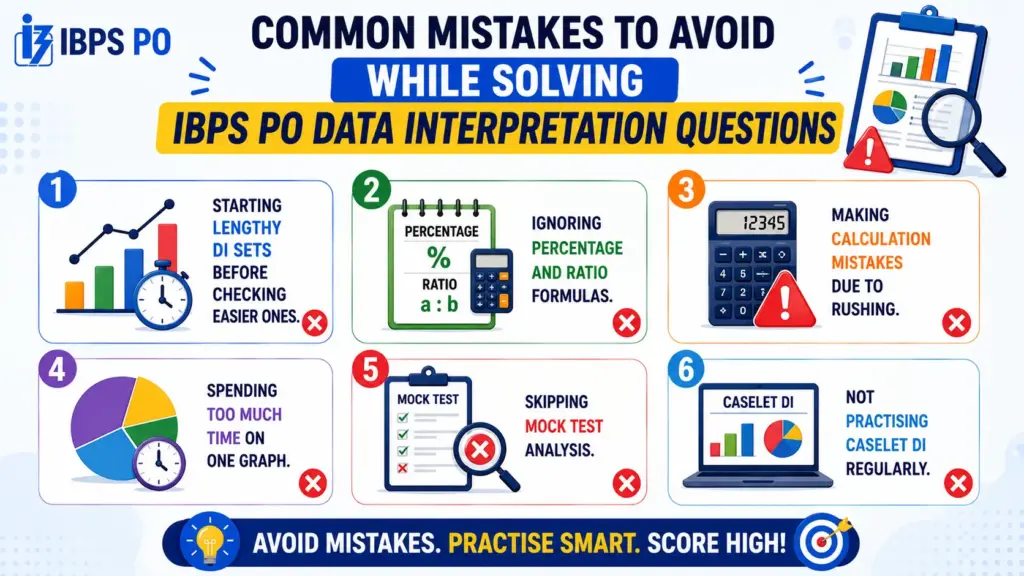
Common Mistakes to Avoid While Solving IBPS PO Data Interpretation Questions
Many candidates lose marks because of simple mistakes. Identifying and correcting these errors can significantly improve your score. Keep the following points in mind during your preparation:
Daily Practice Plan for Data Interpretation Questions for IBPS PO
A consistent practice routine helps improve calculation speed and accuracy. Following this routine daily will help you become more confident with Data Interpretation Questions for IBPS PO before the examination.
| Time | Activity |
| 30 Minutes | Revise formulas and calculation shortcuts |
| 45 Minutes | Solve one Table or Pie Chart DI set |
| 45 Minutes | Solve one Caselet or Mixed DI set |
| 30 Minutes | Analyse mistakes and revise solutions |
| 30 Minutes | Attempt a Quantitative Aptitude sectional quiz |
Also Read
| IBPS PO Exam Pattern | IBPS PO Salary |
| IBPS PO Previous Year Question Paper | IBPS PO Cut Off |
| IBPS PO Study Plan | IBPS PO Syllabus PDF |
Final Thoughts
Practising Data Interpretation Questions for IBPS PO regularly can significantly improve your Quantitative Aptitude score. Start with basic Table and Pie Chart DI sets, then gradually move to Caselet and Mixed DI questions. Focus on improving your calculation speed, accuracy, and time management instead of attempting every question. Most importantly, analyse your mistakes after every mock test and revise the concepts regularly. With smart strategy, and regular sectional tests, you can solve DI questions confidently and boost your chances of clearing the IBPS PO 2026 examination.
FAQs
Q1. How many Data Interpretation Questions are asked in the IBPS PO exam?
Ans: In the IBPS PO Preliminary exam, candidates can generally expect 5–10 Data Interpretation questions. In the Main examination, the number may increase to 15–20 questions, depending on the paper pattern.
Q2. Which types of Data Interpretation are most important for IBPS PO?
Ans: Candidates should regularly practise different types of Data Interpretation sets, including Table DI, Pie Chart DI, Bar Graph DI, Line Graph DI, Caselet DI, and Mixed Data Interpretation. These are the most frequently asked DI formats in recent IBPS PO examinations and help improve calculation speed, data analysis, and question-solving accuracy.
Q3. How can I improve my speed in Data Interpretation Questions for IBPS PO?
Ans: Improve your calculation speed by revising percentages, ratios, averages, squares, cubes, and multiplication shortcuts daily. Also, practise one or two DI sets every day with a timer and analyse your mistakes after each practice session.
Q4. How much time should I spend on one DI set in the IBPS PO Prelims exam?
Ans: Try to solve an easy DI set within 3–4 minutes and a moderate set within 5–6 minutes. If a set looks lengthy or calculation-intensive, skip it initially and return later if time permits.
Q5. Are Caselet Data Interpretation questions important for IBPS PO?
Ans: Yes. Caselet DI has become increasingly common in recent IBPS PO exams. Since the information is presented in paragraph form instead of tables or graphs, candidates should practise these questions regularly to improve comprehension and calculation speed.
Q6. Is mock test analysis important for Data Interpretation preparation?
Ans: Absolutely. Mock test analysis helps you identify calculation mistakes, improve question selection, understand weak areas, and develop better time management. Analysing every mock is one of the best ways to improve your DI score.
Q7. Can beginners score well in IBPS PO Data Interpretation Questions?
Ans: Yes. Beginners can score well by first mastering basic concepts like percentages, averages, and ratios. After that, they should start with simple Table and Pie Chart DI before moving to Caselet and Mixed DI sets.
Q8. Where can I practise free Data Interpretation Questions for IBPS PO?
Ans: You can practise free Data Interpretation Questions for IBPS PO through PracticeMock’s full-length mock tests, sectional tests, topic-wise quizzes, and downloadable PDFs. Regular practice on exam-level questions helps improve speed, accuracy, and confidence before the examination.
- Sign Up on Practicemock for Updated Current Affairs, Topic Tests and Mini Mocks
- Sign Up Here to Download Free Study Material
Free Mock Tests for the Upcoming Exams
- IBPS PO Free Mock Test
- RBI Grade B Free Mock Test
- IBPS SO Free Mock Test
- NABARD Grade A Free Mock Test
- SSC CGL Free Mock Test
- IBPS Clerk Free Mock Test
- IBPS RRB PO Free Mock Test
- IBPS RRB Clerk Free Mock Test
- RRB NTPC Free Mock Test
- SSC MTS Free Mock Test
- SSC Stenographer Free Mock Test
- GATE Mechanical Free Mock Test
- GATE Civil Free Mock Test
- RRB ALP Free Mock Test
- SSC CPO Free Mock Test
- AFCAT Free Mock Test
- SEBI Grade A Free Mock Test
- IFSCA Grade A Free Mock Test
- RRB JE Free Mock Test
- Free Banking Live Test
- Free SSC Live Test