


To crack SBI Clerk Mains with a realistic target of 100+ marks, candidates need to build their scores around their strongest subjects, maintain realistic expectations from General/Financial Awareness and practise all four sections under their fixed sectional timings. The Clerk Mains examination carries 200 marks across 190 questions and lasts 160 minutes, making sustained concentration as important as subject knowledge. A practical SBI Clerk Mains Preparation Strategy is to target approximately 60–65 marks from Quantitative Aptitude and Reasoning combined and around 40 marks from English and General/Financial Awareness. Candidates should refine this distribution through full-length and sectional mock tests according to their actual performance.
Current SBI Clerk Mains Exam 2026 Update: SBI has tentatively scheduled the Junior Associates Mains examination for 26 and 27 November 2026. The SBI Clerk Mains admit card download facility is available on the official Careers portal. Candidates should follow the examination date, shift and reporting time mentioned on their individual call letters.
Key Takeaways on How to Crack SBI Clerk Mains
- Cracking SBI Clerk Mains requires clearing the overall state-wise merit with a target of 100+ marks out of 200, as there is no sectional cut-off and no interview.
- Divide the 200-mark paper into two strategic halves: aim for 60 to 65+ marks from Quant and Reasoning (110 marks combined) and 35 to 40+ marks from GA and English (90 marks combined).
- Keep GA expectations realistic due to unpredictability, and anchor your score on at least two strong core subjects among Quant, Reasoning, and English.
- Follow the SBI Clerk Mains Preparation Strategy subject-wise provided in this blog to boost your preparation level.
- In Quantitative Aptitude, prioritise high-yield Arithmetic chapters and fundamental Clerical Mains DI (Caselets, Double Pie Charts, Variable Tables, and Arithmetic DI) instead of wasting time on exotic chart types.
- Use the Green, Grey, and Red Area method inside every section to bank quick one-liners first, solve doable Arithmetic and DI next, and skip time-consuming traps immediately.
- Train specifically for 2 hours and 40 minutes (160 minutes) of uninterrupted focus through full-length Mains mock tests and detailed error analysis.
SBI Clerk Mains Exam Pattern and Selection Rules
The SBI Clerk (Junior Associate) Mains examination consists of 190 objective multiple-choice questions carrying 200 marks, conducted online over 2 hours and 40 minutes (160 minutes) with fixed sectional timers. Understanding the official SBI Clerk Mains exam pattern helps you allocate energy properly across each locked time slot.

| Section | Number of Questions | Maximum Marks | Sectional Time Limit |
| General / Financial Awareness | 50 | 50 | 35 Minutes |
| General English | 40 | 40 | 35 Minutes |
| Quantitative Aptitude | 50 | 50 | 45 Minutes |
| Reasoning Ability and Computer Aptitude | 50 | 60 | 45 Minutes |
| Total | 190 | 200 | 2 Hours 40 Minutes (160 Minutes) |
Key rules that shape your SBI Clerk Mains exam preparation:

- No Sectional Cut-Off: SBI Clerk Mains does not enforce individual subject qualifying marks. Only your overall aggregate score out of 200 matters for state-wise merit.
- Locked Sectional Timers: Each section has an independent timer. You cannot save unused minutes from General Awareness or English to spend on Quantitative Aptitude or Reasoning.
- Negative Marking: One-fourth (0.25) of the marks assigned to a question is deducted for every incorrect answer. Unanswered questions carry zero penalty.
- Direct Final Selection: Prelims marks are qualifying only. Your Mains score determines final merit, followed by Document Verification and the Local Language Test (if applicable).
How to Crack SBI Clerk Mains: The 100+ Marks Score Blueprint
Based on SBI Clerk Mains cut off trends from the last three to four years across competitive states, setting a benchmark of 100+ marks out of 200 places you safely above the selection threshold. Rather than forcing an unrealistic target in every subject, divide the 200-mark paper into two strategic halves so a tough section never derails your overall score.
| Paper Division | Subjects Covered | Maximum Marks | Realistic Target Range | Strategic Purpose |
| Part 1: Skill-Based Core | Quantitative Aptitude (50) + Reasoning Ability (60) | 110 Marks | 60 to 65+ Marks | Concept-driven sections where structured practice produces predictable scores |
| Part 2: Awareness & Language | General Awareness (50) + General English (40) | 90 Marks | 35 to 40+ Marks | Balances GA unpredictability with steady accuracy in General English |
| Combined Total | All Four Sections | 200 Marks | 100 to 105+ Marks | Secures a safe selection margin without over-relying on any single section |
Why You Should Keep General Awareness Expectations Realistic for SBI Clerk Mains Exam
General and Financial Awareness is consistently the most unpredictable section in the SBI Clerk Mains exam. Even well-prepared aspirants can face unexpected static or offbeat questions on exam day. If you build your 100-mark math assuming you will easily score 35 to 40 marks in GA alone, a tougher-than-expected GA paper can shake your confidence during the remaining sections.
Continue revising GA seriously, but keep a modest, realistic buffer for it in your target sheet. Anchor your score on at least two strong skill-based subjects among Quantitative Aptitude, Reasoning Ability, and General English. Because there is no sectional cut-off, scoring well in two or three core sections easily compensates for a difficult GA slot.
SBI Clerk Mains Preparation Strategy: Subject-Wise Plan
An effective SBI Clerk Mains Preparation Strategy focuses on high-return chapters, Mains-level question selection, and cutting out low-value study habits. Follow the section-wise plan below for all four subjects.
1. Quantitative Aptitude Strategy (50 Questions, 50 Marks, 45 Minutes)
In SBI Clerk Mains, not every Quantitative Aptitude question is meant to be solved. Typically, roughly 20 to 22 marks are calculation-heavy or tricky, while around 28 marks remain completely doable for candidates who pick questions wisely.
Quantitative Aptitude 50-Mark Blueprint
| Topic Category | Expected Marks | Typical Mains Question Patterns |
| Number Series and Quadratic Equations | 10 to 15 Marks | Missing or wrong number series (sometimes with a simple variable step like finding the square root of a+1); quadratic root comparisons, sum and product of roots, nature of roots, or light linear and cubic equations |
| Arithmetic Word Problems | 15 to 17 Marks | 7 to 9 direct, conceptual arithmetic questions alongside moderate Quantity Comparison or Data Sufficiency problems |
| Data Interpretation (DI) | Around 20 Marks | 1 to 2 Caselets, 1 Double Pie Chart or Variable-Based Table DI, and 1 to 2 Arithmetic-Based DI sets (Profit & Loss, Time & Work, Mixture & Alligation) |
Three Important Quant Preparation Lessons
- Do Not Start Arithmetic Revision From Percentage and Ratio: Many aspirants spend four to five valuable days revising basic chapters like Percentage and Ratio first. While those topics form your foundation, SBI Clerk Mains rarely asks direct standalone questions from them. Aim to complete chapter-wise arithmetic revision within 8 to 10 days by starting with high-yield application chapters: Time, Speed and Distance, Boats and Streams, Time and Work, Pipes and Cisterns, Simple and Compound Interest, Profit and Loss, Mixture and Alligation, Partnership, Probability, Permutation and Combination, and Mensuration.
- Stop Spending 1 to 1.5 Hours Daily on One-Liners Early On: If you cleared SBI Clerk Prelims, you already know Number Series and Quadratic Equations. Mains only adds slight calculation steps or minor variable framing. Do not spend an hour every day practising one-liners right now. Save them for 20 to 25-minute quick revision drills during the final week and let your mock tests keep them sharp. Use your primary study blocks for Arithmetic, DI, Puzzles, English, and GA.
- Avoid Chasing Fancy, Over-Complicated DI Charts: When preparing for Mains, many candidates waste hours on exotic funnel charts, multi-layered donut charts, or scatter plots that rarely appear in clerical Mains exams. Focus strictly on fundamental Clerical Mains DI: Double Pie Charts, Variable-Based Tables, Logical Caselets, and Arithmetic-Based DI built on Profit and Loss, Time and Work, and Mixture and Alligation.
2. Reasoning Ability and Computer Aptitude Strategy (50 Questions, 60 Marks, 45 Minutes)
Reasoning Ability carries the highest weightage (60 marks) in the paper, making it the biggest score-driver in your SBI Clerk Mains Preparation Strategy.
- Lock In Non-Puzzle Scoring Topics First: Nearly half the puzzles in Mains are designed as time traps. Scan the section early and bank quick, accurate marks from Coded Inequalities, Reverse and Coded Syllogisms, Coded Blood Relations, Direction Sense, Alphanumeric and Word-Based Series, Data Sufficiency, and Critical Reasoning (Assumptions, Inference, Course of Action).
- Select 2 to 3 Doable Puzzles: Practise 4 to 5 Mains-level puzzles daily covering Floor and Flat, Box-Based, Scheduling (Month, Date, Year), and two-variable Linear or Circular Seating Arrangements. Never spend 10 minutes fighting a 4-variable puzzle when manageable sets sit further down the paper.
- Focus on Logic-Based Computer Aptitude: SBI Clerk Mains rarely tests basic hardware or software definitions. Expect analytical reasoning questions based on Machine Input-Output, Flowcharts, and Binary Coding.
3. General English Strategy (40 Questions, 40 Marks, 35 Minutes)
SBI Clerk Mains General English offers the highest marks-per-minute return in the paper and frequently pushes a borderline score comfortably past 100.
- Reading Comprehension (15 to 18 Marks): Expect two Mains-level passages. Read the questions briefly before reading the passage, attempt direct factual and contextual vocabulary questions first, and skip ambiguous tone or title questions if two options look equally close.
- High-Accuracy Grammar and Structure Topics: Practise Cloze Tests, Para Jumbles, Sentence Rearrangement, Connectors, Phrase Replacement, Error Detection, Double Fillers, and Word Usage regularly.
- Daily Reading Habit: Spend 20 to 30 minutes reading editorials and financial news articles daily to build reading speed and focus for lengthy passages.
4. General and Financial Awareness Strategy (50 Questions, 50 Marks, 35 Minutes)
A structured 5 to 6-month revision plan for SBI Clerk Mains exam turns General Awareness into a steady scoring cushion without draining the mental energy needed for Quant and Reasoning.
- Time Window to Cover: Thoroughly revise the last 5 to 6 months of current affairs, giving maximum revision priority to the most recent 3 to 4 months before the exam date.
- High-Priority Themes: Focus on RBI circulars and Monetary Policy updates, Banking and Financial Awareness, Government Schemes, Union Budget and Economic Survey highlights, Reports and Indices, Appointments, MoUs, and Major Awards or Sports.
- Test Yourself Daily: Passive reading creates a false sense of familiarity. Revise monthly current affairs capsules multiple times and solve 50 to 100 GA MCQs daily to lock in exact facts and avoid 0.25 negative marking penalties.
SBI Clerk Mains Exam-Hall Attempt Strategy: Green, Grey, and Red Areas
Knowing the SBI Clerk Mains syllabus only turns into 100+ marks when paired with disciplined question selection inside each 45-minute timer. Divide every Quant and Reasoning section mentally into three priority zones as you move through the paper:
| Question Zone | What Belongs in This Zone? | Exam-Hall Action |
| Green Area (Must-Do First) | Direct One-Liners (Number Series, Quadratic Equations), Coded Inequality, Syllogism, Direction Sense, Direct Vocabulary and Fillers | Solve immediately in Round 1. Even here, happily skip 2 to 3 overly calculative one-liners rather than forcing 100% completion. |
| Grey Area (Second Pass) | Doable Arithmetic word problems, well-linked Caselets, Double Pie Charts, Variable Tables, and manageable 2-variable Puzzles | Attempt cleanly in Round 2. Use Mark for Review for moderate questions that look solvable once Green questions are banked. |
| Red Area (Leave / Last Resort) | Ambiguous 4-variable puzzles, lengthy multi-step arithmetic traps, or convoluted DI sets where variables do not connect quickly | Skip immediately. Revisit these only if spare minutes remain at the end of the sectional timer. |
Attempt Tip: In SBI Clerk Mains Quantitative Aptitude (45 minutes), follow a strict sequence: Green One-Liners first, Doable Arithmetic second, and Cleanest DI sets third. When scanning a DI set, check whether the data points interlink cleanly within 30 to 45 seconds. If the logic clicks, solve all 5 questions; if not, move on to the next set right away.
Is 100+ a Good Score in SBI Clerk Mains?
A score of 100+ out of 200 in the SBI Clerk Mains exam can be used as a competitive preparation target, but it should not be treated as a universal safe cutoff or guaranteed selection score.
The actual cutoff varies according to the state, category, number of vacancies, examination difficulty and overall candidate performance.
Candidates should compare their mock-test scores with the relevant previous-year state-wise and category-wise cutoffs to understand their preparation level.
The most useful approach is to develop a consistent ability to score 100+ in Mains mocks while maintaining accuracy and improving weak subjects.
Common Mistakes to Avoid in SBI Clerk Mains Exam
Candidates can lose valuable marks in the SBI Clerk Mains exam because of avoidable mistakes in their preparation and examination approach.
- Starting revision from basic chapters only: Spending days revising elementary Percentage and Ratio instead of tackling Time & Work, Profit & Loss, SI-CI, and Mains DI.
- Over-practising Prelims-level one-liners: Dedicating hours every day to easy simplification or number series while neglecting Mains-level Caselets, Puzzles, and GA revision.
- Falling for ego traps in Puzzles and DI: Refusing to quit a stubborn puzzle or calculation-heavy table after 4 minutes costs you 6 to 8 easy marks waiting ahead.
- Blind guessing in General Awareness: Guessing 15 uncertain GA questions under 0.25 negative marking wipes out hard-earned marks from Quant and Reasoning.
- Skipping full 160-minute mock sittings: Relying only on short topic quizzes leaves your brain fatigued by the time the final 45-minute section begins.
- Picking up new books in the final days: Switching study sources right before the exam creates confusion; stick to revising your own notes, formulas, and monthly GA capsules.
Last-Minute SBI Clerk Mains Preparation Strategy
During the final days before the SBI Clerk Mains examination, candidates should avoid changing their entire study plan.
The focus should shift towards revision, accuracy, time management and familiarity with the examination environment.
1. Do Not Start Too Many New Topics
Avoid starting multiple unfamiliar chapters at the last moment. Revise the concepts you have already studied and improve the accuracy of familiar question types.
2. Revise Arithmetic and DI
Focus on important arithmetic concepts such as Time and Work, Time and Speed, Profit and Loss, Simple and Compound Interest, Mixture and Alligation and Mensuration.
Practise fundamental DI formats rather than spending several hours on unusually complicated sets.
3. Practise Quick Tests for One-Liners
Number series, quadratic equations and standalone reasoning questions can be revised through short practice tests.
You do not need to dedicate one or two hours every day exclusively to these familiar formats. A few quick quizzes during the final revision phase can help keep them fresh.
4. Revise General Awareness Regularly
Revise monthly current affairs compilations, banking awareness notes, RBI updates, important schemes and financial news.
Avoid collecting too many new sources at the last minute.
5. Take Mocks Judiciously
An SBI Clerk Mains full-length mock can help check your stamina and overall strategy. However, repeatedly attempting mock tests without analysis may lead to fatigue.
Attempt a test when it adds meaningful value to your preparation and use its analysis to revise weak areas.
6. Keep the Final Day Light
Before the examination:
- Revise important formulas and short notes.
- Review current affairs and banking awareness.
- Revisit your mock-test error notebook.
- Avoid unfamiliar topics and excessive practice.
- Check your examination call letter.
- Keep the required identity documents ready.
- Get sufficient sleep.
SBI Clerk Mains 2026: Important Exam-Day Instructions
Candidates appearing in the SBI Clerk 2026 Mains examination should carefully read the instructions in the official Acquaint Yourself Booklet and their individual call letters.
Important instructions include:
- Reach the examination venue 15 minutes before the reporting time mentioned on your call letter. Latecomers will not be allowed.
- Affix a recent passport-size photograph in the space provided on the Mains call letter.
- Carry the original photo identity proof and a photocopy.
- Carry the Prelims call letter and the photo ID copy authenticated or stamped by examination officials during the Preliminary Examination.
- Bring the Mains call letter with the photograph affixed.
- Carry a ballpoint pen for the required examination formalities.
- Do not carry calculators, mobile phones, smartwatches, Bluetooth devices or prohibited stationery.
- Follow the biometric, photo capture and IRIS scanning instructions at the venue.
- Submit the call letters and required documents according to the examination instructions.
Candidates using a scribe should also follow the separate declaration and supporting-document requirements specified by SBI.
Conclusion
Cracking SBI Clerk Mains comes down to executing a disciplined 100+ marks game plan across 160 uninterrupted minutes rather than trying to attempt every tough question on the screen. Build reliable scores in Quantitative Aptitude, Reasoning Ability, and General English while keeping General Awareness steady through regular MCQ revision. Apply the Green, Grey, and Red area attempt method, revise high-yield Arithmetic and fundamental Mains DI without getting distracted by overly fancy charts, and analyse every mistake after your tests. To build 160-minute exam-hall stamina and benchmark your accuracy against real competition, attempt full-length SBI Clerk Mains Mock Tests and sectional quizzes on PracticeMock.
Related SBI Clerk Blogs
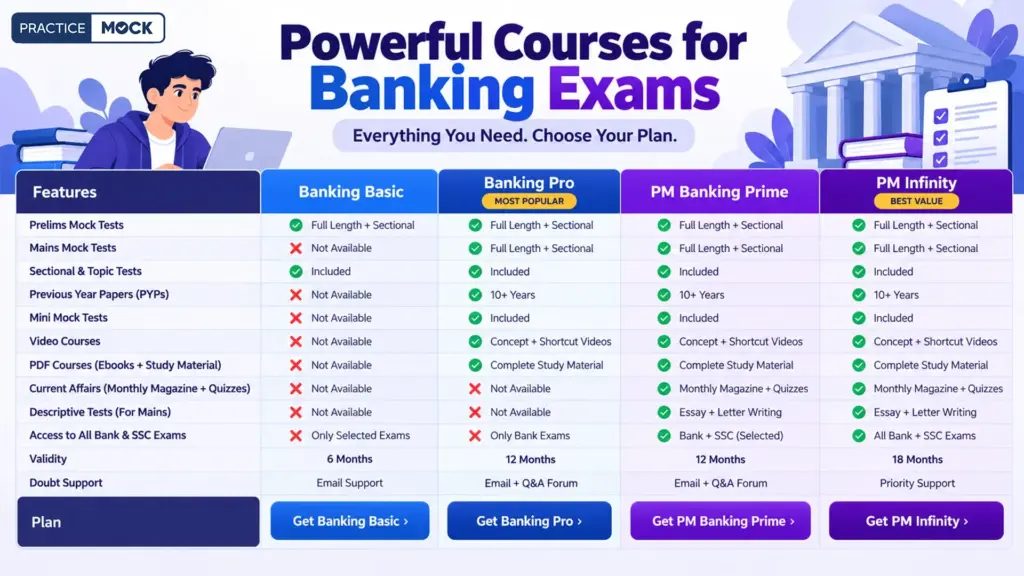
Powerful Courses for Banking Exams
FAQs on How to Crack SBI Clerk Mains
1. How to score 100+ marks in SBI Clerk Mains?
To score 100+ marks in SBI Clerk Mains, split the 200-mark paper into two targets: extract 60 to 65+ marks from Quantitative Aptitude and Reasoning Ability (110 marks combined) and 35 to 40+ marks from General Awareness and General English (90 marks combined). Maintain 85% to 90% accuracy and skip lengthy puzzle or DI traps early.
2. Is there any sectional cut-off in SBI Clerk Mains?
No, SBI Clerk Mains has no sectional cut-off. Candidates only need to clear the overall state-wise and category-wise aggregate cut-off out of 200 marks. However, each of the four sections has a locked sectional timer, so you must maximize your score within each allotted time window.
3. What is the best SBI Clerk Mains Preparation Strategy for Quantitative Aptitude?
Focus on the three core scoring areas of the SBI Clerk Mains 50-mark Quant section: 10 to 15 marks from Number Series and Quadratic Equations, 15 to 17 marks from Arithmetic word problems, and around 20 marks from fundamental DI (Caselets, Double Pie Charts, Variable Tables, and Arithmetic DI). Revise high-yield Arithmetic chapters first rather than lingering on basics.
4. Is it easy to crack SBI Clerk Mains?
SBI Clerk Mains is competitive because roughly 10% of Mains candidates make the final selection list, and the 160-minute paper tests mental stamina. However, it is very achievable with a focused SBI Clerk Mains Preparation Strategy built around smart question selection, 5 to 6 months of GA revision, fundamental Mains DI, and consistent mock analysis.
5. What is considered a good score in SBI Clerk Mains?
SBI Clerk Mains Cut-offs vary by state, vacancy count, and shift difficulty, often ranging between 80 and 95 marks out of 200 for the General category in high-competition states. Targeting 100+ marks with high accuracy provides a safe buffer for final selection across most states.
6. Is there an interview after SBI Clerk Mains?
No, there is no interview stage in the SBI Clerk (Junior Associate) recruitment process. Final selection is based solely on your aggregate marks in the 200-mark Mains examination, subject to Document Verification and qualifying the Local Language Test (where applicable).
- Sign Up on Practicemock for Updated Current Affairs, Topic Tests and Mini Mocks
- Sign Up Here to Download Free Study Material
Free Mock Tests for the Upcoming Exams
- IBPS PO Free Mock Test
- RBI Grade B Free Mock Test
- IBPS SO Free Mock Test
- NABARD Grade A Free Mock Test
- SSC CGL Free Mock Test
- IBPS Clerk Free Mock Test
- IBPS RRB PO Free Mock Test
- IBPS RRB Clerk Free Mock Test
- RRB NTPC Free Mock Test
- SSC MTS Free Mock Test
- SSC Stenographer Free Mock Test
- GATE Mechanical Free Mock Test
- GATE Civil Free Mock Test
- RRB ALP Free Mock Test
- SSC CPO Free Mock Test
- AFCAT Free Mock Test
- SEBI Grade A Free Mock Test
- IFSCA Grade A Free Mock Test
- RRB JE Free Mock Test
- Free Banking Live Test
- Free SSC Live Test