


JK Bank Clerk Syllabus 2026 covers three subjects: English Language, Quantitative Aptitude and Reasoning Ability. Jammu & Kashmir Bank conducts the Banking Associate recruitment examination through the Institute of Banking Personnel Selection (IBPS). The online examination consists of 100 questions carrying 100 marks, with a total duration of 60 minutes. Each subject has a separate time limit of 20 minutes. Candidates must qualify in all three sections and secure the prescribed aggregate marks to be considered for selection. The official notification provides the subject-wise JK Bank Clerk Exam Pattern 2026 but does not specify individual chapters. Therefore, candidates can follow the indicative topic-wise syllabus explained below to organise their preparation.
Key Takeaways on JK Bank Clerk Syllabus and Exam Pattern 2026
- The JK Bank Clerk Syllabus 2026 comprises three subjects: English Language, Quantitative Aptitude, and Reasoning Ability.
- The online examination is conducted by IBPS for 100 questions and 100 maximum marks.
- The total duration of the exam is 60 minutes, with a separate 20-minute sectional time limit for each subject.
- English Language has 30 questions for 30 marks, Quantitative Aptitude has 35 questions for 30 marks, and Reasoning Ability has 35 questions for 40 marks.
- All three sections of the online test are conducted strictly in English.
- A negative marking of one-fourth (0.25) of the marks assigned to the question applies to every wrong answer.
- The minimum aggregate qualifying marks for the JK Bank Clerk exam are 40% for General category candidates and 35% for Reserved category candidates, subject to sectional cut-offs and overall merit.
JK Bank Clerk Exam Pattern 2026
The JK Bank Clerk Exam Pattern 2026 consists of a single online objective examination with three sections: English Language, Quantitative Aptitude and Reasoning Ability. The examination carries 100 marks and has a total duration of 60 minutes, with 20 minutes allotted separately to each section.
Jammu & Kashmir Bank has prescribed the examination structure in its JK Bank Clerk notification 2026. IBPS is responsible for conducting the online examination. Candidates should understand the section-wise question distribution, marks and time limits before beginning their preparation.
JK Bank Clerk Online Exam Pattern 2026
The JK Bank Clerk online examination contains 100 objective-type questions for 100 marks. English Language has 30 questions for 30 marks, Quantitative Aptitude has 35 questions for 30 marks, and Reasoning Ability has 35 questions for 40 marks.
The detailed JK Bank Clerk Exam Pattern 2026 is given below.
| Name of Test | Number of Questions | Maximum Marks | Time Allotted |
| English Language | 30 | 30 | 20 Minutes |
| Quantitative Aptitude | 35 | 30 | 20 Minutes |
| Reasoning Ability | 35 | 40 | 20 Minutes |
| Total | 100 | 100 | 60 Minutes |
Important Features of the JK Bank Clerk Exam Pattern 2026
- The JK Bank Clerk examination is conducted online by IBPS.
- The question paper contains 100 objective-type questions.
- The maximum marks for the examination are 100.
- English Language, Quantitative Aptitude and Reasoning Ability are the three prescribed sections.
- Each section has a separate time limit of 20 minutes.
- All three tests are conducted in English.
- Candidates must qualify in each section by obtaining the cut-off marks decided by IBPS in consultation with J&K Bank.
- The examination also has an overall qualifying requirement based on the candidate’s category.
Important: JK Bank Clerk Quantitative Aptitude and Reasoning Ability both contain 35 questions, but their maximum marks are different. Quantitative Aptitude carries 30 marks, whereas Reasoning Ability carries 40 marks. Therefore, candidates should consider both question distribution and maximum marks while planning their preparation.
JK Bank Clerk Negative Marking 2026
There is negative marking in the JK Bank Clerk online examination. For every incorrect answer, one-fourth of the marks assigned to that question will be deducted from the corrected score. No marks are deducted for questions left unanswered.
The penalty is applied while calculating the candidate’s corrected score. Candidates should therefore focus on accuracy instead of attempting every question without proper calculation.
JK Bank Clerk Marking Scheme 2026
| Response Type | Marking Rule |
| Correct Answer | Marks assigned to the question are awarded |
| Incorrect Answer | One-fourth of the marks assigned to that question are deducted |
| Unanswered Question | No negative marking |
For example, if a question carries 1 mark, an incorrect answer attracts a deduction of 0.25 marks. If a question carries a different mark value, the penalty is calculated as one-fourth of the marks assigned to that question.
Preparation Tip: Avoid random guessing, particularly in Quantitative Aptitude and Reasoning Ability. Read the question carefully, eliminate incorrect options and attempt questions where you can reach a reasonably accurate answer.
JK Bank Clerk Syllabus 2026
The JK Bank Clerk Syllabus 2026 prescribed for the Banking Associate online examination includes English Language, Quantitative Aptitude and Reasoning Ability. The official recruitment notification confirms these three subjects along with their respective question distribution, marks and time limits.
The official notification does not provide a detailed chapter-wise syllabus. The following subject-wise topics are an indicative preparation guide based on commonly covered topics in banking examinations. Candidates can use this list to organise their studies and practise relevant questions for each section.
1. JK Bank Clerk English Language Syllabus 2026
The JK Bank Clerk English Language section evaluates candidates’ grammar, vocabulary, reading comprehension and sentence formation skills. It contains 30 questions carrying 30 marks, with a separate time limit of 20 minutes.
Candidates should practise reading-based questions, grammatical corrections, vocabulary and sentence rearrangement to improve their performance.
The indicative JK Bank Clerk English Language syllabus includes:
| Important Topics | What to Prepare |
| Reading Comprehension | Main idea, theme, inference, factual questions and vocabulary-based questions from passages |
| Cloze Test | Selecting suitable words to complete a passage while maintaining grammatical and contextual accuracy |
| Error Detection | Identifying grammatical errors involving tenses, subject-verb agreement, articles and prepositions |
| Sentence Correction | Correcting grammatical and structural mistakes in sentences |
| Fill in the Blanks | Single fillers, double fillers and context-based word selection |
| Para Jumbles | Arranging scattered sentences in a logically connected paragraph |
| Phrase Replacement | Replacing incorrect or unsuitable phrases with grammatically appropriate expressions |
| Vocabulary | Synonyms, antonyms, idioms, phrases and word meanings |
| Word Usage | Understanding the correct use of words according to their meaning and context |
| Sentence Rearrangement | Organising words or sentence parts into meaningful structures |
| Spelling Errors | Identifying incorrectly spelt words |
| Grammar | Tenses, articles, prepositions, pronouns, conjunctions and subject-verb agreement |
| Active and Passive Voice | Identifying and transforming sentences between active and passive constructions |
| Direct and Indirect Speech | Understanding changes in tense, pronouns and sentence structure during narration |
Important Areas to Focus On
- Reading Comprehension requires regular reading practice and the ability to identify the main idea of a passage.
- Cloze Tests and Fill in the Blanks improve vocabulary and contextual understanding.
- Error Detection and Sentence Correction require a strong understanding of basic English grammar.
- Para Jumbles and Sentence Rearrangement test logical understanding and sentence connections.
- Vocabulary questions require consistent practice with synonyms, antonyms, idioms and word usage.
Candidates should practise different types of English questions instead of relying only on vocabulary exercises. Regular sectional practice within 20 minutes can improve both speed and accuracy.
2. JK Bank Clerk Quantitative Aptitude Syllabus 2026
The JK Bank Clerk Quantitative Aptitude section tests numerical ability, mathematical calculations and problem-solving skills. It contains 35 questions carrying 30 marks, with a separate time limit of 20 minutes.
Candidates should develop calculation speed, understand arithmetic concepts and practise different forms of Data Interpretation.
The indicative JK Bank Clerk Quantitative Aptitude syllabus includes:
| Important Topics | What to Prepare |
| Simplification | BODMAS, fractions, decimals, percentages and basic mathematical calculations |
| Approximation | Estimating numerical values and solving calculation-based questions quickly |
| Number Series | Missing number series and wrong number identification |
| Quadratic Equations | Solving quadratic equations and comparing the values of variables |
| Percentage | Percentage increase, decrease and application-based questions |
| Ratio and Proportion | Direct and inverse proportion, comparison of quantities and related problems |
| Average | Simple average, combined average and problems involving different quantities |
| Profit and Loss | Cost price, selling price, profit percentage and loss percentage |
| Discount | Marked price, selling price and successive discounts |
| Simple Interest | Principal, rate, time and simple interest calculations |
| Compound Interest | Annual, half-yearly and other standard compound interest calculations |
| Time and Work | Efficiency, individual work, combined work and work completion problems |
| Pipes and Cisterns | Inlet pipes, outlet pipes and tank-filling problems |
| Time, Speed and Distance | Speed calculations, relative speed and distance-based questions |
| Boats and Streams | Upstream speed, downstream speed and speed of the stream |
| Mixture and Alligation | Mixing quantities of different prices or concentrations |
| Partnership | Investment ratios, capital duration and profit distribution |
| Problems on Ages | Present ages, past ages, future ages and age relationships |
| Data Interpretation | Tables, bar graphs, line graphs, pie charts and caselet-based calculations |
| Probability | Basic probability and outcome-based numerical questions |
| Permutation and Combination | Arrangements and selections of different objects |
| Mensuration | Area, perimeter and volume of standard geometric figures |
| Data Sufficiency | Determining whether the given information is sufficient to answer a mathematical question |
Important Areas to Focus On
- Simplification and Approximation help improve calculation speed.
- Data Interpretation requires accurate calculations and the ability to analyse numerical information presented in tables and graphs.
- Percentage, Ratio, Average, Profit and Loss and Interest form an important foundation for arithmetic questions.
- Time and Work, Pipes and Cisterns and Time, Speed and Distance require a clear understanding of formulas and their application.
- Number Series and Quadratic Equations provide practice in identifying numerical patterns and solving equations.
Preparation Tip: Learn the basic formulas before attempting advanced arithmetic questions. Practise calculation shortcuts, fractions, percentage conversions and multiplication tables regularly to reduce the time required for numerical calculations.
3. JK Bank Clerk Reasoning Ability Syllabus 2026
The JK Bank Clerk Reasoning Ability section evaluates logical thinking, analytical ability and problem-solving skills. It contains 35 questions carrying 40 marks, with a separate time limit of 20 minutes.
Candidates should practise puzzles, seating arrangements, syllogism, inequalities and other logical reasoning topics to improve their performance.
The indicative JK Bank Clerk Reasoning Ability syllabus includes:
| Important Topics | What to Prepare |
| Seating Arrangement | Linear, circular, square and rectangular seating arrangements |
| Puzzles | Floor-based, box-based, month-based, day-based and scheduling puzzles |
| Syllogism | Statements, conclusions and Venn diagram-based questions |
| Inequality | Direct and coded inequality questions |
| Coding and Decoding | Letter shifting, coding patterns, number coding and symbol-based questions |
| Blood Relations | Family relationships, coded relations and family-tree questions |
| Direction and Distance | Direction-based movements, distance calculations and position-based problems |
| Order and Ranking | Position, ranking, comparison and arrangement-based questions |
| Alphanumeric Series | Mixed sequences containing letters, numbers and symbols |
| Alphabet Series | Alphabetical patterns, positions and sequence-based questions |
| Number Series | Identifying numerical relationships and missing values in logical sequences |
| Pair Formation | Identifying related pairs of letters, numbers or words |
| Input-Output | Identifying patterns through different stages of rearrangement |
| Data Sufficiency | Determining whether the given information is sufficient to answer a logical question |
| Logical Reasoning | Analysing statements, arguments, conclusions and assumptions |
| Statement and Conclusion | Evaluating whether a conclusion logically follows from the given statements |
| Statement and Assumption | Identifying assumptions underlying a particular statement |
| Cause and Effect | Understanding the relationship between events and their possible causes or outcomes |
Important Areas to Focus On
- Puzzles and Seating Arrangements require practice in organising information and analysing multiple conditions.
- Syllogism and Inequality questions test the ability to draw logical conclusions from given statements.
- Coding-Decoding and Alphanumeric Series improve pattern recognition and analytical speed.
- Blood Relations and Direction and Distance require careful interpretation of relationships and movements.
- Input-Output and Data Sufficiency questions test the ability to identify patterns and evaluate available information.
Preparation Tip: Start with basic topics such as Inequality, Syllogism, Blood Relations and Direction Sense. Once you understand the concepts, gradually move towards floor-based puzzles, box puzzles and complex seating arrangements.
Important Topics for JK Bank Clerk Exam 2026
Candidates should cover all three subjects mentioned in the JK Bank Clerk Syllabus 2026 while giving additional practice to topics that require regular calculations, logical analysis and reading comprehension.
The following table provides a useful starting point for prioritising preparation.
| Subject | Important Topics to Prepare First |
| English Language | Reading Comprehension, Cloze Test, Error Detection, Fill in the Blanks and Para Jumbles |
| Quantitative Aptitude | Simplification, Approximation, Number Series, Data Interpretation, Percentage, Ratio and Profit and Loss |
| Reasoning Ability | Puzzles, Seating Arrangements, Syllogism, Inequality, Coding-Decoding and Blood Relations |
This is a suggested preparation priority, not an official JK Bank Clerk topic-wise question distribution. The notification does not assign a fixed number of questions to individual chapters.
Candidates should also remember that Reasoning Ability carries 40 marks, whereas Quantitative Aptitude carries 30 marks. Therefore, preparation should be based on the complete examination structure rather than only the number of questions.
JK Bank Clerk Qualifying Marks 2026
Candidates appearing for the JK Bank Clerk examination must secure the minimum qualifying marks in individual sections as well as the overall examination. The sectional cut-off marks are decided by IBPS in consultation with Jammu & Kashmir Bank.
The official JK Bank Clerk notification 2026 specifies the following minimum aggregate qualifying marks for General and reserved category candidates.
| Category | Minimum Aggregate Qualifying Marks |
| General | 40% |
| Reserved Categories | 35% |
For the 100-mark examination, these percentages correspond to 40 marks for General category candidates and 35 marks for reserved category candidates.
However, these are minimum aggregate qualifying requirements, not guaranteed final selection marks. Candidates must also clear the individual sectional cut-offs. The actual JK Bank Clerk cut-offs for shortlisting depend on the available vacancies, candidate performance and applicable reservation rules.
Important Points About JK Bank Clerk Qualifying Marks
- Candidates must qualify in all three sections.
- The individual sectional cut-offs are decided by IBPS in consultation with J&K Bank.
- The overall minimum qualifying marks are 40% for General category candidates.
- Reserved category candidates have a minimum aggregate qualifying requirement of 35%.
- Final shortlisting and provisional selection are subject to overall merit, applicable reservation rules and fulfilment of other selection requirements.
How Is the JK Bank Clerk Online Exam Score Calculated?
The JK Bank Clerk online examination score is calculated after applying the prescribed penalty for incorrect answers. If the examination is conducted in different sessions, the corrected scores may be equated to account for minor differences in difficulty levels.
The notification specifies the following procedure for arriving at the examination scores:
- Corrected Score: The number of correctly answered questions is considered after applying the penalty for incorrect answers.
- Equated Score: Corrected scores may be made equivalent to account for minor differences in the difficulty level of different examination sessions.
- Final Score Reporting: Test-wise scores and the total score are reported up to two decimal places.
The bank uses these scores for applying individual and overall cut-offs, preparing merit and considering candidates for provisional selection.
How to Prepare for JK Bank Clerk Syllabus 2026?
Candidates preparing for the JK Bank Clerk Syllabus 2026 should follow a balanced study plan covering English Language, Quantitative Aptitude and Reasoning Ability. Since each section has a separate 20-minute time limit, preparation should focus on concept clarity, speed, accuracy and sectional time management.
The following preparation strategies can help candidates organise their studies.
1. Understand the JK Bank Clerk Exam Pattern
Start by understanding the complete JK Bank Clerk Syllabus and exam structure. Check the number of questions, maximum marks and sectional time limits for all three subjects.
Pay attention to the difference between the number of questions and maximum marks in Quantitative Aptitude and Reasoning Ability. This will help you plan your preparation according to the actual examination structure.
2. Prepare a Subject-Wise Study Plan for JK Bank Clerk Examination
Divide your JK Bank Clerk exam preparation into three sections and allocate sufficient time to each subject.
- English Language: Focus on grammar, vocabulary, reading comprehension, cloze tests and sentence rearrangement.
- Quantitative Aptitude: Cover arithmetic, Data Interpretation, number series, simplification and approximation.
- Reasoning Ability: Practise puzzles, seating arrangements, syllogism, inequality, coding-decoding and other logical reasoning topics.
Do not completely ignore any section because candidates must qualify in all three individual tests.
3. Practise Questions Within 20 Minutes
Each section of JK Bank Clerk exam has a separate time limit of 20 minutes. Therefore, candidates should regularly practise sectional tests within the prescribed time.
Start with topic-wise practice to improve conceptual understanding. Gradually attempt complete sectional tests to develop the ability to solve questions within the actual examination duration.
4. Focus on Accuracy Along With Speed
The JK Bank Clerk examination has negative marking of one-fourth of the marks assigned to an incorrect question. Therefore, attempting more questions without checking their accuracy can reduce the final score.
Practise identifying questions that you can solve confidently. Avoid spending too much time on a single difficult question when other manageable questions are available.
5. Practise JK Bank Clerk Full-Length Mock Tests
JK Bank Clerk Full-length mock tests help candidates understand the complete examination structure and practise all three subjects within 60 minutes.
Attempt mock tests regularly and follow the prescribed sectional time limits. This will help you become comfortable with the actual online examination format.
6. Analyse Your Mock Test Performance
Taking JK Bank Clerk mock tests alone is not enough. Candidates should analyse their performance after every test to understand their mistakes and identify areas that require improvement.
Maintain a record of:
- Questions answered incorrectly.
- Questions left unanswered due to time limitations.
- Topics that require additional practice.
- Calculation mistakes in Quantitative Aptitude.
- Logical errors in Reasoning Ability.
- Grammar and vocabulary mistakes in English Language.
Use this analysis to modify your study plan and improve your performance in subsequent tests.
7. Revise Important Concepts Regularly
Revision is necessary to retain formulas, grammatical rules, vocabulary and logical concepts. Candidates should maintain short notes for important formulas, mathematical shortcuts, grammar rules and commonly confusing reasoning concepts.
Regular revision also helps reduce calculation time and improves accuracy during timed practice.
Conclusion
JK Bank Clerk Syllabus 2026 covers three important subjects: English Language, Quantitative Aptitude and Reasoning Ability. Candidates must understand the complete JK Bank Clerk Exam Pattern 2026, including the 100 questions, 100 marks, 60-minute examination duration and separate 20-minute sectional timings. Since the official notification does not provide a detailed chapter-wise syllabus, candidates should cover the indicative topics mentioned above and practise questions from all three subjects. Regular revision, sectional tests, accuracy and proper time management can help candidates improve their examination performance. Aspirants can also use PracticeMock mock tests and study resources to assess their preparation, identify weak areas and strengthen their performance for the JK Bank Banking Associate examination.
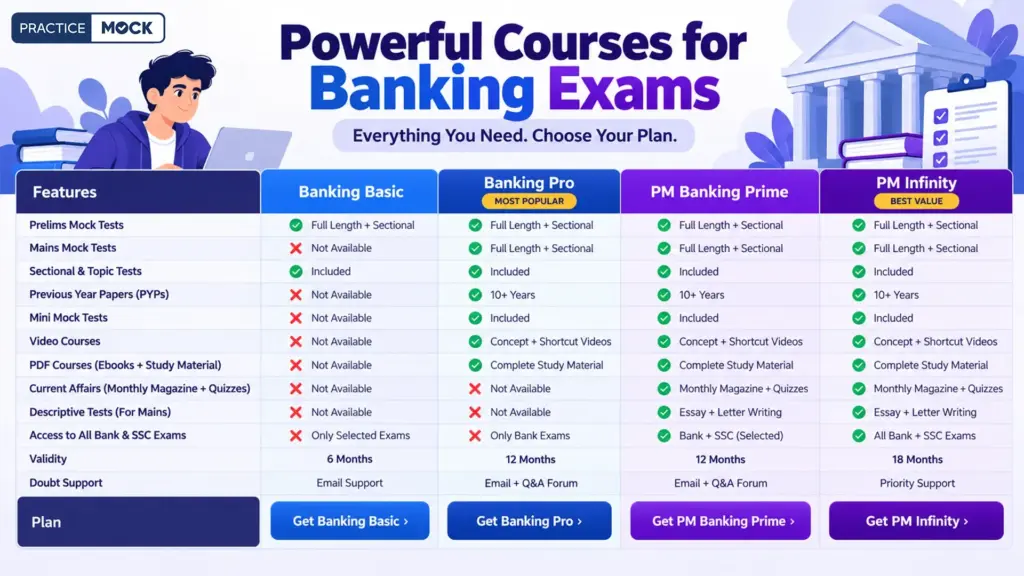
Powerful Courses for Banking Exams:
FAQs on JK Bank Clerk Syllabus 2026
1. How many subjects are included in the JK Bank Clerk Syllabus 2026?
The JK Bank Clerk Syllabus 2026 includes three subjects: English Language, Quantitative Aptitude and Reasoning Ability. The online examination contains 100 questions for 100 marks. Each subject has a separate time limit of 20 minutes, as prescribed in the 2026 Banking Associate recruitment notification.
2. Has Jammu & Kashmir Bank released the detailed topic-wise syllabus for 2026?
No. The official J&K Bank Banking Associate notification specifies the three examination subjects, question distribution, maximum marks and sectional time limits. It does not provide a chapter-wise syllabus. Candidates can use the indicative subject-wise topics commonly covered in banking examinations to organise their preparation.
3. What is the JK Bank Clerk Exam Pattern 2026?
The JK Bank Clerk Exam Pattern 2026 consists of 100 objective questions for 100 marks, with a total duration of 60 minutes. English Language has 30 questions for 30 marks, Quantitative Aptitude has 35 questions for 30 marks and Reasoning Ability has 35 questions for 40 marks.
4. Is there negative marking in the JK Bank Clerk examination?
Yes. The JK Bank Clerk online examination has negative marking for incorrect answers. One-fourth of the marks assigned to a question is deducted for every wrong response. Candidates do not lose marks for unanswered questions. The deduction is applied while calculating the corrected examination score.
5. What is the sectional timing for the JK Bank Clerk Exam 2026?
The JK Bank Clerk examination has a separate time limit of 20 minutes for each of its three sections. Candidates receive 20 minutes for English Language, 20 minutes for Quantitative Aptitude and 20 minutes for Reasoning Ability, making the overall examination duration 60 minutes.
6. What are the minimum qualifying marks for the JK Bank Clerk examination?
The minimum aggregate qualifying marks for JK Bank Clerk exam are 40% for General category candidates and 35% for reserved category candidates. Candidates must also secure the individual sectional cut-offs decided by IBPS in consultation with J&K Bank. These are minimum qualifying requirements, not guaranteed final selection cut-offs.
- Sign Up on Practicemock for Updated Current Affairs, Topic Tests and Mini Mocks
- Sign Up Here to Download Free Study Material
Free Mock Tests for the Upcoming Exams
- IBPS PO Free Mock Test
- RBI Grade B Free Mock Test
- IBPS SO Free Mock Test
- NABARD Grade A Free Mock Test
- SSC CGL Free Mock Test
- IBPS Clerk Free Mock Test
- IBPS RRB PO Free Mock Test
- IBPS RRB Clerk Free Mock Test
- RRB NTPC Free Mock Test
- SSC MTS Free Mock Test
- SSC Stenographer Free Mock Test
- GATE Mechanical Free Mock Test
- GATE Civil Free Mock Test
- RRB ALP Free Mock Test
- SSC CPO Free Mock Test
- AFCAT Free Mock Test
- SEBI Grade A Free Mock Test
- IFSCA Grade A Free Mock Test
- RRB JE Free Mock Test
- Free Banking Live Test
- Free SSC Live Test