


Time and Work Questions for Bank Exams Free PDF: Master time and work concepts with our comprehensive collection of questions and solutions. Elevate your problem-solving skills with our downloadable PDF. Time & Work Questions for bank exams are one of the most scoring topics in the Quantitative Aptitude section. You can improve this topic by practising free quizzes, topic-wise practice sets, mock tests, available on trusted banking exam platforms. These questions test concepts like work efficiency, men-days-hours, alternate days concept, pipes and cisterns, and time calculation. In this blog, you’ll get an exam-level quiz, important formulas, shortcut tricks, and expert preparation tips.
Time & Work Practice Quiz with Answer Key: Bank Exam-Level Questions
Here is a free Time & Work Questions for banking quiz based on the latest banking Prelims exam pattern. These questions cover Work Efficiency, Men-Days-Hours, Alternate Days, Pipes & Cisterns, and Combined Work. Attempt the quiz first and then verify your answers with the detailed explanations given below.

Get more time and work questions for practice with banking Prep Kit.
Bank Exam Prelims: Time & Work Practice Set
Q1. A can complete a piece of work in 12 days, while B can complete the same work in 18 days. They start working together, but A leaves after 4 days. In how many more days will B finish the remaining work?
Explanation: Together, A and B complete 1/12 + 1/18 = 5/36 per day. In 4 days they complete 5/9. Remaining work = 4/9. B alone takes (4/9) ÷ (1/18) = 8 days.
Q2. 12 men can complete a work in 20 days by working 8 hours a day. How many men are required to complete the same work in 12 days by working 10 hours a day?
Explanation: For the same work, Men × Days × Hours is constant. 12×20×8 = M×12×10, so M = 16.
Q3. A is 40% more efficient than B. If B alone can complete a work in 28 days, in how many days can A complete the same work?
Explanation: A's efficiency is 140% of B's. Time is inversely proportional to efficiency, so A's time = 28/1.4 = 20 days.
Q4. A alone completes a work in 15 days, while B alone completes it in 10 days. Working together, in how many days will they complete the work?
Explanation: Combined rate = 1/15 + 1/10 = 1/6. Therefore they complete the work in 6 days.
Q5. 15 workers can complete a project in 24 days by working 8 hours daily. If they work 10 hours daily, how many days will they take to complete the same project?
Explanation: With workers unchanged, Days × Hours is constant. 24×8 = D×10, so D = 19.2 days.
Q6. A can finish a work in 8 days and B can finish the same work in 12 days. They work on alternate days, starting with A. In how many days will the work be completed?
Explanation: In 2 days they complete 1/8 + 1/12 = 5/24. After 8 days, 20/24 = 5/6 is done. On Day 9, A completes 1/8, taking total work done to 23/24. The remaining 1/24 is completed by B on Day 10 in (1/24) ÷ (1/12) = 1/2 day. Total = 9½ days.
Q7. A, B, and C can complete a work individually in 20, 30, and 60 days respectively. If they work together, how many days will they take?
Explanation: Combined rate = 1/20 + 1/30 + 1/60 = 1/10, so time = 10 days.
Q8. Pipe A fills a tank in 12 hours, while Pipe B fills it in 18 hours. If both pipes are opened together, how much time will they take to fill the tank?
Explanation: Combined rate = 1/12 + 1/18 = 5/36 tank per hour. Time = 36/5 = 7.2 hours.
Q9. Pipe A fills a tank in 10 hours, while Pipe B empties it in 15 hours. If both pipes are opened together, how much time will the tank take to fill completely?
Explanation: Net rate = 1/10 − 1/15 = 1/30 tank per hour. Therefore the tank fills in 30 hours.
Q10. Two pipes can fill a tank in 20 hours and 30 hours respectively. A third pipe can empty the tank in 60 hours. If all three are opened together, how much time will they take to fill the tank?
Explanation: Net rate = 1/20 + 1/30 − 1/60 = 1/15 tank per hour. Therefore, time = 15 hours.
Quiz Summary
Time & Work Questions for Bank Exams: Understanding the Exam Trend
In recent banking exams, Time & Work Questions for Bank Exams have become more application-based instead of focusing only on direct formula questions. Candidates are expected to solve real exam-style problems by applying concepts quickly and accurately.

Most questions are based on:
- Work Efficiency & Wages – Understanding the relationship between work rate and time.
- Men-Days-Hours – Solving questions using the M₁ × D₁ × H₁ = M₂ × D₂ × H₂ concept.
- Alternate Days – Calculating total work when workers perform on alternate days.
- Pipes & Cisterns – Questions based on inlet, outlet, and combined efficiency.
Tip: If a Time & Work question takes more than 60 seconds during the banking Prelims exam, skip it and move to the next one. Return to it later if time permits.
Core Conceptual Guide: Time & Work Formulas & Shortcuts
Before attempting Time & Work Questions for bank, revise these important concepts. A strong understanding of these basics will help you solve questions faster and avoid calculation mistakes in the exam.
| Concept | Formula |
| Efficiency | Work ÷ Time |
| Time | Work ÷ Efficiency |
| Combined Efficiency | Sum of Individual Efficiencies |
| Men-Days-Hours | M₁ × D₁ × H₁ = M₂ × D₂ × H₂ |
| Remaining Work after Replacement | Remaining Work = Initial Work − Completed Work |
Strategy Checklist to Solve Time & Work Questions for Banking Exams
Scoring well in Time & Work Questions for banking exams is all about choosing the right method and avoiding lengthy calculations. Follow these simple strategies to improve your speed and accuracy during the exam.
1. Use the LCM Method: Instead of assuming the total work as 1 unit, take the LCM of the given days. This removes fractions and makes calculations much easier.
2. Learn Efficiency-Based Questions: Most banking questions are based on work efficiency.
Remember:
- More efficiency = Less time
- Less efficiency = More time
3. Memorise Important Formulas: Keep these formulas ready before the exam. Daily revision helps you solve questions quickly.
- Work = Efficiency × Time
- Efficiency = Work ÷ Time
- Men × Days × Hours = Constant
- Combined Efficiency = Sum of Individual Efficiencies
4. Practise Alternate Day Questions: These questions are common in bank exams. This approach reduces calculation mistakes.
- Calculate the work completed in one complete cycle.
- Find the remaining work.
- Complete the last cycle separately.
5. Master Pipes & Cisterns: Treat each pipe like a worker. Find the net efficiency before calculating the final answer.
- Filling pipe → Positive work
- Emptying pipe → Negative work
6. Improve Calculation Speed: Fast calculations save valuable time. These skills are useful in almost every Time & Work question. Practise:
- Fractions
- Percentages
- Ratios
- LCM and HCF
- Simplification
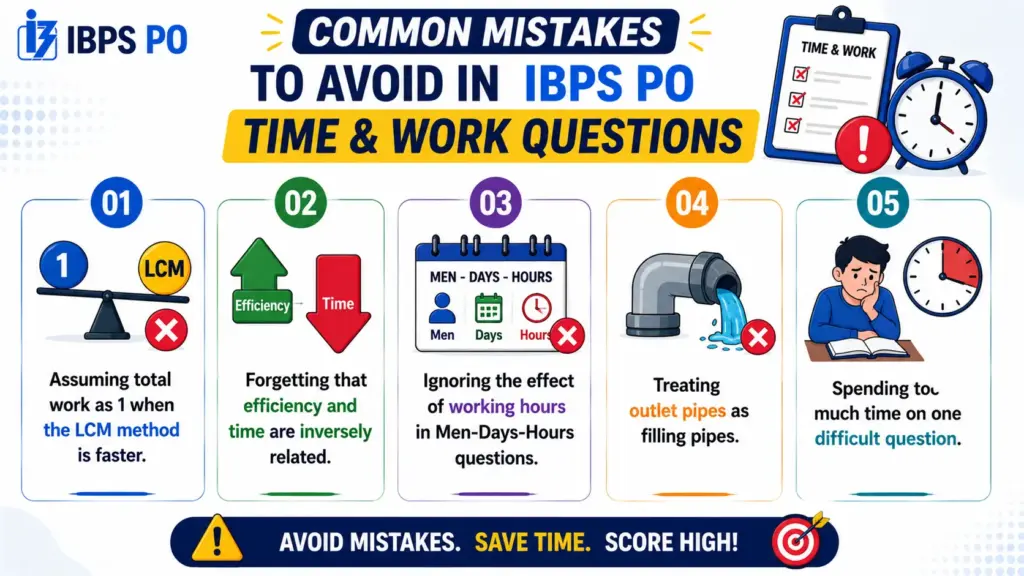
Common Mistakes to Avoid in Bank Exams: Time & Work Questions
Many candidates lose easy marks because of simple mistakes. Avoiding these errors while practising Time & Work Questions for banking exams can improve both your speed and accuracy in the actual exam.
Daily Practice Plan for Banking Exams: Time & Work Questions
A small daily practice routine can significantly improve your performance. Practising consistently helps improve calculation speed, formula retention, and overall confidence in the Quantitative Aptitude section.
| Activity | Time |
| Revise formulas | 10 minutes |
| Solve basic Time & Work questions | 20 minutes |
| Practise Men-Days-Hours & Alternate Days | 15 minutes |
| Solve Pipes & Cisterns questions | 15 minutes |
| Analyse mistakes and revise concepts | 10 minutes |
Final Thoughts
Time & Work Questions for Banking exams are among the most scoring topics in the Quantitative Aptitude section if your concepts are clear. By learning the important formulas, practising the LCM method, improving calculation speed, and solving regular quizzes, you can answer these questions accurately in less time. Make topic-wise practice, mock tests, and revision a part of your daily study plan. Consistent practice will not only improve your speed but also boost your confidence for the IBPS PO examination.
Related Blogs
Time & Work Questions for Banking Exams FAQs
Q1. How many Time & Work Questions are asked in the banking exam?
Ans: You can generally expect 2–4 Time & Work Questions for banking exams in the Preliminary examination. In the Mains exam, these concepts are often combined with Data Interpretation or Arithmetic-based caselets, making them slightly more challenging.
Q2. What is the fastest method to solve Time & Work Questions for Banking exams?
Ans: The LCM Method is one of the quickest approaches. Instead of assuming total work as 1, take the LCM of the given number of days. This avoids fractions, simplifies calculations, and helps you solve questions much faster.
Q3. Which formulas are most important for Time & Work preparation?
Ans: The most important formulas for Time & Work include Work = Efficiency × Time, Efficiency = Work ÷ Time, Men × Days × Hours = Constant, and Combined Efficiency = Sum of Individual Efficiencies. Along with these, you should also revise the formulas for Pipes & Cisterns and Alternate Days, as these concepts are frequently used to solve exam-level questions quickly and accurately. Regular revision of these formulas will help you save time in the Quantitative Aptitude section of the banking exam.
Q4. How can I improve my speed in Time & Work Questions?
Ans: Speed improves with regular practice. Revise formulas daily, solve topic-wise quizzes, practise calculation shortcuts, and attempt sectional mock tests. After every practice session, analyse your mistakes to avoid repeating them in the exam.
Q5. Are Pipes & Cisterns and Men-Days-Hours important for banking exams?
Ans: Yes. These are important subtopics of Time & Work Questions for banking exams. Questions based on Pipes & Cisterns, Men-Days-Hours, Work Efficiency, and Alternate Days are frequently asked in the Quantitative Aptitude section and should be part of your daily preparation routine.
- Sign Up on Practicemock for Updated Current Affairs, Topic Tests and Mini Mocks
- Sign Up Here to Download Free Study Material
Free Mock Tests for the Upcoming Exams
- IBPS PO Free Mock Test
- RBI Grade B Free Mock Test
- IBPS SO Free Mock Test
- NABARD Grade A Free Mock Test
- SSC CGL Free Mock Test
- IBPS Clerk Free Mock Test
- IBPS RRB PO Free Mock Test
- IBPS RRB Clerk Free Mock Test
- RRB NTPC Free Mock Test
- SSC MTS Free Mock Test
- SSC Stenographer Free Mock Test
- GATE Mechanical Free Mock Test
- GATE Civil Free Mock Test
- RRB ALP Free Mock Test
- SSC CPO Free Mock Test
- AFCAT Free Mock Test
- SEBI Grade A Free Mock Test
- IFSCA Grade A Free Mock Test
- RRB JE Free Mock Test
- Free Banking Live Test
- Free SSC Live Test