


For practising IBPS PO vocabulary effectively, candidates can start with targeted mini-quizzes and daily English practice sets to improve their accuracy and speed. Vocabulary Questions for IBPS PO play an important role in the English Language section of the IBPS PO examination. A strong vocabulary helps you solve questions on synonyms, antonyms, cloze tests, fillers, reading comprehension, and sentence-based questions with better accuracy. Regular practice through topic-wise quizzes, daily word lists, mini vocabulary tests, and downloadable PDFs can significantly improve your score. In this blog, you will get a free Vocabulary Quiz for IBPS PO, important word lists, expert preparation tips, and a downloadable PDF to strengthen your vocabulary for the exam.
Vocabulary Questions for IBPS PO: Understanding the Exam Trend
In recent IBPS PO examinations, Vocabulary Questions for IBPS PO have become more application-based instead of asking only direct synonym or antonym questions. Regular practice through mini quizzes, daily vocabulary builders, topic-wise exercises, and exam-level mock tests helps improve both accuracy and confidence.

You can expect questions based on:
- Synonyms: Choosing words with similar meanings.
- Antonyms: Identifying words with opposite meanings.
- Cloze Tests: Selecting contextually suitable words.
- Fill in the Blanks: Choosing the correct vocabulary word.
- Reading Comprehension: Understanding word meanings from context.
- Word Replacement: Replacing incorrect words with suitable alternatives.
- High-Frequency Banking Vocabulary: Common words asked in competitive banking exams.
Tip: Instead of memorising difficult words, learn them through sentences. Understanding how a word is used makes it easier to remember during the exam.
Vocabulary Practice Quiz with Answer Key: IBPS PO Prelims Exam-Level Questions
Below is a complete set of 10 exam-level Vocabulary Questions for IBPS PO designed according to the latest IBPS PO Preliminary examination pattern. These questions cover synonyms, antonyms, contextual vocabulary, fillers, and banking-related words to help you practise the most frequently asked question types.
Q1. Choose the word closest in meaning to “Abundant”.
Explanation: Abundant means available in a large quantity. Plentiful is the closest synonym. “Plenty” was corrected to “Plentiful” to match the adjective form.
Q2. Choose the synonym of “Diligent”.
Explanation: Diligent means hardworking, careful, and consistent.
Q3. Choose the synonym of “Prosper”.
Explanation: Prosper means to grow, succeed, or flourish.
Q4. Choose the antonym of “Fragile”.
Explanation: Fragile means easily broken or damaged. Strong is its opposite.
Q5. Choose the antonym of “Hostile”.
Explanation: Hostile means unfriendly or aggressive. Friendly is the correct antonym.
Q6. The manager appreciated the employee for his ________ efforts during the project.
Explanation: Because the employee is appreciated, the positive adjective diligent is the best fit.
Q7. The bank introduced a new scheme to ________ financial inclusion in rural areas.
Explanation: Promote means encourage or support, which fits the context.
Q8. Choose the correct meaning of “Collateral”.
Explanation: Collateral is an asset pledged as security for a loan.
Q9. Choose the word that best replaces “scarcity” in the sentence: The company faced a scarcity of skilled employees during expansion.
Explanation: Scarcity means shortage or insufficient supply.
Q10. The RBI announced several measures to maintain ________ in the financial system.
Explanation: Stability correctly describes a secure and balanced financial system.
Quiz Summary
Core Conceptual Guide: Important Vocabulary Concepts
Before attempting Vocabulary Questions for IBPS PO, revise these important concepts. Most vocabulary questions are designed to test your understanding of words in different situations rather than your ability to memorise dictionary meanings.
| Concept | Explanation |
| Synonyms | Words that have similar meanings. |
| Antonyms | Words that have opposite meanings. |
| Contextual Vocabulary | Choosing the correct word according to the sentence. |
| Cloze Test Vocabulary | Selecting words that fit both grammar and meaning. |
| One-Word Substitution | Replacing a phrase with a single suitable word. |
| Idioms & Phrases | Understanding common expressions and their meanings. |
| Banking Vocabulary | Frequently used words in banking and finance. |
| Root Words | Learning prefixes, suffixes, and word origins to understand unfamiliar words. |
Strategy Checklist to Master Vocabulary Questions for IBPS PO 2026
Scoring well in Vocabulary Questions for IBPS PO requires more than memorising difficult words. You need to understand how words are used in different contexts and practise them regularly. Follow these simple strategies to improve your vocabulary and score better in the English Language section.
1. Build Your Vocabulary Daily: Learning a few new words every day is more effective than studying hundreds of words at once.
Make it a habit to:
- Learn 10–15 new words daily.
- Revise previously learned words regularly.
- Write down difficult words in a notebook.
- Learn one synonym and one antonym for every new word.
2. Learn Words in Context: Understanding the meaning of a word through a sentence makes it easier to remember. This method improves your understanding of contextual vocabulary, which is frequently tested in IBPS PO.
3. Read English Every Day: Reading regularly helps you improve both vocabulary and comprehension.
You can read:
- Newspaper editorials
- Banking and finance articles
- English magazines
- PracticeMock English blogs
4. Practise Topic-Wise Vocabulary Questions: Don’t limit yourself to learning word lists. The more question types you practise, the more confident you become during the examination. Solve different vocabulary-based questions such as:
5. Revise High-Frequency Banking Words: Many English questions include words related to banking and finance. These words are commonly seen in Reading Comprehension passages and vocabulary questions. Focus on words such as:
- Collateral
- Liquidity
- Inflation
- Deposit
- Mortgage
- Credit
- Debit
- Dividend
- Investment
- Equity
6. Attempt Daily English Mock Tests: Regular mock tests help you identify your weak areas and improve your accuracy. After every mock test:
- Review incorrect answers.
- Learn the meanings of unfamiliar words.
- Revise grammar and vocabulary together.
- Attempt similar questions again.
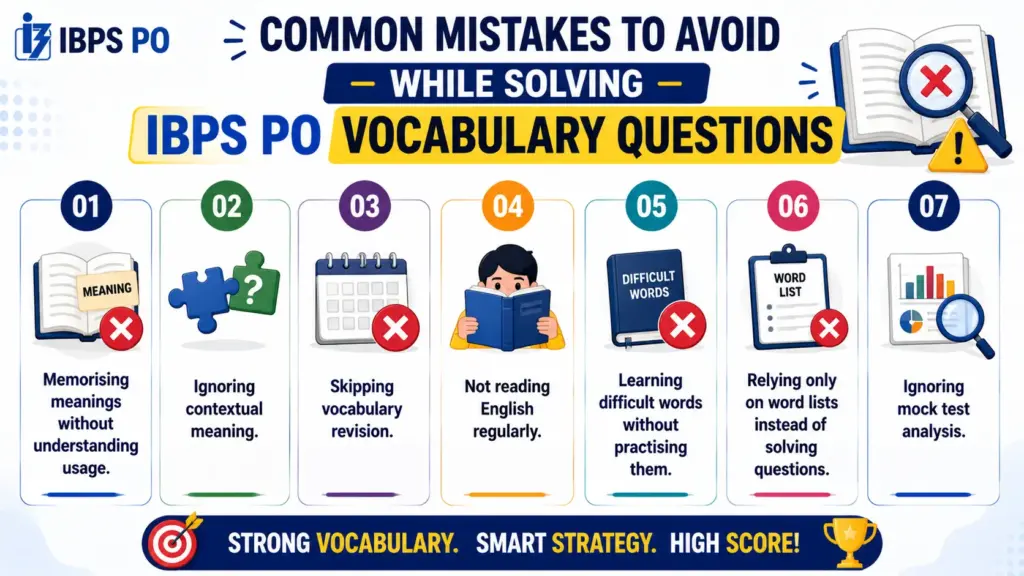
Common Mistakes to Avoid While Solving IBPS PO Vocabulary Questions
Many candidates lose marks because of avoidable mistakes. By solving Vocabulary Questions for IBPS PO regularly, you can strengthen your vocabulary, understand word usage in context, and improve your score in the English Language section.
Daily Practice Plan for IBPS PO Vocabulary Questions
A consistent study routine helps improve vocabulary, reading skills, and overall English accuracy. Along with daily revision, solving Vocabulary Questions for IBPS PO regularly will improve your word usage, reading comprehension, and overall performance in the English section.
| Time | Activity |
| 20 Minutes | Learn 10–15 new vocabulary words |
| 20 Minutes | Revise previously learned words |
| 30 Minutes | Solve Vocabulary Questions and quizzes |
| 20 Minutes | Attempt English sectional quiz |
| 20 Minutes | Analyse mistakes and revise explanations |
| 15 Minutes | Read an English newspaper editorial or banking article |
Final Thoughts
Practising Vocabulary Questions for IBPS PO regularly can significantly improve your score in the English Language section. Instead of memorising long word lists, focus on understanding word meanings, usage, synonyms, antonyms, and contextual application. Read English newspapers daily, revise high-frequency banking vocabulary, and solve topic-wise quizzes to strengthen your preparation. Most importantly, analyse every mock test to learn from your mistakes. With consistent practice, regular revision, and the right strategy, you can answer vocabulary questions quickly and confidently in the IBPS PO 2026 examination.
Also Read
| IBPS PO Exam Pattern | IBPS PO Salary |
| IBPS PO Previous Year Question Paper | IBPS PO Cut Off |
| IBPS PO Study Plan | IBPS PO Syllabus PDF |
FAQs
Q1. How many Vocabulary Questions are asked in the IBPS PO exam?
Ans: In the IBPS PO Preliminary examination, candidates can generally expect 3–5 vocabulary-based questions. These may appear as synonyms, antonyms, fillers, cloze tests, word replacement, or reading comprehension-based vocabulary questions. The Main examination may include even more vocabulary questions within RCs and descriptive passages.
Q2. Which vocabulary topics are most important for the IBPS PO exam?
Ans: Candidates should regularly practise important vocabulary topics such as synonyms, antonyms, contextual vocabulary, fillers, cloze test vocabulary, one-word substitutions, idioms and phrases, and banking vocabulary. Regular practice of these topics will also enhance their understanding of word usage and context-based questions.
Q3. How can I improve my vocabulary for the IBPS PO English section?
Ans: Improve your vocabulary by reading English newspapers daily, learning 10–15 new words every day, revising previously learned words, solving topic-wise quizzes, and attempting regular English sectional mock tests. Learning words in context helps you remember them better.
Q4. How much time should I spend on one Vocabulary question in the IBPS PO Prelims exam?
Ans: Try to solve an easy vocabulary question within 20–30 seconds. If a question is lengthy or context-based, spend 30–40 seconds. Skip difficult questions initially and revisit them later if time permits.
Q5. Is vocabulary an important topic for the IBPS PO English section?
Ans: Yes. Vocabulary plays an important role in many English topics, including Reading Comprehension, Cloze Test, Fillers, Phrase Replacement, Sentence Improvement, and Error Detection. A strong vocabulary improves your overall English score.
Q6. Is mock test analysis important for vocabulary preparation?
Ans: Absolutely. Mock test analysis helps you identify unfamiliar words, understand contextual usage, improve retention, and avoid repeating the same mistakes in future tests.
Q7. Can beginners score well in Vocabulary Questions for IBPS PO?
Ans: Yes. Beginners can score well by building their vocabulary gradually. Learning a few words every day, revising regularly, reading newspapers, and solving practice quizzes consistently can improve both confidence and accuracy.
Q8. Where can I practise free Vocabulary Questions for IBPS PO?
Ans: You can practise Vocabulary Questions for IBPS PO through PracticeMock’s full-length mock tests, English sectional tests, topic-wise quizzes, daily vocabulary practice, and downloadable PDFs. Regular practice with exam-level questions helps improve vocabulary, reading speed, contextual understanding, and overall English performance before the examination.
- Sign Up on Practicemock for Updated Current Affairs, Topic Tests and Mini Mocks
- Sign Up Here to Download Free Study Material
Free Mock Tests for the Upcoming Exams
- IBPS PO Free Mock Test
- RBI Grade B Free Mock Test
- IBPS SO Free Mock Test
- NABARD Grade A Free Mock Test
- SSC CGL Free Mock Test
- IBPS Clerk Free Mock Test
- IBPS RRB PO Free Mock Test
- IBPS RRB Clerk Free Mock Test
- RRB NTPC Free Mock Test
- SSC MTS Free Mock Test
- SSC Stenographer Free Mock Test
- GATE Mechanical Free Mock Test
- GATE Civil Free Mock Test
- RRB ALP Free Mock Test
- SSC CPO Free Mock Test
- AFCAT Free Mock Test
- SEBI Grade A Free Mock Test
- IFSCA Grade A Free Mock Test
- RRB JE Free Mock Test
- Free Banking Live Test
- Free SSC Live Test