


SBI PO Exam Pressure Strategy plays a key role in improving your Prelims score. A smart strategy helps you stay calm by managing each 20-minute section, attempting easy questions first, and focusing on accuracy instead of attempts. Aim for a target score of 65–70 marks. Every year, many candidates lose marks because they panic during the 60-minute exam. In this article, you’ll learn simple techniques to stay confident and maximize your SBI PO Prelims score.
SBI PO Exam Pressure Strategy: Key Takeaways
- Follow an SBI PO Exam Pressure Strategy that focuses on accuracy instead of attempting every question.
- Divide your exam into three fixed 20-minute sections and manage each one independently.
- Use the Two-Round Rule to complete easy questions before difficult ones.
- Apply the Traffic Light Trick to identify which questions to attempt, review, or skip.
- Avoid spending more than one minute on a single difficult question.
- Practise with full-length mock tests under actual exam conditions.
- Build confidence by following the same strategy in every mock test.
Understanding the SBI PO Prelims Exam Structure
A successful SBI PO Exam Pressure Strategy begins with knowing how the exam is structured. Since the SBI PO exam pattern prelims follows sectional timings, every section must be handled independently. Treat every 20-minute section as a fresh opportunity to score.

| Section | Questions | Marks | Time |
| English Language | 30 | 30 | 20 Minutes |
| Quantitative Aptitude | 35 | 35 | 20 Minutes |
| Reasoning Ability | 35 | 35 | 20 Minutes |
| Total | 100 | 100 | 60 Minutes |
SBI PO Exam Pressure Strategy for English Language
English is usually the first section of the exam, and a good start can reduce anxiety for the remaining paper. An effective SBI PO Exam Pressure Strategy for English is to secure marks quickly before moving to lengthy questions.

Suggested Attempt
| Error Detection | Sentence Improvement |
| Fillers | Vocabulary Question |
| Synonyms and Antonyms | |
These questions generally require less time and help you build momentum.
Attempt Later
- Reading Comprehension
- Inference-based Questions
- Para Jumbles
Avoid spending several minutes on a difficult Reading Comprehension passage. Solve direct vocabulary and factual questions first, then return to inference-based questions if time permits.
SBI PO Exam Pressure Strategy for Quantitative Aptitude
Quantitative Aptitude often creates the highest pressure due to lengthy calculations. A smart SBI PO Exam Pressure Strategy helps you prioritise quick-scoring topics and avoid unnecessary time traps.
Suggested Attempt
| Simplification | Number Series |
| Approximation | Quadratic Equations |
These topics usually provide easy scoring opportunities.
Attempt Later
- Arithmetic Word Problems
- Data Interpretation
- Calculation-intensive Questions
If a Data Interpretation set appears lengthy, scan all the questions first. Attempt direct questions involving ratios, totals, or simple comparisons before calculation-heavy ones.
SBI PO Exam Pressure Strategy for Reasoning Ability
Reasoning Ability is one of the highest-scoring sections, but it also contains puzzles that can consume several minutes. A well-planned SBI PO Exam Pressure Strategy helps you stay calm and choose questions wisely.
Suggested Attempt
| Inequality | Syllogism |
| Coding-Decoding | Blood Relations |
| Direction Sense | |
These standalone topics are generally quicker and easier to solve.
Attempt Later
- Seating Arrangements
- Floor-based Puzzles
- Multi-variable Puzzles
- Uncertain Linear Arrangements
Never begin the section with a complex puzzle.
If a puzzle leads to multiple cases or repeated dead ends, leave it immediately and move to the next question. Staying stuck on one puzzle only increases exam pressure and reduces your overall attempts.
The Two-Round Rule to Stay Calm During the SBI PO Prelims Exam
One of the most effective techniques in an SBI PO Exam Pressure Strategy is the Two-Round Rule. Instead of trying to solve every question in one go, divide your attempts into two rounds.
Round 1: These quick questions help you build confidence and secure easy marks early. Attempt only questions that:
- It looks easy at first glance.
- Can be solved within 30–40 seconds.
- Come from your strong topics.
- Require minimal calculations.
Round 2: Avoid spending valuable time on extremely difficult questions even during Round 2. This strategy keeps you calm and prevents unnecessary panic throughout the exam. Return to questions that:
- Require slightly longer calculations.
- Need careful reading.
- Were skipped earlier but seem manageable.
- Can still be solved within the remaining time.
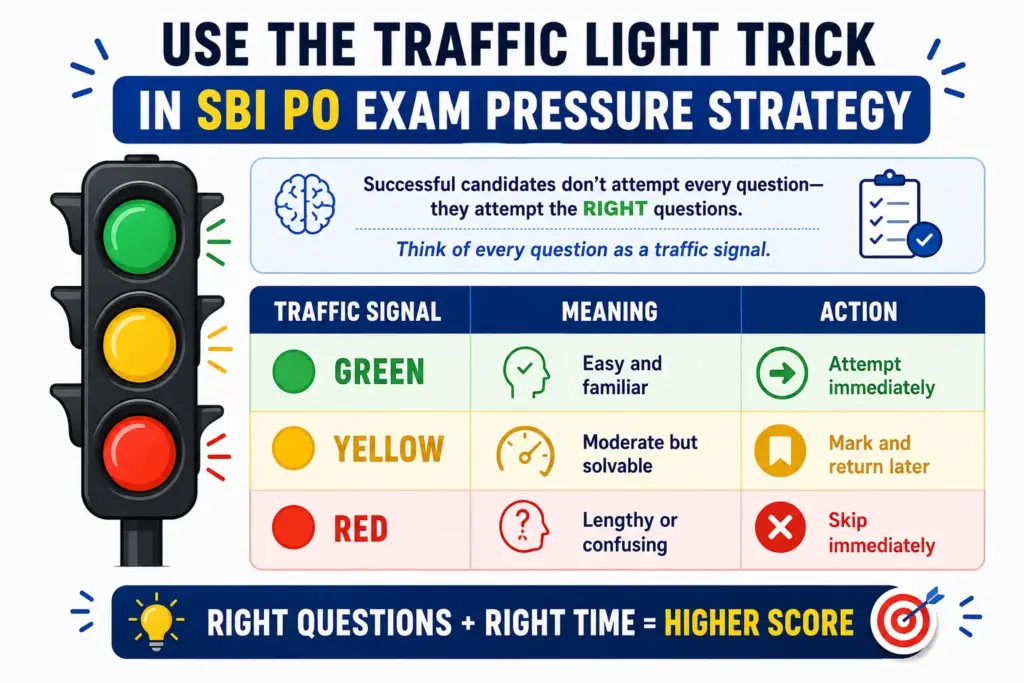
Use the Traffic Light Trick in SBI PO Exam Pressure Strategy
The SBI PO Exam Pressure Strategy also recommends using the Traffic Light Trick while solving questions. This simple method prevents you from getting stuck on difficult questions and improves your overall question selection.
How to Stay Calm During the SBI PO Exam?
The SBI PO Exam Pressure Strategy is not just about managing time—it is also about controlling your thoughts during the exam. Even a few minutes of panic can affect your confidence and lead to unnecessary mistakes. Here are a few simple techniques to stay calm throughout the 60-minute exam.
Take Deep Breaths
If you feel nervous after seeing a difficult question, don’t panic. Take a slow, deep breath, hold it for about four seconds, and breathe out slowly. This simple technique helps lower your heart rate, relax your mind, and improve concentration before moving to the next question.
Use Positive Self-Talk
Positive thinking helps you regain confidence and avoid unnecessary stress. Instead of thinking, “I don’t know this question,” remind yourself:
- “If this question is difficult for me, it is probably difficult for others too.”
- “I don’t need to solve every question to clear the exam.”
- “I will focus on the next question.”
Focus Only on the Current Question
Do not think about the previous section or the remaining questions. Concentrate only on the question in front of you and make one good decision at a time. Small, correct decisions throughout the exam lead to a better overall score.
How to Analyse SBI PO Exam Pressure Strategy After Every Mock Test?
The SBI PO Exam Pressure Strategy becomes stronger when you review your performance after every mock test. Instead of checking only your score, analyse how pressure affected your decision-making. This analysis helps you identify patterns and gradually improve your exam temperament.
| Analysis Area | Questions to Ask |
| Time Management | Which section created the most pressure? |
| Difficult Questions | Did I spend too much time on them? |
| Easy Questions Missed | Why did I leave them unanswered? |
| Wrong Attempts | Were they caused by panic or guessing? |
| Confidence Level | Did I lose focus after one difficult question? |
Weekly Practice Plan to Reduce SBI PO Prelims Exam Pressure
Practising under actual exam conditions helps reduce nervousness and builds confidence before the real exam. The SBI PO Exam Pressure Strategy becomes effective only through consistent practice.
| Day | Activity |
| Monday | Full-Length SBI PO Mock Test |
| Tuesday | Mock Analysis & Time Review |
| Wednesday | Sectional Tests Under Timed Conditions |
| Thursday | Error Log Review |
| Friday | Weak Topic Practice |
| Saturday | Full-Length Mock Test |
| Sunday | Performance Analysis & Strategy Improvement |
How Many SBI PO Prelims Mock Tests Should You Take?
Regular mock tests are the best way to become comfortable with SBI PO prelims exam pressure. The goal is not to attempt the highest number of mocks but to learn from every mock through detailed analysis.
| Preparation Stage | Recommended Mock Tests |
| Beginner | 2–3 per Week |
| Intermediate | 3–4 per Week |
| Advanced | 5–6 per Week |
| Last 15 Days Before Exam | Daily Mock Test |
Final Thoughts on SBI PO Exam Pressure Strategy
The SBI PO Exam Pressure Strategy teaches candidates that clearing the SBI PO Prelims is not just about knowing the right answers—it is also about staying calm under pressure.By following a fixed attempt strategy, practising with regular mock tests, and analysing your performance after every test, you can gradually build confidence for the actual exam. Remember, the goal is not to attempt every question but to attempt the right questions with maximum accuracy.
Also Read:
FAQs on SBI PO Exam Pressure Strategy
What is the SBI PO Exam Pressure Strategy?
The SBI PO Exam Pressure Strategy is a structured approach that helps candidates stay calm, manage sectional time effectively, and make better question-selection decisions during the 60-minute Prelims exam.
Why do candidates panic during the SBI PO Prelims?
Most candidates panic because of difficult questions, poor time management, fear of missing the cut-off, or spending too much time on one question. Regular mock practice helps reduce exam pressure.
What is the Two-Round Rule in the SBI PO exam?
The Two-Round Rule recommends attempting easy and direct questions first. Difficult or lengthy questions should be marked for review and attempted only if time permits.
How does the Traffic Light Trick help in the SBI PO exam?
The Traffic Light Trick classifies questions into Green (attempt now), Yellow (review later), and Red (skip). This improves question selection and prevents unnecessary time wastage.
How can I stay calm during the SBI PO exam?
Deep breathing, positive self-talk, following a fixed attempt order, and avoiding random guesses are some of the best ways to stay calm during the SBI PO Prelims examination.
How can mock tests reduce exam pressure?
SBI PO Mock tests simulate the real exam environment. They improve time management, build confidence, strengthen decision-making, and help candidates handle pressure more effectively on the actual exam day.
- Sign Up on Practicemock for Updated Current Affairs, Topic Tests and Mini Mocks
- Sign Up Here to Download Free Study Material
Free Mock Tests for the Upcoming Exams
- IBPS PO Free Mock Test
- RBI Grade B Free Mock Test
- IBPS SO Free Mock Test
- NABARD Grade A Free Mock Test
- SSC CGL Free Mock Test
- IBPS Clerk Free Mock Test
- IBPS RRB PO Free Mock Test
- IBPS RRB Clerk Free Mock Test
- RRB NTPC Free Mock Test
- SSC MTS Free Mock Test
- SSC Stenographer Free Mock Test
- GATE Mechanical Free Mock Test
- GATE Civil Free Mock Test
- RRB ALP Free Mock Test
- SSC CPO Free Mock Test
- AFCAT Free Mock Test
- SEBI Grade A Free Mock Test
- IFSCA Grade A Free Mock Test
- RRB JE Free Mock Test
- Free Banking Live Test
- Free SSC Live Test