


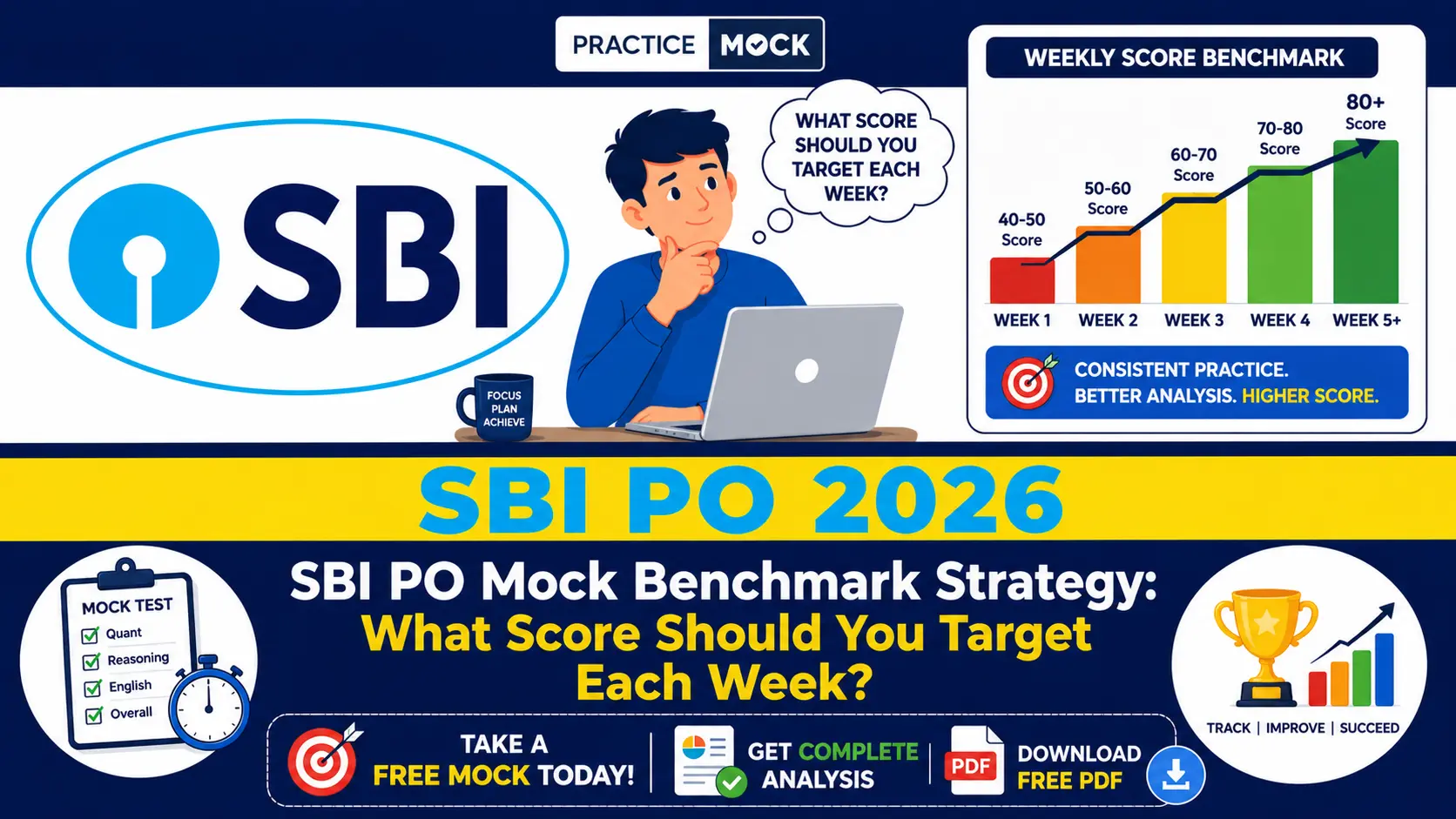
An effective SBI PO mock benchmark strategy helps you measure whether your preparation is improving every week. Instead of expecting a sudden jump from 35 to 65 marks, set smaller targets for score, accuracy, attempts, and section-wise performance. Beginners may initially target 35–40 marks, while candidates in the final preparation stage can work towards consistently scoring 60 or more in balanced mock tests.
However, these weekly benchmarks are preparation targets, not official SBI PO cut-offs. Mock difficulty, candidate participation, normalization, vacancies, and the actual examination level can affect the qualifying score. Therefore, use benchmarks to monitor personal improvement rather than treating one mock score as a guarantee of selection.

SBI PO Mock Benchmark Strategy: Key Takeaways
- Use the first full-length mock to establish your baseline score.
- Target an improvement of approximately three to five marks per week.
- Do not increase attempts by sacrificing accuracy.
- Track the average of three recent mocks instead of one score.
- Treat 50+, 55+, and 60+ as progressive preparation milestones.
- Maintain separate targets for English, Quant, and Reasoning.
- Analyse easy questions left unattempted after every test.
- Reduce the weekly target when the mock level is unusually difficult.
- Focus on consistency before attempting to maximise your score.
- Remember that mock benchmarks are not official cut-off predictions.
SBI PO Prelims is a speed-based examination in which candidates must manage English Language, Quantitative Aptitude, and Reasoning Ability under sectional time limits. Consequently, a useful benchmark must measure more than total marks; it should also track section-wise balance, accuracy, and question selection. SBI’s recruitment information and recent PracticeMock preparation material emphasise structured test practice and analysis rather than judging readiness through a single score.

What Score Should You Target in SBI PO Mocks Each Week?
Your weekly SBI PO mock target should depend on your starting score and the number of weeks remaining before the examination.
A candidate starting at 30 marks should not copy the same target as someone already scoring 55. The first candidate needs to strengthen concepts and reduce mistakes, while the second may need better question selection and time management.
Suggested Weekly SBI PO Mock Score Benchmarks
| Preparation Week | Suggested Score Benchmark | Accuracy Target | Main Objective |
| Baseline Test | Record current score | Measure current accuracy | Identify starting level |
| Week 1 | 35–40 marks | 75% or above | Fix basic concepts |
| Week 2 | 40–45 marks | 78% or above | Reduce avoidable errors |
| Week 3 | 45–50 marks | 80% or above | Improve speed and selection |
| Week 4 | 50–55 marks | 82% or above | Build section-wise balance |
| Week 5 | 55–60 marks | 85% or above | Improve consistency |
| Final Preparation | 60+ marks | 85–90% | Simulate exam conditions |
These are flexible preparation benchmarks. Candidates should adjust them according to mock difficulty, current preparation level, and the time available before the examination.
For example, scoring 52 in a difficult mock with high accuracy may indicate stronger preparation than scoring 60 in an unusually easy test.
Are Weekly SBI PO Mock Targets the Same as the Cut-Off?
No. A weekly SBI PO mock score target is not the same as the official cut-off.
A mock benchmark is a personal preparation target. It helps you determine whether your speed, accuracy, and question-selection strategy are improving. The official SBI PO cut-off, on the other hand, is determined after the examination and can be influenced by:
- Number of vacancies
- Difficulty level of the actual examination
- Number of candidates appearing
- Candidate performance
- Category-wise requirements
- SBI’s shortlisting criteria
- Normalization, where applicable
Therefore, do not assume that scoring a particular mark in a mock guarantees qualification. Similarly, one low mock score does not mean that you cannot clear the examination.
How Should You Set Your First SBI PO Mock Benchmark?
Your first full-length test should be treated as a diagnostic mock. Do not attempt it with an artificial score target.
After completing the mock, record the following:
| Performance Metric | What to Record |
| Total score | Marks obtained after negative marking |
| Total attempts | Number of questions attempted |
| Correct answers | Questions solved accurately |
| Incorrect answers | Questions carrying negative marks |
| Overall accuracy | Correct answers divided by attempts |
| English score | Section-wise marks |
| Quant score | Section-wise marks |
| Reasoning score | Section-wise marks |
| Easy questions missed | Solvable questions left unattempted |
| Slow questions | Correct questions taking excessive time |
| Repeated errors | Mistakes seen in earlier practice |
Suppose you score 38 marks with 72% accuracy. Your next objective should not immediately be 60 marks. A realistic Week 1 target may be:
- Increase score to 41–43.
- Improve accuracy to at least 76%.
- Reduce wrong answers by three.
- Attempt two additional easy questions.
- Improve the weakest section by two marks.
This approach creates a manageable improvement plan.
Week 1 Benchmark: Build a Stable 35–40 Score
During the first week, focus on understanding your existing preparation level. Candidates beginning their mock-test journey should aim to produce a stable performance rather than chase an aggressive number.
Week 1 Targets
- Suggested score: 35–40 marks
- Suggested accuracy: At least 75%
- Full mocks: Two or three
- Primary focus: Concept gaps and careless mistakes
- Sectional tests: One or two per weak section
What Should You Improve in Week 1?
Review whether you are losing marks because of:
- Weak arithmetic fundamentals
- Difficulty identifying manageable puzzles
- Poor grammar knowledge
- Slow calculations
- Random guessing
- Spending too long on one question
- Leaving direct questions unattempted
At this stage, every incorrect question should be classified as a concept error, calculation error, reading error, or selection error.
Week 2 Benchmark: Move Towards 40–45 Marks
Once you understand your common mistakes, Week 2 should focus on correcting them.
Week 2 Targets
- Suggested score: 40–45 marks
- Suggested accuracy: At least 78%
- Full mocks: Three
- Primary focus: Reducing repeated errors
- Score improvement target: Three to five marks
The additional marks should ideally come from correcting existing weaknesses rather than attempting every available question.
For example:
| Improvement Source | Possible Score Gain |
| Two fewer incorrect answers | Better net score |
| Two additional easy attempts | Approximately two marks |
| Improved puzzle selection | Three to five questions |
| Faster simplification | One to three questions |
| Better RC option elimination | One to two questions |
A structured improvement strategy is more sustainable than attempting ten extra questions without accuracy.
Week 3 Benchmark: Reach the 45–50 Range
A score of 45–50 generally indicates that the candidate has developed basic control over the examination but still has room to improve attempts, speed, or section-wise consistency.
Week 3 Targets
- Suggested score: 45–50 marks
- Suggested accuracy: 80% or above
- Full mocks: Three or four
- Primary focus: Speed and question selection
- Weak-section target: Prevent any section from collapsing
At this stage, examine whether one section is repeatedly lowering the total score.
For example:
| Section | Mock 1 | Mock 2 | Mock 3 | Observation |
| English | 20 | 21 | 20 | Stable |
| Quant | 11 | 9 | 12 | Needs improvement |
| Reasoning | 18 | 19 | 17 | Mostly stable |
| Total | 49 | 49 | 49 | Quant limiting growth |
The total score appears consistent, but the section-wise data shows where additional marks can be gained.
Week 4 Benchmark: Target 50–55 Marks
The 50–55 range should be approached through balanced performance rather than excessive attempts.
Week 4 Targets
- Suggested score: 50–55 marks
- Suggested accuracy: At least 82%
- Full mocks: Four
- Primary focus: Balanced sectional performance
- Analysis target: Identify easy marks lost in every test
Candidates in this range frequently lose marks because they:
- Select a lengthy puzzle before an easier one.
- Spend too much time on difficult arithmetic.
- Misread English instructions.
- Attempt uncertain questions near the end.
- Fail to revise a marked response.
- Change correct answers without evidence.
Instead of learning several new topics, focus on converting already-known concepts into marks.
Week 5 Benchmark: Build a Consistent 55–60 Score
Reaching 55 once is different from maintaining 55 or more across multiple mocks.
Week 5 Targets
- Suggested score: 55–60 marks
- Suggested accuracy: 85% or above
- Full mocks: Four or five
- Primary focus: Consistency
- Performance measure: Average score across recent tests
Use a three-mock moving average:
Three-Mock Average = Total score of the last three mocks ÷ 3
For example:
| Mock | Score |
| Mock 1 | 54 |
| Mock 2 | 61 |
| Mock 3 | 58 |
| Average | 57.67 |
Your working benchmark is approximately 58, not simply the highest score of 61.
This method reduces overreaction to one unusually easy or difficult mock.
Final Preparation Benchmark: Target 60+ Consistently
Candidates with completed concepts can target 60 or more during the final preparation stage. However, the objective should be consistency under timed conditions.
Final-Stage Targets
- Suggested score: 60+
- Suggested accuracy: 85–90%
- Full mocks: Five to seven per week
- Primary focus: Exam temperament
- Analysis priority: Avoidable negative marks
PracticeMock’s recent SBI PO preparation guidance recommends matching the plan to the candidate’s current score level and applying the 1:1 analysis rule—approximately one hour of analysis for a one-hour test.
During this stage:
- Attempt mocks without interruptions.
- Follow the fixed sectional timer.
- Avoid pausing the test.
- Use the same attempt sequence repeatedly.
- Analyse the test on the same day.
- Revise the error log before the next mock.
- Avoid experimenting with an entirely new strategy before the exam.
What Should Your Section-Wise SBI PO Mock Benchmark Be?
A strong total score requires a balanced contribution from all three sections.
The following table provides flexible practice targets:
| Preparation Level | English Target | Quant Target | Reasoning Target | Approximate Total |
| Beginner | 14–17 | 9–12 | 12–15 | 35–44 |
| Developing | 17–20 | 12–15 | 15–18 | 44–53 |
| Competitive | 20–23 | 15–18 | 18–21 | 53–62 |
| Advanced | 23+ | 18+ | 21+ | 62+ |
These are not sectional cut-offs. They are practice benchmarks designed to prevent overdependence on one subject.
For example, relying entirely on English and Reasoning while scoring very low in Quant may create an unstable overall performance. Your strategy should gradually strengthen the weakest section without reducing the strongest one.
What Accuracy Should You Target Every Week?
Accuracy should improve alongside the score.
| Current Accuracy | What It Indicates | Recommended Action |
| Below 70% | Excessive guessing or concept gaps | Reduce attempts and revise basics |
| 70–75% | Unstable selection | Analyse incorrect questions |
| 75–80% | Developing performance | Improve calculation and reading accuracy |
| 80–85% | Competitive practice level | Increase attempts gradually |
| 85–90% | Strong control | Focus on speed and consistency |
| Above 90% | High accuracy | Check whether attempts are too conservative |
A candidate with 65 attempts and 88% accuracy may be in a stronger position than someone attempting 78 questions with 70% accuracy.
Negative marking makes reckless attempts costly. Therefore, score growth should come from a combination of:
- More correct answers
- Fewer incorrect answers
- Better question selection
- Improved speed
- Reduced time on unsolvable questions
How Much Should Your SBI PO Mock Score Improve Each Week?
A realistic weekly score increase is approximately three to five marks during the early and middle stages.
However, improvement is rarely perfectly linear.
Your scores may look like this:
| Week | Average Score |
| Week 1 | 37 |
| Week 2 | 42 |
| Week 3 | 47 |
| Week 4 | 46 |
| Week 5 | 53 |
| Week 6 | 57 |
The slight decline in Week 4 does not necessarily indicate failure. The mock may have been harder, or the candidate may have been adjusting to a new attempt strategy.
Review the reason behind the decline before changing the complete plan.
Why Is Your SBI PO Mock Score Not Increasing?
A score plateau usually occurs because the same weaknesses continue across several tests.
You Are Attempting Mocks Without Analysis
Completing more tests does not guarantee improvement. Every mock should produce a list of topics, mistakes, and questions to revise.
Your Accuracy Is Falling
Increasing attempts too rapidly may add incorrect answers and reduce the final score.
You Are Ignoring Easy Questions
Review questions that were simple but left unattempted. These are often the easiest source of additional marks.
One Section Is Limiting the Total
A low Quant, Reasoning, or English score can prevent overall growth even when the other two sections are strong.
You Keep Changing Your Strategy
Do not change the section-wise approach after every low score. Test a strategy across at least three comparable mocks before evaluating it.
Your Concepts Are Incomplete
If you cannot understand solutions after the test, reduce full-mock frequency and return to topic-wise preparation.
SBI PO Weekly Mock Benchmark Tracker
Use the following table at the end of every week:
| Metric | Week 1 | Week 2 | Week 3 | Week 4 |
| Average score | ||||
| Highest score | ||||
| Lowest score | ||||
| Average attempts | ||||
| Average accuracy | ||||
| English average | ||||
| Quant average | ||||
| Reasoning average | ||||
| Incorrect answers | ||||
| Easy questions missed | ||||
| Repeated mistakes | ||||
| Next week’s target |
This tracker shows whether your improvement is genuine and repeatable.
What Should You Do After Missing a Weekly Target?
Missing a weekly benchmark does not mean you should immediately attempt more full-length mocks.
Use the following correction process:
- Calculate your average score across the week.
- Identify the lowest-performing section.
- Review every incorrect answer from that section.
- List easy questions you failed to attempt.
- Take one or two sectional tests.
- Reattempt the difficult questions without solutions.
- Revise formulas, grammar rules, or puzzle methods.
- Attempt the next full mock.
- Compare the same metrics again.
Do not increase the following week’s target until you understand why the previous benchmark was missed.
Common SBI PO Mock Benchmark Mistakes to Avoid
Treating 60 Marks as a Universal Target
A beginner scoring 30 cannot use the same immediate target as a candidate scoring 55. Benchmarks must reflect the starting level.
Comparing Scores From Different Mock Platforms
Mock difficulty and ranking populations can vary. Compare your performance primarily within the same test series or across mocks of similar difficulty.
Focusing Only on the Highest Score
Your average and lowest scores reveal consistency more accurately than one exceptional result.
Ignoring Accuracy
A score increase supported by falling accuracy may not be sustainable.
Treating Mock Scores as Official Cut-Off Predictions
Preparation benchmarks and official cut-offs serve different purposes. Keep them separate.
Increasing Attempts Every Week Without Analysis
Attempts should rise only when question selection and accuracy remain stable.
Final SBI PO Mock Benchmark Strategy
The best SBI PO mock benchmark strategy begins with a diagnostic test and progresses through realistic weekly targets. Candidates can initially work towards 35–40 marks, then move to 40–45, 45–50, 50–55, 55–60, and eventually 60 or more.
However, total marks should never be the only benchmark. Track accuracy, section-wise scores, easy questions missed, incorrect answers, and your three-mock average. These indicators reveal whether your preparation is genuinely improving.
Most importantly, treat every benchmark as a guide rather than an official qualifying score. A difficult mock may temporarily reduce your marks, while an easy test may inflate them. Consistent performance, controlled attempts, strong accuracy, and proper analysis provide a more reliable measure of SBI PO readiness.
Take a Free SBI PO Prelims Mock Test and Get Complete Section-Wise Performance Analysis
FAQs on SBI PO Mock Benchmark Strategy
What score should I target in the first SBI PO mock?
Do not set an aggressive target for your first mock. Use it as a diagnostic test to record your current score, attempts, accuracy, and section-wise weaknesses.
Is 40 marks a good score in an SBI PO mock?
A score of 40 can be a useful early-stage benchmark, particularly for beginners. The next objective should be to improve accuracy and gradually move towards the 45–50 range.
Is 50 marks enough in SBI PO Prelims mocks?
A score of 50 shows developing preparation, but it should not be treated as a guaranteed qualifying score. Work towards improving consistency, accuracy, and section-wise balance.
Should I target 60 marks in every SBI PO mock?
Candidates with completed concepts can target 60 or more. However, mock difficulty varies, so evaluate your average score and accuracy rather than expecting the same marks in every test.
How many marks should my SBI PO mock score improve each week?
An improvement of approximately three to five marks per week is a realistic target for many candidates. Progress may slow as the score increases.
What accuracy should I maintain in SBI PO mocks?
Initially, aim for at least 75–80% accuracy. Gradually work towards 85% or more while increasing attempts carefully.
Should I compare my score or percentile in SBI PO mocks?
Track both. Score measures your marks, while percentile indicates your performance relative to other test takers. Also review rank, accuracy, and mock difficulty.
What should I do when my SBI PO mock score decreases?
Analyse whether the decline resulted from a difficult test, low accuracy, poor question selection, fatigue, or unresolved concepts. Correct the cause before attempting more mocks.
Are SBI PO mock benchmarks equal to official cut-offs?
No. Mock benchmarks are personal preparation targets. Official cut-offs are determined by SBI after considering examination difficulty, vacancies, candidate performance, and other recruitment factors.
How should I calculate my current SBI PO mock benchmark?
Add your scores from the last three comparable mocks and divide the total by three. Use this average as your current working benchmark.
- Sign Up on Practicemock for Updated Current Affairs, Topic Tests and Mini Mocks
- Sign Up Here to Download Free Study Material
Free Mock Tests for the Upcoming Exams
- IBPS PO Free Mock Test
- RBI Grade B Free Mock Test
- IBPS SO Free Mock Test
- NABARD Grade A Free Mock Test
- SSC CGL Free Mock Test
- IBPS Clerk Free Mock Test
- IBPS RRB PO Free Mock Test
- IBPS RRB Clerk Free Mock Test
- RRB NTPC Free Mock Test
- SSC MTS Free Mock Test
- SSC Stenographer Free Mock Test
- GATE Mechanical Free Mock Test
- GATE Civil Free Mock Test
- RRB ALP Free Mock Test
- SSC CPO Free Mock Test
- AFCAT Free Mock Test
- SEBI Grade A Free Mock Test
- IFSCA Grade A Free Mock Test
- RRB JE Free Mock Test
- Free Banking Live Test
- Free SSC Live Test