


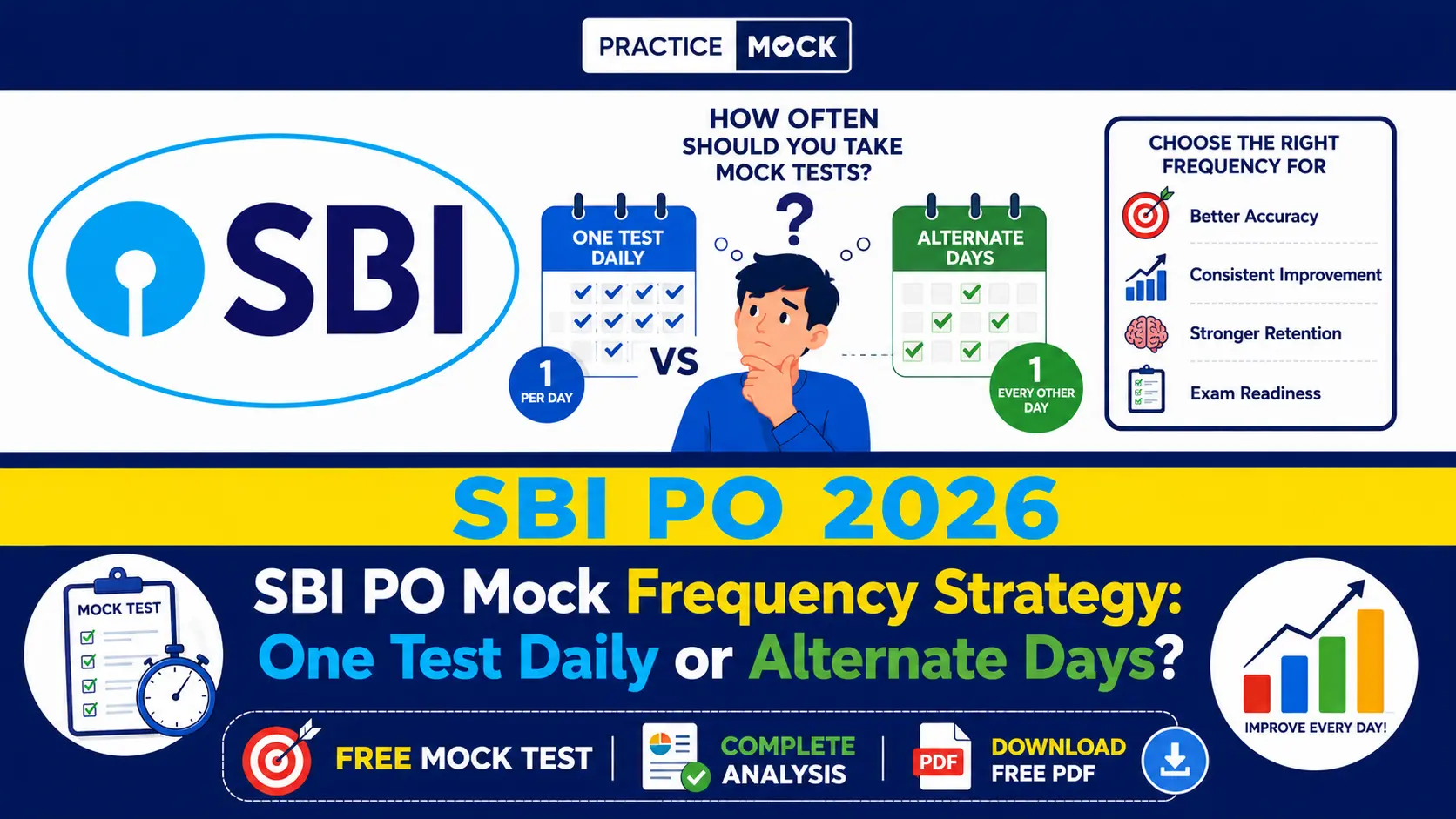
The right SBI PO mock frequency strategy depends on your preparation level, available study time, and ability to analyse each test. Beginners should generally attempt one full-length mock every two or three days, while candidates with completed concepts can take one mock daily during the final preparation phase. However, attempting more tests without analysing mistakes will not automatically improve your score.
Begin by attempting a free latest-pattern SBI PO Prelims mock test. Check your total score, section-wise attempts, accuracy, time spent, incorrect answers, and easy questions left unattempted. Use this performance report to decide whether you currently need daily mocks, alternate-day mocks, or more concept-building practice.

SBI PO Mock Frequency Strategy: Key Takeaways
- Beginners should attempt two to three full-length mocks per week.
- Intermediate candidates can follow an alternate-day mock schedule.
- Advanced candidates may attempt one mock daily near the examination.
- Every 60-minute mock should be followed by detailed analysis.
- Do not replace concept revision with excessive mock attempts.
- Use sectional tests on non-mock days to fix specific weaknesses.
- Track average scores instead of judging preparation through one test.
- Reduce mock frequency when the same mistakes keep repeating.
- Increase frequency only after concepts and accuracy become stable.
- Avoid attempting multiple full mocks in one day without a clear purpose.
The SBI PO Prelims examination contains 100 questions divided among English Language, Quantitative Aptitude, and Reasoning Ability. Each section has an independent 20-minute time limit, making section-wise speed and question selection important components of mock-test analysis.

Should You Attempt an SBI PO Mock Test Daily or on Alternate Days?
Most SBI PO aspirants should begin with alternate-day full mocks and move to daily mocks only after completing the core syllabus.
An alternate-day schedule gives candidates enough time to:
- Analyse the previous test.
- Revise incorrect concepts.
- Reattempt skipped questions.
- Practise weak chapters.
- Test the corrected approach in the next mock.
Daily mocks are useful when your concepts are already clear and you need to improve exam temperament, speed, consistency, and question selection. They are less useful when you are still learning fundamental topics such as percentages, syllogisms, grammar rules, or basic seating arrangements.
Daily vs Alternate-Day SBI PO Mock Strategy
| Preparation Situation | Recommended Full-Mock Frequency | Main Objective |
| Syllabus coverage is below 40% | 1–2 mocks per week | Diagnosis and concept building |
| Basic concepts are being completed | 2–3 mocks per week | Improve application |
| Most Prelims topics are covered | One mock on alternate days | Improve speed and accuracy |
| Exam is three to four weeks away | 4–5 mocks per week | Build consistency |
| Exam is within the final 10–15 days | One mock daily | Simulate the actual examination |
| Scores are falling continuously | Reduce frequency temporarily | Analyse and correct mistakes |
| Working professional with limited time | 2–3 full mocks per week | Maintain quality analysis |
The correct frequency is therefore not the highest number of tests you can attempt. It is the highest number of tests you can attempt, analyse, revise, and learn from properly.
When Should You Follow the Alternate-Day Mock Strategy?
An alternate-day SBI PO mock strategy is suitable for most candidates during the middle stage of preparation.
For example:
- Day 1: Attempt a full mock and analyse it.
- Day 2: Revise errors, practise weak topics, and take a sectional test.
- Day 3: Attempt the next full mock.
- Day 4: Correct mistakes and practise again.
This cycle creates a direct connection between testing and improvement. The second mock checks whether the corrections made after the first test actually worked.
Who Should Attempt Mocks on Alternate Days?
Follow this approach when:
- You have completed approximately half or more of the syllabus.
- Your score changes considerably from one mock to another.
- You are making concept and calculation errors.
- Your accuracy is below your desired level.
- You need more time to revise English, Quant, or Reasoning topics.
- You have two to four hours available for daily preparation.
- You cannot analyse a full mock properly on the same day.
The alternate-day approach is especially effective for candidates scoring around 35–50 marks because score improvement at this stage usually requires both practice and concept correction.
When Should You Attempt One SBI PO Mock Test Daily?
Daily SBI PO mock tests are appropriate after you have completed the major Prelims topics and developed a basic attempt strategy for all three sections.
Daily testing can help you improve:
- Mental stamina for the 60-minute examination.
- Adjustment between easy and difficult papers.
- Section-wise attempt order.
- Question selection under pressure.
- Control over negative marking.
- Speed without sacrificing accuracy.
- Consistency across different mock-test levels.
However, a daily mock does not mean that you should spend the rest of the day only attempting more questions. The mock should generate a clear revision plan for the remaining study session.
Who Can Follow a Daily SBI PO Mock Schedule?
Attempt one full mock daily when:
- Most Prelims topics have been covered.
- Your accuracy is consistently above approximately 80–85%.
- You can analyse the test on the same day.
- Your mistakes are mainly related to speed or selection.
- The examination is approaching.
- You can maintain concentration without experiencing test fatigue.
- Your scores have become relatively stable.
Daily mocks are not compulsory for selection. A candidate who attempts four well-analysed mocks per week may improve faster than someone who attempts seven mocks without reviewing them.
SBI PO Mock Frequency Plan According to Preparation Level
Stage 1: Concept-Building Phase
During the concept-building phase, full mocks should be used primarily as diagnostic tests.
Recommended frequency: One mock every three or four days.
Your weekly preparation can include:
- One or two full-length mocks.
- Topic-wise Quant tests.
- Short Reasoning puzzle tests.
- English grammar and comprehension quizzes.
- One sectional test for each subject.
- Revision of formulas, rules, and previous errors.
Do not become discouraged by a low initial score. The purpose of the first few mocks is to identify where your preparation currently stands.
Stage 2: Practice and Application Phase
Once basic topics are covered, move to an alternate-day schedule.
Recommended frequency: Three or four full mocks per week.
At this stage, focus on:
- Selecting the right questions.
- Reducing calculation errors.
- Identifying manageable puzzle sets.
- Improving reading speed.
- Developing a fixed section-wise attempt sequence.
- Maintaining accuracy under time pressure.
The reference PracticeMock preparation framework similarly recommends adjusting sectional and full-test frequency according to concept strength and proximity to the examination rather than taking numerous tests without analysis.
Stage 3: Score-Improvement Phase
This phase begins when your concepts are mostly complete but your score remains below the target.
Recommended frequency: Four to five mocks per week.
Use every mock to answer:
- Which section limited my total score?
- How many easy questions did I miss?
- Which correct answers took too much time?
- Which wrong answers were avoidable?
- Did I select the wrong puzzle, DI set, or reading passage?
- Did my accuracy fall because I increased attempts?
- Which mistake has appeared in previous tests?
Your score may not increase after every mock. Therefore, compare the average of three to five recent tests instead of focusing only on the latest result.
Stage 4: Final Exam-Simulation Phase
During the final 10–15 days, candidates with completed concepts can attempt one mock daily.
Recommended frequency: Five to seven mocks per week.
Attempt some mocks during the same time slot in which you expect to take the real examination. Follow examination-like conditions:
- Sit in a quiet place.
- Keep the phone away.
- Do not pause the test.
- Avoid checking formulas or notes.
- Complete all sections within their fixed limits.
- Do not take unnecessary breaks.
- Analyse the test after a short rest.
Use the final few days to stabilise your strategy rather than experimenting with a completely new attempt order.
A Seven-Day SBI PO Mock Test Schedule
The following plan balances full mocks, sectional practice, revision, and analysis.
| Day | Main Activity | Supporting Activity |
| Monday | Full-length SBI PO mock | Complete test analysis |
| Tuesday | Quant sectional test | Revise Monday’s Quant errors |
| Wednesday | Full-length SBI PO mock | Reattempt missed easy questions |
| Thursday | Reasoning and English sectional tests | Revise puzzles, grammar, and RC |
| Friday | Full-length SBI PO mock | Update the error log |
| Saturday | Weak-topic tests | Reattempt incorrect mock questions |
| Sunday | Full-length mock or previous-year paper | Weekly performance review |
Advanced candidates can convert Tuesday, Thursday, and Saturday into full-mock days during the final preparation stage.
How Much Time Should You Spend Analysing an SBI PO Mock?
Apply the 1:1 mock-analysis rule: after a 60-minute full-length test, spend approximately 60 minutes analysing your performance.
Your analysis should include more than checking the correct answers.
Analyse Every Question Under Five Categories
| Question Category | What It Indicates | Corrective Action |
| Correct and fast | Strong topic and method | Maintain through revision |
| Correct but slow | Inefficient approach | Learn a shorter method |
| Incorrect | Concept, calculation, or judgement error | Record and correct |
| Unattempted but solvable | Weak scanning or selection | Improve question selection |
| Unattempted and difficult | Appropriate skip | Review without over-prioritising |
“Unattempted but solvable” questions offer one of the fastest opportunities for score improvement. They can add marks without requiring you to learn an entirely new chapter.
What Should You Do on Non-Mock Days?
Non-mock days should not become rest days unless fatigue is affecting your performance. Use them to convert mock-test data into improvement.
Quantitative Aptitude
- Reattempt calculation errors.
- Practise simplification and approximation.
- Revise percentages, ratios, averages, and arithmetic formulas.
- Solve the DI set you skipped in the mock.
- Compare long and short solution methods.
- Take a 20-minute sectional test.
Reasoning Ability
- Redraw incorrectly solved arrangements.
- Reattempt puzzles without looking at the solution.
- Practise direct topics such as inequality and syllogism.
- Identify why an incorrect puzzle was selected.
- Improve diagram and case-management techniques.
- Take one timed puzzle or sectional test.
English Language
- Review grammar-based mistakes.
- Read the evidence behind RC answers.
- Check why rejected options were incorrect.
- Revise contextual vocabulary.
- Practise fillers, error detection, and sentence rearrangement.
- Take a timed English sectional test.
When Should You Reduce Your SBI PO Mock Frequency?
More tests are not always the solution. Temporarily reduce the frequency when:
- Your scores have fallen for three or more tests.
- You repeatedly make the same errors.
- Your accuracy is decreasing.
- Large portions of the syllabus remain incomplete.
- You are attempting mocks only to meet a numerical target.
- You feel mentally exhausted before starting the test.
- You do not have time to analyse previous attempts.
- You are ignoring revision and concept practice.
Take one or two days to review your error log, strengthen weak concepts, and reattempt old questions. Then resume the mock schedule.
Common SBI PO Mock Test Mistakes to Avoid
Attempting Too Many Tests Too Early
Beginners often believe that daily mocks will automatically build speed. In reality, frequent tests may repeatedly expose the same concept gaps without correcting them.
Checking Only the Total Score
Two candidates with the same score may have completely different problems. One may have low accuracy, while another may be leaving too many easy questions.
Ignoring Section-Wise Performance
SBI PO Prelims has separate sectional timings. Therefore, total score alone cannot reveal whether English, Quant, or Reasoning is restricting your performance.
Increasing Attempts Without Improving Accuracy
Attempting five additional questions is not helpful when three of them are incorrect. Improve accuracy first and then raise attempts gradually.
Not Reattempting Wrong Questions
Reading the solution may create temporary understanding. Reattempt the question independently to verify that you can apply the method.
Comparing Scores Across Different Mock Levels
Mock-test difficulty may vary. Compare accuracy, rank, percentile, selection, and average performance instead of expecting an identical score in every test.
SBI PO Mock Performance Tracker
Maintain a simple table after every full mock.
| Metric | Mock 1 | Mock 2 | Mock 3 | Mock 4 |
| Total score | ||||
| Total attempts | ||||
| Overall accuracy | ||||
| English score | ||||
| Quant score | ||||
| Reasoning score | ||||
| Easy questions missed | ||||
| Incorrect answers | ||||
| Questions taking over two minutes | ||||
| Repeated mistakes |
Review the tracker at the end of every week. Increase mock frequency only when analysis shows that your concepts and accuracy are becoming stable.
Final SBI PO Mock Test Strategy
The best SBI PO mock frequency strategy is to attempt tests according to your preparation stage. Beginners should focus on concepts and take one or two diagnostic mocks per week. Candidates with partial syllabus coverage can attempt two or three mocks weekly. Once the major topics are complete, an alternate-day schedule provides the right balance between testing, analysis, and revision.
Daily mocks become useful during the final preparation phase, provided that every test is analysed properly. Do not measure preparation only by the number of mocks completed. Measure it through improved accuracy, fewer repeated errors, better question selection, and a rising average score.
Most importantly, allow each mock to influence the next day’s preparation. A mock test should not be the end of a study session; it should provide the plan for what you need to improve next.
Take a Free SBI PO Prelims Mock Test and Get Complete Section-Wise Analysis
FAQs on SBI PO Mock Frequency Strategy
Should I attempt an SBI PO mock test daily?
You can attempt one SBI PO mock daily after completing most of the Prelims syllabus. Beginners should start with two or three mocks per week and use the remaining days for concept practice and revision.
Is it better to attempt SBI PO mocks daily or on alternate days?
Alternate-day mocks are generally better during the middle stage of preparation because they provide enough time for analysis and weak-topic practice. Daily mocks are more suitable during the final 10–15 days.
How many SBI PO mock tests should I attempt per week?
Beginners can attempt one or two full mocks per week, intermediate candidates can attempt three or four, and advanced candidates may attempt five to seven mocks near the examination.
How much time should I spend analysing an SBI PO mock?
Spend approximately the same amount of time analysing the test as you spent attempting it. A 60-minute mock should ideally be followed by around 60 minutes of structured analysis.
Should I take sectional tests on non-mock days?
Yes. Sectional tests help you correct specific problems in English, Quant, or Reasoning without spending another complete hour on a full-length test.
Can attempting too many SBI PO mocks reduce my score?
Yes. Excessive testing without revision can cause fatigue, reduce accuracy, and repeat unresolved mistakes. Reduce mock frequency temporarily when your scores or concentration begin to decline.
- Sign Up on Practicemock for Updated Current Affairs, Topic Tests and Mini Mocks
- Sign Up Here to Download Free Study Material
Free Mock Tests for the Upcoming Exams
- IBPS PO Free Mock Test
- RBI Grade B Free Mock Test
- IBPS SO Free Mock Test
- NABARD Grade A Free Mock Test
- SSC CGL Free Mock Test
- IBPS Clerk Free Mock Test
- IBPS RRB PO Free Mock Test
- IBPS RRB Clerk Free Mock Test
- RRB NTPC Free Mock Test
- SSC MTS Free Mock Test
- SSC Stenographer Free Mock Test
- GATE Mechanical Free Mock Test
- GATE Civil Free Mock Test
- RRB ALP Free Mock Test
- SSC CPO Free Mock Test
- AFCAT Free Mock Test
- SEBI Grade A Free Mock Test
- IFSCA Grade A Free Mock Test
- RRB JE Free Mock Test
- Free Banking Live Test
- Free SSC Live Test